Browsed by
Author: hortoris

Avoid too Much Water and Wet Gardens

Avoid too Much Water and Wet Gardens

You can have too much of a good thing in the garden and this also applies to water.
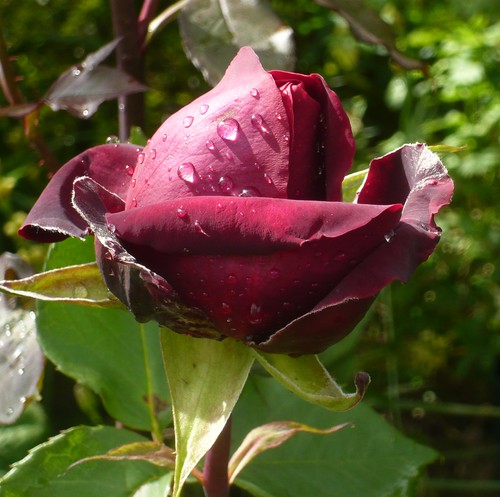
After prolonged rain some rose buds fail to open and the outer petals start to rot, creating a soggy mess (prune them off if it happens).
Waterlogged soil is the bain of badly drained soils – water displaces air and turns the soil sour. I can drown plant roots and invertebrates.

Water Excess

  • It is no accident that many if not most plants require soil with good drainage or free draining compost. That is because roots can drown and rot.
  • Do not stand pots in deep saucers or containers full of water or you may loose the plant.
  • Even too much rain can cause tender alpines to rot. Some need a glass roof or semi-shelter to keep off the worst excesses of heavy rain.
  • Flower-heads can fill with rain and droop or bring a plant too its knees. Shake out excess rain of possible.
  • …

    Read More Read More

Garden Colour Wheel – Hints and Tips

Garden Colour Wheel – Hints and Tips

Am I a bit colour blind? I see shades in black and white because I do not think and digest what I see.

Colourful gardens are not hard to achieve but here are a few hints and tips to help you with various aspects of planning and using colour.

Tips and Hints for Colourful Tints

  • Light creates colour so think about the Sun’s effect in the morning, around mid day and in the evening. It has a cooler temperature and helps yellows and pastle colours early, can burn out soft colours in the full glare but adds warm tones later in the afternoon. Look at some old photographs to see what I mean.
  • Throw your own light into dull corners by painting trellis and furniture white. Light coloured bricks, paving and gravel can also make a huge difference.
  • Small gardens appear larger if you place soft colours furthest away with vivid colours nearest. For the appearance of width put dark blue at the back and pastels at the front.
  • Vivid colours make pastel colours seem washed out so separate them with the neutrality of white flowers.
  • Soften large areas of blue with its complementary colour orange. A complementary colour is directly opposite in a colour wheel. So red and green work well.
  • Cream, white and mauve can have a peaceful tranquil effect.
  • It is easy to forget the colour of a flower so tie a piece of coloured nylon yarn to the plant. Then when you move it or plant a companion you know what you will get.
  • Green is the predominant colour in the garden and has more shades than any other colour. Mix variegated leaves and yellow leaved plants for effect.

Read also Purple coloured flowers on Gardeners Tips
Orange Flower Photo club
This extract is from Red and Green in the Garden
Colour is classified in three ways.
1. Hue- This is the kind of colour and whether it is intense or greyed
2. Brightness – is the total light reflected that provides the tone or luminosity. It is how the eye perceives light to dark colours.
3. Saturation – Is intensity or pureness. spectral colours are the maximum intensity the eye can appreciate. Mixed with any other colour reduces saturation.

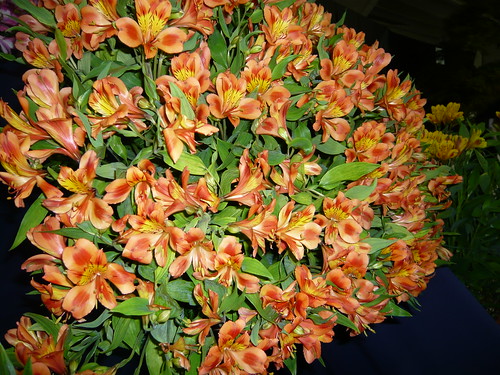
Alstroemeria

Wheel shaped arrangement of orange Alstroemeria

Top Ten Plant Hunters

Top Ten Plant Hunters

Another top ten list this time of top ten plant hunters.
Book Cover

Carl Linnaeus is known as the father of taxonomy

Sir Joseph Banks possibly the father of Kew accompanied Captain Cook on HMS Endeavour’s voyage to the South Pacific (1768-1771), was involved with the HMS Bounty and breadfruit and many early plant hunts. He was appointed as a of Kew Gardens by George III in 1773. A Joseph Banks Tribute Garden has been established in Lincolnshire which is now part of the National Gardens scheme. Many plants are now named Banksii as a tribute to his collecting, introducing and organising the Plant Hunting of the 18th century.

William Lobb and his brother Thomas Lobb were prolific plant hunters in the Georgian and Victorian era when new plant introductions were in great demand. South America was the terratory where they collected many trees and species for Veitch the nursery.

George Forrest, 1873 – 1932 was a Scot who collected Rhododendron forrestii, R. sinogrande, R. repens, R. griersonianum, R. intricatum and R. giganteum, as well as more than 50 species of primula. Also introduced were numerous buddleias, anemones, asters, deutzias, conifers, berberis, alliums and cotoneasters and plants that now bear his name including Pleione forrestii, Pieris forrestii, Iris forrestii, Acer forrestii.
…

Read More Read More

Autumn Seasonal Alpines

Autumn Seasonal Alpines

Spring is action time for alpines but autumn will not disappoint either.

Autumn is a season for care and maintenance of your Alpines plus planning and regeneration for next year. I have taken on a couple of regeneration projects and am currently making my plans.

Regeneration

I will buy some small bulbs this week before the best ones get picked over.  The small Fritillaria appeal like Hermonis amana, Davisii or Minuta yet the pudica ‘Giant’s yellow bells are only 7 inches high. Fritillaria Whittallii with green bells and black tessellations is good for pots.

I am going to plant up 6 dwarf rhododendrons I bought at the Harrogate Autumn flower show last week. This will involve increasing the Rockery area in my garden with a corner dedicated to acid loving plants.

The fashion for a ‘Crevice Garden’ with the slates or rocks aligned in neat rows has finally encouraged me to start growing saxifrage this way.
…

Read More Read More

Acid or Alkaline Soil Improvers

Acid or Alkaline Soil Improvers

Don’t let pH be a mystery, it is easy to get the soil you need for a small contained area or even garden wide if you know the science.
Book Cover

Acidity and alkalinity are measured on a pH scale. Below pH 7.0 is verging towards acidic so pH 4.5 is very acid. Test kits are available from many sources.

Increasing Alkalinity.

For vegetables a pH of around 6.5 is ideal and to achieve this it may be necessary to add some lime into the top 6 inches of your soil.
Garden lime is available from most garden centers. Builders lime or quick lime is more aggressive to plants.
If your soil is around a pH of 7.0 (neutral) I would not bother to try adjust it. Above that it is limey soil and less suitable for acid lovers like rhododendrons and blueberries.
Adding lime helps vegetables take up nutrients. It also suppresses club root in members of the brassica family.
Manure then a couple of weeks later lime your soil during winter, it helps to break up the soil.
For lawns, shrubs, roses, fruit or trees, apply lime before planting.
Calcified seaweed and ground chalk or powdered limestone are other forms of calcium carbonate that will help reduce acid soil.

The RHS has a table of lime quantities needed to correct different levels of acidity read more

Acidifying Soil

To change the pH of the top 6inches of soil from neutral pH 7.0, or slightly alkaline pH 7.5 to slightly acid pH 6.0-pH 6.5 sulphur powder may be required.
Aluminium sulphate or Ferrous sulphate can also be used as a soil acidifiers. The effects are rapid, but large quantities can interfere with phosphorus levels in the soil and may also reduce pH excessively.
Soil-acidifying materials can be applied at any time of the year but products containing sulphur take longer to work when the soil is cold so are normally best applied from spring to autumn.

Dead or Environmentally Friendly Grass

Dead or Environmentally Friendly Grass

Halloween grass is special and only grows one day of the year.

Dead grass

Assuming you have elected not to leave your grass to become a wild flower meadow, or a rough patch as a haven for wild life, there are still measures you can take to be environmentally friendly.

Green Watering Tips

  • Save water by selecting a tough grass mix including Rye, fine Fescues and other seeds.
  • If you must water do it thoroughly and evenly, early in the morning to avoid too much evaporation. Do not over water or water too frequently as this encourages surface roots and weak grass.
  • Use rain water caught in a water butt or grey water collected from your bath or shower.
  • Do not waste water in a drought, brown grass will recover when the rain comes.
  • …

    Read More Read More

Winter Trees With Winter Tips

Winter Trees With Winter Tips

At the first sign of snow I walk round my trees or at least the garden they are planted in.

Snowy Winter Tips

Conifer branches were weighed down with wet snow and a cane was used to knock excess off before branches broke or were set at an ungainly angle. Some ornamental conifers can be wired up so the shape is retained.

Rock salt was not used on paths where there was any danger of ‘run off’ as the salt could poison the ground and plants.

I tried to avoid walking on lawns when the ground was frozen or covered in snow.

Birds were fed with seeds, peanuts and fat balls to help them through the winter. They will pay back by eating insects later on.

…

Read More Read More

Quirky One Off Gardening Tips

Quirky One Off Gardening Tips

Give slugs a slug of beer to drown in. Birds succeed in your garden if you give them seeds to suck!

Gardeners Tips want to live up to its name but it is hard to make a full post out of some small tips. So here is a few uncodified items that may be of use.
Why not pay a visit to ‘the less fattening flower show’ your own Lo-cal flower show.

Vegetables
Parsnip seeds are often sown too early and rot. In April put seeds in the fridge for a week, to help break dormancy, before sowing. Bring back to room temperature, allow to dry, sow and mark the row with radishes that germinate quicker.
Grow green Soyabean seeds  ‘Envy’ or ‘Agate’  this May for 20+ pods per plant but add rhizomatous bacteria to the soil when sowing.
When herbs flower they loose some flavour so cut Chives and Fennel to the ground and other leafy herbs down by half as soon as they have flowered.
Pinch out the top inch of broad bean plants when you spot any black-fly.
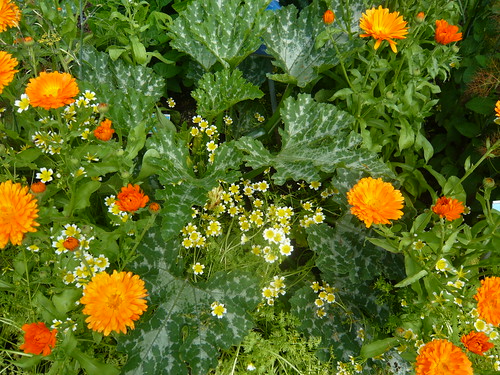
Calendula ‘Pot Marigolds’ help keep green and black flies off your veg

Coloured veg plot
Practical Gardening
Water plants from a water butt as any water direct from the mains is likely to be cold.
Black plastic pots get hotter than the terracotta equivalents by absorbing the suns heat. It suits some plants but dries out quicker so I use one size larger than normal.
If planting bulbs in pots the deeper the pot the taller the bulb and flower is likely to grow.

Pruning
Prune Lavender in August to remove old flowers and a couple of inches of new growth but do not cut  into old wood. Then in March lightly trim again to tidy up. Put August prunings in a sandy soil as cuttings to propagate new plants.
There is no law that says you must prune Roses. Left alone they will be fine, more roses are killed by over pruning than anything else.
Cutting dried or desiccated plums from a tree is not pruneing. Prune prune-plums in summer.

Moss is Green and Environmentally Friendly

Moss is Green and Environmentally Friendly

Moss in the right place can look good but in your lawn it is a no-no.

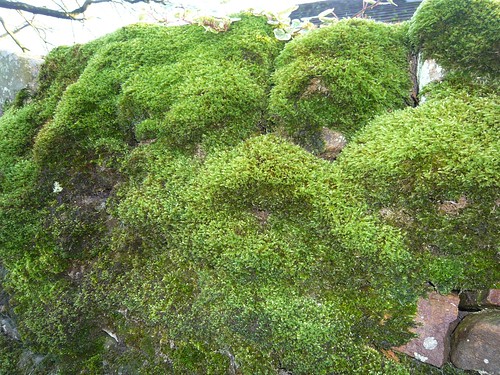
Moss

Whilst I am on an environmentally friendly kick I thought I would comment on Moss.
Mosses are bryophytes and there are over 10,000 species that grow from spores. Moss can grow on rocks, roof, lawns paths and many other places. Beware raking or removing live moss as you only spreads the spores.

Sphagnum moss is a group of several hundred mosses that can decay into peat over many decades and centuries. The sphagnum peat is the dead brown moss formed in boggy conditions that have now been exploited or over exploited for peat burning and garden purposes. Use peat substitutes to protect our old peat bog environments.

Moss Facts

  • Moss traps carbon and as peat locks up carbon gasses
  • Sphagnum moss can hold 20 times its own weight in water.
  • Moss is slow to rot as it contains carbolic acid and the boggy conditions where it grows remove oxygen. It also gets its only nutrient from rain water which adds to the acidity.
  • …

    Read More Read More

Growing Scilla mischtschenkoana or Squills

Growing Scilla mischtschenkoana or Squills

More spring bulbs to try on for size.

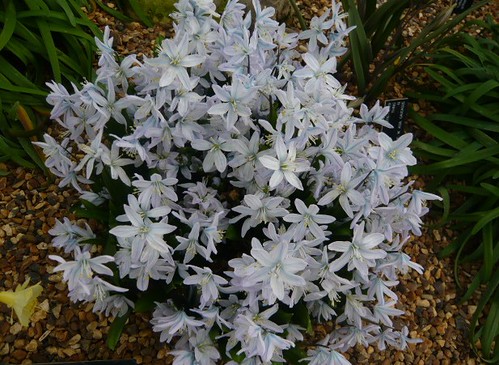
Scilla mischtschenkoana
Scilla commonly know as Squills are a group of bulbs for outdoor and Alpine house growing. The ice-blue flowers of Scilla mischtschenkoana open out almost flat, first appear in February and continue well into March. Sunshine and a well-drained soil will make them at home in a bed or in thin grass.

Other members of the family include

  • Scilla bifolia -one of the earliest bulbs to flower, often with the snowdrops. It has a raceme of small, intense blue starry flowers.
  • Scilla sibirica ‘Spring Beauty’ is taller and has nodding flowers of intense royal blue during March or April.
  • Scilla peruviana has large heads of deep violet-blue flowers with strap like leaves.
  • Scilla lilio-hyacinthus. prefers woodland habitats with broad, fleshy leaves and pyramidal heads of sky-blue excelling in a cool, humus rich soil.
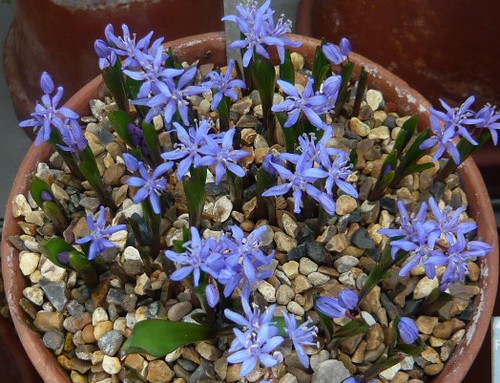
  • Scillia bifolia

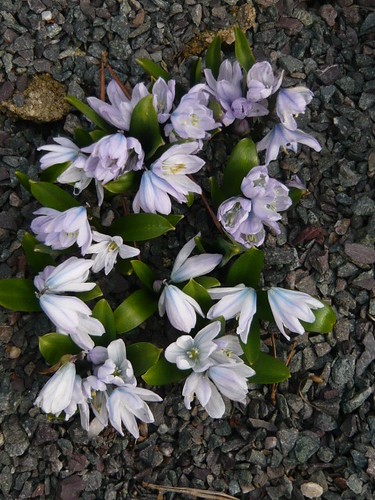
    Scilla bifolia above and Scilla mischtschenkoana growing outdoors in a gravel bed below

Scilla mischtschenkoana

See ‘Why don’t my Scilla look like this?’