Grow Narcissus romieuxii

Grow Narcissus romieuxii

Hoop petticoat or early flowering daffodils in a profusion of white or yellow flowers.
Narcissus romieuxii

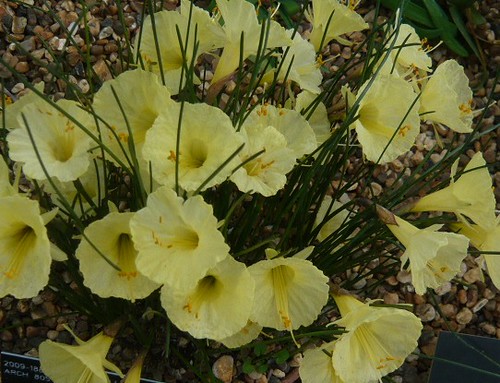
Narcissus romieuxii ‘Julia Jane’ is a small, low-growing daffodil with rough dark green leaves similar to Narcissus bulbocodium but distinguished by short wavy petals and protruding stamens. Flowers are pale yellow blooming well each year between late December and March. This is an early flowering species and is a native of Morocco
White flowering Narcissus romieuxii ssp. Zaianicus flowers in the very depths of winter and is unusually precious.
Protect your plants under glass, in pots in an alpine house, or planted out in a bulb frame. Although they will withstand at least 15 degrees of frost while in full flower without being damaged, if exposed to the wind and rain of a typical English winter, the pristine flowers spoil. Also, the bulbs need complete desiccation in summer, and it is difficult to ensure this in the open garden. If you doubt this advice read this from the Alpine Garden Society.
‘A few years ago I read that a distinguished grower of Mediterranean bulbs never completely dries them off, but leaves the pots in a sand plunge which is kept slightly damp in summer. When I followed this prescription for N. romieuxii, the bulbs were smaller, failed to multiply, and no flowers whatever were produced the following winter. When I reverted to the previous treatment in which the pots were lifted from the plunge in early May as the foliage withers and placed on a hot sunny ledge without any water for three months, it took two years for full vigour to be restored. I repot into fresh gritty sandy John Innes No 3 in the first week of August, water heavily, and keep the compost moist until growth starts. If there is no frost, I water with a dilute feed every two weeks throughout the winter.’

The best supplier I have found so far is Pottertons but let me know if you know of other companies.

Gardening for Birds

Gardening for Birds

Where have all the blackbirds gone?

Viburnum opulus xanthocarpum

Are you bird friendly letting insects thrive, growing berried shrubs and trees and leaving a natural area in your garden? If so then you know the way to attract more birds into your garden is via the birds appetite.
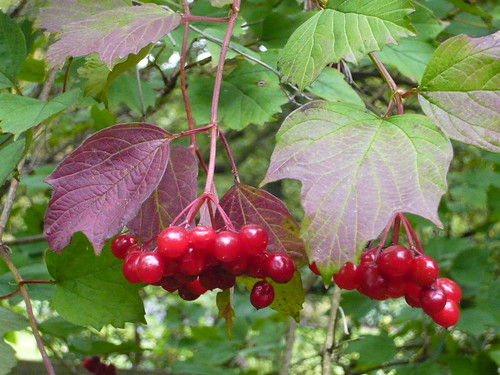
I have been encouraged by the sight of Redwings and Fieldflares during this snowy winter gobbling up the many berries in the garden. The first to go were these Viburnum followed before Christmas by the Holly berries which never seem to last on the trees until Christmas.
Perhaps the birds are attracted by the red colouring because Crab apple Red Sentinel is also pecked to death later on in winter. The Redwings were the gross feeders on my Cotoneasters but there is still a snack or two left for the next snowfall. The Pyracantha are well sorted probably by Thrushes but I never seem to catch them eating.

If you want to give birds a supplementary feed then high energy foods are best in winter. It is no use feeding something that needs a lot of energy to consume so Sunflower hearts, crushed Peanuts, Fat balls, Nyjer seed and even raisins are popular.

Read More Read More

Grow Eranthis or Winter Aconites

Grow Eranthis or Winter Aconites

An early yellow flower grown under deciduous trees.

Aconites

Grow Winter Aconites

  • The tuberous Winter Aconite or Eranthis likes a loose, well-drained chalky soil but will naturalise in a lawn or under a deciduous tree.
  • In the wild these do exactly what bulbs are supposed to do – grow, flower and seed while light penetrates the bare branches of the trees above them.
  • The knobbly tubers need to be planted 2” deep. The tubers can be divided after flowering every few  years and transplanted ‘in the green’ . They dry out very easily, generally   dislike being moved and are best left to their own devices.
  • Winter aconite does well in containers as long as they get water and winter sunshine.
  • Winter aconites grow to 3-4 inches high and have upturned yellow cup shaped flowers around 1 inch across. The flowers sit stalkless on a ruff of bright green leaves and they can flower for up to six weeks.
  • They do particularly well in chalky soil. Good drainage is essential.
  • Some gardeners dislike aconites for the messy mass of foliage but allow the leaves die down and the plant will be dormant and hidden until next winter.
  • Read More Read More

    Grow Green Tulips

    Grow Green Tulips

    It is almost too late to plant your tulips for this year but if you have some unplanted bulbs get them into the ground before the worst frosts.

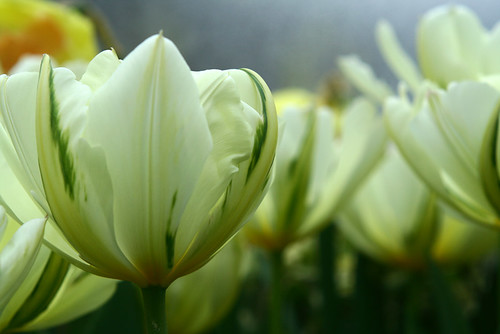
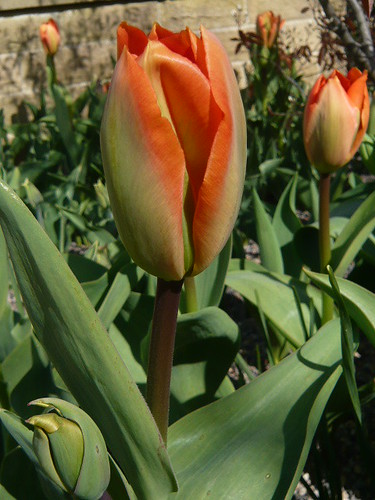
    Take a note book when you visit a spring garden and record the plants you want to grow for next year. When the Tulips are in flower look for those with a green band particularly on the outer petals as this adds a new dimension to your traditional tulip.

    Types of Green Tulips

    • Viridiflora Tulips can have a lot of green on the outer petals. ‘Florosa’ is a pink and white with a slim and elegant lily shaped flower. ‘Spring  Green’ is cream and ‘Greenland’ is rose but my favourite is the terracotta coloured ‘Artist’
    • Amongst Parrot tulips ‘Super Parrot’ has ivory and green petals that look a bit like a leaf and make a good cut flower.
    • Some of the new multi-flowered tulips have green tinges like ‘Ester Rynveld’ and ‘Greenwave’
    • Traditional cottage tulip ‘Palestrina’ combines Salmon pink with  a green vertical band.
    • Fosteriana are very early flowering and ‘Exotic Emperor’ is one of the best. See pictures on Tulips in the Wood
    • ‘Doll Minuet’ is a deep pink flower with a rich green at the base of each petal.

    Tulip viridiflora


    More Sources

    Cut Flower Tulip varieties

    More Scented Tulip varieties

    Reasons to Order Tulips

    Elephant Garlic 10 Tips

    Elephant Garlic 10 Tips

    A Mediterranean diet is allegedly good for us so eat more tomatoes and garlic.

    Elephant garlic is an allium but not a true garlic. It is technically a stem leek which produces massive bulbs approximately 4 inches in diameter. The cloves are also much larger than conventional garlic with a milder taste making it suitable for a wide choice of culinary uses, especially roasting.

    Top 10 Tips

    1. Suitable for Spring or Autumn planting I am starting mine off in February but I could wait as late as May.
    2. Cover the individual cloves with one to one and half inches of soil over the top of the clove.
    3. Give each plant space to grow, 6 inches plus.
    4. Garlic responds to well dug soil with adequate amounts of phosphate and potash.
    5. Sulphate of potash will help protect against rust disease the main problem with garlics.
    6. Never let the plants run dry until a couple of weeks before harvest.
    7. As harvest approaches lift the head with their green leaves.
    8. Hang is a warm dry area with all the leaves attached until there is no moisture in the necks.
    9. Store in a warm, dry place, a cool place will encourage the cloves to sprout.
    10. The curly flower stalks also called scapes should be removed to concentrate growth into the bulb. The flower arrangers may have different ideas.


    ‘Elephant garlic sprouts small bulbils on the cloves or on the leaf bases, usually at least three per head. If these become detached from the parent bulb and left in situ they develop into rounds. If, however, bulbils form at the leaf tips it is not elephant garlic, but Babington’s Leek, which some growers mistakenly offer as elephant. According to the National Vegetable Society
    The best crop will be produced on light, friable, well drained soil in full sun.
    When planting ordinary garlic plant only the outer cloves from each head. Those cloves, that is, with one rounded and one flat side, the inner cloves, which are square or triangular in section, should be used in the kitchen.’

    Roast Garlic

    To buy a selection of Garlic at Thompson & Morgan click here.
    For more read Tricks to get great garlic

    Increasing Gardeners Productivity in the Garden

    Increasing Gardeners Productivity in the Garden

    Plan to get more from your time gardening. That’s it; have a plan, and try these tips
    mixed border

    The garden is a place of both leisure and work. We create a garden to enjoy, but sometimes we find it difficult to sit back and relax; instead we find numerous small jobs to do. We may go out in the garden to do one thing, but get sidetracked and start doing several things at once. If we are not careful we can spend a long time working in the garden but not change very much. These are some tips to increase your productivity in the garden.

    1. Be Focused.

    Decide on the most important task and then stick to that exclusively. If you want to weed a border; just concentrate on weeding. Don’t start splitting up plants or trimming bushes.

    2. Economies of Scale.

    Think how long it takes to get out the equipment and then put it back. It can easily be 10 minutes to get started and 10 minutes to pack up. Therefore, it is better to spend 1-2 hours working rather than several 15 minute sessions. Set aside an hour and then work really hard on that task; don’t waste time always getting started and putting things away.

    3. Right Tools.

    The right jobs can make a big difference. If you are pruning with a blunt pair of secateurs, everything will be harder work. Make sure you look after tools and if blades become blunt replace them, it will save time and make gardening more enjoyable in long run.

    4. Choose Most Important Task

    In any garden there are always a 100 different things that we can do. It is therefore important to prioritise. Start off with the most prominent border or place you want to look good; don’t worry about the odd weed behind the compost heap.

    5. Create Time

    Some jobs may be labour intensive meaning you don’t have time for more important tasks. For example, if you cut the grass every 4 days, you could cut it every 8 days and create an extra hour a week for weeding and planting.

    Read More Read More

    Muscari my Grape Hyacinths

    Muscari my Grape Hyacinths

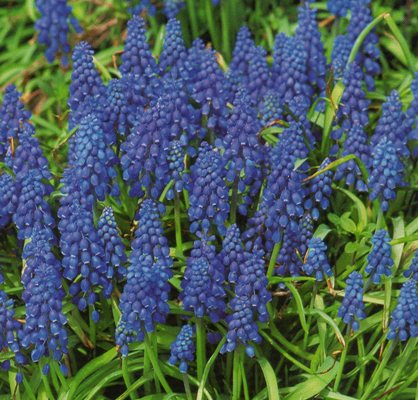
    One of the earliest blue bulbs to show in my garden are the Muscari.

    At the end of June I received ‘J Parkers’ Autumn wholesale catalogue. They claim to be ‘the greatest name in Dutch Bulbs’ and I have bought from them for my garden several times with good results. Last season I bought several varieties of Muscari. Whilst the wholesale catalogue is priced without vat the prices and rates for larger quantities make for a reasonably economic priced deal if you spend the minimum order value. They supply many of the local retailers but also have a retail catalogue.

    Grape Hyacinth – Muscari Varieties

    • Other common names for Muscari include Starch Hyacinth or Feather Hyacinth.
    • M. Plumosum the feather hyacinth have grown well and the flower heads are fuller and fluffy
    • M. Azureum have soft blue flowers and I grew them in pots some of which made excellent gifts to friends and fellow gardeners.
    • The third variety I bought were the porcelain blue M. Valerie Finnis and they were OK without being special.
    • M Golden fragrance has yellow florets toped with purple before they are fully open. It is said to be very fragrant and I may try some this year.
    • Another musk scented variety is M. Muscarium with purple to olive flower heads. They are a bit later flowering in May
    • Ofter the name explains the flower shape or colour M Azureum album is pure white and M Mount Hood has a white top like a hood on the blue flowers whilst M lactifolium has a single broad leaf with a bi-coloured flower spike

    Cultural tips for Grape Hyacinth

    Read More Read More

    Leycesteria Formosa Shrubs

    Leycesteria Formosa Shrubs

    Leycestria

    Leycesteria Formosa

    Green winter stems on this attractive fast-growing shrub is described as ‘cut-and-come-again’ as it can be reduced to ground level in early spring to encourage rejuvenation. Although this plant has only been lightly pruned, it is a bit thick and congested now so I will cut it back after flowering and right back in spring.

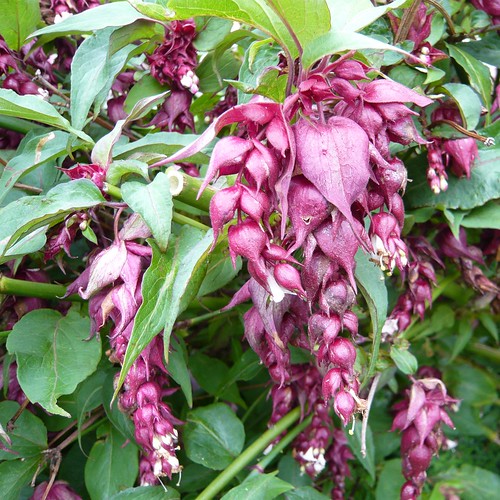
    Leycesteria has long, hanging, purple-red bracts in summer surmounting racemes of white flowers followed by purple fruits in late autumn. It has a light fragrance from the white flowers. Its foliage can be quite dense and its hollow, bright green stems, not dissimilar to those of bamboo, give a good winter display. It grows to 8 foot plus and flowers at the end of this years stems

    Propagate and Cultivate

    By cuttings of half-ripe wood, 3-4 inches with a heel in July/August or from larger cuttings of mature wood, 8-10’’ with a heel, planted in open ground in October/November. Or by seed and the birds may help with that job. When established it is quite robust

    I have seen Leycesteria also named Flowering Nutmeg and Himalayan Honeysuckle from which family it belongs. The green leaved variety is most common but you may find a yellow leaved form.

    Growing Top Ten Euphorbia

    Growing Top Ten Euphorbia

    The most popular Euphorbia purchase in December is the poinsettia but many cacti are also Euphorbias.
    euphorbia

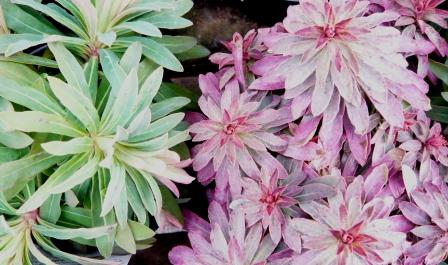
    Euphorbia is one of the most diverse genera in the plant kingdom with over 2100 species. Members of the family and genus are sometimes referred to as Spurges. They range from annual weeds to trees. They all have a latex sap which can be an irritant and a unique flower structure. Many Euphorbias are succulent and the characias species are an architectural perennial with fresh bluish-green foliage.

    Top Ten Euphorbias

    1. Euphorbia milii or Crown of Thorns is a succulent houseplant which has spiny stems and comes from Madagascar. Easy to grow in cool, bright conditionsit is propagated from tip cutings.
    2. E. griffithii ‘Fireglow’ one of the few euphorbias with orange-tinted bracts and a red flush to its leaves. ‘Fireglow’ has the Award of Garden Merit (AGM).
    3. Euphorbia pulcherrima is the plant often associated with Christmas the Poinsettia with flame red bracts or cream and pink varieties for indoor growing.

      Read More Read More

    Growing Broccoli all through the Year

    Growing Broccoli all through the Year

    A versatile vegetable from the brassica family.


    There are many vegetables that have long seasons but you can be eating home grown broccoli every month of the year. There are the range of sprouting types and the heading Romanesco and Calabrese types. Most varieties take 5-6 weeks to reach maturity. If you have an allotment then you could try some of these varieties from seed:

    • Summer purple sprouting matures between June and October
    • Rudolph is an early sprouting ready to pick in January-February
    • Red Admiral is a vigorous F1 for February March and Red arrow lasts until April
    • The heirloom Late Sprouting produces small sweet heads through until July. Keep picking
    • Tendergreen is worth a mention purely for the high level of vitamin C
    • There is a perennial ‘Nine Star’ that can be picked regularly for years but do not let it set seed.

    Broccoli has vitamin A, C and D in varying proportions and is currently thought to help protect against the onset of some cancers.

    Broccoli

    T&M Seed Advice

    Sow sprouting broccoli seeds in a well-prepared seed bed from March to June at a depth of 13mm (½”) and spaced 30cm (12″) apart. Transplant to their final positions around 5 weeks later when the seedlings have four or five leaves.

    When growing purple sprouting broccoli, choose a sheltered position in firm, rich fertile, well drained soil in full sun. Prepare the soil in early spring by adding plenty of well rotted farmyard manure to the soil to improve its structure and fertility. Plant purple sprouting broccoli deeply for stability at a distance of 60cm (24″) apart, and cover with a protective netting or fleece to prevent attack from birds and insects. Water the plants thoroughly after planting.