Golden Winter Colour
Golden Winter Colour

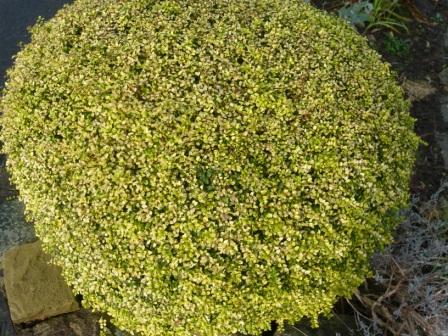
Lonicera nitida Baggessen's Gold

What colours predominate in the grey winter days when greens seem muddy and mud seems very grey. Well I like golden yellow colours and here are a couple of January examples that didn’t take much trouble finding in the garden during a short sunny spell.

Lonicera nitida ‘Baggesen’s Gold’ tips you off in the title. This relative of the honeysuckle is grown for its leaf and the ability to prune to shape. It will not flower and is easy to propagate from cuttings. Unpruned the leaves can appear bicoloured but young growth will be fresh and bright golden coloured. It is easy to prune and a very forgiving shrub. Close up these small ovate leaves are not made from gold leaf unfortunately.
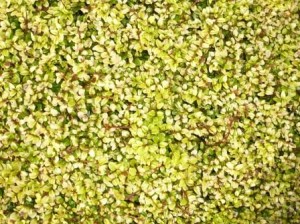
Tight leaf formation

Choisya ternata Sundance was another yellow shrub doing its best in the weak January sun this afternoon. If the winter is too prolonged some young yellow leaves may get slightly frost burnt but despite -8 degrees last week these shrubs are still showing well. I also like the smell of bruised leaves and the delicate white spring blossom. This golden wonder performs even in a crisp winter frost.
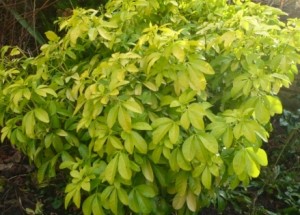
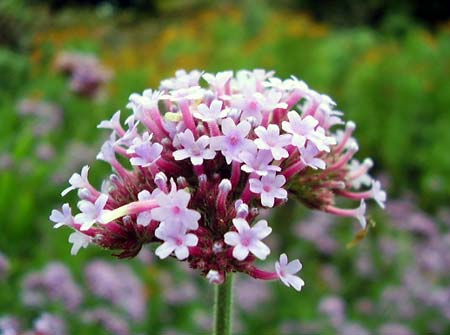
Choisya ternata golden sun

Read More Read More

10 New Year Gardening Resolutions

10 New Year Gardening Resolutions

Verbena
verbena bonariensis

My gardening New Year Resolutions

  1. Enjoy The Garden. Will take time to enjoy the garden without feeling obliged to pick up weeds …
  2. Grow more from seed. There is a thrill in growing things from seed. Will use cold frame and pots to grow sweet peas. – Hard work, but, one plant always worth the effort.
  3. Will be more focused in Doing jobs. A lot of my gardening is done without planning. I just go out in my slippers to pick some flowers and before I know it – I’ve started cutting back a shrub and pulling up pernicious weeds. It means I often do jobs without proper tools or focus. If really target 1 problem at a time with all the right equipment, you can solve it rather than doing things half heartedly.
  4. Be Bolder. As gardeners, we often think what would other people do, what are we supposed to do. I’m going to be bolder in planting sweet peas and tall plants in front garden, which has traditionally been a place of low growing bedding plants.
  5. Time Saving Plans. Some bamboo has become time consuming, because it is sending runners all over the place. Rather than dealing with the endless runners – I’m just going to take it all out and replant something new or a bamboo which definitely doesn’t send runners everywhere.
  6. Build a Pond. A pond will attract more wildlife and add a new element of interest. I have been put off doing it because it is a big project, so I’m going to scale down the size to something more manageable and add it.
  7. Spend as much time Planting as weeding. Last year, I was always weeding and creating wonderful beds of blank soil. The result was I didn’t have enough time to spend time growing plants from seed / diving e.t.c. This is the fun part of gardening so I will do more of it.
  8. Grow Something new. For the past few years, I have been relying on same plants. There is great fun in trying something new from seed – something completely different and see how it gets on.
  9. Visit More Gardens. The best way to gain inspiration from a garden is not through books or talking about it, but visiting other gardens. Visiting  professional and well kempt gardens you come back with lots of enthusiasm for creating a better garden and also combinations of plants which work well.
  10. Clean Tools. A good gardener doesn’t just keep order in the garden, but, also his tool shed. If tools are kept in great working order – blades sharp and well oiled then it makes the whole experience of garden more enjoyable.


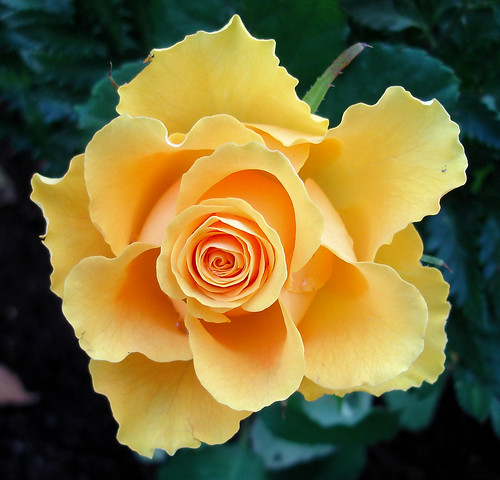
Roses in Winter

Roses in Winter

source

What to do with Roses  in Winter

  • Planning ahead  in January to get the best from your garden roses can be a restful pastime. What varieties and forms do you want to try? Check out some catalogues for ideas and more information.
  • Tidy up leaves that may hold blackspot spores
  • Prune any broken or damaged branches. Tie up loose ramblers or climbers.
  • Spray with tar-oil wash to kill over-wintering pests if you are troubled by them.
  • Prepare sites for new roses to be planted in spring. Double dig the ground and add organic matter, compost, humus and/or manure. Mix in bone meal or long lasting fertilizer.
  • Transplant any old roses you wish to move but into a fresh site where roses have not been grown before.

    Read More Read More

Brilliant Garden Colour

Brilliant Garden Colour

Book Cover

Colour for adventurous Gardeners by Christopher LLoyd

Colour to Attract Book Worms

  • My personal favourite plants for colour tend towards the bright, brash and bold of Dahlias, Roses, Gladioli and even Gerbera.
  • I do not have much of an eye for harmony or hazy, pastel shades but go for in your face hot colours that form part of my Shock and Awe campaign.
  • Christopher Lloyd may educate me with his book on adventurous gardeners use of colour but we will see.
  • In the meantime I will keep growing my brash coloured Dahlias.

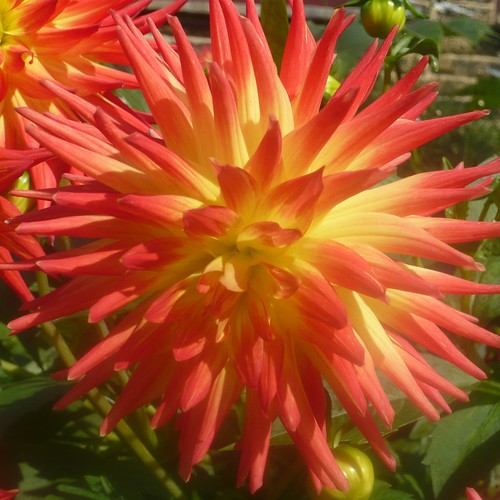
Cactus Dahlia

Read More Read More

Topiary Tips and Sites to Visit

Topiary Tips and Sites to Visit

Some evergreen shrubs lend themselves to topiary and simple sculpture shapes. From simple Box hedges as knot gardens to large geometric shapes you can train and prune to get effects with a large range of plants and shrubs.

Good Plants to Start
Yew (Taxus) is a traditional topiary subject that stands hard pruning with it’s fine textured needles and moderate growth rates.
Juniper is a fine textured evergreen with tree, shrub and prostrate forms that respond to pruning.
Holly (Ilex) is a glossy leaved evergreen with various leaf forms depending on variety. It is slow growing and can be trimmed quite hard.
Box (Boxus) is useful for smaller sculpted shapes needing fine detail. It is slow growing.
Cupressus are often used for spiral shapes or cloud pruning.
Bay (Laurel nobilis) has coarse aromatic leaves that are popular for training as a round-headed standard.

Book Cover

Read More Read More

Bright Indoor Bromeliads

Bright Indoor Bromeliads

Try a bromide ‘oops’ I mean a Bromeliad.

bromeliad

This Bromeliad is a relative of the pineapple and as it is easy to grow indoors it makes a fine house plant. There are a wide range of Bromeliads and a society dedicated to there culture the Bromeliad Society

Bromeliad Tips

  • Grow the Bromeliads for their coloured leaves that spring from the plants center.
  • If flowers are wanted try a dose of epsom salts or magnesium sulphate as this promotes healthy growth, cell structure and the production of chlorophyll.
  • As the inflorescence or coloured spike starts to go brown cut it down to encourage off sets called ‘pups’ and get a new generation of plants.
  • It can be good fun growing from seed as different Bromeliads pollinate one another and you can’t be sure what you will get.
  • For water holding Bromeliads keep the center topped up with soft water.
  • For more data try a reference book  on Bromeliads

Book Cover

Fungi the Good the Bad and the Evil

Fungi the Good the Bad and the Evil

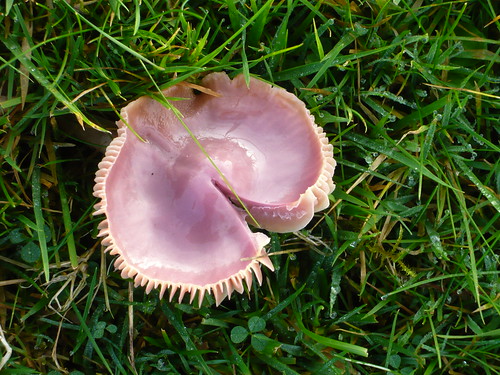
Fungus is all around your garden and we and the garden are better for it. Fungus is a natural process that helps rot down dead plant matter and sometimes produces stunning fungi.

Halloween 039

The first frost of this winter may have turned most fungi fruit to mush but you can brush up with a good book.

Book Cover Identify Mushrooms

Mushrooms and toadstools have a good season in 2014 due to mild weather in October. Like bracket fungi they produce large fruit-bodies as reproductive organs above ground and are called macro-fungi. Some are edible whist others hallucinogenic or deadly poison. The fungus proper is the mycelium a web of of thread-like growth known as spawn in mushroom growing.

Read More Read More

Half Price Bulbs

Half Price Bulbs

Many retailers are selling bulbs at half price to clear their stocks to make space for Christmas goods. I have just bought 80 Dutch Iris of a particular shade for less than £2. Our local Hampsons has remainder stock at £1 a bag but be selective.

harlow 17.4 070

Tips on Cheap Bulbs

      • Tulips, Alliums and Anemones can be planted later than narcissus and I would go for them up till Christmas.
      • If bulbs seem to be stored in a draft they will be drying faster so leave them. I even saw bulbs under a hot air blower that was shriveling the poor hyacinths.
      • Size can be important so if they seem small leave them alone.
      • If bulbs are damaged, moldy or light leave them at the shop.
      • If the bulb is sprouting but not ‘forced’ ie too long thin and pale then I am happy buying them
      • Plant as soon as you can and get them into cool conditions.

Amaryllis Hippeastrum

      • These large bulbs in gift boxes are often sold off after Christmas in the sales.
      • Any you were given or gave at Christmas were not going to be planted until after Santa had visited so buying them in January isn’t a problem
      • If you see them at a discount before Christmas you could buy them, plant them and give them as a growing present rather than in a gift box.


Gardeners Tips & RHS December Advice

Gardeners Tips & RHS December Advice

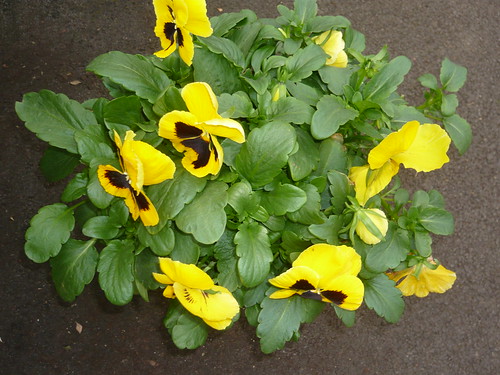
pansy

Gardeners Tips for Winter

  • Say temporary farewell to winter flowering Pansies. When the snow has gone and the temperature gets above 5C they will perform again.
  • Knock snow off the tops of conifers and evergreen shrubs or the branches will bend and be set in untidy positions.
  • Read more on Gardeners tips about Lawns in Winter & Winter Trees

Make frost your ally

  • Remember many plants like a cold spell to help seed germination. Frost helps to develop roots on Daffodils.
  • Frost will break down the clods of soil in a vegetable garden that has been dug over and left in lumps.
  • Insects and pests may survive mild winters unless the frost kills or reduces their number.

RHS December Advice

  1. Prune open-grown apples and pears but not those trained against walls
  2. Deciduous trees and shrubs can still be planted and transplanted
  3. Harvest leeks, parsnips, winter cabbage and sprouts
  4. Prevent ponds and stand pipes from freezing
  5. Check that greenhouse heaters are working OK
  6. If you are not already an RHS member it makes a good Christmas present


Read More Read More