Browsed by
Category: Gardening

General gardening tips and hints

Harlow Carr Library & Learning Centre is Eco Friendly

Harlow Carr Library & Learning Centre is Eco Friendly

HHarlow Carr Library & Learning Center

Harlow Carr continues to be a rising star amongst the Royal Horticultural Societies Gardens.
Opening in the next few weeks will be the new library and learning centre at the gardens in Harrogate.

‘The building, designed by one of the leading practitioners of sustainable building architect Andrew Yeats (Winner of the Queens Award For Sustainable Design), is designed to be one of the ‘greenest’ buildings in the UK with a zero carbon footprint.’ (Dean Peckett)

Eco Friendly Features
Super insulated, low energy consumption building.
It will have integrated renewable energy technologies including  rainwater harvesting and a grey water recycling system.
A small wind turbine will provide energy to the building and a ground source heat pump will help with the minimal heating requirements.
A sedum roof design to help blend the building into its surroundings and provide an insulating surface, promoting biodiversity and assisting with  the absorption of carbon dioxide.

Other Energy Saving Features include:
• Solar panels and Sun pipes
• Wind turbine
• Cement replacement concrete
• Clay blocks
• Natural ventilation
• Timber from sustainable sources.
These will all be incorporated by the main contractor William Birch of York.

If you are interested in ‘Homes for a Changing Climate’,  Will Anderson has a new book out.

Book Cover

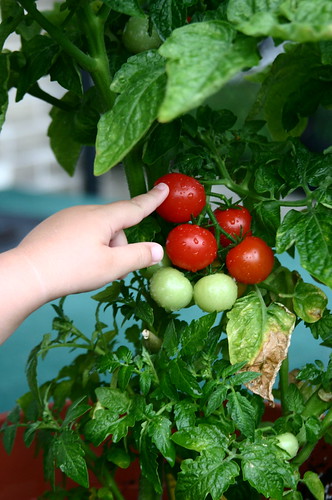
Tips for Growing Cherry Tomatoes

Tips for Growing Cherry Tomatoes

Chris Winters

Bush tucker trials could refer to Tomatoes grown on bush varieties because they make great ‘tucker’. I love the sweet sharp taste of some of the new Cherry Tomato varieties.

Quick Tips for Growing Cherry Tomatoes

Buy a variety like Sweet Million or Gardeners Delight.
Garden Pearl has been specially bred by Unwins for growing in containers.
Baby Plum Tomatoes are now available in a variety called Sweet Olive.
The Tumblin’ series can be grown in hanging baskets or containers.

Cultivation of Tomatoes

The surface roots take up the fertilizer and nourishment. Encourage them by building soil around the stem.
The tap roots go deep in search of water. Help by making sure you water well into the soil by sinking a pipe or pot near the plant to fill up & make sure the water gets deep down.
Do not be too greedy with each plant. Stop them growing when you have 5-8 trusses of fruit by pinching out the growing tips. This channels the energy into your fruit.
Feed and water on a regular consistent basis.
I still support my Cherry tomato plants with a cane and string.

Plants and seeds available from Thompson Morgan

More Tomato growing tips

Spring Shrubs Forsythia and Flowering Currant

Spring Shrubs Forsythia and Flowering Currant

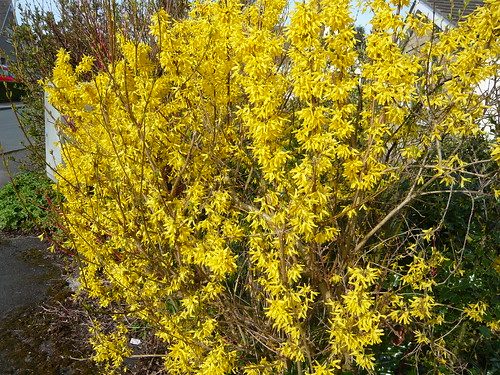
Forsythia

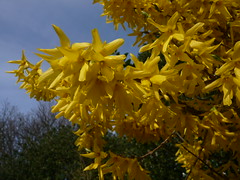
Forsythia is now in rampant bloom around our village. The sunny yellow flowers compete with the Daffodils for a place in the yellow spectrum of colour.

Blossom arrives before any leaves on the twiggy growth from earlier years. This cloaks the shrub in a mass of yellow blossom that really takes some beating. Only the very old wood has not got blossom this year and I will be tempted to encourage new twiggy stems by selective pruning when the flowering has finished. This will only be a light trim like they say at the barbers not a No 1.

Forsythia grows 1-2 feet per year from cuttings taken in late spring when the wood is green. Push 6 inch stems into a gritty soil preferably with some peat added as they like acidic soil. The shrub grows to 7-10 feet tall and almost as wide if left untended but it is then open and erring towards straggly, so I recommend the post flowering trim.

Flowering Currant

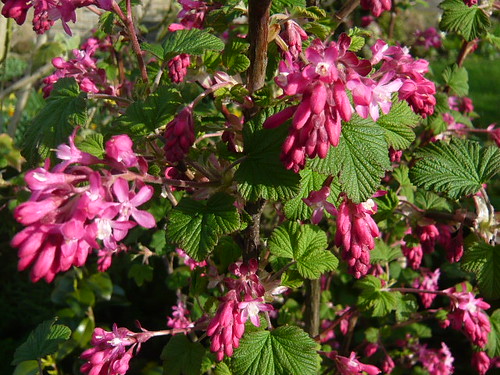
Flowering Currants also called Ribes sanguineum are also early spring blossoming shrubs. The sprays of flowers are like racemes of red or dark pink that are on show as the scented grey green leaves start to open. There is also a light pink variety that is a strong grower reaching 10 feet tall if left to its own devices.It is best kept at a 4-5 foot height.

Some better know varieties include ‘King Edward VII’, with red flowers, ‘Pulborough Scarlet’, also with red flowers and ‘White Icicle’, with white flowers.

Pink Ribes

Tips for Spring Shrubs

  • Prune after flowering. This encourages new flowering wood to grow for next year.
  • Take cuttings to propagate new shrubs in spring or early summer.
  • Mulch shrubs after summer rain or a good watering to see them through a dry summer.
  • Both Flowering Currants and Forsythia are east shrubs to grow.

Forsythia

Pollination Makes The World Go Around

Pollination Makes The World Go Around

Reflective Pollination

Without pollination there would be no new seed, no new crops for animals and no food in our supermarkets. (No supermarkets may be good news for several reasons but I will put up with them to keep being fed).

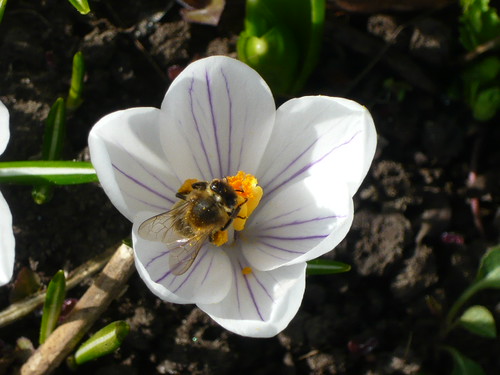
Wind pollination may work for some plants particularly those with catkins that shed pollen in copious quantities. The main pollinators in a garden are insects and they deserve our respect. There have been scare stories about the declining population of Bees so I was pleased to capture (in photos ) these bees hard at work on my Crocus crop last week.

Pollination crocus

Tips to Aid Pollination

  • Avoid using pesticides.
  • Grow plants that attract and feed butterflies, birds and insects.
  • Make insects safe and at home in your garden.
  • Do not expect F1 plants to pollinate.
  • Hand pollinate your curcurbits (courgettes, marrows and cucumbers).
  • Tap flowering greenhouse tomato plants to get the pollen into the air and thus other flowers.
Gardening for Maximum Flowers per Square Foot

Gardening for Maximum Flowers per Square Foot

What is the annual plant that produces the greatest number of flowers per square foot of ground? Despite the ‘Million Bells Petunias’ I still think it is the old reliable Sweet-Pea! Sweet Peas are loved for their scent, wide range of colours and as a cut flower.

  • Sweet Peas are easy to grow if you provide well manured ground. The roots are long so dig deep and compost well to provide food and moisture and you will be well rewarded.
  • Plant out, your seed raised, Sweet Peas in the first week of April or buy sturdy deep green plants from a nursery.
  • Take care not to damage or bend the long roots so they will need a deep hole.
  • Support each Sweet Pea with a twiggy stick and put some black cotton between the twigs to keep birds away from eating the tasty new plants. I also use a pea net.
  • After the plants have settled, about 7-10 days, nip out the growing tip to encourage branching and sturdy, bushy plants.
  • Feed weekly with a liquid tomato feed when buds start to appear.
  • Train up canes, removing tendrils, if you want long stemmed exhibition flowers.
Tips for Growing Busy Lizzie

Tips for Growing Busy Lizzie


Photo by ndrwfgg

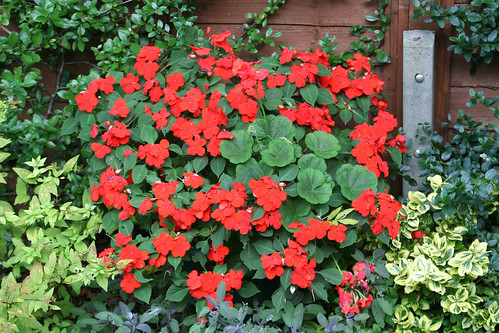
Busy Lizzie are bright and colourful bedding plants that you will find easy to grow if you avoid frost. Stick to the annual varieties and you will have flowers from June through to the first frost. They do not need pinching out unless they are leggy when you get them.

Busy Lizzie Tips

  • Buy plug plants or seedlings and grow them on until the danger of frost has gone. If you do not have a windowsill wait until mid May to buy them.
  • Seeds are very small and I have found germination is erratic. That may be due to my lack of green fingers.
  • Busy Lizzie are great for shady areas because nothing flowers in those positions as well as they do. They will perform in sun as well.
  • Busy Lizzie have a succulent stem and need plenty of water when they are growing quickly.
  • Plants grow about 8-12 inches tall with a similar spread depending on variety.
  • Busy Lizzie are fine in baskets, containers or the front of flower beds.

Colourful flowers is one of the main reasons for growing Busy Lizzie. Pastel shades called ‘Tempo’ , white, purple, candy striped Tuti and vibrant Spectra or even a bronzed leaf version are all available. Busy Lizzie do not make cut flowers.

Useful Links

Read More Read More

Gardening Epithets and Plant Names

Gardening Epithets and Plant Names

The purpose   botanical names of plants is to provide some information about a particular plant that distinguishes it from other plants. Starting with the species or type of plant then an adjective applied to the plant, the specific epithet, which is often helpful in describing the plant.

This second word can often tell us the colour of the flowers, the height of the plant, whether the leaves are long and thin or short and fat, whether the plant is sticky or prickly, where it comes or who discovered it. (There is only so much space for information so a bit of detective work may be needed).

Below are three lists of the Latin specific epithets often used in gardening or naming of plants. Nearly all trees and shrubs are feminine usually ending in –a, ( whilst male names end –us but mean the same). You can add to these lists as your knowledge grows.

Latin Epithets for Colour
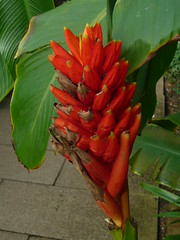
Musa coccinea Red banana
Musa Coccinea.

alba – white
aurea – golden, yellow
chrysantha or flava,  lutea   -yellow and sulphurea – yellow
aurantiaca – orange and citronella – lemon
coccinea, rubra or punica – red and sanguinea – blood-red
purpurea – deep pink or rosea – rose pink
phoenicea – purple and violacea – violet
viridis – green
pallidia – cream,
incana – grey or glaucus – greyish- blueish
argentea – silvery,
azurea  or caerulea – blue
nigra – black

Dictionary of Botanical Epithets contains a great deal more information, derivations, stems and meanings.

Latinized Epithets Location or Origination

Read More Read More

Plants Around a Birdbath

Plants Around a Birdbath

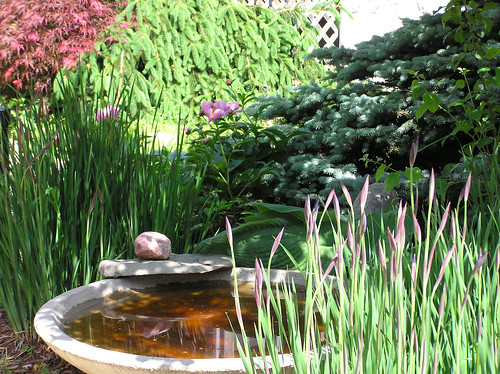
Attracting wild life and birds in particular is achieved by providing food, water and safety. Your bird-bath has provided the central issue, water, and your plants can help in the other two areas. There is no need to sacrifice colour or the ability to grow flowers for cutting if you choose wisely.

Aiming for a Cool Effect
Vebascum bombyciferum the Mullein has yellow floral spires on grey green foliage and lots of seeds later in the year.
Lamb’s Ears or Stachys byzantiana have mauve flowers with hairy grey leaves.
Yarrow is easy to grow and Achillea Moonshine is the lacy leaved variety I would go for to add to the grey leaved scheme.
Grass is popular with birds and Fountain Grass ‘Pennisetium alopecuroides’ produces late summer floral spikes and winter seeds.
White flowering Rosa Nevada has pale green foliage and the Foxtail Lily Eremurus stenophyllus has white racemes.

Other Plants and Tips
Birds will be attracted by insects who visit flowers like Thyme, Sedum, Sweet Rocket (also called Hesperis matronalis) and Heather.
Background plants can overwinter insects in Virginia creeper and Ivy and also provide nesting sites.
A mixed hedges provide a place of sanctuary.
See also Gardening for Birds on Gardeners Tips or Trees and Shrubs for Birds.
Purchase a good mix of plants of varying heights including some low lying creepers for the edges.
For plants in the shade read


Getting birds in your garden

Photo Credit normanack flickr creative commons.

Grow Edible Flowers For a Salad

Grow Edible Flowers For a Salad

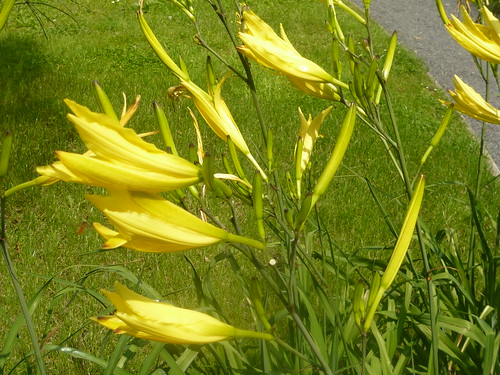
Day Lily

Do you like flavour and fragrance in your salad or would you like some more colour? If the answer is ‘Yes’ then I suggest you grow edible flowers in your own garden.

Harvesting Edible Flowers

It is normally the petals that are eaten but small flowers may be eaten whole.
Gather the flowers early in the day when the dew has just evaporated.
Cut with a small pair of scissors
Handle them gently and carry them in a basket to avoid bruising .
Leave them aside so any insects and beetles can escape. Only wash them if necessary then pat dry with a paper towel.
Keep in a closed plastic bag in the refrigerator until required and refresh with cold water before use.
Scatter over a salad in modest proportions.

Popular Salad Flowers

Pot Marigold or Calendula petals have a vibrant range of colours and can be used fresh or dried. They add seasoning as well as colour.
Nasturtium are popular as they are easy to grow and have been eaten for centuries. Buds flowers and seeds are all peppery to taste.
Pansy and Viola have little flavour but the colour can be made available virtually all year round with winter flowering varieties.
Primroses used to be collected from the wild but it is more PC to grow your own mild flavoured flowers.
Old fashioned Roses add colour and scent but test the variety first as the base of some petals can leave an after taste.
Dianthus such as Pinks and Sweet Williams can be strongly flavoured and scented.
The flowers of herbs;  Lavender, Sweet Bergamot, Sage, and Borage are suitable to eat in moderation.

Gardeners Tips

  • Pick young, small flowers and use with subtlety to enhance a salad not over power it.
  • Check the plants are identified correctly to avoid toxic flowers.
  • Add dressing to a salad before sprinkling with flowers to avoid discolouration.
  • Experiment with a wider range of flowers, there are lots to choose from. See Whats Cooking  America ‘Edible Flowers in salads’
Home Made Plant Protection

Home Made Plant Protection

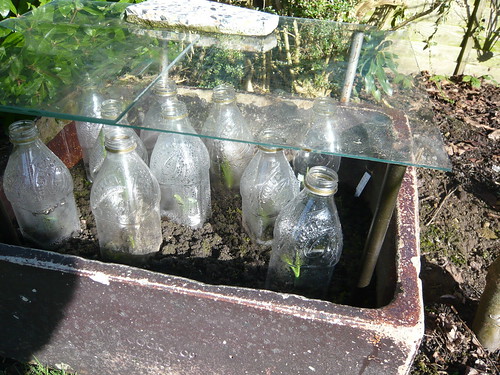
Bottle Glass House

This ‘double glazing for plants’ is getting these early onions off to a good start at the beginning of March.

Each plant has its own baseless pop bottle for individual cover. Then there is the glass sheet that will keep off the snow and the sink sides to keep out some frost. Intensive care for plants that can be treated as individuals may be worth the effort when our local vegetable show comes around (no wonder I have lost to this neighbour before.)

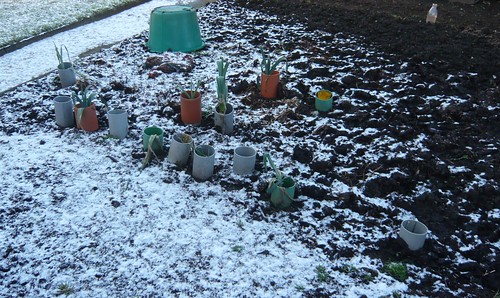
Winter Protection

This is another of the local money free protection schemes where the Leeks are grown in lengths of drain pipe. I guess this helps with blanching  but more importantly extends the cropping season. Talking of Leeks, yesterday I bought some seed of Swiss Giant Zermatt to pick from July as baby leeks and some Blue Green Autumn Neptune for resistance to Leek rust disease.