Browsed by
Category: Gardening

General gardening tips and hints

Cornus Chop – Dogwoods Bark Red
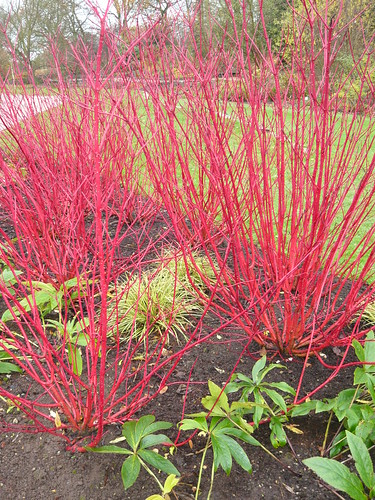
Cornus Chop – Dogwoods Bark Red

Cornus Alba Siberica

The first week of March and it was time for me to chop the Cornus Dogwoods down to size. The red stems that have shown up so well during winter will never be the same again if left on the shrub so they are ‘out for the chop’.

Pruning Cornus

  • Cut all the upright stems down to within 3 – 4 inches of the ground.
  • Water well and mulch the stump with good compost or manure to encourage new growth. Dogwoods like water!
  • New stems will grow, show leaf, flower and be ready for another winter display come Autumn.
  • Some pencil thick stems, 6 inch long, can be used as cuttings for growing new plants.
  • Check around the stool of the plant as you may have several new plants available from the layering of the old stems – any with roots can be severed from the main plant and relocated.

There are many other interesting Cornus trees and shrubs or new Cornus Alba Sibirica plants can be bought via Amazon
Follow the full story of Bark on our other pages
Growing Sweet Rocket or Dame’s Rocket

Growing Sweet Rocket or Dame’s Rocket

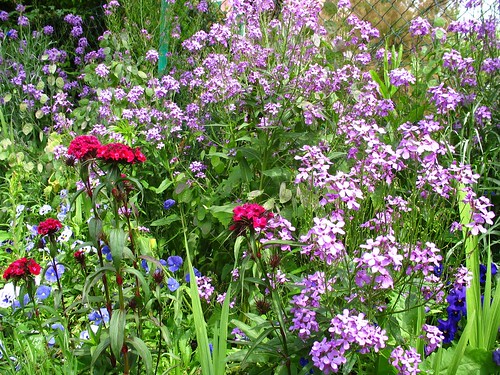
I planted some seeds of Hesperis Matronalis also called Sweet Rocket or Dame’s Rocket, and the plants came up like grass in next to no time. I should have reacted to the advice on the packet ‘scatter thinly when sowing …..thin out as necessary. Plants will self seed in following years after flowering. Sow outdoors in May to June, transplant in autumn.’ Well now I have a veritable forest to prick-out and keep under cover until the frost goes.

Growing up to 3 foot high the open airy plant flowers in shades of purple and lilac to white.The fragrance is as sweet as a violet’s, and most pronounced in the evening. It looks good in a border or a cottage garden and is attractive to wildlife. Some plants may bloom until August but warm weather shortens the flowering period.

Treat the plant as a biennial although it can often be perennial. When established it can be invasive and seeds freely.

Seeds are available from Thompson Morgan Sweet Rocket

Photo by nicoretro on flickr

Ideas for a Purple Patch

Ideas for a Purple Patch

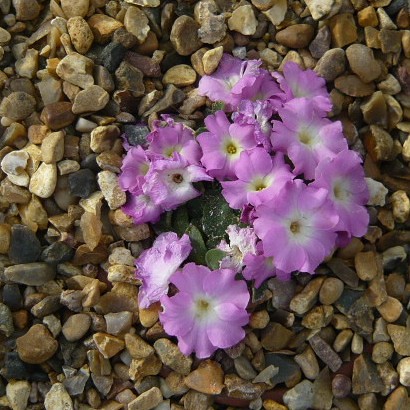
Primula 'Elizabeth Burrow'

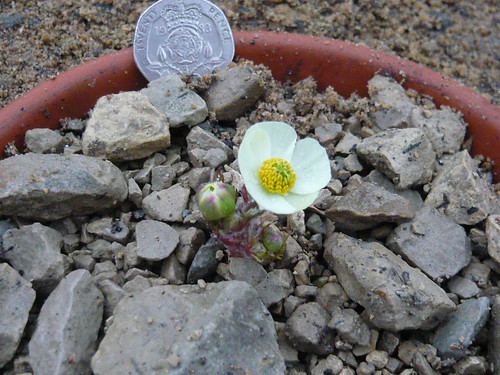
This delicate little Primula ‘Elizabeth Burrow’ is not the best example of a purple patch plant as it is little bigger than a £2 coin. Primula Denticula however can be a real stunner with lilac or purple flowers on lollipop stems. This is just an example of the range of purple colourings available on modern plants ranging from deep violet to lilac.
Also from the Primula family come the Japonica and Harlow Carr Hybrids that often sport a purple hue to the flower-heads.

Kew 365
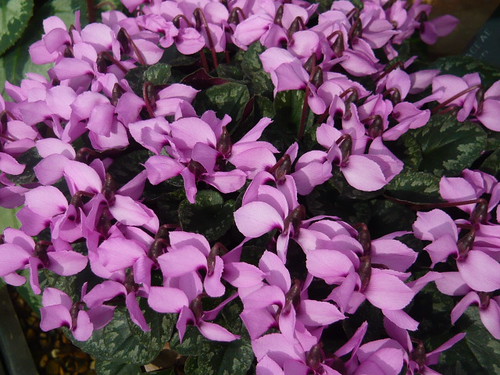
At the red end of the purple spectrum this cyclamen make a strong colour statement and it could be paired with the 18″ high Allium hollandicum ‘Purple Sensation’. There are also many purple Rhododendrons for early flowering like the compact Ramapo.

Read More Read More

Tips for Flowering Shrubs in Your Border

Tips for Flowering Shrubs in Your Border

Tips for Designing Shrub Borders

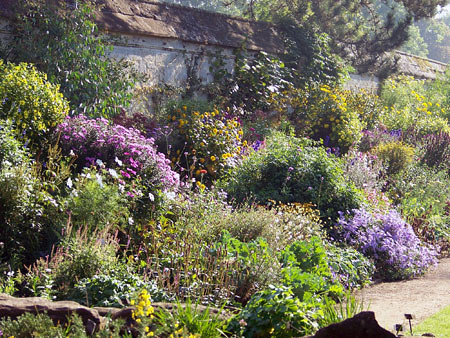
  • Create a tiered effect in your border by using shrubs of different heights.
  • Plant low growing types at the base and later flowering ground cover.
  • Select flowering shrubs who’s colour will lead the eye from one plant to the next.
  • Only bother to prune to take out dead wood or if the shrubs become unruly or too high.
  • Grow flowering shrubs to make a partially shaded plot for delicate flowers.
  • Plant larger trees or shrubs off-center to avoid a too formal appearance.

Plant selection for an Acid Soil Border

  • Camellia japonica can be planted at the back as it will grow 6-12 feet tall but only spread 3-5 feet. Red, white and pink are the most common colours to buy and the thick leathery leaves are evergreen.
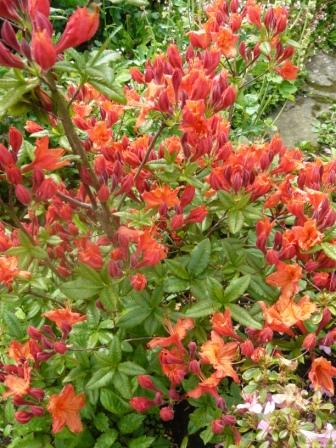
  • Azalea Knap Hill hybrids or Mollis are very floriferous decidious plants that flower in spring before the leaves grow. Mine are now 4 feet tall after 5 years. Depending on the size of you border I would use 3, 5 or 7 of these great plants in various colours.
  • Callicarpa bodinieri produces stunning purple berries in Autumn 3-6 feet tall and wide.
  • At the front you may need some shade loving plants like Epimedium with copper tinted leaves. Trillium sessile has ivy like leaves and white, red or brown springtime flowers.
  • For shape it may be appropriate to add some Box (Boxus Sempervirens) near the front. 12-36″ tall.

Other Selections

  • The scheme above is strongly spring flowering and Mahonia x media ‘ Charity’ or Pieris japonica could also be incorporated into the planting.
  • For summer interest you may substitute or add Escallonia ‘Apple Blossom’, Hydrangea macrophylla or a hardy Fuchsia magellancia.
  • Ceanothus ‘Autumn Blue’ will fit in a sunny spot and a variegated Ilex aquifolium at up to 12 feet adds berry interest late in the year.
  • For general all year round cover the Elaegnus pungens Maculata has good colour in the leaves, Euonymus can grow to 10 feet and Skimmia has cream flowers in spring followed by red berries.

Plant Label for Madagascar Periwinkle

Plant Label for Madagascar Periwinkle

Kew Lable Catharanthus roseus

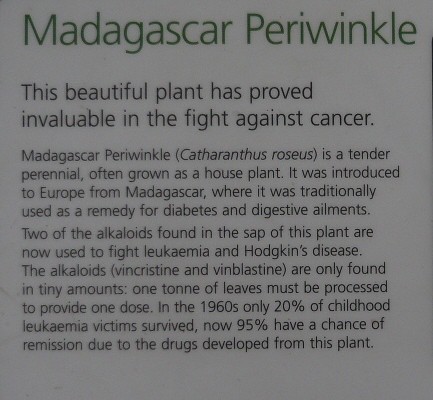
If you want an informative label on your plant you can do a lot worse than go to Kew gardens. This fulsome label informs and educates the visitor about the periwinkle or dogbane that is currently in flower. Catheransus roseus or Madagascar Periwinkle’s alkaloids have contributed to 70 different drug formulations from this one plant species.

Catheransus roseus

Below is the more normal horticultural label for the same plant. The family name is top right – Apocynaceae or dogbane is a family of flowering plants that includes trees, shrubs, herbs, and lianas. often found in tropical rainforests, and most are from the tropics and subtropics. Some are perennial herbs from temperate zones and many have milky sap that make them poisonous if ingested. Vinca major and minor are part of this family.

Small is Beautiful in Gardening with Conifers

Small is Beautiful in Gardening with Conifers

‘Do not forget to pause and smell the flowers’ is an injunction oft repeated but it could also apply to pausing to inspect the flowers. It is easy to see the brash flowers of Dahlias, Peonies of Delphiniums for instance but close inspection of the petal-pattern or the individual florets can open up a new view of gardening.

One flower that fascinates me is the Cyclamen with the nodding head that straightens to a twist of petals what slowly untwist to reflex the petals back towards the stem. A fascinating natural process to observe. Look out for other dwarf bulbs including Crocus chrysanthus, Eranthis hyemalis (yellow aconite), Oxalis and Grape Hyacinth.

For structure in a miniature garden you can do a lot worse than Dwarf Conifers but be wary of slow growers that will eventually dominate like Juniper horizontalis and Chamaecyparis lawsoniana ‘Ellwoods Gold’.

Dwarf Conifers under 18″

  • Juniper communis Compressa is recognised as one of the best conifers for creating a miniature landscape with its slender spire of tightly packed grey-green foliage.
  • Abies balsamea Hudsonia grows to 12″
  • Chamaecyparis lawsoniana ‘Minima Aurea’ has wonderful golden foliage in a dense conical bush. Chamaecyparis lawsoniana Pygmaea Argenta also tops out at a similar 24″ but is blueish green with creamy white tipped shoots.
  • Juniper squamata Blue Star is a spreading 10″ high contrast to yellow leaved conifers.
  • Thuja occidentalis Danica is a neat bush with bronzed winter tints.

It pays to think small and to look closely. If you are limited for space it may pay to create a garden in miniature selecting all the small species you would like to see in Acres of space.

Cottage Garden for Edible Crops

Cottage Garden for Edible Crops

The traditional Cottage Garden was a working garden for the growing ornamental and edible crops. Planting included fruit, vegetables and herbs mixed with flowers such as Peonies, Delphiniums and Aquilegia to produce a haven for insects, an eye opener for gardeners and crops for the house.

Cottage Fruit Garden

  • Rhubarb would be one of my key plants in any cottage garden. In addition to the fruit pies from the pink and red stalks I would allow some plants to throw up the striking flower stalk. The Sutton or Victoria from Thompson Morgan would be appropriate varieties.
  • Gooseberries remind me of grandparents garden and Lancer is a green mid season fruit that crops well. Whinham’s Industry is a neat red.
  • Raspberries like Malling Jewel with some wire support near a wall or strung from two stout posts would also go into the cottage fruit patch.
  • Currants smell so good when the leaves are slightly crushed and redcurrant  Red Lake and the blackcurrant Wellington XXX would fill up the patch.
  • An old Apple tree in the corner may be supplemented by new ballerina columnar trained small trees.
  • If there is space for a Plum tree it will be an eating variety like Czar fan trained against a wall.

Cottage Vegetable Garden

  • Runner beans can hold there own amongst many flowers and I am growing Painted Lady variety this year.
  • French beans and broad beans are popular in my household so I will grow more of these than the brassicas which do not get eaten.
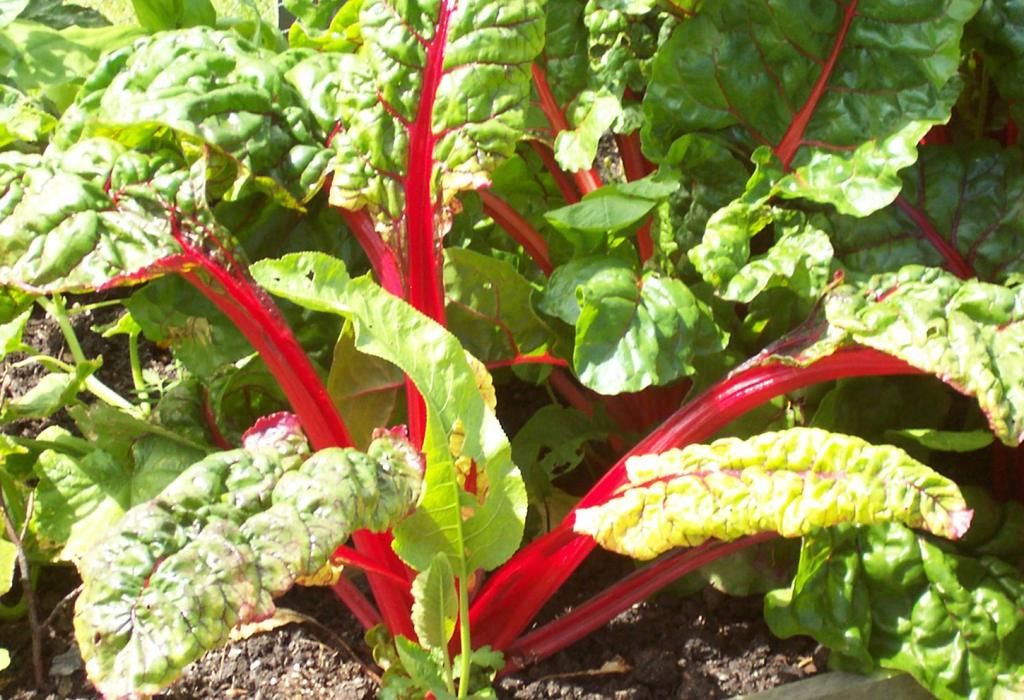
  • For colourful vegetables I will plant some Swiss Chard ‘ Bright Lights’.
  • I grow a mix of mangetout and garden peas that need regular picking.
  • You can also get away with a Tumbler tomato or two in a front garden.
  • Leeks look flamboyant when grown with  large flags and a good leafy marrow will provide lush green growth.

It is hard to agree on a range of flowers for a cottage garden so I have ducked the issue a bit. Nasturtiums are edible and cottagy and where would a garden be without Sweet Peas.

Swiss Chard
Growing Dried Flowers

Growing Dried Flowers

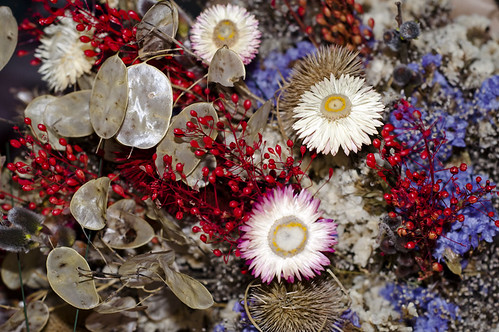
I guess when they are growing they are not dried flowers so the real title should be growing flowers for drying. As the display above shows you can get colour and texture into a bunch of dried flowers. The display is likely to last longer than a bouquet of fresh flowers and will be available when other material is expensive or in short supply.

There are 5 stages of development when a plant can produces flowers for drying.

  1. In bud as colour appears, examples being Helichrysum (Straw flowers) and Ammobium ( Everlasting flowers).
  2. As the buds open, with Echinops (Globe thistle), Eringium (Sea Holly), Lavender and Ornamental Grasses.
  3. In full bloom, with Achillea (Yarrow), Alchemilla mollis, Gypsophillia and Alliums (ornamental onions)
  4. After seeds have formed, like the Honesty in the bunch above and Antirrhinum, Poppy and Digitalis (Foxglove)
  5. Just before the seed pods open, but after spraying with hair lacquer to prevent seeds scattering, Nigella and Scripus ( Bulrush)

The best way to dry flowers is to pick them  in mid morning when the dew has evaporated.

  • Group them into small bunches and hang them upside down to dry.
  • To preserve the colours, hang them in a dry well ventilated space with little or low levels of light.
  • Large heads like Alliums and Artichokes need to be dried standing up. Make a chicken wire frame to separate and hold each bloom.
  • Read More Read More

Courgette & Marrow, Watering, Pollinating and Harvesting

Courgette & Marrow, Watering, Pollinating and Harvesting

Watering Marrows

  • Marrows are over 80% water and need plenty of watering when in full growth and the first fruits have set, at least 2 gallons per square yard per week or a gallon per plant per day.
  • Plant a cane or marker with the baby plant or seed so you know where the roots starts. Half bury an empty plant pot so you can pour water into it to get water directly to the roots.
  • Avoid splashing water on the stems of the young marrow plants.
  • You can apply a moist mulch of grass cuttings or compost after watering. This helps conserve soil moisture and keeps the weeds down.

Pollinating Marrows

  • If it is very cold, wet or windy while the plants are flowering then insect pollination is less likely to be successful.
  • Hand pollination is the best method in these circumstances and when growing under glass. Rremove the petals from a male flower; push the core into the centre of the female flower.
  • The female flowers are distinguished by the swelling below the bloom. Male flowers have a prominent phallus shaped central core, bearing yellow pollen. Male flowers may appear first but are regularly produced.

Harvesting Marrows

  • Ripe marrows have hardened skin and make a hollow sound when rapped with the knuckles.
  • Marrows mature quickly taking only two and a half months.
  • Young marrows may have been picked when very small, as courgettes but at the beginning of Autumn harvest all marrows leaving a long stalk on each. Do not wait until they have been frosted.
  • Store in nets suspended from a ceiling in a cool airy dry environment. They will keep for up to 6 months depending on variety.

Varieties to Grow

Read More Read More

Measuring Aids When Gardening

Measuring Aids When Gardening

Ranunculus  seguieri

Bodgers know about making use of the ordinary to help achieve results and here are a few tips for gardeners when measuring in the garden.

Your own body has natural measurement so check them out against a tape measure or ruler and remember the key ones. A stride is about 3 feet, a hand span from tip of thumb to tip of little finger is about 9″, an index finger 3″, heel to toe in a gardening boot 12″, arms akimbo 6 feet, hand width 4″ etc.

Home made measuring sticks can be created, from a 3 foot cane you have a yard stick, on a longer strip of wood paint a mark every foot or every 6″. On your garden rake or other tools paint sizes or lengths.

Buy your watering can with measures already marked or test the capacity with a kitchen jug and record the size with a permanent marker pen. Invaluable when mixing concentrated chemicals.

Buy a graduated dibber and trowel with marks every 2″ or make your own. Measure the depth of the blade on your spade.

Tie a known length of string to two pegs and stretch it out to get a straight edge of known length. If you are a sports field groundsman you may have a metal linked chain for your cricket pitch which will be 22 feet or ‘one chain’ long.

Areas are harder to measure but 4 by 3 foot canes in a square equals a square yard and this can be useful for spreading dry fertilizer and lawn weed killers.

Thermometers for the greenhouse and rain gauges are best bought from your hardware store of Amazon like the tri dial weather station.

Even the RHS promotes the use of a homemade Measuring Stick