Browsed by
Category: Gardening

General gardening tips and hints

Plants I Grow from Cuttings

Plants I Grow from Cuttings

It is still not too late to take semi ripe and hard wood cuttings. Many perennials are short lived, like Penstemon, Pelargoniums and Pinks but they can be reinvigorated from new cuttings. Plants are not at their best in Autumn so results may not be perfect but I find it pays to experiment.

Semi-ripe cuttings should be hard at the base while the tip is still soft. Late summer to winter are good times to find material. Evergreens like Ceanothus, Choisya, Cistus, Erica, and Hebe have all grown well for me from cuttings.

Gardeners Autumn Cutting Tips

  • Take more cuttings than you need to cover losses.
  • Add perlite to your compost or use damp sand and peat
  • Hardwood cuttings of shrubs and trees can be taken and left outside under some shelter from a hedge. Buddleja, Cornus, Forsythia, Philadelphus and Ribes the flowering currant seem to do well overwintered as cuttings. Do not rush to look for roots give them time.
  • Pelargonium and decorative Fuchsia need to be over wintered away from frost and I find it easier to do this with soft cuttings rather than large plants.

Tips for Growing Pulsatilla the Pasque Flower

Tips for Growing Pulsatilla the Pasque Flower

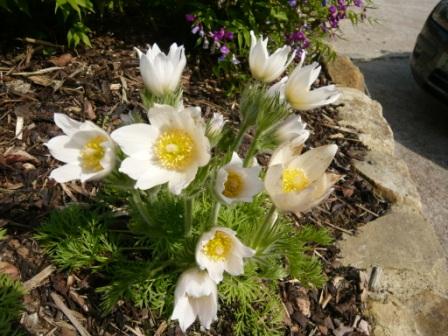
pasque-flowers

The Pulsatilla is also called the Pasque flower or meadow anemone and although related to the anemone it is a separate part of the buttercup family Ranunculus.

Also commonly known as the prairie crocus, Anemone Pulsatilla, Wind flower and Easter Flowe.

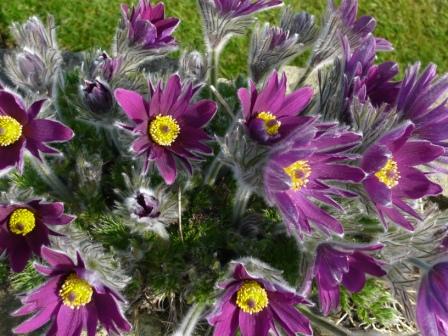
  • This clump forming herbaceous perennial is 6 inches tall and the flowers can be red, blue, purple or white and have six velvety petals with curled, pointed tips surrounding a ring of bright yellow stamens. Flowering around Easter they have the alternative native British name of Pasque flower.
  • All plant surfaces are covered in fine, soft hairs as can be seen in this images.The attractive seed heads which follow are spherical with silvery plume like styles raised on elongated flower stems.
  • Not to be out done the foliage is exquisite in spring.
  • The plant is best treated as poisonous although it is occasionally used in herbal medicine.
  • Protect from excessive wet winter weather. They tolerate alkaline soils and are found naturally in the wild.
  • They dislike root disturbance and can be difficult to establish. They can be grown from seed or propagated by root cutting but try not to disturb the main plant as they take several years to flower at their best. Plant when small and leave undisturbed.
  • Pulsatilla vulgaris Red Cloak is a great variety to grow from seed. Rubra is another red variety.

Seeds from Thompson & Morgan

Other Pulsatilla Facts
Pulsatilla vulgaris is the county flower for both Hertfordshire and Cambridgeshire.
Single flowers are followed by attractive fuzzy seedheads resembling those of clematis.
There is one double cultivar called Papageno

Passion flower Pulsatilla

Other Pulsatilla species  include:

Pulsatilla alpina
# Pulsatilla chinensis
# Pulsatilla grandis
# Pulsatilla halleri
# Pulsatilla montana
# Pulsatilla nigricans
# Pulsatilla patens
# Pulsatilla pratensis
# Pulsatilla vernalis
# Pulsatilla vulgaris
# Pulsatilla subslavica
# Pulsatilla cernua

Funky Growing

Funky Growing

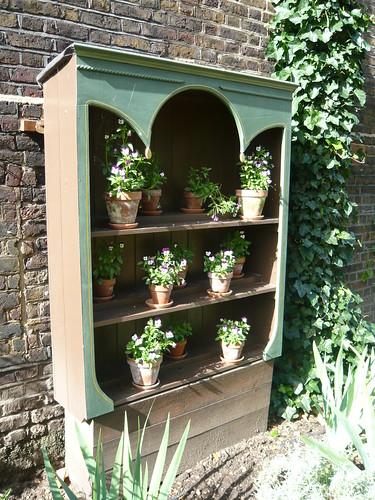
Going to the theater used to mean a trip out to see actors performing. Then someone built a stage to show off Auriculas and they called this an Auricula theatre.
Victorians and Edwardians grew some fine plants shown off in these neat custom built arenas like the one at the Geffrye Museum in London.

London liverpool st 132

So what has this to do with funky veg or the Hot Chilli & Sweet Pepper Kit by Plant Theatre – 6 Different Varieties to Grow?. Well I have given it away as these are products sold by Plant Theatre and available as gifts via Amazon.

More About Funky Veg

The kit is promoted as a really novel gift and would work for gardeners or cooks with just a window box.
The kit contains 5 distinctive and unusual vegetables including the following varieties: Purple Carrot seeds, Yellow Courgettes seeds, Stripy Tomatoes seeds, Red Brussels Sprouts seeds and Multi Coloured Brightlights Swiss Chard seeds
Also included in the box are: 5 starter growing pots made from peat 5 peat blocks which expand when watered 5 plant markers and Sowing & Growing Tips.
All the seeds are of UK origin.
I would be a bit worried about the extent of the companies disclaimer of responsibility which says ‘The germination and growing results are the purchasers responsibility and depend on many factors such as planting time, seed depth, watering, light and weather conditions. These factors are out of Plant Theatres control and Plant Theatre or any company selling this product can not be held responsible for non germinating seeds. This kit is deemed as a novelty gift and is sold as such.’
A cynical gardener may think they doth cover their muddy footprints too much.

cosmic purple carrots
Cosmic (and funky) purple carrots by kthread CC BY-NC-SA 2.0

Mix of Favourite Seeds and Saving Tips

Mix of Favourite Seeds and Saving Tips

Mixed bunch

This collection of 27 different packets of seeds for sowing from the start of February contains a fine mix of varieties. The cost is below £40 and that is good value when you realise 10 of the packets are F1 hybrids which are generally quite expensive and nearly worth the entrance price alone.

Customer favourite seeds at Thompson & Morgan

Flowers in the Mix

Amberboa muricata
Begonia x tuberhybrida illumination Apricot Shades F1 Hybrid
Californian Poppy Fruit Crush
Marigold patula x erecta Zenith Mixed F1 Hybrid
Papaver oriental Coral Reef
Digitalis purpurea Candy Mountain
Echinacea purpurea Pink Parasol
Nasturtium minus Princess of India
Petunia x hybrida Purple Velvet F1 Hybrid
Petunia x hybrida Salmon Velvet F1 Hybrid
Papaver paeoniflorum Ooh La La
Sweet Pea Sugar ‘n’ Spiceâ„¢
Sweet Pea Flying the Flag
Sweet Pea Fragrantissima
Scabiosa atropurpurea Beaujolais Bonnets
Silene laciniata Jack Flash

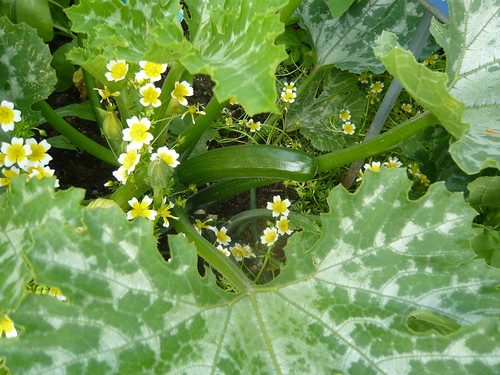
Courgette and Egg plant

Vegetable Seeds in the Mix

Beetroot Wodan F1 Hybrid (Globe)
Runner Bean White Lady
Tomato Sungold F1
Tomato Suncherry Premium F1 Hybrid
Lettuce Chartwell (Romaine)
Lettuce Ultimate Mixed
Pea Oregon Sugar Pod (Mangetout)
Carrot Flyaway F1 Hybrid
Brussels Sprout Trafalgar F1
Climbing Bean Cobra
Courgette Defender F1 Hybrid

Gardeners Tips for a Mix of Favourite Seeds

  • If you like to grow your own from scratch or are looking for some new inspiration try this wide ranging collection. Sorry if you were misled in to thinking you could grow fuchsias from this seed collection – blame T&M.
  • Why not share the packets and growing with friends and neighbors or your local allotmenteers. There should be plenty to go around.
  • Flowering and cropping period for this mix vary from May to September. Sowing Months are from February to June or July
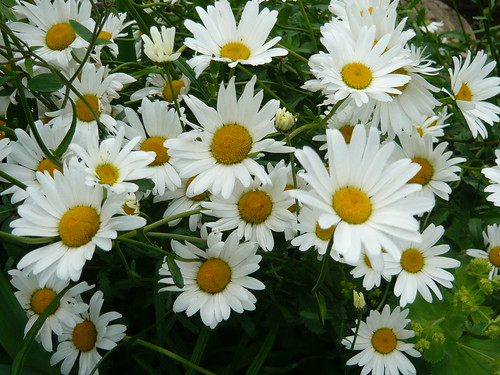
  • Leucanthemum

    Storing Unused Seed for Future Years

  • Most seed will remain viable for several years in unopened packets.
  • A bit of care can help keep opened seeds for several seasons.
  • Seed deteriorates if badly stored particularly in hot and fluctuating temperatures.
  • Seed is ‘done for’ if it gets moist and can rot or germinate so store it in dry conditions. I use a Tupperware box and have some desiccant crystals I got free with some bought goods.
  • I fold over the edge of foil wrappers so air and moisture can’t get into packets when I am saving some of the seed for other seasons or later sowing.
  • Seeds that I have collected from my garden are kept in paper bags or envelopes and try to avoid excessive drying out.
  • Germination rates vary from plant to plant and will deteriorate over time but if in doubt save your seed and hope for the best. Beware Parsnips and some varieties of seed have a very short shelf life. Other seed is best sown as soon as it is collected.
  • Some gardeners recommend storing seed in a container in a refrigerator but I have never bothered.
  • What is Acid Soil for Gardeners

    What is Acid Soil for Gardeners

    Many plants grow best in what is termed ‘acid soil’ but what acid and how strong. How can we gardeners find answers to these questions so we give our plants the most appropriate soil conditions.

    Ph tester

    Measuring Soil Acidity

    • Acidity in soil or solutions is measured in terms of the pH level. pH is the abbreviation for potential hydrogen the measure of its hydrogen-ion concentration.
    • pH for soil varies on a numeric scale where, between 1 and 7 is very acidic to neutral and between 7 and 14 is neutral to alkaline basic or limey
    • UK soils are normally the pH range of between pH 4.0 and 8.5. (4.0 is quite acidic and 8.5 very basic or alkaline).
    • I aim for soil between 6.0 and 7.5 an this suits most of my plants

    This scale shows pH in relation to common household liquids. 7.0 is pure distilled water.

    What is the Impact of pH on Plants

    • pH levels influence which plants will grow.
    • pH levels determine if a plant can take up and use normal nutrients.
    • An acid-loving plant in alkaline soil is likely to suffer and die.
    • Below 5.5pH the availability of manganese and aluminum could become toxic to plants.
    • In alkaline soils you may experience bacterial diseases eg in potatoes.

    Field Poppies

    What Affects Soil Acidity

    • Soil is not homogenous and you need to test soil from several areas. There are kits and measuring devices to help.
    • The original underlying parent material will determine your soil pH.
    • Rainfall and leaching can take soluble chemicals from the soil making it more acidic
    • The application of fertilisers and organic matter can influence the pH level.
    • High and regular crop harvesting can change the soil.

    Changing Soils pH Acidity

    • To make soil less acidic for vegetables, saxifrages and annuals for example you can add lime or pulverised chalk.
    • Bone meal is a good source of calcium and with wood ash it can help raise your soil’s pH over time. It is used for soils that are only slightly acidic.
    • Ericaceous plants such as most rhododendrons, heathers, camellias, acers and blueberries need acid soil.
    • Peat is naturally acidic and a mulch of pine needles, peat moss, or shredded bark that will organically reduce pH levels. Otherwise ericaceous compounds are sold
    • For container plants water several times with a solution of 2 tablespoons vinegar to a gallon of water

    June garden 069  Rhododendron

    Footnote
    The term Ericaceous is used for acidic soil or acid loving plants. Another way of looking at it is that Ericaceous plants are known as lime-hating or calcifuge plants. The term comes from Ericas which are generally peat loving moorland plants.

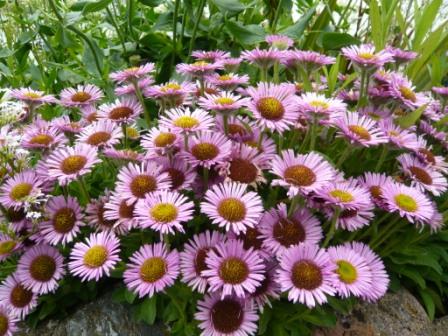
    Stokesia Laevis Aster Like Flowers

    Stokesia Laevis Aster Like Flowers

    Stokes’ aster is an unusual plant with large cornflower-like blooms on low growing plants, with rosettes of narrowly lance-shaped, dark-green leaves. It has a long flowering season, from mid-summer until the first severe frost in mid-autumn. The flowers are very good for cutting.
    Stokes' Aster

    Growing Conditions

    • An evergreen, Stokesia Laevis preferring acid soil, a sunny spot, and very good drainage. The roots may rot if plants are too wet in winter.
    • The long lasting flower heads are produced on plants 12-18 inches high with a similar spread.
    • The summer flowers are generally purplish/blue in a starry pattern and are ideal for cutting or attracting butterflies.
    • Stokesia laevis like good drainage, particularly in the winter, so a raised bed or rock garden may be worth trying.
    • Stokes’ Aster is a North American native wildflower with a double Shasta Daisy in effect.
    • Plants form a low mound of leathery green leaves, remaining evergreen in mild winter areas.


    Selected Varieties

    Stokesia Laevis Purple Parasols
    Stokesia Laevis alba
    Stokesia laevis ‘Blue Danube’ with 4 inch wide lavender flowerheads
    Stokesia laevis ‘Wyoming’ has the darkest blue flowerheads of all
    Stokesia laevis ‘Omega Skyrocket’ is a vigorous variety growing 3-4 ft tall and has long-stems of white to pale blue flower.

    STOKESIA

    Photo credits
    Stokes’ Aster by BlueRidgeKitties CC BY-NC-SA 2.0 ‘These pretty flowers were planted at the Daniel Boone Native Gardens in Boone. They are native to North Carolina, but more at home in the coastal plains than in the mountains. They are commonly cultivated for garden use. If you have them in your yard, cutting the dying flowers before they set seeds will make the plants produce more flowers throughout the entire summer. ‘
    STOKESIA by Swami Stream, CC BY 2.0
    Stokes Aster by cmcgough CC BY-NC-ND 2.0

    Stokes Aster

    Good Root Growth with Root Stimulators

    Good Root Growth with Root Stimulators

    Root and beech beach

    Rootgrow is an organic treatment that was originally launched to improve the vigour of roses via the roots when incorporated at planting. Rootgrow helps to improve the uptake of water and nutrients from the soil and is now more widely used. It encourages the roots to grow more quickly and also helps to prevent rose replant sickness. It is especially beneficial in poor soil but do not use with bonemeal as that inhibits growth of the fungi.
    Rootgrow can be bought in most good garden centres or via amazon

    Plants use hormones to influence and promote the development of their cells. Root stimulators, like rootgrow usually come packed with bacteria that can actually produce phytohormones directly into your plant. The hormones encourage much faster growth which results in bigger yields and faster harvests. Mycorrhizal fungi can now be added when planting as there is a symbiotic relationship that encourages healthy root growth.

    According to some, quality rooting stimulators come with certain strains of bacteria, most notably paenibacillus, designed to enhance the Nitrogen your plant receives so it can help maximize root and plant health. This bacteria provides your roots with a steady stream of reduced nitrogen by converting N2 gas in the air into a form of nitrogen that can help your roots grow to their potential. ‘The volume of soil space controlled by tree roots is directly related to tree health’ Dr Kim Coder 2000

    Hydroponics growers have had to deal with the encroachment of harmful fungi, usually when their conditions becomes too humid but there are certain strains of fungi that can actually benefit root development. When these fungi are introduced to your hydroponic system, they can break down debris and turn any undissolved nutrients into materials that your plant can actually absorb by increasing nutrient uptake, releasing Growth Hormones and promoting Beneficial Fungi, with Nitrogen, Phosphorous and Potassium.

    A mixture of 5% nitrogen, 12% phosphoric acid, 3% soluable potash is highly effective as a plant starter. It stimulates early strong root formation and reduces transplant shock.

    Tree Roots

    Good Roots and Bad Roots

    • This shrub has evolved a root system that fits the landscape literally.
    • Good large roots should be oriented both laterally and vertically to provide better root systems.
    • Many plants need large roots for anchorage and fine feeder roots for water and sustenance.
    • Higher quality root systems have several large main roots emerging from just below the soil surface.

    Roots get low recognition by many gardeners but the science of root growth and root development is about to change all that. No longer is it good enough to dig a £5 hole for a £1 plant. More care and thought needs to go into the roots and their needs and aspirations.

    Trees and Shrubs For Birds

    Trees and Shrubs For Birds

    Birds need food, cover and nesting sites to survive in your garden. A good perching point will help birds feel and be safe and good leaf cover will help in bad weather.

    The more varied you make your garden the better for wild life, lawns, hedges, ponds and varied habitats all help. Avoid planting too many non-native species and choose a selection of trees and shrubs to provide insects and berries for bird food.

    Shrubs

    Berberis have spiny branches for cover and berries or fruit. Berberis wilsoniae is ideal for small gardens or you could try B. thunderbergii, vulgaris, gagrepainii or dawinii.

    The Cotoneaster family produce many berries. Do not bother planting Cotoneaster conspicuax decora as birds will not eat the berries. Pyracantha Firethorn is very popular with birds and most gardeners.

    Hedge shrubs like Hawthorn and Holly and Privet provide safe cover for small birds. Yew’s red berries feed thrushes.

    Buddleia globosa the Butterfly bush attract large quantities of insects which in turn feed birds.

    Trees for Perching

    Birch supports insects including caterpillars as do Goat Willow Salix caprea.

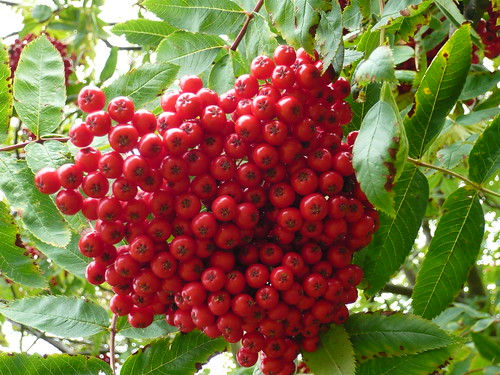
    Rowan mountain Ash Sorbus aucuparia is a avian favourite.

    Bird Cherry and Wild Cherry produce early fruit and are well sought after by birds.

    Conifers appeal to Siskins and Tits. Try Larch Larix decidua or Scots Pine Pinus sylvestris.

    Climbers

    Honeysuckle bears red fruit and also provide nesting sites. Lonicera periclymenum or L.caprifolium are suitable species to grow and you get the scent thrown in.

    Hedera helix or the common ivy is excellent cover, attracts insects and Thrushes, Pigeons and Robins like the fruit.

    Virginia creeper are vigorous growers providing nesting and roosting cover.

    Rambling Brambles, Rubus fruticosus are popular in dry weather for the juicy berries particularly for finches.

    Other Plants

    Good seed setters including Cornflower, Forget-me-not and Michaelmas daisy provide food over the growing months.

    Sunflower seeds are popular for extra protein. Wallflowers can also be left to seed.

    Unfortunately for gardeners many weeds are popular with birds including chickweed, dandelion, sowthistle and groundsel.

    Lawns attract small flies and the soil provides worms for Starlings, Thrushes and Robins.

    Sources of further plant selections
    RHS
    RSPB
    Wild Life Trust
    Getting birds in your garden from Garden Products


    Gardeners Tips Favourite Links

    Gardeners Promises

    Gardeners Promises

    Last winter I recorded some of the promises I had made myself about the garden and gardening. Nine months on some have worked, some have been ignored and the jury is still out on others.
    This review may tip you off or give you some hints for your own set of promises.
    These gardeners promises were recorded on the computer so I couldn’t escape. I also put some in a garden log book which I ‘promised’ to keep up with but seldom did – I blame the weather!

    Daisy
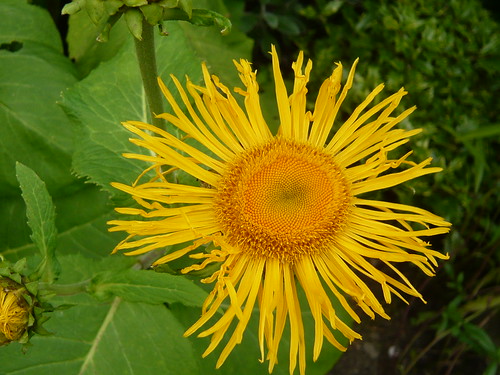
    ‘Inula hookeri’

    Garden Promises

    1. Get more scent from flowers particularly for the house. Fair progress with good Sweetpeas, that produced umpteen bunches and from strongly scented Phlox. Spring was a bit slow so I have just planted some ‘Narcissus Cheerfulness’ for next year.
    2. Create a plant and seed nursery. I have again failed to dedicate even a small area to sow seeds direct into the ground or a plant nursery spot for growing-on plants or taking cuttings. I am a plonker, that is I plonk in anything anywhere. The promise for next year must be to stop being a plonker.
    3. Take more care of chrysanths. I see these great flowers as high maintenance and I do not do right by them. I forget to pinch out, failed to pot on or stake as soon as needed and do not deserve to do well; nor do I.
    4. Fruit area design & order. I have reduced the veg patch and ordered more raspberries, red currants and bought a thornless blackberry. This is one promise that is well on the way.
    5. Rambler rose. I lost my rambler some year ago and intend growing another but haven’t found the space or variety yet.
    6. Lift crown on the bamboo clump. I must look out the variety of the well behaved bamboo that I grow as part of a mixed hedge. I wanted space underneath the green canopy and so pruned out some of the lower growth leaving the top untouched. Early days yet and I have probably been too cautious. 50% of a job well done I guess.
    7. Allow plants to grow old. I want to move on in the garden before plants have matured and given us the best. Again I am chopping down to early and loosing potential specimen plants before they can look old. I know I am impatient and missing out.
    8. Keep a better record of names and varieties. Failed
    9. Give plants appropriate space. Failed I still cram everything in
    10. Use more hard landscaping. Failed still clearing more ground for more plants.

    Daisy

    Secateur and Secateurs Tips

    Secateur and Secateurs Tips

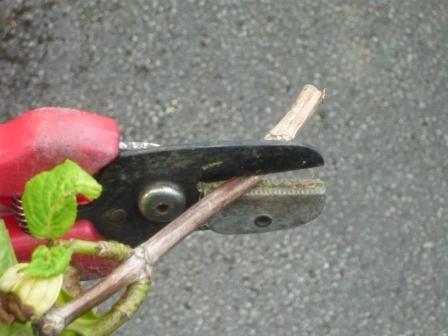
    anvil-secateurs-052

    Americans may call them pruning shears or hand pruners but my short handled pruners are called secateurs. Secateurs are like special scissors for cutting stems and branches that are less than a finger thick. They have a form of spring to open them and a catch to lock them in place.

    Tips for Secateurs

    • Buy a good pair (or one of each style see below) and look after them.
    • Keep the blade(s) clean and honed sharp. Old plant sap needs to be wiped off at the end of use.
    • Do not twist the secateurs to cut through a stubborn stem as it can strain the blades.
    • You need to find your secateurs when you put them down so choose a bright colour or add some paint to make them visible.
    • Select a pair with good feel and balance – they will work better and so will you.
    • After use give then a spray of WD40 or plunge in an oil/sand tray.

    Types of Secateurs

    • Cheap secateurs start from under £5 but you get what you pay for. A top line Felco pair will cost around £45.
    • Anvil secateurs have only one blade which closes onto a flat surface or anvil as in the picture above. They are reputed to crush the stem but I like them for many jobs particularly chopping down stems for the compost heap.

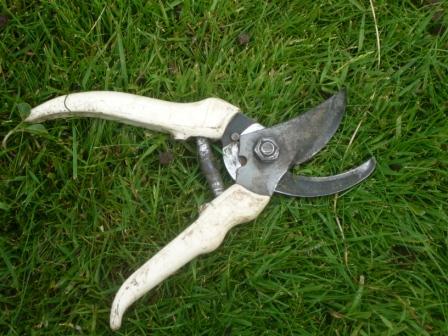
    bypass-secateurs-038

    • Bypass secateurs work exactly like a pair of scissors with one blade passing the other to make the cut. At least one of the blades will be curved with a convex upper blade and either a concave or straight lower one.
    • Parrot-beak secateurs consist of two concave passing blades which trap the stem between them to make the cut. These are suitable only for narrower stems and intricate work.
    • Bonsai have there own pruning tools including leaf cutters like miniature shearing shears and sharpened pincers.


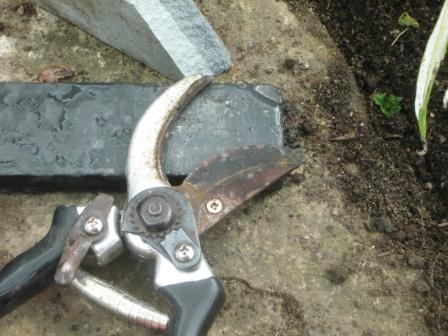
    wet-stone6

    Maintain Your Secateurs

    • Anvil secateurs remain reliable when slightly blunt but are easy to sharpen on a wet stone.
    • Use an oil stone or wet stone to sharpen the blade.
    • Two types of wet or oil stones are shown above.
    • The liquid quickly makes a grinding paste which is how the blade is sharpened
    • Normally 5 or 6 strokes will be enough to hone an edge but when renovating an old pair like the ones in the picture more effort may be required.
    • Only sharpen the outer blade on bypass secateurs.
    • Clean off sap and plant juice before putting secateurs away.
    • I spray moving parts monthly with WD40 to keep them in good condition


    Felco and other Secatuers from Amazon link