Browsed by
Category: Articles

Gardening articles that may not include tips

Majestic and RemarkableTrees

Majestic and RemarkableTrees

Book Cover

New Trees: Recent Introductions to Cultivation by John Grimshaw, Ross Bayton and illustrated by Hazel Wilks. Amazon

A good reference work or wonderful coffee table book can be costly but the joy of a book on your favourite subject may be a great investment. I adore Trees and wish I could own and plant up my own Arboretum. Unfortunately I have to be content with good books, regular trips to sites of interest and a small number of trees in my own garden.

If I was looking for something different then this book would be amongst my first reference work from Kew and Royal Botanic Publishers. I have made plans to have a trip to Kew gardens to check out one or two ideas that I have been accumulating through winter.

Another series of books I like to browse are the ‘Remarkable’ series by Thomas Pakenham
Book Cover

Meetings With Remarkable Trees starts “The two largest Common Oaks (Quercus robur) in Britain and probably Europe, too – are the Fredville Oak in Kent and the Bowthorpe Oak in Lincolnshire”. In Meetings with Remarkable Trees Pakenham assembles a beautifully photographed gallery of 60-odd trees of Scotland, England and Ireland, and magnificent trees they are. One is a 600-year-old king oak that looms large over Charleville, Ireland; another is the yew tree that Wordsworth called the “pride of Lorton’s vale”; still another is a sequoia brought from the United States and planted in a Herefordshire grove in 1851. Amazon

In ‘Remarkable Trees of the World’ there are sections entitled, Giants, Dwarfs, Methuselahs, Dreams and an exceptional section about Trees in Peril. Amazon

Read More Read More

Growing Cannas – Facts and Fancy

Growing Cannas – Facts and Fancy

You don’t need global warming to get a warm glow in your garden if you plant some Canna. The fiery hot flowers and leaves on some Cannas are hard to beat and are worth a place in any passionate garden.

What other plant starts flowering in June and keeps flowering right through until the first frosts. Do not deadhead the flowers at any price as new blooms arise from the center of old ones. They flower in shades of red, orange, pink and yellow often bi-coloured with blotches, spots and streaks. The foliage is also a most attractive feature, and can be shades of purple/bronze, red, green and striped.

Growing Canna

  • Rhizomes have to be started into growth in February and you can be certain that if you see a new root, then a new shoot will soon follow. Start them by putting them in a hot place in a poly bag. An airing cupboard is ideal.
  • Part fill a 2 liter pot with peat based compost improved with slow release fertilizer and insecticide and lay the rhizome on the compost. If any shoots are growing, place these pointing upwards. Be very careful with any shoots because they break off very easily.
  • Fill the pot, affix a label showing the variety and the date of planting. Give the compost a good drenching, and sprinkle a few slug pellets around.
  • Place the pot in a warm frost free place. They will grow much quicker if heat is provided.
  • They can be planted out in June in sun, shade or preferably semi-shade.
  • Cannas prefer a damp soil but can survive some drought conditions. Some varieties grow well in bog gardens.
  • Large clumps can be divided in Autumn when the rizomes are stored in a frost free environment. Keep slightly damp.
  • Canna are very strong and sturdy and do not require staking. They are generally insect free in the UK.

Read More Read More

Gardening with Dummies

Gardening with Dummies

Book Cover

Gardeners Tips for Dummies are contained in the above book.

Other Dummies to Consider

If your veg crop fails, buy some dummies from the local greengrocer.
Do not be upset if your dummy is not working in the garden today.
Slugs and pests are seldom dummies, they are always live.
Babies dummies sometimes benefit from a bit of sugar – so too can your Tomatoes and Carrots prior to eating.
Do not throw your dummy out with the rain butt water.

This is just a dummy post – a garden post

Growing Veg in Winter for Spring Crops

Growing Veg in Winter for Spring Crops

Book Cover

Sowing and planting vegetable in Autumn will ensure produce can be harvested from next April in mild districts. Over wintered crops avoid the problems of insect and pest damage suffered by spring sown crops but beware of mice when planting seeds.

Winter Vegetables to Grow

  • Broad Beans can be sown in October or November. Most varieties should be hardy though I would select The Sutton which grows 2′ tall or Aquadulce Claudia.
  • Peas of round seeded varieties such as Felthams First, Pilot or Douce Provence are suitable for autumn sowing.
  • Mange-Tout should overwinter if you grow Oregon Sugar Pod.
  • Garlic and Shallots are best planted in November.
  • Carrots of the Nantes type such as Adelaide or Nantucket will mature in June if overwintered.
  • Winter greens can often be bought as young plants for putting out in your veg plot.

Growing Tips for Winter Vegetables

  • Protection is the name of the game if you want to boost crop yields.
    • In wet regions use cloches to protect seedlings.
    • Sow some seed in modules in a cold greenhouse for planting out in March to get an early crop.
    • Cover with fleece in really cold weather.
    • Shelter for strong winds where practical.
  • Great Preparation will help winter crops
    • Plan to get all your crops started before December by which time the soil will be too cold for sowing or planting out.
    • Good drainage will help so I use  raised beds.
    • Place crops to benefit from winter sunshine.

The Winter Harvest Handbook: Year-round Vegetable Production Using Deep-organic Techniques and Unheated Greenhouses.  Eliot Colman helps the Home Farmer (and the keen gardener) extend their growing season to cover   winter   as his techniques can easily be adapted.

Carbon Neutral Garden

Carbon Neutral Garden

tree

They are not making ‘Carbon’ anymore nor is carbon ever totally destroyed. Carbon is one of natures greatest recycling projects. Carbon is present in gaseous form like Methane(CH4), Carbon dioxide(CO2) and Carbon monoxide(CO). Carbon is also dissolved in water particularly the oceans but is naturally present most notably as a solid in rocks such as limestone, minerals like oil and coal plus trees and plant matter.

Do you think about the carbon cycle?

Is your garden carbon neutral?

Are you offsetting your own carbon emissions?

Environmental Benefits of Planting Trees

Common Sense Carbon Neutral

Read More Read More

Growing Citrus – Oranges, Lemons, and Others

Growing Citrus – Oranges, Lemons, and Others

Book Cover

Glasshouse gardeners and those with large conservatories may be tempted to grow citrus trees. This book by Martin Page contains well written, instructive comments. Due to an American influence on the varieties chosen it is worth doing more research for UK purchases before plunging.


Don’t expect a crop of sweet juicy fruit in normal UK conditions.

It is noaccident that oranges grapefruit and other citrus come from Florida, North Africa and hot fertile climates

‘Growing Citrus’ is also  available as an ebook.

A more general text may suit casual growers of fruit. The book below contains interesting ideas on 50 different fruit crops.
Book Cover

Lavatera Tree Mallows

Lavatera Tree Mallows

This tree Lavatera arborea ‘Olbia Rosea’ is a deciduous shrub growing 10 ‘ tall. It has a profusion of deep pink veined flowers, two inches across, that appear throughout the summer with lobed, mid green leaves.
There are a range of Lavetera species or Mallows from the tree and shrub varieties to annuals called Lavetera trimestris. The annual Ruby Regis is a ceris colour whilst Mont Blanc is pure white and pink Silver Cup has an AGM. All are easy to grow from seed and produce lots of hibiscus like flowers.

Lavatera davaei is a Portuguese shrub, up to four feet high, with clusters of violet-rose flowers.
Lavatera mauritanica, from North Africa, is an annual of two feet, with violet flowers, shaded darker at the base.
Lavetra maritima bicolour is a small evergreen shrub with grey-green foliage that produces a profusion of large, pink, lilac and white flowers with magenta veins from late summer.

* Tip 1 Grow perennial Lavetera from cuttings and annuals from seed.

* Tip 2 Prune hard in the spring to encourage flowers on the new wood.

Lavetera Barnsley is a popular and readily available plant. The lower growing Lavatera Barnsley Baby is useful for borders and patio containers, where the branching plants give racemes of hollyhock-like, soft pink blooms.
Annuals and mallows from Thompson & Morgan

Bark that Looks Like Barcodes

Bark that Looks Like Barcodes

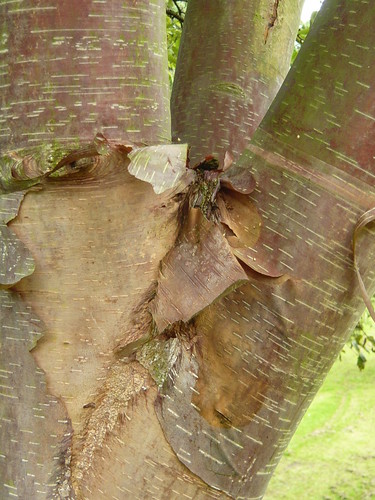
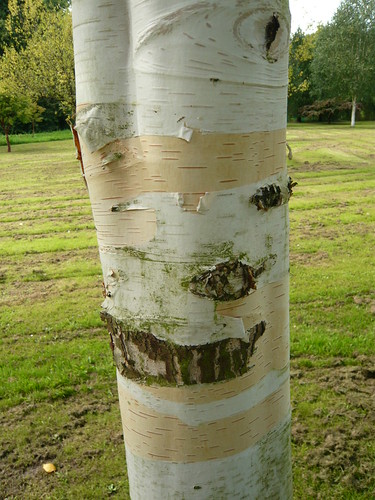
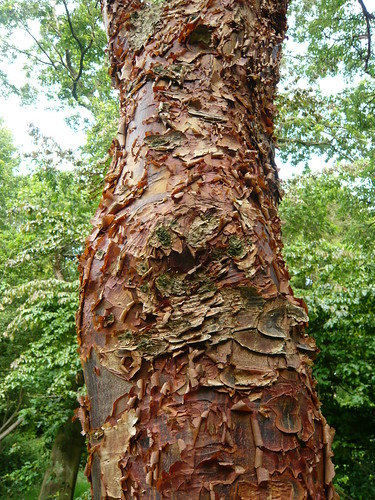
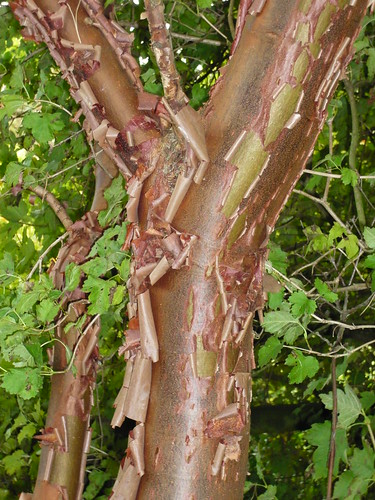
All you want to know about the outer covering of a tree trunk is contained in our recommended books. Our own pictures and comments describe different types of bark and provide some comments for gardeners.
Why keep a tree and bark yourself?

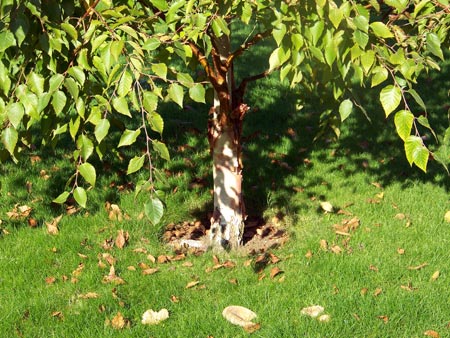
Bark cherry

Tree rings are something children learn about when aging trees.
The outer bark is dead cells the tree wishes to shed, the inner bark and cambium lead to sapwood and heartwood. It is the growing and resting of the cambium layer that helps date trees.

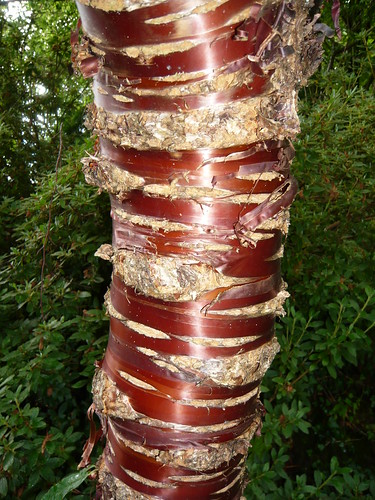
Acer griseum chinese paperbark

Types of Bark

Smooth which speaks for itself like Beech
Furrowed like Black Walnut or Fibrous bark is furrowed but the furrows themselves are also furrowed.
Scaly bark like pine or plated which is like scaly but the scales are much larger or even Shaggy with large scales loose at both ends.
Warty bark may be inherited or due to insects or disease.
Other descriptions will indicate the texture or appearance like snake-skin, spiky or Corky

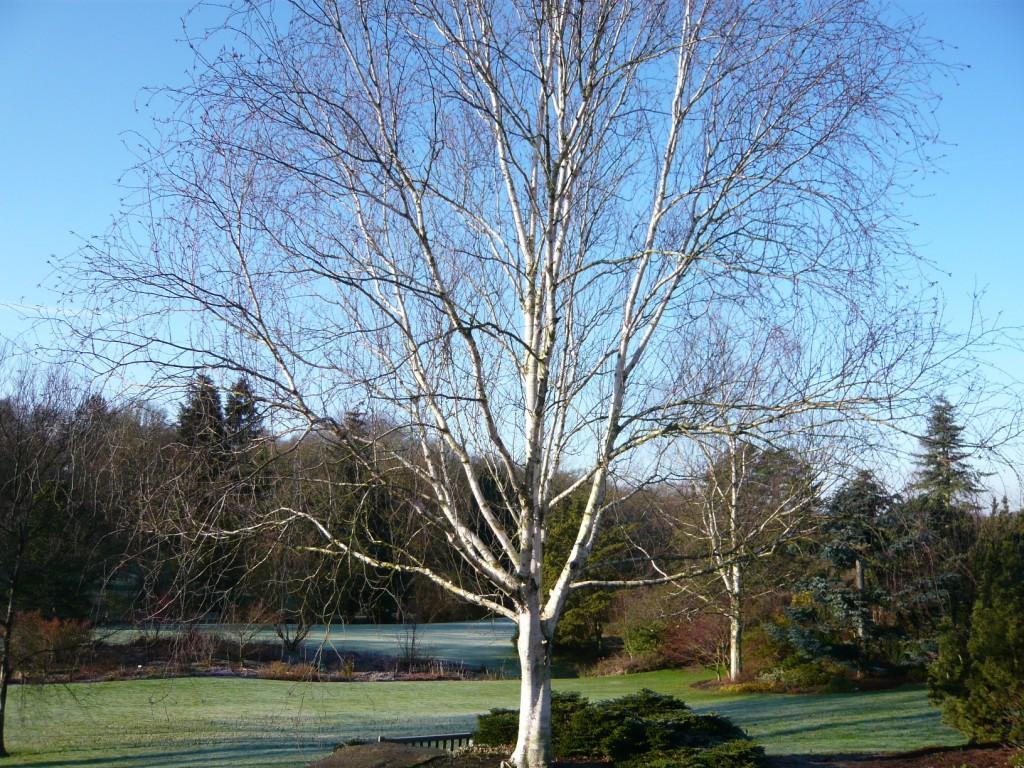
Betula albosinensis

The cambium layer is only a few cells thick and grows both xylem and phloem. The bark’s phloem transports nutrients from the leaves to the roots. Xylem carries water and minerals from the roots to the leaves.

Thorp Perrow bark
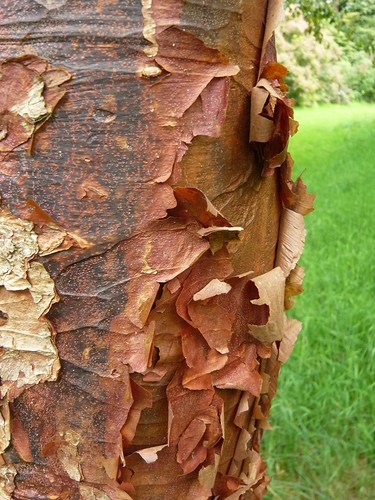
Bark develops and changes with age. A young Sycamore trees usually has smooth, silvery-grey bark that is occasionally brown. As the tree ages the bark develops cracks followed by large peeling scales.

Acer griseum chinese paperbark

The outermost part of the bark can often help in identification of the tree species.
Bark consists of dead cells and often has a characteristic colour and texture that is all designed to protect the underlying tissues from damage.

Barking up the wrong tree

Gardeners Tips for Bark

Protect young trees from damage to the bark caused by rabbits or garden equipment.
Consider bark as one of the key decorative features of a tree you are planing to grow.
Bark can add a whole dimension to your gardening enjoyment.

Recommended Books About Bark

Book Cover
Bark: An Intimate Look at the World’s Trees by Cédric Pollet

Book Cover
Tree Bark: A Colour Guide by Hugues Vaucher

Book Cover
Trees and Their Bark: A Selection with Stories and Pictures by John Mortimer and Bunny Mortimer

Just Published September 2012 Beautiful Trees: Close-Ups of Amazing Tree Bark from Around the World by Cédric Pollet

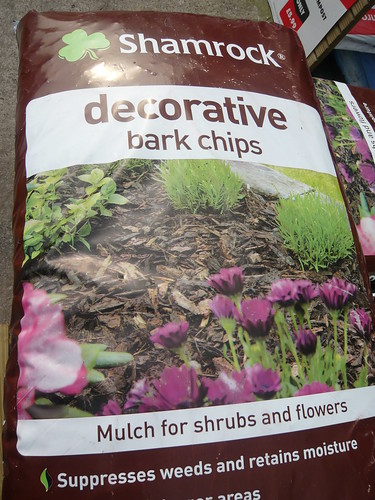
Good Uses of Bark Chippings

  • In natural wood land areas for a consistant appearance.
  • Where there is planting through the bark and it is used as a mulch as much as a decoration.
  • Amongst heathers and prickly subjects where you do not want to put your hands.
  • Some people use bark as a cushion where children may fall but animals and insects can make the bark less than perfect.

Bark chips


Walled Gardens And Garden Walls

Walled Gardens And Garden Walls

Most walled gardens are comparatively small and the walls act as wind breaks. The micro climates created help the plants through hard times.


If you are lucky enough to have a walled garden you will know what a boon they can be specially for growing vegetables and fruit. This 5 acre garden is in Helmsley North Yorkshire and has outstanding fruit and vegetables despite the climate. There is information on fruit grown within this garden on Gods Own County.

Tips from a Walled Garden

  • Think about the different micro climates in your garden. A walled garden accentuates and creates micro climates that you can use to your gardening advantage but you have many already.

menston march 14 029

Read More Read More

Swiss Chard as Coloured Spinach

Swiss Chard as Coloured Spinach

swiss Chard HC

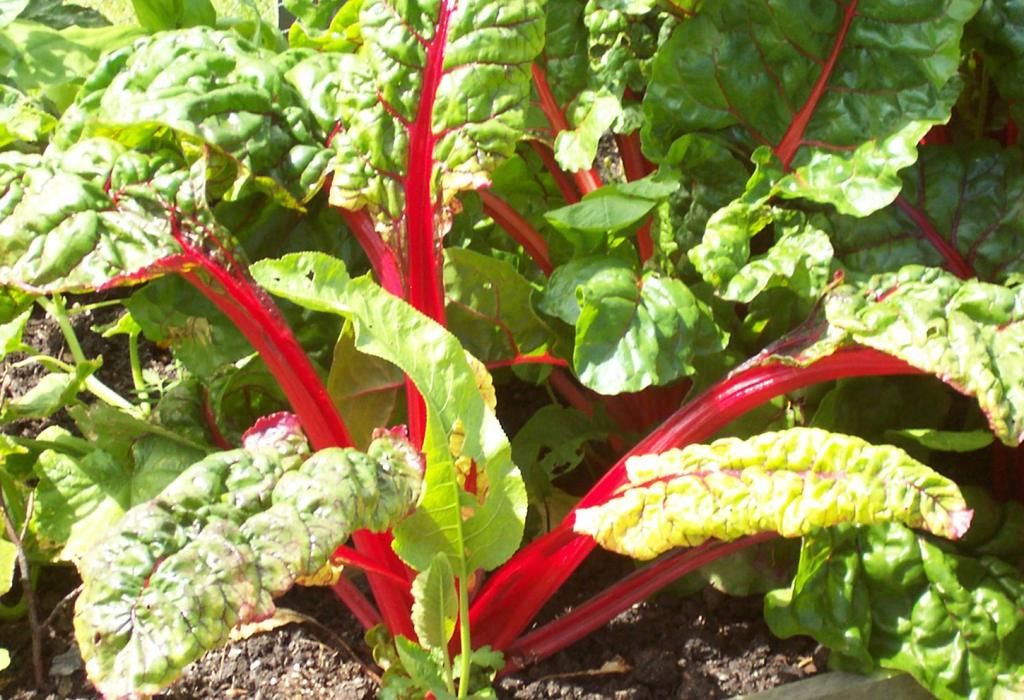
Similar to spinach with a slightly bitter flavour Swiss Chard is pungent and slightly salty. It contains an exceptionally impressive list of health promoting nutrients. Although Swiss Chard is available throughout the year, its season runs from June through August when it is at its best.

  • Swiss Chard is a tall leafy green vegetable with a thick, crunchy stalk that comes in white, red or yellow with wide fan-like green leaves.
  • It is ornamental enough to grow in the border.
  • Chard is easy to grow from seed and grows upto 18 inches tall and spread.
  • Eat and cook Chards like spinach. Both the leaves and stalk of chard are edible, although the stems vary in texture with the white ones being the most tender.
  • ‘Ruby Red’ has stunning deep veins and can be picked young.
  • ‘Bright Lights’ is a seed mixture ready within a month
  • Organic seed is available and if growing it organically watch out for slugs

Book Cover