Browsed by
Author: hortoris

Fuchsia from Cutting to Show
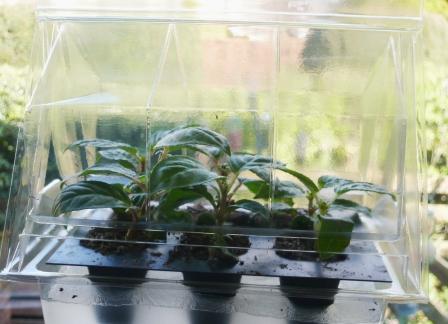
Fuchsia from Cutting to Show

micro-greenhouse

My Fuchsias didn’t over winter very well so I wanted some new ‘cheap’ stock. My first attempt was to buy strong looking plants from a nursery but foolishly left them to get frosted in a very cold greenhouse. These cuttings were on sale in there own nifty mini greenhouse with the roots in a water-gel to sustain then through the retail lifecycle.

I got 12 plants for less than £3 and I have potted them on on a window ledge and 4 days later the largest is already for ‘stopping’. I will pinch it and then others out at the growing tip to encourage branching.  If you are wanting a ‘standard’  shape ie a single bare stem topped with a globe of flowers, then do not pinch out the top but remove all the side shoots and main leaves on the stem until the stem is 12 inches tall and the head has been formed.

Training Fuchsias

  • Standards have already been discussed and they follow the training of a bush fuchsia. The bush fuchsia will be trained to have a stem of about 1.5 inches without branches and all growth then eminated from a selected number of laterals.
  • A shrub has multiple growths from below soil level. training starts ater 2 or 3 pairs of leaves have formed by pinching out the growing tip. this process is repeated until the plant is the size and shape required.
  • After every stop give the plants a nitrogenous feed to promote new branches. Plants flower 6-8 weeks after the last stop and in that time the feed can be changed to a 1:1:2 ratio with more potassium to encourage flowering.
…

Read More Read More

Wallflower Bowles Mauve

Wallflower Bowles Mauve

everlasting-wallflowers

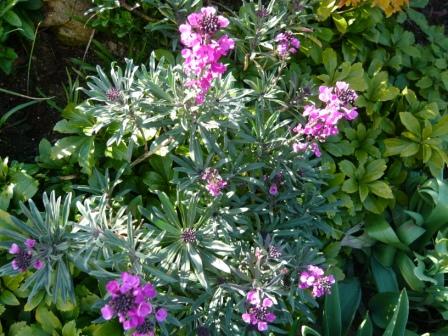
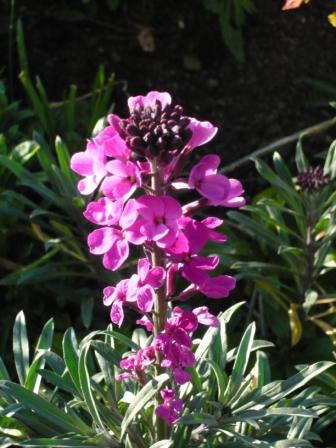
Bowles Mauve is a wallflower Erysimum linifolium that performs for several years unlike its strongly scented cousins. It is a short lived evergreen perennial that gets a bit leggy if not kept in check. The plant flowers all summer long and it seems as though it is flowering itself to death.

  • Take regular cuttings which are easy to root and grow on.
  • It grows 2 feet high and wide in most types of soil preferring alkaline to acid
  • Also try  other Perennial Wallflowers, Bowles Yellow or the shorter ‘Little Lilac Kiss’ from seed
  • Erysimum perofskianum Gold Shot as its name suggests has golden yellow flowers
  • Butterflies are attracted to this plant of the brassica family
  • As a member of the Cruciferae family the flowers grow from stems originating in the centre of the grey leaves and have 4 petals each in the shape of a cross.

everlasting-wallflower


Read also Everlasting Wallflowers

Colour of Spring

Colour of Spring

colour

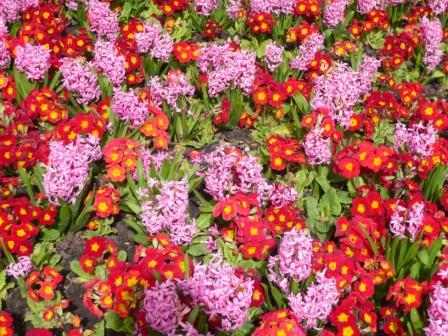
What is your favourite colour combination? 
Cerise, Shocking Pink scarlet and yellow seems a bit off colour to me.

colour-2

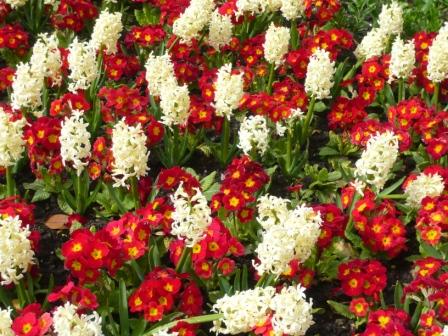
Your second choice includes a white Hyacinth perhaps Carnegie or Aiolos
A bit better at keeping the colour temperature in check.

colour-3

Which Parks Gardener thought up this combination?
My kids would call it yucky and I think that is polite.
Think about colour schemes when putting plant close to one another.
The stripped greens of newly mown grass have a lot to commend them.

…

Read More Read More

Dandelion a Martians Favourite

Dandelion a Martians Favourite

dandelion

What is wrong with the humble Dandelion and why do we take against it so? The flowers are prolific, uniform with good and vibrant colour. The seed heads look light and airy before the Dandelion Clock strikes and blows all the seeds to germinate where they will. The leaves are lance-shaped, so deeply toothed, they gave the plant its name in Old French – Dent-de-lion means lion’s tooth. So is it the profligate flowering, the ability to seed so freely the French Connection or some other prejudice.

Dandelion Wine

…

Read More Read More

Honesty Seedheads & Flowers

Honesty Seedheads & Flowers

everlasting-flower

Honesty also called Lunaria annua has beautiful purple flowers in April and May that are one of the few early nectar attractions for butterflies. In spite of it’s Latin name, Honesty is actually a biennial putting down a long tap root in it’s first year. This is why you seldom see it for sale in garden centres.

Gardeners Tips Growing Honesty

  • Honesty will also grow in shade and the seed heads make a great Autumn and Winter attraction as the coin shaped seed heads shed an outer skin and become luminous white moon shapes like tracing paper.
  • The growth is stiff and entirely self-supporting, a central stem branching out freely and bearing abundance of small flowers like Wallflowers.
  • Honesty should be massed with say a dozen plants in a group to give the best effect. The white variety is well worth growing, the colour being very pure and luminous in quality but purple is the main colour.
  • Honesty self sows quite freely and young seedlings can be transplanted with care being take of the tap root. Collect the seeds in October as the husks are shed but leave the papery head.
  • Seed heads can be cut, hung to dry in Autumn and used as dried flowers in floral arrangements. They look good with Christmas arrangements.
  • Most are anything but nondescript, and there are some strains with richly coloured flowers of a vibrant deep purple with a hint of magenta.
  • Lunaria annua is a biennial belonging to the brassica  family and will grow in most soil, if it looks unhappy try a bit of lime. When it is happy, which is most of the time since it generally chooses for itself where to live, it can develop into a robust, branching plant, 2ft tall and 1.5ft across.
  • Unfortunately it has no scent. Although a biennial, with each plant living only two years, when it is established it will go on forever, becoming a feature of the late spring garden. When left to its own devices it often turns up in unexpected places.
  • There is a perennial honesty Lunaria rediviva that is an exceptionally beautiful plant. It has a simple grace with yard-high stems clothed in similar fresh green heart-shaped leaves. Its cross-shaped flowers are pale lavender and sweetly scented.
  • Honesty develops thick storage roots, almost like tubers, and, in common with other brassicas, has deep tap roots.
  • Avoid overfeeding and do not use manure Honesty does best without pampering.

Read Honesty is the best policy

Lawns in Spring

Lawns in Spring

lawn

Tips for Sowing a new Lawn

  • Mid Spring is a good time to sow a new lawn. The soil is warming up and light showers should help germination.
  • If it is too dry you will need to water the seedlings with a fine spray – do not be tempted to drown the seed.
  • Select an appropriate seed mixture. They are available for a range of lawns from bowling green, prize lawn, back garden, shaded lawn etc.  Shake the box of seed as some mixtures settle and separate out.
  • Sow at the rate of 1-1.5 oz (35 gms) per square yard and eventually cut the grass to half an inch
  • Prepare the ground thoroughly, remove perennial weeds and stones. Compact and level then rake to a fine tilth, Sow when the top is dry but the ground is still holding moisture.
  • Measure out a square yard at a time and spread evenly then try maintain a similar density across the whole area sown. Cast seed horizontally and vertically to avoid patched.
  • Rake very gently once sown to cover the seed. If troubled by birds get a cat if trouble by cats get netting or string across the new area.
  • If just reseeding a patch scratch the bare area incorporate some multi-purpose compost and sow at half the quantity.

Seed Mixes

…

Read More Read More

Selfsown Forget-me-nots

Selfsown Forget-me-nots

white-forget-me-not

Some Mytosis (Forget me not) flowers are great self sowers. All the Forget me nots in my garden are self sown and have been for many years. I have white, pinky purple and the traditional blue varieties and they get all over. The white flower above has sown itsself between the external wall and pavement and it is just blooming now despite the attentions of a local dog.

  • I try to pull up as many as I can before they flower particularly if they are in the wrong place. Any plant in the wrong place can become a weed in my mind.
  • It is hard to pull up for erradication of Forget-me-nots when they have flowered as many will have already seeded before the flowers are over
  • The blue flowers can create a pleasing effect over a large area and after they are finished there is new space for summer half-hardy annuals.
  • Plants become straggly and spread as they age and it often a poor form of plant that is the most prolific self sower. Pull them up and compost them.
  • If you want Forget me nots not surprisingly you can grow them from seed or scrounge some plants from an over stocked garden.

See Growing Forget-me-nots seeds from Thompson & Morgan

Hydrangea Houseplants

Hydrangea Houseplants

pink-hydrangea

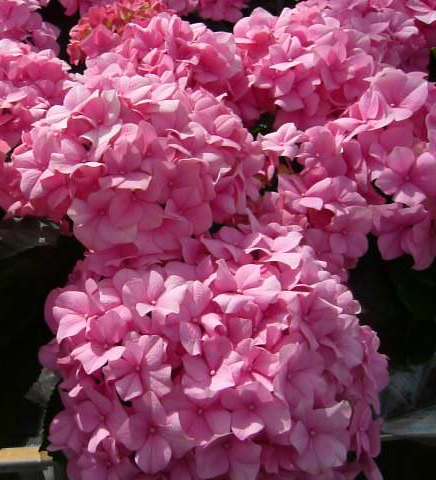
Hydrangeas make good houseplants flowering in spring from a shop bought plant. Hydrangea have been successfully grown as blooming house plants for many years. They are colourful full of flower and relatively trouble free if you give them a good drink of water regularly. Keep plants cool between 50-60 ° F when in flower but give them some good light.

Indoor Hydrangea Tips

  • Buy a new plant each year and plant the old one in the garden when it has finished flowering. It may not be hardy enough to survive but getting it to reflower indoors will mean you have to emulate the seasonal conditions it would expect in the wild.
  • To buy a good hydrangea for indoors look for a plant with just a few blooms showing color and lots of buds still developing. The plant should fill out the pot with healthy dark green leaves.

hydrangea-buds …

Read More Read More

Simple Gardening Tips for Spring

Simple Gardening Tips for Spring

Foliar Feeding

  • Plants can take up food through their green leaves and stems. Dilute liquid feed by twice the recommended volume of water to avoid burning the leaves. Spray a good quantity on to  the leaves later in the afternoon is more effective. Bulbs like Crocus and Daffodills benefit as they are building up reserves for next year. Stressed and weak plants will probably pick up after a foliar feed  but thick leaved plants are less receptive to feeding this way.

Frost Damage

  • Hardy shrubs that have had the leaves browned off by frost damage will recover all being well. My hydrangeas have been frosted despite leaving the old mopheads on for a bit of winter protection. I will trim the brown very lightly to avoid damage to the buds. Other shrubs can be trimmed back to the healthy shoots or leaves but if another heavy frost is likely I would leave the trimming job or protect with horticultural fleece. My Pieris japonica have been damaged but the new red leaves should still perform.
  • It is still too early to sow half-hardy annuals as even cold weather will kill them off. Hardy annuals should be acclimatised to cold and wind gradually. This gardeners call  ‘hardening off’ and is done by bringing plants into exposed areas during the day and moving them indoors or protecting them at night.

Staking and Supporting …

Read More Read More

Combinations of Plants

Combinations of Plants

plant-combinations

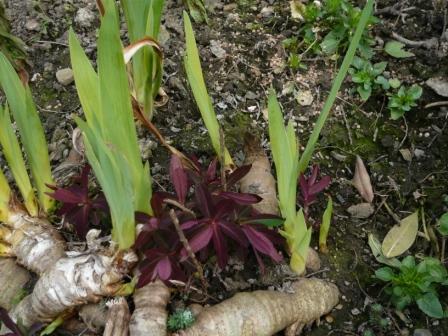
Some plants look right together because the gardener planned it that way. In my case happy accidents are often the cause of plant combinations that work well. In yet other gardens it is the growing conditions that are the over riding factor that create the overall effect.

The Flag Iris above are in the process of being colonised by the small Euphorbia which spreads rapidly by creeping roots. In spring I am happy that the red shoots contrast with the lime-green, sword shaped leaves of the Iris so I plan to leave them until the Iris flower. By then the dark blue flowers will not need a red leaved under planting so they may have to come out. These Iris also need to be split as the rhizomes are old and each piece only produces one stem. I will do this splitting a few weeks after flowering and plant pieces of root and throw away the old woody center.

…

Read More Read More