Browsed by
Author: hortoris

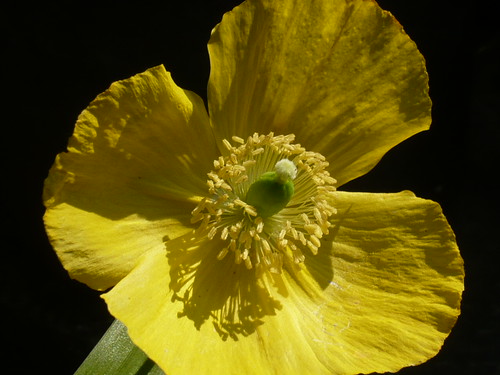
Icelandic Poppies

Icelandic Poppies

159

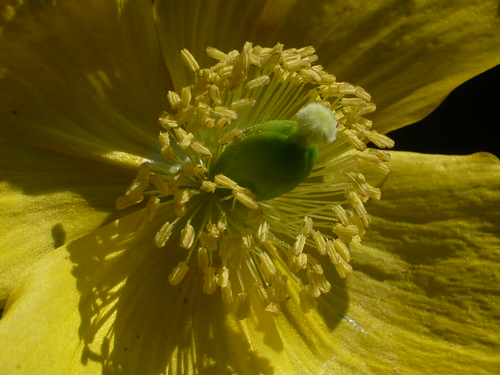
Icelandic Poppies are native of North America rather than Iceland. I am not aware of any exclusively native Iceland plants.

I find this poppy variety self sows very easily and the seed remains viable in the garden for several seasons.
The plants have a long tap root which may make them harder to transplant.
If the root gets broken when trying to dig out the plant a new one will probably grow in its place. Due to this and its profligate seeding I treat them like weeds.

poppy

Other Icelandic Poppy Images from Google
…

Read More Read More

Misleading Plant Labels

Misleading Plant Labels

Roses

What you see is not always what you get!

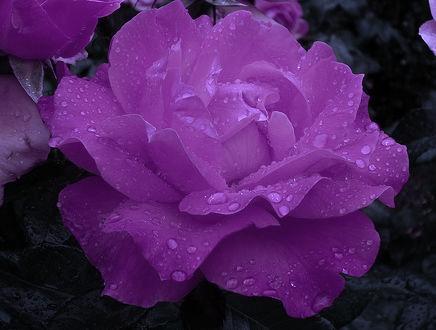
This is an original photograph but the rain drops may have been added by a water spray just before the picture was taken. Many garden photographers carry glycerin water around to enhance a subject prior to snapping away.

Plant Label Pictures

  • When it comes to plant labels be extra cynical.
  • The time of day affects the colour of the flower.
  • Filters can be used on the camera to modify the end image.
  • When ready to be reproduced the image can be changed with digital tools. You may have seen wedding photographs with the naughty uncle painted out or spots on some ones face touched up. Well that can and does happen to plant pictures that are designed to sell the flower.
  • Even at the printers the inks and machine settings used can change the picture on the label. What you see may not be what you get.
  • More radical changes can  be done or may be I have created the first true Blue Rose.


Blue, Mauve, Purple, I am not sure what colour this is. All I know is it will never grow in my garden or anywhere else short of laboratory experiments

Garden Clippings

Garden Clippings

As I search for sensible articles and reports on various garden subjects I collect a range on odd bits of information. Not knowing what is helpful I hope at least one of the following gardeners tip is of use but let’s see how we go.

Trendy flowers are fads waiting to be superceeded. Three years ago I highlighted the grass Calamagrostis x acutifolia Karl Foerster, Euphorbia cyparissias Fens Ruby, Dogwoods and Gillenia trifoliata. (They grow 6′, 3′, 4′, and 18″ respectively). Who grows them now?.

Organic items that have been slow to compost on my bin this year have been egg shells, avocado skins and stones, spiky top leaves of pineapples plus those green biodegradable plastic bags sold for indoor compost collecting. 12 months should have been long enough but have patience.

Clumps of Primroses and Primulas that have finished flowering can be lifted and divided by pulling apart good sized pieces that should already have rooted. Keep them moist and planted in some shade. If plants are too small to divide mulch them with organic matter to bulk up for next year.

Aubrietia should be sheared hard after they finish their display. A new cushion of foliage will help keep the plants growing for years without feed as Aubretia have no liking for rich soil. …

Read More Read More
The Edible Yellow Garden

The Edible Yellow Garden

They are not called Lemons and Oranges for nothing. As a project I have been considering creating a colour themed garden. The thought of being able to eat the yellow produce has led me to a series of plant discoveries and fresh ideas.

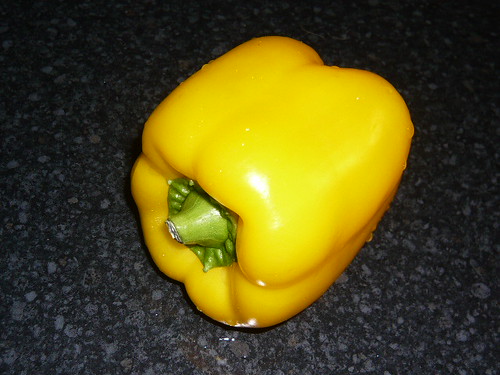
pepper

Vegetables In Yellow

  • Tomatoes would be my first choice as there are many yellow or gold varieties to select from. Yellow Debut F1, Gold Nugget and Lemon Boy are cherry toms. Banana Legs is descriptive of the long, pointed, yellow, determinate tomato good for slicing on salads. Larger Yellow tomatoes include Golden Sunrise, Yellow Perfection and Garden Peach.
  • Yellow beans are available as Sonesta or Hildora varieties.
  • Courgette Gold Rush is a reliable FI hybrid and Sunburst Scallop is a favourite squash. Butternut squash is closer to light  brown than yellow in colour.
  • Hot peppers like Hungarian Yellow Wax matures to red but Sweet peppers like Early Sunrise and Golden Bell start and stay bright yellow.
  • Swiss Chard has some powerful yellows but the seeds are often sold in mixed colour packets but look for Leaf Beet Bright Yellow.
  • Sweetcorn minipop is harvested before pollination so doesn’t need to be sown in blocks. Other sweetcorn is a top yellow vegetable.
  • Carrots and Onions with the name yellow in the title haven’t appealed to me but you may wish to consider them.

Yellow Edible Flowers

  • Several garden flowers are edible including nasturtiums, pansy and  daylilies. They are useful as they can decorate a mixedsalad
  • Shungiku is the edible chrysanthemum with yellow flowers.
  • …

    Read More Read More

Architectural Rheum not Just Rhubarb

Architectural Rheum not Just Rhubarb

rheum-flower

Ornamental Rhubarb

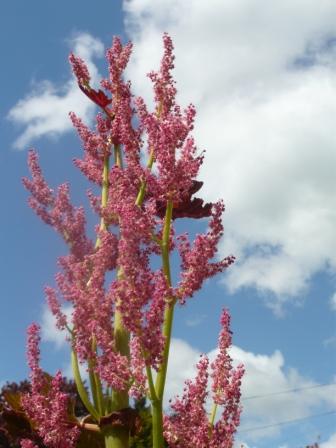
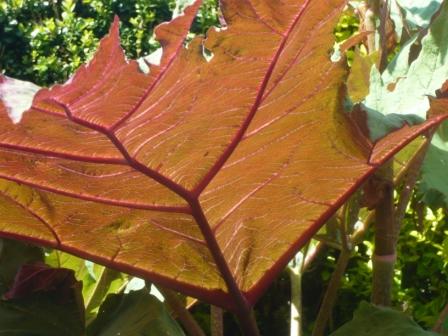
This sculptural plant has tall ‘frothy’ flower stalks pretty much like your Rhubarb when it runs to flower. Not surprising because Rhubarb is a variety of Rheum. Rheum palmatum ‘Atrosanguineum’ has very large leaves with a red underside and a rosey glow throughout the plant. They like plenty of humus in the soil.

Rheum Palmatum and Rheum Ace of Hearts are other herbaceous perennial varieties. Palmatum has large palm like dark green leaves that are purple-red beneath and creamy green to deep red flowers. It grows up to 7-8 feet and spreads 6 feet. Ace of Hearts has large heart shaped leaves.

This plant is grown on a steep slope so it can be viewed from underneath or above. The ground is moist most of the year so the rhizome is kept moist. As a herbaceous perennial it dies back in winter producing new spring leaves and early summer flowers.

rheum

…

Read More Read More

Pak Choy Choice Salad

Pak Choy Choice Salad

Pack your plot with Pak Choy
pak-choy

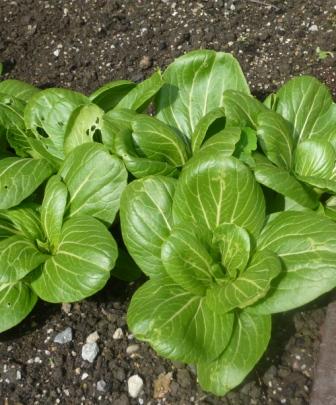
Pak Choy was one of the vegetables most in view at Chelsea last year. The regular shape and decorative leaves help create a formal structure to vegetable planting. There are also new varieties coming on the market including one with long stems (not bolting stems) that can be eaten as pick and come again vegetables.

Growing Tips for Pak Choy

  • Green Pak Choy, Bok Choy, Chinese Mustard, Celery Mustard, Mustard Cabbage and other recommendations below are available from Nickys seeds or Thompson Morgan (50% seed sale till June)
  • …

    Read More Read More

White Pink and Bluebells –

White Pink and Bluebells –

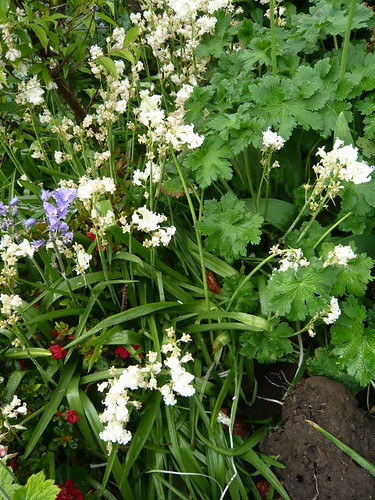
White Bluebells

Is it a contradiction to have white bluebells, a gardeners oxymoron?
It is very unusual to have British bluebells flowering in white but their Spanish cousins Hyacinthoides hispanica are prolific white flowers.

How Should Bluebells Be Planted

  • The bulbs can be planted in the green, that is whilst they still have leaves. Dried bulbs are available from September.
  • Observe how deep the bulbs were previously planted. The green leaves were above ground and the white below. So planting 5-6″ deep seems necessary. Some bulbs have roots that can pull the bulb deeper in to the ground and bluebells like to seek out moisture so are planted deeper.
  • Bluebells can be grown from seed, indeed they become rampant in fertile soil if allowed to self sow. The seed stays viable in the soil for several years so I would not let my bluebells self sow.
  • Hyacinthoides hispanica is of Spanish origin and should not be planted in the wild where it can dominate our native species Hyacinthoides non scripta.

White Bluebells

Observe Bluebells Close Up

  • If you study a bluebell it is easy to see how the bell name came into being.
  • You can also see the close resemblance to Hyacinth flowers to which they are closely related.
  • The leaves are smooth, shiny and slightly succulent usually linear or oblong in shape with a blunt tip.
  • Bulbs divide in the ground and even small bulbils can be replanted or left to increase the clump
  • Spanish Blue-bells are paler with larger blue flowers a more erect flower stem and broader leaves than our native species.

White Bluebells
White Bluebells running to seed.

Naming The Bluebell

  • Unfortunately names are seldom simple. The botanic name is now Scilla campanulata and you can buy bulbs under this name.
  • Previously they were classified as Endymion who was a mythical Greek. Endymion campanulatus, Endymion hispanicus, Endymion patulus, and Scilla hispanica have also been used.
  • Another common name ‘Wood Hyacinth’, seems to describe the plant and its preferred location.
  • There are now many hybrid ‘Bluebells’ with names that indicate the colour eg Mount Everest (white) and Azalea (pink).
Container Gardeners Tips

Container Gardeners Tips

container-gardening

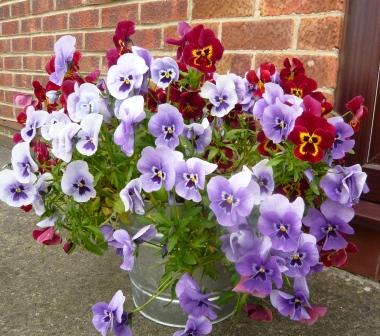
Silver champagne buckets or plain galvanised steel, there is a container for every purpose. These Pansies contrast with the brick wall and almost cover the container.

Gardeners Container Tips

  • Wether using a pot, tub, bowl, trough or urn make sure there is a drainage hole to allow rain and water to escape. Plants can drown far too easily.
  • Select the material for the container to complement the garden design and chosen plants. Stone, wood, plastic and metal containers are freely available.
  • For a conservation garden ‘found materials’ can be made into a container. A  hollowed out log, old barrel or any container coated in a slurry of concrete and yogurt or peat can look and do good.
  • You may plan to use a containers for one season or several years. Use compost that will suit the conditions eg John Innes no 3 for trees and shrubs or peat substitute for annuals.
  • Plan the planting to soften the edges of the container with plants spilling over. Do not leave a lot of soil showing as it will look sparse.
  • When planting from a pot use the current pot to make a suitable sized hole shape in the container so you can drop the plant straight in and firm it easily.

Alpine Strawberries

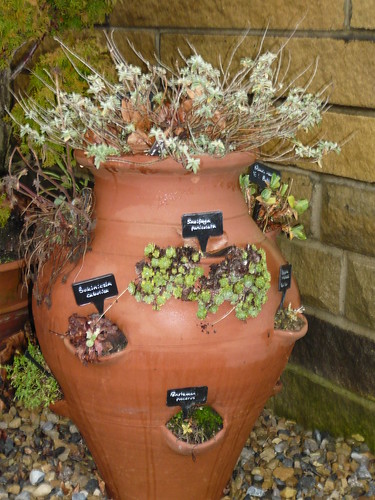
Outdoor containers made from terracotta or pottery need to be frost proof to avoid cracking. It is also advisable to lift them off the ground so they do not freeze to the path. A hard frost can see the base left behind when the pot is moved. To prevent this you can buy small pot feet, put the container up on bricks or stand it on some gravel or bubble wrap.

Winter Container Care Tips
Keep winter containers out of cold drying wind for the best results. Any shelter will be appreciated by plants that have to do battle with winter conditions.
Winter can often have dry spells so keep an eye on pots that may need some watering. This is also true of pots under roofs and eaves.
I like to use a woooden tub or half barrel and start by lining the container with a few bits of broken flowerpot or polystyrene for drainage.
Plant pre-grown bulbs before adding the other plants with trailing plants at the edge of the container. You can bury small pots in a larger container and change them as necessary.
Plants grow more slowly in winter so pack them in fairly close together to get a quick effect.
If you have special plants that do not like their crowns to get wet put a glass cover over the pot.

Tips for Good Lawns

Tips for Good Lawns

Lawns, particularly when the grass is newly cut, can provide the most evocative of garden scents. Lawns act as a natural soak a-way for rain and in so many ways are preferable to hard landscaping. Keep the geese off!

London  jan 13

Improve the look of your garden by cutting the grass and trimming the edges. A neatly mowed lawn sets off the rest of the garden.

  • In June you can lower your mowers  cutting blades if you wish but leave 1 inch of grass or it will looked scalped and get bare patches.
  • If you have too many daisies or weeds in the lawn it is OK to give it a ‘feed and weed’ treatment. I find it easier to use a liquid combo for this job but there are also several granular applications you could use. I also have a spot weeder for dandelions and one off weeds.
  • Do not worry if the lawn is dry and starting to go brown it will soon green up again after rain. It is a waste of time and effort to water the lawn except in the most extreme conditions when hosepipes will be banned anyway.
  • It isn’t too late to rake over the lawn scratching the surface to remove dead grass, moss and other debris.
  • On bare patches brush in some sand and lawn seed.
  • If edges are crumbling and damaged  cut out a length about 10 inches wide and turn it around so the damaged part is in the centre of the lawn and the new edge is crisp. water the new piece and it will knit back together.

Enjoy the grass on your lawn, walk barefooted or lay out to get a sun tan. Do not be a slave to your lawn or garden but enjoy.

Daffodils by Weight and Variety

Daffodils by Weight and Variety

Quantity and quality can be found from bulk, bulb suppliers. Plan out your needs early and get an order placed.

Daffodil selection

An update on my Daffodil purchases for flowering  next spring. Our local nursery has good connections with Holland and I guess that is where they source a large range of different varieties of bulbs. This range is then laid out in wicker baskets and sold by weight – £2.45 per kilo (well we are part of Europe and it probably illegal to sell in pounds and ounces!)

Reasons for Buying Loose Bulbs

  • This weekend I bought 5 varieties from about 35 that I could have chosen from. This is a wider range than you see in pre-packs.
  • I planned growing them for cut flowers and they are as cheap as a bunch of flowers you will buy in spring and the bulbs can be planted out to naturalise. A double win.
  • You have the fun of choosing select varieties and growing your own.
  • Picking bulbs from large baskets allows you to be selective about the bulbs you choose. No undersized, soft or rotting bulbs in my bags.
  • Spoilt for choice I decided to buy varieties that were 14 inches or so tall. The 18″ varieties will not do as well in our windy area and I needed some yard stick or I would have bought too many sorts.
  • The bulbs were in good condition, had nor been over handled or left to dry out. I could burrow down the basket to find bulbs I wanted.
  • I tried to get uniform bulbs. For many varieties I selected round bulbs with no offsets. Others I selected bulbs with 2 or 3 noses. Hopefully I will remember which and be able to assess the quality and quantity of flower so that next year I will buy on a more informed basis.

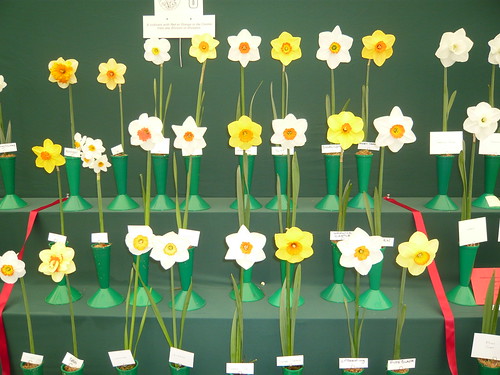
Daffodil Exhibition display

Varieties Purchased

  • Strictly narcissus the Dutch Master is a traditional Daffodil with golden-yellow flowers in mid-spring. My largest purchase.
  • Obdam should be fragrant and a later-flowering double daffodil. Its blooms are an eye-catching cream yellow.
  • Binkie is division 2 in Daffodil terms but not football. It will have bi-coloured petals of lemon and yellow with 1 or2 flowers per stem. They make excellent cut flowers I hope.
  • Verger is a Division 3 Small-cupped Daffodils. White petals (perianth) with an orange yellow shallow cup (one third of petal length).
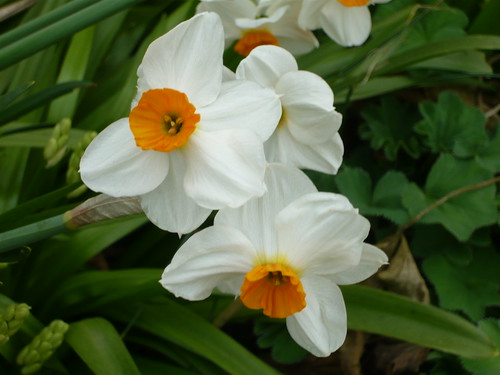
  • Geranium has a pure white perianth, with a bright orange cup. It is one of the multi headed Narcissus tazettas and I am interested to see how they perform as they are said to be excellent for pots so here is hoping.

For more information on the 14 divisions for Daffodils and details of the various parts of the flower from Perianth to Spathe read Gardeners Tips This page also contains the Top 12 Daffodil Tips from the Daffodil Society.