First Flowers of Spring

First Flowers of Spring

Spring sprung early this year and then lasted and lasted. Many are now faded and just a happy memory. Get your cameras in use to record what plants are where and how good they looked.
IMG_3667

You never tire of seeing the first snowdrops of the year.

IMG_3670

Winter aconites (Eranthis hyemalis) are also amongst the first spring bulbs giving a lovely dash of yellow.

IMG_3666

Both winter aconites and snowdrops do well in shady positions such as under trees. They are relatively low maintenance and once established can spread left to their own devices.

Read More Read More

Container Gardeners Tips

Container Gardeners Tips

container-gardening

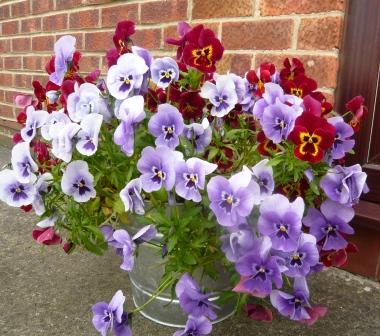
Silver champagne buckets or plain galvanised steel, there is a container for every purpose. These Pansies contrast with the brick wall and almost cover the container.

Gardeners Container Tips

  • Wether using a pot, tub, bowl, trough or urn make sure there is a drainage hole to allow rain and water to escape. Plants can drown far too easily.
  • Select the material for the container to complement the garden design and chosen plants. Stone, wood, plastic and metal containers are freely available.
  • For a conservation garden ‘found materials’ can be made into a container. A  hollowed out log, old barrel or any container coated in a slurry of concrete and yogurt or peat can look and do good.
  • You may plan to use a containers for one season or several years. Use compost that will suit the conditions eg John Innes no 3 for trees and shrubs or peat substitute for annuals.
  • Plan the planting to soften the edges of the container with plants spilling over. Do not leave a lot of soil showing as it will look sparse.
  • When planting from a pot use the current pot to make a suitable sized hole shape in the container so you can drop the plant straight in and firm it easily.

Alpine Strawberries

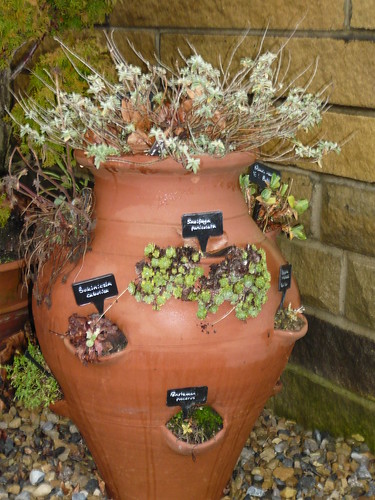
Outdoor containers made from terracotta or pottery need to be frost proof to avoid cracking. It is also advisable to lift them off the ground so they do not freeze to the path. A hard frost can see the base left behind when the pot is moved. To prevent this you can buy small pot feet, put the container up on bricks or stand it on some gravel or bubble wrap.

Winter Container Care Tips
Keep winter containers out of cold drying wind for the best results. Any shelter will be appreciated by plants that have to do battle with winter conditions.
Winter can often have dry spells so keep an eye on pots that may need some watering. This is also true of pots under roofs and eaves.
I like to use a woooden tub or half barrel and start by lining the container with a few bits of broken flowerpot or polystyrene for drainage.
Plant pre-grown bulbs before adding the other plants with trailing plants at the edge of the container. You can bury small pots in a larger container and change them as necessary.
Plants grow more slowly in winter so pack them in fairly close together to get a quick effect.
If you have special plants that do not like their crowns to get wet put a glass cover over the pot.

Tips for Good Lawns

Tips for Good Lawns

Lawns, particularly when the grass is newly cut, can provide the most evocative of garden scents. Lawns act as a natural soak a-way for rain and in so many ways are preferable to hard landscaping. Keep the geese off!

London  jan 13

Improve the look of your garden by cutting the grass and trimming the edges. A neatly mowed lawn sets off the rest of the garden.

  • In June you can lower your mowers  cutting blades if you wish but leave 1 inch of grass or it will looked scalped and get bare patches.
  • If you have too many daisies or weeds in the lawn it is OK to give it a ‘feed and weed’ treatment. I find it easier to use a liquid combo for this job but there are also several granular applications you could use. I also have a spot weeder for dandelions and one off weeds.
  • Do not worry if the lawn is dry and starting to go brown it will soon green up again after rain. It is a waste of time and effort to water the lawn except in the most extreme conditions when hosepipes will be banned anyway.
  • It isn’t too late to rake over the lawn scratching the surface to remove dead grass, moss and other debris.
  • On bare patches brush in some sand and lawn seed.
  • If edges are crumbling and damaged  cut out a length about 10 inches wide and turn it around so the damaged part is in the centre of the lawn and the new edge is crisp. water the new piece and it will knit back together.

Enjoy the grass on your lawn, walk barefooted or lay out to get a sun tan. Do not be a slave to your lawn or garden but enjoy.

Daffodils by Weight and Variety

Daffodils by Weight and Variety

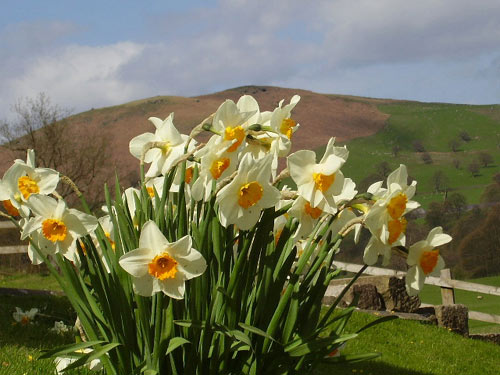
Quantity and quality can be found from bulk, bulb suppliers. Plan out your needs early and get an order placed.

Daffodil selection

An update on my Daffodil purchases for flowering  next spring. Our local nursery has good connections with Holland and I guess that is where they source a large range of different varieties of bulbs. This range is then laid out in wicker baskets and sold by weight – £2.45 per kilo (well we are part of Europe and it probably illegal to sell in pounds and ounces!)

Reasons for Buying Loose Bulbs

  • This weekend I bought 5 varieties from about 35 that I could have chosen from. This is a wider range than you see in pre-packs.
  • I planned growing them for cut flowers and they are as cheap as a bunch of flowers you will buy in spring and the bulbs can be planted out to naturalise. A double win.
  • You have the fun of choosing select varieties and growing your own.
  • Picking bulbs from large baskets allows you to be selective about the bulbs you choose. No undersized, soft or rotting bulbs in my bags.
  • Spoilt for choice I decided to buy varieties that were 14 inches or so tall. The 18″ varieties will not do as well in our windy area and I needed some yard stick or I would have bought too many sorts.
  • The bulbs were in good condition, had nor been over handled or left to dry out. I could burrow down the basket to find bulbs I wanted.
  • I tried to get uniform bulbs. For many varieties I selected round bulbs with no offsets. Others I selected bulbs with 2 or 3 noses. Hopefully I will remember which and be able to assess the quality and quantity of flower so that next year I will buy on a more informed basis.

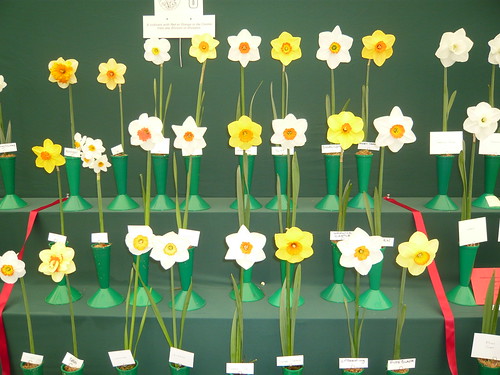
Daffodil Exhibition display

Varieties Purchased

  • Strictly narcissus the Dutch Master is a traditional Daffodil with golden-yellow flowers in mid-spring. My largest purchase.
  • Obdam should be fragrant and a later-flowering double daffodil. Its blooms are an eye-catching cream yellow.
  • Binkie is division 2 in Daffodil terms but not football. It will have bi-coloured petals of lemon and yellow with 1 or2 flowers per stem. They make excellent cut flowers I hope.
  • Verger is a Division 3 Small-cupped Daffodils. White petals (perianth) with an orange yellow shallow cup (one third of petal length).
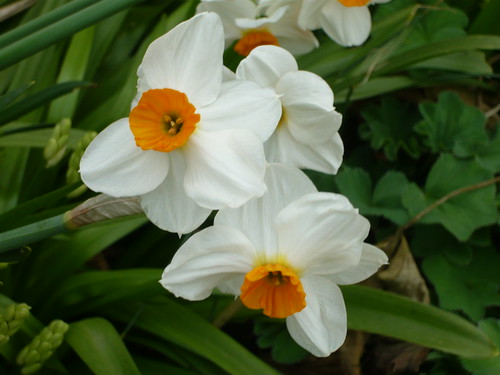
  • Geranium has a pure white perianth, with a bright orange cup. It is one of the multi headed Narcissus tazettas and I am interested to see how they perform as they are said to be excellent for pots so here is hoping.

For more information on the 14 divisions for Daffodils and details of the various parts of the flower from Perianth to Spathe read Gardeners Tips This page also contains the Top 12 Daffodil Tips from the Daffodil Society.


Dead Daffodil Deadheading and Splitting

Dead Daffodil Deadheading and Splitting

Lift and divide overgrown clumps of Narcissus. Replant at the same depth with the foliage intact or wait until autumn.

058

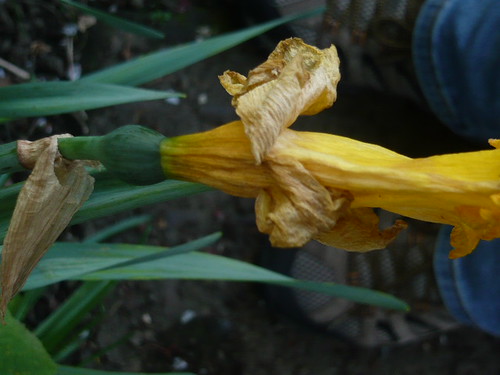
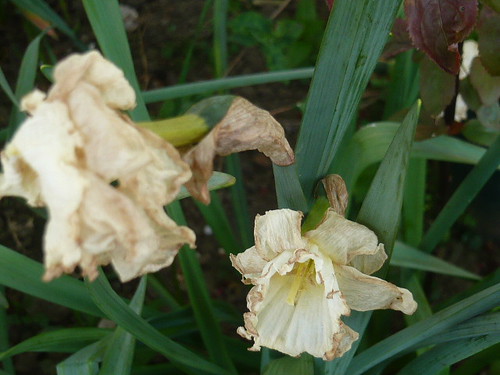
By now your Daffodils will have given good service in the garden and it is time for them to move on.

Dead Daffodil Tips

  • Deadhead Daffodils by cutting or pinching off the old flower and the seed capsule behind the flower. This redirects energy back into the bulb not the formation of seed.
  • Leave all the leaves on the plant. This allows photosynthesis to continue putting energy back into the bulb.
  • Spray or water the leaves with a foliar feed of weak fertilizer (about half normal strength).
  • Do not tie leaves, plat or tidy them with a rubber band.
  • When the leaves start to yellow 8 weeks or so, then it is safe to clear them.
  • If the Daffodils are in the grass you still need to leave them uncut.
  • Give the pruned deadheads a decent burial in the compost heap.

Other Daffodil Tips

  • Blind Daffodils are ones that haven’t flowered. This can be because they are too immature and need feeding up.
  • It may be that the bulbs have become too cramped and close together. These can be split and replanted but wait until the leaves have died back.  Splitting is best be done in September if you can remember where they are growing.
  • Planting your  daffodils in a large flower pot which is sunk into the ground. You can then lift the pot and put it out of the way to die back or wait for splitting at the end of each season.
  • Daffodils are Narcissus and all these comments apply to your narcissus bulbs.
  • Always pick plenty of Daffodils for the vase. This is just early deadheading.

059

Flower Arranging Dahlias

Flower Arranging Dahlias

cactus-dahlia

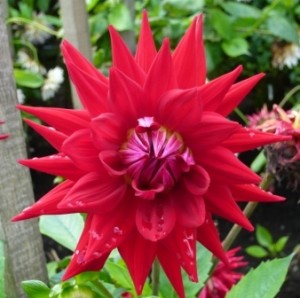
Not Dahlias again you may say but this is ‘The First Amongst Sequels’ or more photographs from my summer selection. Dahlias are a great cut flower for arranging and displaying and there is no better flower for continious cutting.

Dahlia Flower Arranging Tips

  • Pompom or decorative types are the best for flower arrangers as the large headed Dinner-plate types are so difficult to arrange.
  • Dahlias like a little sugar in the water and an aspirin discourages the formation of green algae
  • Put stems in a little boiling water and then give them a long drink.
  • Pick flowers when they have opened, tight buds will not give of their best.
  • One flower can be the focal point of an arrangement or table center-piece.
  • When planting select colours that you will want to pick for your house.
  • Pink flowered varieties such as Jerry Hoek or Delicious go well with mauve Asters and give a lift to a red arrangement.

Read More Read More

Dahlia History and the Blue Dahlias

Dahlia History and the Blue Dahlias

Wish List

Today’s hybridisers are still seeking the true blue Dahlia. We would also like one with a scent and if it was frost hardy that would be a triple bonus but then again it may not be a Dahlia at all. If you want to name a variety you have selected and grown yourself the National Dahlia Society publish the rules for naming and the register of existing names is maintained by the RHS.

Dahlias a History

The National Dahlia Society publish a history of the Dahlia from which the excerpts below have been taken

Read More Read More

Famous Celebrity Gardeners

Famous Celebrity Gardeners

Who features amongst your top famous Gardeners?  Percy Thrower‘   Geoff Hamilton or  Alan Titchmarsh are in the traditional mold along with Geoffrey Smith, Beth Chatto and perhaps Peter Seabrook although he is more a journalist as Alan Titchmarsh is a TV presenter.

The modern off-cumdens like Monty Don, Diarmuid Gavin and Charlie Dimmock seem to be all form over substance. An outsider in this modern category could be Adrian Fisher the designer of over 500 mazes and setting 6 Guinness world records. He has also designed over 40 hedge mazes, including those at Leeds Castle, Blenheim Palace and Scone Palace.

Gertrude Jekyll, Christopher Lloyd and Roy Strong inspired my father but then so did Adam the Gardener from the Sunday Express so whoever you put at the top of your list do not forget the true number one – you or your spouse.

‘Lloyd George knew my gardener’ engraving caption competition send in your own caption on the comments page.

I was a bit cruel to our Water gardener Charlie Dimmock so will promote one of her books ‘Enjoy your Garden’.
Book Cover

I have just read Royton Heath‘s tome on Collectors Alpines. A prolific alpine plantsman he has helped many rock and trough gadeners to understand the speciality of these small alpine forms. His books and broadcasting rates him amongst my list of celebrity gardeners of note.

A femail gardener that is easy to listen too is the earth Christine Walkden with her distinctive Lancashire accent.

Fronds Found in Yorkshire

Fronds Found in Yorkshire

yorkshire-december

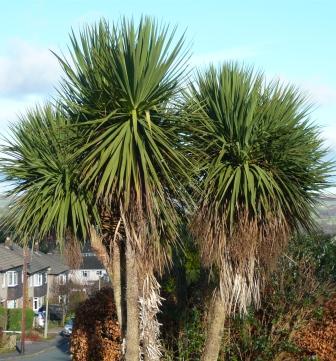
Is this Maderia or Yorkshire?  Are they Palm trees,  stonking great Yuccas or something else?
The houses in Menston, Yorkshire with the Wharfedale scene on the horizon gives the game away, it is not a photograph of exotic climes. This just shows what can be achieved in a another English garden. The copper beech hedge, still to show leaf colour, is more normal in these suburban gardens.

Whilst these tree specimen are now about 20 foot tall there are many tropical transplants that have been surviving in our gardens. After a mild winter with little snow or hard frosts it will be interesting to see what damage if any has been done. The worst I have noticed is the bent conifer branches due to snow, poor Camellias and the burnt edges of the young Choysia leaves.

At the moment I can’t do anything about it due to the snow covering that is keeping the tender plants under a blanket sheltered from artic winds.

Roll on late spring when the Yorkshire moors will be covered in heath, heather and ferns.

More Space for More Crops

More Space for More Crops

new-picture-2

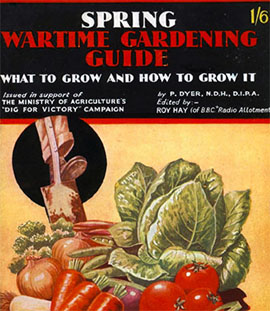
Gardening will help in the war against economic recession. These tips give you some ideas how to increase the area you cultivate and the number of crops you can grow even if your garden space is restricted.

More Growing Area for a Small Garden

Grow Bags and Containers

  • Grow bags can be stood on paths or waste land and can be used for many crops like onions, salads, tomatoes or courgettes.
  • Make your own grow bag, if they are too expensive, with ordinary soil in a plastic bag. To help water retention I have used those packets of silica they use to keep electrical products dry.
  • To get a deep grow bag I cut them in two and stand them on there ends for crops I want to cosset.
  • There are a wide range of baskets and boxes that can be fixed to a wall or fence to increase your growing area.
  • You can make a raised bed on hard standing. I have put 10 inches of soil over an old tarmac drive and it is fine for leafy crops.

Read More Read More