Browsed by
Category: Fruit, Vegetables & Herbs

Tips on growing good Fruit, Vegetables and Herbs

Growing Veg in The Greenhouse
Growing Veg in The Greenhouse

tomato

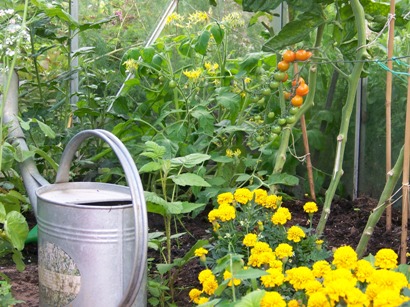
Tomatoes grown in greenhouse. Marigold to attract hoverfly – a prolific aphid eater.
The Greenhouse offers a much wider range of vegetables that you can grow. Because space will be limited make sure you make best use of the space to grow early / unusual vegetables you can’t grow outside.

Top Tips for Growing Veg in the Greenhouse.

1. Sow Early Vegetables.

There’s an added benefit from growing early vegetables which are not quite ready for the shops. By sowing indoors, and planting in a heated greenhouse, you can have an early crop of carrots, lettuce, and peas.

2. Soil Rotation.

If you are growing in the confines of a greenhouse, you need to make sure the soil is kept disease free. If you grow tomatoes directly in the soil it is worth digging out the soil and swapping with somewhere else in the garden which has had a different crop like legumes.

3. Cleanliness.

Read More Read More

Eating Nasturtium a Peppery Food Crop

Eating Nasturtium a Peppery Food Crop

Nasturtium

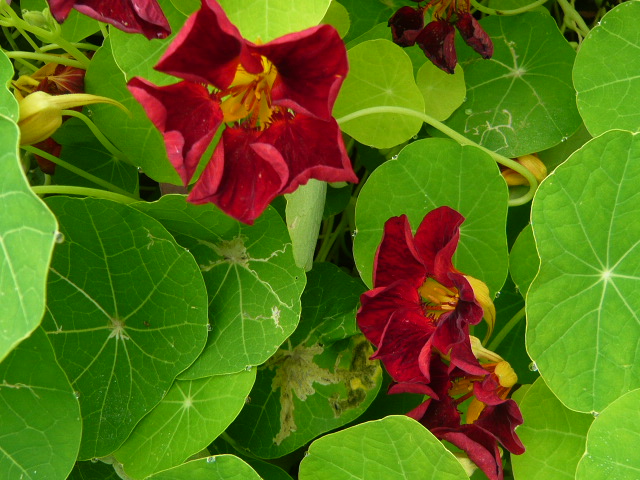
I think of Nasturtium as an ornamental, annual, flowering plant but my vegetarian children take a different view. For many vegetarians ‘Nasturtiums make a salad’. In the case of Watercress they also make a soup and a vegetable.

Growing Nasturtium Leaves, Flowers and Seed Pods

  • Grow Nasturtiums from seed in your vegetable patch.
  • Rich soil will encourage leaves at the expense of flowers. Nasturtiums grown for decoration need a poor soil.
  • Nasturtium seeds from Thompson & Morgan
  • Before planting Nasturtiums in containers make sure they are well rooted in smaller pots started under cover.
  • Watercress Nasturtium Microphyllum or Nasturtium Officionale are best grown from rooted cuttings. Rooting in water is relatively easy.

Salad: Watercress, spinach and apple.

Eating Nasturtium Leaves and Pods

  • The leaves of the nasturtium plant are edible, with a peppery flavour. They can be tossed into salads mixed with sweeter varieties of lettuce.
  • The flowers make a unique garnish to fresh foods and add a splash of colour.
  • The seed pods can be treated like Capers and pickled or used as a crunchy addition to salads.
  • For tastiest nasturtium leaves, keep the plants well watered, which helps to moderate the spiciness of the leaves and flowers. Keep a bit drier to add a sharper tangy flavour to your summer salads

nasturtiums

Growing Watercress Nasturtium Officinale

  • Watercress is called Nasturtium Officinale or Nasturtium Microphyllum
  • Watercress is traditionally grown in gardens with chalk streams or a good supply of water as a semi-aquatic plant
  • Buy watercress with roots on at your local supermarket
  • An ordinary bunch placed in a bowl of fresh clean water will develop roots. Discard any that turn yellow or do not root and plant the rest.
  • You can grow watercress in a container but keep it exceptionally well watered.

chicken watercress salad

Tip
Growing Nasturtiums near Brassicas can deflect greenfly and white fly on to the nasturtiums to protect your other crops.
Pickling the seed pods of Nasturtium produces a crop similar to Capers.

Nasturtium-FowlersVacola-Num10-9108

Credits
Nasturtium by Dvortygirl CC BY-SA 2.0
Salad: Watercress, spinach and apple. by ulterior epicure CC BY-NC-ND 2.0
nasturtiums by artolog CC BY-NC 2.0
chicken watercress salad by aquino.paolo CC BY-NC-ND 2.0
Nasturtium-FowlersVacola-Num10-9108 by graibeard CC BY-SA 2.0 Pickled Nasturtium seeds look like and taste similar to capers.
Nasturtiums by robynejay CC BY-SA 2.0

Nasturtiums

Top 10 Garlic Varieties

Top 10 Garlic Varieties

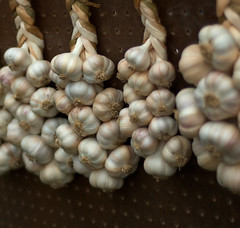
Garlic is increasing in popularity in the UK and a wide selection of varieties are now available. They grow well under glass or poly tunnel but also produce worthwhile crops in most sunny gardens and allotments.

Top Ten Varieties for the UK

    1. Solent Wight – a heavy cropper with large cloves
    2. Albigensian Wight – spring or autumn planting good keeper
    3. Purple Wight a ‘hard neck’ best used fresh as it is a poor storer
    4. Long Keeper large white bulbs to harvest in July from autumn planting.
    5. Early Wight another ‘hard neck variety’ with AGM in purple variety

Planting Garlic

  1. Luatrec Wight fat pink cloves with white outer skin and a good keeper.
  2. White Pearl autumn planted will store reasonalble well.
  3. Pink Lady a pink skinned bulbs and gloves that can be eaten raw.
  4. Germidore softneck variety that is well adapted to British conditions. Produces large, white bulbs with a mild but rich flavour.
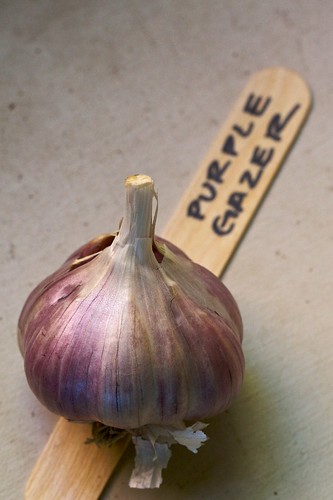
  5. Chesnok Red a hardneck variety from Georgia with attractive purple striping and a lovely, full-bodied flavour. Lovely choice for baking as it has a lovely creamy texture. Great for garlic bread!

Garlic
Elephant Garlic would be in many best top ten lists but is closely related to the Leek side of the allium family   see Gardeners tips

To buy a selection of Garlic at Thompson & Morgan

Credits
Planting Garlic by Chiot’s Run CC BY-NC 2.0
Garlic by mrwalker CC BY-NC-SA 2.0

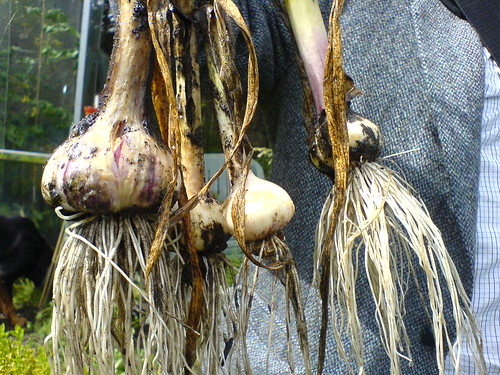
‘It’s that time of the year to plant garlic. I’ve read that you should plant it around fall equinox, which I missed by about a month. I received my planting garlic the day before we left on vacation and just planted it on Sunday. I ordered 2 garlic samplers from Gourmet Garlic Gardens again this year. Each year I’ve grown garlic, I’ve tried a few different method for planting. I’m hoping this year I’ll finally be able to grow nice big heads of garlic. Mine usually end up being small, but they’re still quite tasty. I chose a free-draining area of the front garden and amended the soil heavily with compost.

For specific varieties planted and planting directions from another site visit:  chiotsrun.com/2010/10/28/planting-garlic/’

For more information  read Tricks to get great garlic


Growing Fennel for Home Cooking

Growing Fennel for Home Cooking

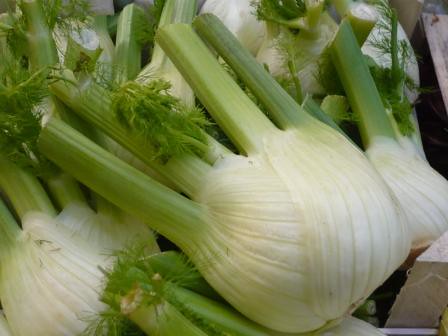
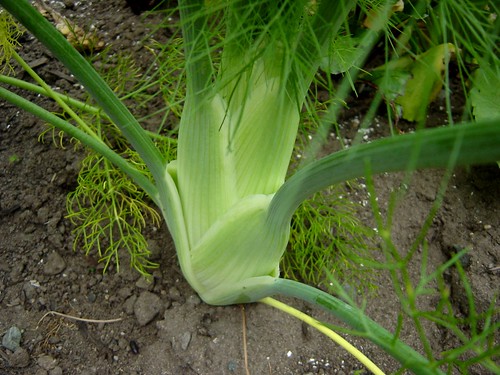
Fennel

Fennel is a fine herb and aniseedy tasting vegetable that you can grow and cook at home from a simple packet of seeds. You can eat the bulb, leaves and stems fresh then save the seeds to eat in dried form.

Growing Varieties of Fennel

  • Sow seeds April to July. Prepare the ground well and rake to a fine tilth before sowing. Sow outdoors where they are to grow, ½in deep in rows 15in apart.
  • When large enough to handle thin out to 9in apart.
  • Prefers a well drained soil in full sun and should not be allowed to dry out. The bulbs of Florence Fennel should be watered well in dry weather.
  • Soil needs to be drawn around the bottom of the bulbs when it reaches the size of a golf ball. After it has reached this size it should more than double in size over the next 2-3 weeks this is when it is ready to harvest.
  • The hardy perennial Fennel Victoria F1 Hybrid Seeds
    available from Thompson & Morgan produce bulbs that can be harvested July to October.
  • Outstanding yields of large, smooth and pure white bulbs with an enticing and traditional aniseed flavour. Fennel Victoria is a newly bred form which has neat foliage and improved resistance to bolting.
  • Foeniculum vulgare is the normal green form with Foeniculum ‘Purpureum’ a bronze-leaved” fennel that is grown as a decorative garden plant.

Fennel

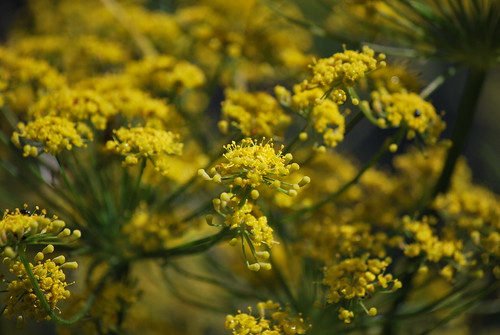
Fennel Herb ‘Foeniculum vulgare’  seeds from Thompson & Morgan produce fine foliage useful for cooking purposes and the flowers are yellow. It can be prone to bolting after seeds are transplanted.

Cooking Home Grown Fennel

Use the frondy leaves to flavour delicate dishes
‘Fennel is delicious, with a sweet and delicate aniseed flavour. Use in salads and with fish to counteract oiliness.
Beauty: An infusion of Fennel used as a compress is excellent for softening rough chapped hands. Pour hot water over the leaves and stems for a cleansing facial steam bath.
Nature’s Remedy: Reputed use for many ailments, particularly regularising painful and abnormal menstrual periods. It has long been recommended to combat obesity and aid slimming, as an eyewash for sore eyes and as a gentle laxative. Steep 1 tablespoonful of freshly crushed seeds in 1 cup of water for 5 minutes. Sweeten with honey to taste.’

Fennel (Foeniculum vulgare)
Credits
Fennel by Satrina0, CC BY-NC-ND 2.0
Fennel (Foeniculum vulgare) by epicnom CC BY-NC 2.0 ‘Beautiful herb, long used and appreciated for it’s many medicinal uses. It has also been used as a flavouring for many things, including toothpaste. Fennel tea, made from the seeds, is very good for mild digestive problems and can be helpful for menopausal symptoms.It is lovely to grow, as it attracts hoverflies and bees.’

Growing Garden Peas

Growing Garden Peas

peas

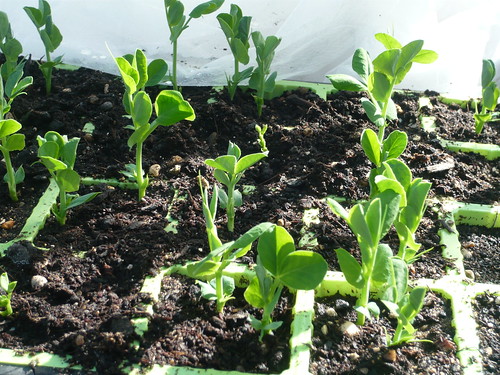
This photo shows some young pea plants ready to grow up some pea sticks.

Garden peas can be one of the most rewarding vegetables to grow because their taste, fresh from the garden, is really something. They also give a good cropping ratio for the amount of land used and so are good for small gardens. Also grown up pea sticks like this they make an attractive vegetable – so could even be grown in your front garden! Modern chefs are keen to use the tender pea shoots with all the pea flavour but none of the starch. I still prefer the mushy peas but it is an acquired northern taste.

As a final bonus, the legume family tend to help put nitrogen back into the soil so are great in crop rotation  before heavy nitrogen users like Green vegetables.
Pea plants
In the early days of sowing they will need protection from frost and slugs. Their leave are tender and so need careful hardening off or covering with fleece during their early days. Also if you are not careful an army of slugs and snails can decimate your crop overnight. See: Methods to reduce slugs

Peas do need supporting, otherwise they will flop over where the crop will be lower and more liable to be eaten by slugs. These pea sticks make an attractive and functional natural support. You can buy them or look for suitable twigs from your own trees. It is good to put them in early and if necessary make a tie to get them started. But, generally, the pea tendrils will find the stick for support.

If you sow indoors during March, they will be ready for planting out late April and this will give a good crop around July. They are quite quick growing so you can stagger sowing by 3 weeks to give you a longer cropping season.

Related

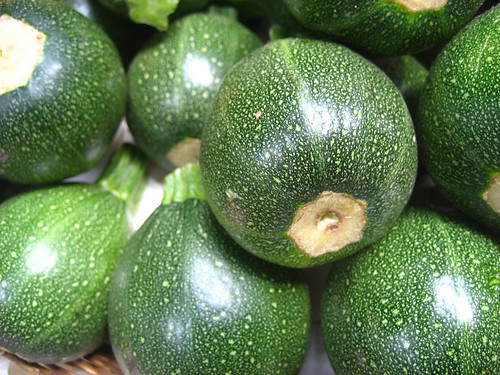
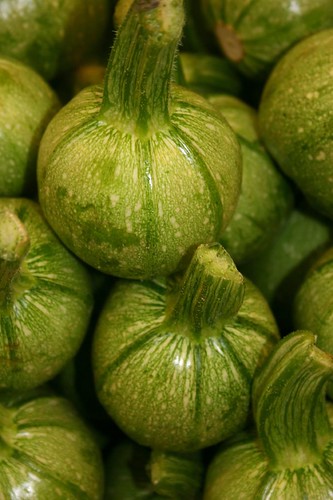
Top Ten Round Courgette Varieties

Top Ten Round Courgette Varieties

If you are getting round to ordering your new vegetable seeds try a round courgette and have a ball
Round courgettes

Curcurbita pepo may have been cultivated for upwards of 5,000 years but I bet they have not always been called Courgettes. We already call them Courgettes, Zucchini, Squash or Marrows.
Below are some of the named varieties of round or ball shaped courgettes now available in the UK and elsewhere.

Top Ten Round or Ball Shaped Courgettes

  1. De Nice a Fruit Rondo – pick from golf ball size upwards.
  2. Tondo Chiaro di Nizza
  3. Florido a yellow fruit
  4. Summer Ball
  5. One Ball another yellow round variety, grow with Eightball.
  6. Tondo di Piacenza a dark green italian variety
  7. Brice a light green skinned ball shaped courgette
  8. Eight Ball is a snooker ball sized courgette OK as a marrow
  9. Zucca Marina sweet skin, yellow flesh and upto 20lbs in weight.
  10. Tricolour F1 hybrid round Courgettes available from Thompson & Morgan

Round Zucchini / Courgette / kishu'im / קשואים

Other sources Marrows – Watering, Pollinating and Harvesting
Seed suppliers list

Top photo Attribution 2.0 Generic (CC BY 2.0) by adactio.
Second Attribution-NonCommercial-NoDerivs 2.0 Generic (CC BY-NC-ND 2.0) by marcusfrieze

Growing Sprouting Seeds for Salads and Stir Fry

Growing Sprouting Seeds for Salads and Stir Fry

Seeds that have germinated and grown roots (radicles) and sprouts (plumules) can add flavour and texture to your meals. They do not take up space in your garden and can be grown all year round.

Bean sprouts in Chinese restaurants are crispy additions to the flavours and textures of your meal. The trick to growing long crisp sprouts is to grow them under pressure. In a dark, free draining container put a half inch layer of bean seeds, cover with a damp cloth and put a one pound weight on top. Rinse daily under a tap and 4-5 days later they will be ready to eat.

Open sprouting can be done like our childhood mustard and cress on a foam base covered with layers of paper towels or on moist cotton wool. Cover with tin foil to exclude the light and germinate in a warm spot.  Method 2 Put some seeds in the bottom of ajar and cover with water to soak for twelve hours. The seeds will expand a lot as they grow. Half to one inch (1cm – 2cm) of dried seeds will usually fill a jar. It varies between seeds – radish expand more than sunflowers.
After twelve hours rinse the seeds in room temperature water then drain the water leaving seeds damp. Repeat every 12 hours for 3-4 days until ready to eat.

There is a wide variety of seeds that can be eaten as sprouts or seedlings but do not eat legumes to excess. Legumes, particularly  Broad beans and French beans are  slightly toxic. Corriander, Leeks and Onions can be eaten as seedlings. Cereals are only eaten as very small sprouts. All Brassicas can be eaten as seedlings.  Buy from health food shops or specialist suppliers and keep seed cool and dry until ready to use. Below is a table of some suitable plants for sprouting.

Common Name Days to Sprout Length when edible
Lima beans 3-5 12-25 mm
Mung Beans 3-5 12- 75 mm
Fenugreek 3-5 12-50 mm
Lentil 2-4 6-20 mm
Alfalfa 1-4 very tiny
Clover 2-5 very tiny
Buckwheat 3-5 tiny
Radish 2-4 12-25 mm
Barley & Rye 3-5 very tiny
Sunflower 1-3 12-38 mm
Sweet Corn 1-3 6-12 mm


Top 10 Vegetable Seed Suppliers

Top 10 Vegetable Seed Suppliers

Last year we reviewed seed companies for general seed supply and offered a deal with Unwins. Now we have an arrangement with Thompson Morgan which has just been rated by the Daily Telegraph as having the best overall range from a review of 8 seed catalogues. They have many unusual veg varieties and are good on potatoes and salad leaf mixes. This review is of Vegetable and Herb seed suppliers.

Edwin Tucker & Sons did not feature in our general seed review and scored highly with the Daily Telegraph. ‘very wide range, best for oriental vegetables with clear informative catalogue. Good value for money’.

Suttons good for beginners but the range is sadly getting smaller and smaller.

D T Brown are good value for money with a range that ‘is dependable in harsh climates’.

Chiltern Seeds emphasises heirloom varieties and has good selection of oriental veg. I like the quirky catalogue descriptions and buy some products from them.

Simpson’s Seeds seem to specialise in tomato and chillies seed with umpteen varieties on offer. Good for selling young vegetable plants.

Organic Gardening Catalogue has many unusual varieties of vegetables and herbs but a limited range.

Wallis Seeds remains one of our favourites with 32 pages of densly packed listings of all traditional veg and a few surprises. They supplied me quite a lot of seed this season.

The RHS have a members distribution scheme but only a small number of veg and herbs are offered. It would be an opportunity to increase the cultivation of heritage varieties if they could source adequate stock.

Seeds to Grow Next Year

Seeds to Grow Next Year

Book Cover
This list of seeds is just a short selection of those I may grow this summer  January is a good time to read seed catalogues

Flowers

Alyssum Carpet of Snow the dwarf spreading variety that grows 8cm high . I bought by weight to get a quantity that will fill parts of the garden with that strong floral fragrance in late summer.

Alyssum Royal Carpet a deep violet I have not tried before – just a packet for fun.

Antirrhinum Tall Cut flowering to about 2 feet tall and useful for cutting. My first choice La Bella F1 were sold out so I will try again next year.

Aquilegia Alans Delight bought to give to a friend called Alan who admired my Aquilegia and has just started an allotment

Gaillardia New Giant Hybrids a two foot tall mix of this desirable perennial.

Helenium Helena a perennial to flower in the first season, bought for cut flowers

Vegetables

Courgette Green Bush for cutting when small a family favourite amongst the vegetarians

Courgette Tuscany F1 as it is resistant to mildew and I am worried about another damp summer

Parsnip Improved Marrow from an organic collection of canker resistant strain

Broad Bean Witkiem Manita for early beans to be sown in February

Broad Bean Masterpiece Long Pod as a contrast to the other beans

Growing Micro-Leaves

Growing Micro-Leaves

You have tried ‘Sprouting Seeds’ now try their slightly older cousins the micro leaves.

Healthy eating will be helped by using your garden, greenhouse and even window box to grow micro leaves.
Micro leaves are just leaves of very young plants that you would probably eat as full grown vegetables or salad crops. The key is to pick and eat them whilst they are young tender and full of vitamins.

What Are Micro Leaves

  • Micro Leaves are salads and vegetables harvested at a very young and tender stage.
  • Usually cropped at cotyledon or first true leaf stage.
  • Think Mustard and Cress from your childhood.
  • But expect stunning colours and intense flavour.
  • Eating all the pent-up energy contained within the seed makes a health flavoursome addition to salads or sandwiches.
  • Used and eaten whole, they take almost no preparation with very little waste.
  • Generally eaten 7-15 days after sowing, but before they take on additional nutrient this fresh crop is simple to grow.
  • Sow on an inert, moisture retentive substance and bring into full light when seeds have germinated.

Seed Selection to Try as Micro-leaves

Read More Read More