Browsed by
Category: Flowers and Plants

Annual, perennial and interesting flowers with advice on culture, information, tips and recommended varieties

Veg as Cheap as Chips

Veg as Cheap as Chips

Book Cover

The last of my root vegetables and Leeks are now consumed and a distant gastronomic memory. New baby salad leaves have been available but I do not take enough care to be able to binge on them until later in the season. Rhubarb once again is prolific and abundant so that I and the neighbours are enjoying the fruit of my labours literally.

The early potatoes that I tried in the cold greenhouse are full of growth, above the soil at least, so I look forward to my own new spuds fairly shortly. The majority of the Earlies or Second earlies have been grown in pots or tubs rather than the ground and I am interested to see how they crop. I have heard good reports of growing Carrots in large pots to avoid pests and get long straight roots but I have just put my new seed in a new bed so that idea will have to wait for next year.

My Tomato plants are starting to go out into the greenhouse now they are six inches high but I need to watch for frost with my fleece at the ready. If you want more information on Vegetable Growing month by month the book will cost less than a fiver from Amazon.

Linden Tree Common Lime -Root and Branch

Linden Tree Common Lime -Root and Branch

linden tree blossoms
The Lime is a tall growing well shaped tree which is often grown along avenues and public places in the UK. The flowers have an exquisite fragrance.

Key Features of the Common Lime

  • Latin name – Tilia Europaea, other common names Linden tree or Basswood
  • Height – Can grow over 150 feet tall one of the UK’s tallest trees
  • Type of tree – deciduous – dictoyledons
  • Leaves – Thin, green and heart shaped with a tapering tip and fine teeth. Lighter green underneath
  • Flowers – Highly scented pale yellow-green with green bracts at the base. Flower in clusters
  • Fruit – Woody round drupe covered with grey-brown hairs dispersed on the wind by wings.
  • Bark – Grey with shallow fissures when mature
  • Family -Tiliaceae

Origins and Distribution of the Common Lime

  • The tree is widely cultivated throughout Europe.
  • Linden trees are now popular in North America.

Read More Read More

Horse Chestnut – Root and Branch Review

Horse Chestnut – Root and Branch Review

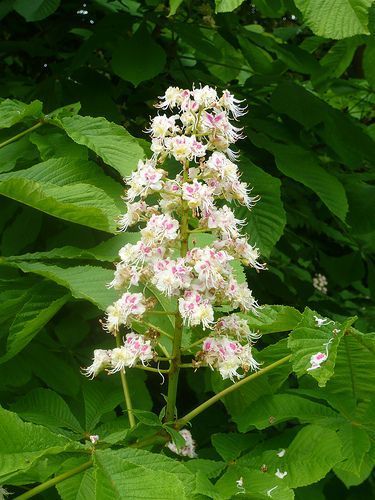
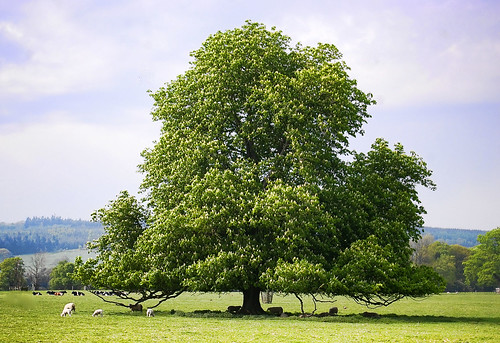
Horse Chestnut tree

Conker collecting has encouraged many a stick to be thrown into a Horse Chestnut tree. The candle or flower heads are even more spectacular than the crop of conkers that they give birth too.

Key Features of the Horse Chestnut

  • Latin name Aesculus Hippocastanum buckeye in USA or Conker tree
  • Height up to 130 feet
  • Type of tree – deciduous –
  • Leaves – Large green palmate with 5-7 fingers or leaflets
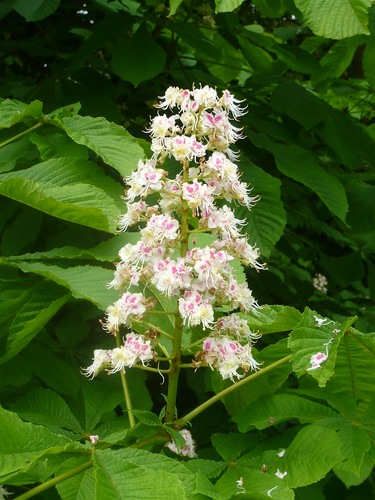
  • Flowers White or pink candle shaped upright panicles
  • Fruit Green spiky spherical husks containing a glossy brown inedible seed or conker
  • Bark Dark brown, coarse and scaly when mature
  • Family Aesculus has about 20 species

Conkers

Origins and Distribution of the Horse Chestnut

  • Native to the Balkans.
  • Planted in temperate zones as an ornamental specimen.

Uses and Attributes of the Horse Chestnut

  • Distilled the conkers make acetone.
  • The seed extracts were used for fulling cloth and whitening hemp, flax, silk and wool.
  • Herbally used to treat varicose veins and haemorrhoids.

Gardeners Tips for the Horse Chestnut

  • Used along avenues, parks and in churchyards.
  • Horse Chestnuts can make large bonsai.

candles in the wind

Other types of Horse Chestnut and key species

  • Texas, californian and other american buckeye or Aesculus species.
  • Aesculus × carnea the red horse chestnut.

Horse Chestnut comments from elsewhere

In Britain, the return to school after the summer holidays is synonymous with conkers. Originally played with cobnuts or snail shells, the use of the horse chestnut in the popular children’s game was first recorded in 1848. Since 1965, the World Conker Championships have taken place every year in Oundle, Northamptonshire. Kew.org

The fruits of this tree vaguely resemble those of the (Sweet) Chestnut tree but they are not related. They develop in prickly cases, and are ripe in September and October – the ‘conker’ season.

Read about our series on British tree reviews with a bakers dozen fact sheets

Credits
“Horse Chestnut tree by JeanM1 CC BY-NC-ND 2.0
“Conkers by MamaPyjama CC BY 2.0

Growing Cannas – Facts and Fancy

Growing Cannas – Facts and Fancy

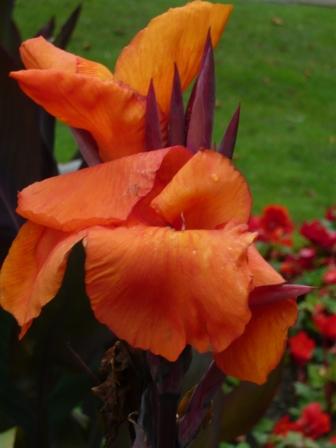
You don’t need global warming to get a warm glow in your garden if you plant some Canna. The fiery hot flowers and leaves on some Cannas are hard to beat and are worth a place in any passionate garden.

What other plant starts flowering in June and keeps flowering right through until the first frosts. Do not deadhead the flowers at any price as new blooms arise from the center of old ones. They flower in shades of red, orange, pink and yellow often bi-coloured with blotches, spots and streaks. The foliage is also a most attractive feature, and can be shades of purple/bronze, red, green and striped.

Growing Canna

  • Rhizomes have to be started into growth in February and you can be certain that if you see a new root, then a new shoot will soon follow. Start them by putting them in a hot place in a poly bag. An airing cupboard is ideal.
  • Part fill a 2 liter pot with peat based compost improved with slow release fertilizer and insecticide and lay the rhizome on the compost. If any shoots are growing, place these pointing upwards. Be very careful with any shoots because they break off very easily.
  • Fill the pot, affix a label showing the variety and the date of planting. Give the compost a good drenching, and sprinkle a few slug pellets around.
  • Place the pot in a warm frost free place. They will grow much quicker if heat is provided.
  • They can be planted out in June in sun, shade or preferably semi-shade.
  • Cannas prefer a damp soil but can survive some drought conditions. Some varieties grow well in bog gardens.
  • Large clumps can be divided in Autumn when the rizomes are stored in a frost free environment. Keep slightly damp.
  • Canna are very strong and sturdy and do not require staking. They are generally insect free in the UK.

Read More Read More

Growing African and French Marigolds

Growing African and French Marigolds

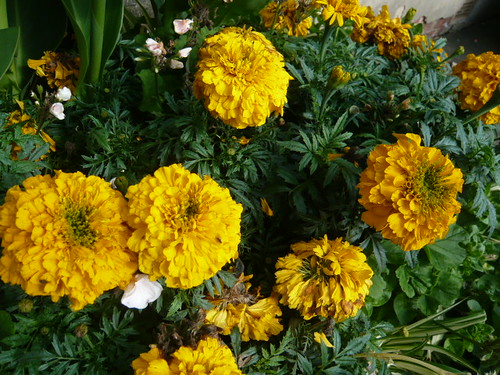
african marigolds

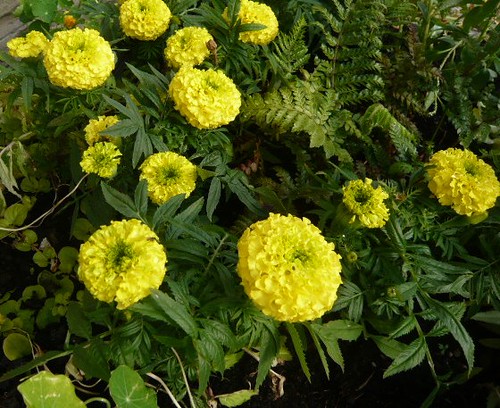
A favorite annual is the Marigold or Tagetes. Bold colours in Yellows, Oranges, Lemons Reds and Creams are a feature of these plants that flower from July to the first frost. Despite the names they all originate from Mexico.

Description of Marigolds

  • Members of the Tagetes family are half hardy annuals that flower profusely from July until September.
  • African Marigold is the taller type 10″ high with flower heads up to 3″ across.
  • French Marigold is a compact, bushier plant suitable for edging to flower beds and paths.
  • Flowers are generally doubles coloured golden, orange, yellow, and white often with maroon highlights.
  • Rounded discs or large florets display vibrant colours on thin deeply cut unassuming leaves.
  • The leaves have a distinct scent that deters some insects.

Cultivation Tips for Marigolds

  • Easily grown from seed these plants flower quickly and can be sown in situ
  • Cover seed with 1/4 inch of soil and provide an average soil warmth of 24°C if grown in a greenhouse.
  • Plant African types 12 inches apart and French types 6-8 inches apart.
  • Deadhead particularly the African types.
  • Can be bought as plug plants in summer.
  • Slugs and snails seem to love nibbling the foliage and can soon denude a plant

african marigolds

Varieties, Species and Types of Marigold

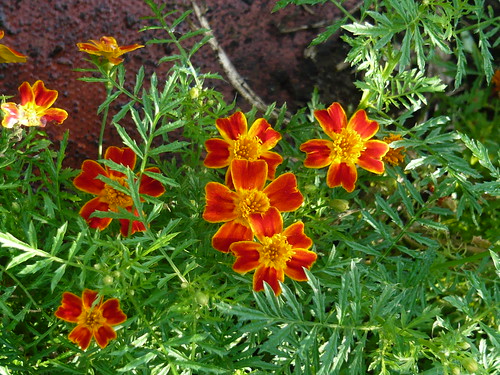
  • Tagetes erecta – African Marigold. Tagetes patula – French Marigold. Tagetes tenuifolia – Marigold gems
  • ‘Honeycomb’ and ‘Safari Tangerine’ have the award of garden merit AGM
  • Marigold ‘Striped Marvel’Tagetes patula has yellow and maroon stripes
  • Pot marigolds or Calendula and Marsh marigolds are a different species
  • Tagetes are the smaller often single flowers. More than 150 years old and still going strong, the heirloom variety of French Marigold Single Legion of Honour fits this description

Tagetes

Horticulture Sources and Advice on Marigolds

  • You can often obtain seeds or plants from our mail order company of choice Thompson & Morgan
  • Easily grown from seed these plants flower quickly and can be sown in situ
  • The ‘French’ varieties tend to be smaller flowers in clusters on bushy plants
  • Africans are larger and showy
  • Some African varieties can grow up to 5 feet tall but have fewer poorer flowers. The finely cut leaves are still attractive. For a medium to tall selection try ‘Crackerjack’
  • Marigold leaves keep white fly away from greenhouse tomatoes and I grow a few plants for that purpose. The roots are also reputed to kill or inhibit some weeds
  • These plants are not to be confused with Pot Marigolds called Calendula

More marigold flower Photographs

Patterns with Plants

Patterns with Plants

spectabile-pattern

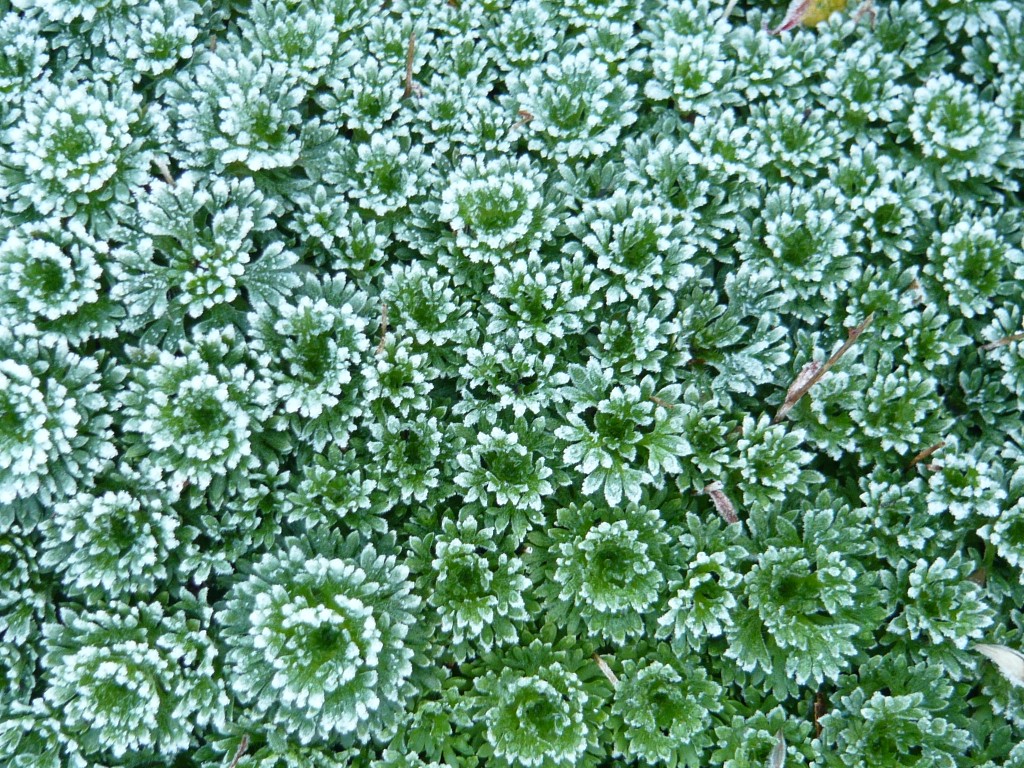
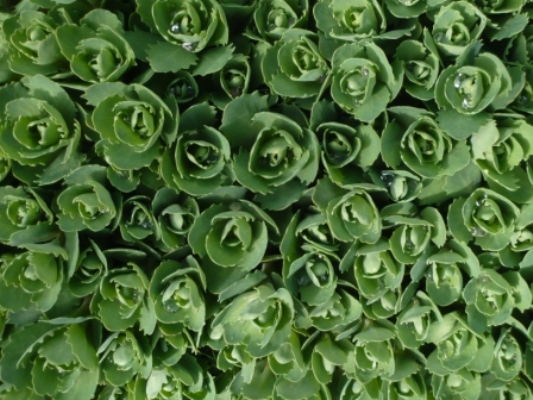
This natural pattern of succulent leaves was spotted in my garden as the Autumn flowering Sedum Spectabile burst forth this Spring. This follows the patten in the leaves at the end of a branch of Monkey Puzzle Tree and set me thinking. Many gardeners spend a lot of time and effort to get patterns of colour and texture, variety of shape and form or harmonious patterns to please the eye but nature does it best.

Read More Read More

Growing Annual Phlox

Growing Annual Phlox

Gardeners Tips 2011 phlox

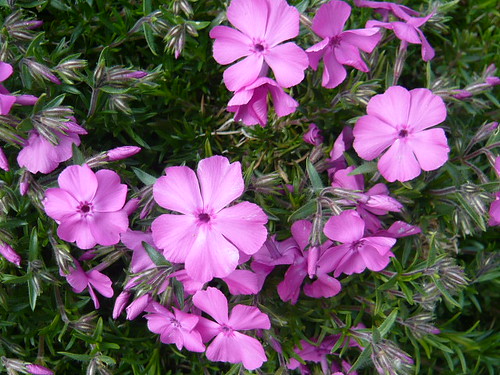
Phlox can be an easy grown half hardy annual suitable for any garden situation particularly a cottage garden. It’s compact bushy habit makes it ideal for planting as drifts of colour, as border edging or in containers. This Phlox differs from the perennial varieties that grow taller and have more scent. Never the less annual Phlox is worth the little effort that is required

Description of Phlox

  • Phlox drummondii is free flowering in a broad range of attractive colours including red, white, blue shades, pastel colours and bright yellowy orange.
  • Phlox flowers throughout the summer on 12″ high plants although some varieties are lower growing.
  • Phlox hybrida compacta has a stripped flower.
  • The flowering period is from June through July & August
  • Blooms are about 1″ across in clusters and are trumpet-shaped with a narrow tube.
  • The leaves are soft, hairy and sticky.

Cultivation Tips for Annual Phlox

  • Grow from seed sown in February- May six weeks before the last frost.
  • Sow seed on the surface of good, free-draining, seed compost.
  • Do not cover the seed. Place in a propagator or seal container inside a polythene bag and place at 18-20C (64-68F) until after germination which takes about 10-21 days.
  • Do not exclude light as this helps germination.
  • Transplant seedlings when large enough to handle into trays or pots. Grow on in cooler conditions for a few weeks before planting out 8″ apart after all risk of frost .
  • Plants prefer a rich well drained soil in a sunny position.
  • A foliar feed of dilute liquid fertiliser will help plants continue flowering through summer.

Special Growing Tips for Phlox

  • The Phlox self deadheads to produce a continuing show
  • The flowers are attractive to Bees and Butterflies and that makes them worth planting for that alone.
  • In USA some species grow will at the roadside so how hard can they be to grow in your garden.

Book Cover
Phlox: A Natural History and Gardener’s Guide by James H. Locklear

Varieties, Species and Types of Annual Phlox

  • Phlox drummondii ‘Crème Brûlée’ a variety of orange-yellow shades.
  • Phlox Drummondii ‘Dwarf Beauty Mixed’ includes reds blues and white.
  • Phlox Drummondii ‘Phlox Of Sheep’ is available in a range of pastel shades
  • Phlox hybrida compacta ‘Peppermint Candy’ is an interesting red and white stripped variety

Horticulture Sources and Origins

  • In 1835, botanist Thomas Drummond collected the seeds of this annual wildflower in America where a red-colored variety grew with a pink-flowered form.
  • You can often obtain seeds or plants from our mail order company of choice Thompson & Morgan
  • Read about perennial Phlox
  • Night Phlox or Zaluzianskya is a plant closely related to Phlox.
  • Pdf article on annual phlox species.
  • More Information from University of Texas plant data base
Lily Flowered Tulips

Lily Flowered Tulips

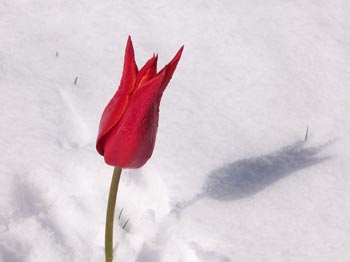
red tulip

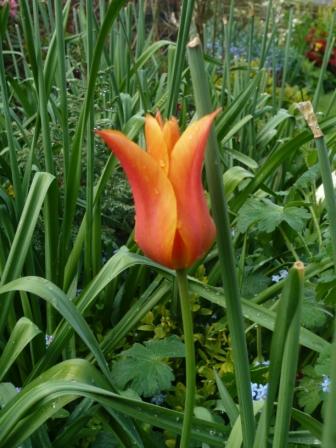
A red ‘Lily Flowered Tulip’ creeping above the late spring snow.

I have just ordered my tulip bulbs for autumn planting.

Lily Flowered tulips are so called because of their unique shape: the blossom resembles a lily, or sometimes an urn. This effect is created by long, pointed petals which tend to bend back; it can give the impression of a six pointed star.

Varieties of Lily Flowered Tulips Include

  • Ballade
  • Ballerina
  • Blom’s Harmonious Mixture
  • China Pink
  • Elegant Lady
  • Fly Away
  • Jane Packer
  • Mariette
  • Marilyn
  • Marjolein
  • Maytime
  • Mona Lisa
  • Moonlight Girl
  • West Point
  • White Triumphator
  • Yuri Dolgorukiy

How to Recognise Lily Flowered Tulips

    • Lily tulips are all classed as Division 6 tulips.
    • They are a small group of tulips, which used to be classified as Cottage Tulips with an hourglass shaped bloom.
    • Lily-flowered tulips with their cinched-in waists and reflexed petals show their distinctive shape off best if not too closely crowded together.
    • In style they are similar to the Ottoman or Turkish tulips of the 18th century.
    • They are a beautiful race of tulips with lovely flowers and gracefully reflexing and pointed petals.
    • The elegant blooms are born on strong wiry stems from mid April to May.

Thanks to Bloms Bulbs

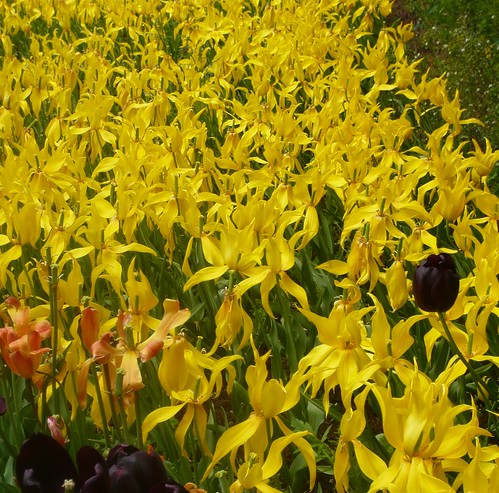
tulip pattern

It is hard to see what type of Tulip is showing in this photograph as the flowers are well blown! (that means they are open to the fullest extent and are nearing the end of there display life.)

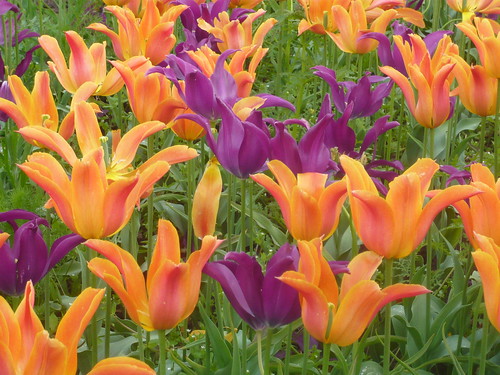
Tip toe through the tulips

Because tulips are such showy flowers I couldn’t resist adding another favourite picture to this short collection of snaps.
See also Parrot Tulips on Gardeners Tips

Growing Nasturtiums

Growing Nasturtiums

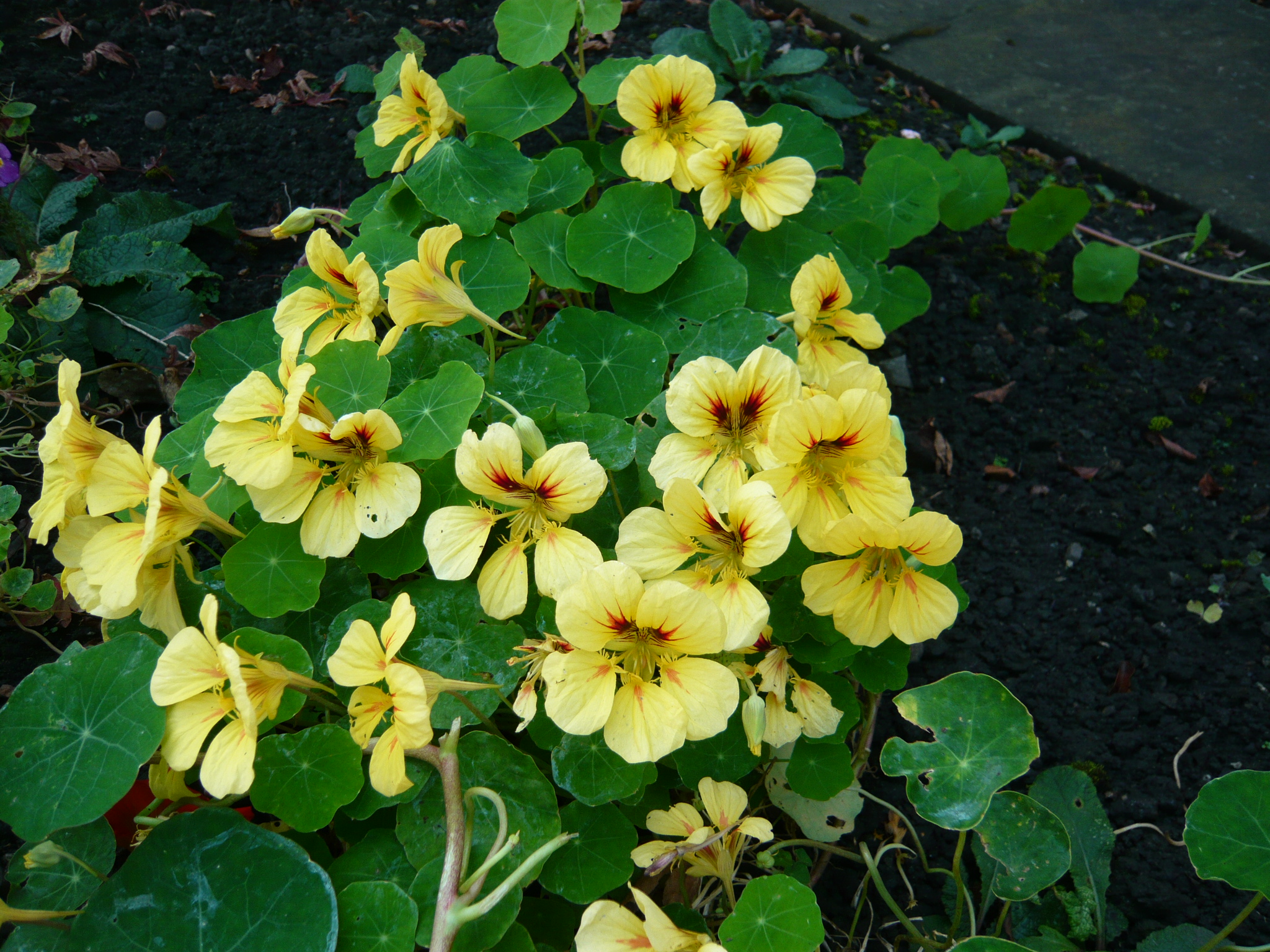
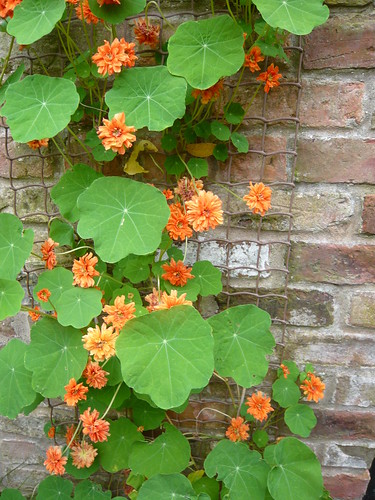
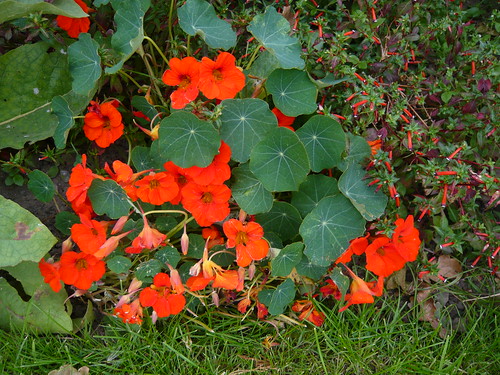
Double Nasturtium

Nasturtiums or Tropaeolum majus are also known as Indian Cress as the peppery leaves can be eaten. However, the best reason for growing Nasturtiums is the large volume of red, orange or yellow flowers you can get on a trailing plants that is planted in poor soil. Also they are so easy you need little help.

Description of Nasturtiums

  • Nasturtiums are soft, fleshy plants with round, veined leaves.
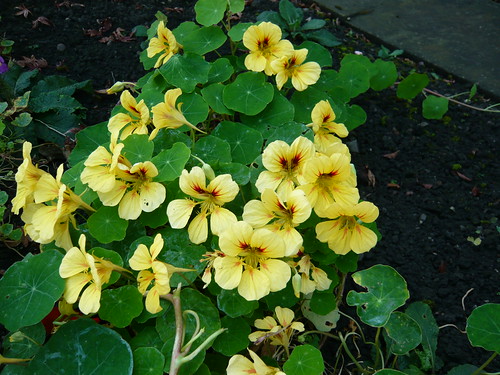
  • Flowers are generally single in small trumpet shapes coloured Red, orange and yellow.
  • The plants will trail or spread over a distance during the summer and can be used for climbing or to trail over a wall.
  • After the first frost plants turn into a mush but the tripod seeds can be collected or left as wild creature food.
  • Nasturtiums flower in summer/autumn. Plants grow in mounds unless supported as climbers.

Nasturtium

Cultivation Tips for Nasturtiums

  • Grow from seed which are oval, pea sized capsules. The seed size makes them easy to handle and suitable for children to plant.
  • Plant direct into the ground where you want the plants to flower.
  • Nasturtiums produce 3 seeds per flower and self sow for next year. The spare seeds are eaten or rot<./li>
  • Poor soil will encourage more nasturtium flowers. Rich soil encourages leafy growth.
  • Do not bother fertilizing Nasturtiums
  • Ideal for bedding, borders, tubs and containers.
  • Flowers can be cut for unusual floral decorations.

Nasturtium

Special Growing Tips for Nasturtiums

  • Black fly, cabbage white butterfly and slugs appreciate a meal of Nasturtiums but do not let that put you off growing them.
  • Flowers seeds and leaves are all edible and enhance a salad.
  • Nasturtiums protect other plants from insects – or more likely act as the host for the insects
  • You can trail your nasturtiums off a balcony by growing them in pots. Provide plenty of water.

Nasturtium

Varieties, Species and Types of Nasturtiums

  • There are 200 species of Tropaeolum but only 3 or 4 in cultivation as flowering Nasturtium being Tropaeolum majus, Tropaeolum peregrinum and Tropaeolum speciosum.
  • Nasturtium Double Gleam looks double due to the frills on the petals.
  • There are many varieties of Nasturtium sold by seed merchants in single colours or mixtures.
  • Nasturtium ‘Banana Split’ Tropaeolum minus, is an eye-catching nasturtium with golden-petalled flowers that fade to lemon as the season progresses
  • Tropaeolum speciosum the Flame Nasturtium, Flame Flower, Flame Creeper is a hardy perennial with spurred blooms in bright red throughout summer followed by spherical blue fruits set against a backdrop of attractive dark green foliage.

Horticulture Sources and Advice

  • True Nasturtium plants are water cress, garden cress and mustard with a peppery, pungent flavor. They should not be confused with flowering nasturtiums which are from the genus Tropaeolum.
  • You can often obtain seeds or plants from our mail order company of choice Thompson & Morgan
  • More tips on growing Nasturtiums
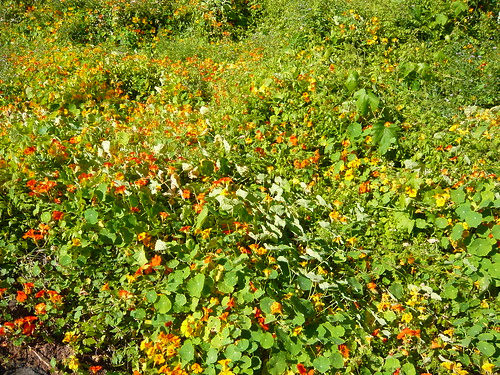
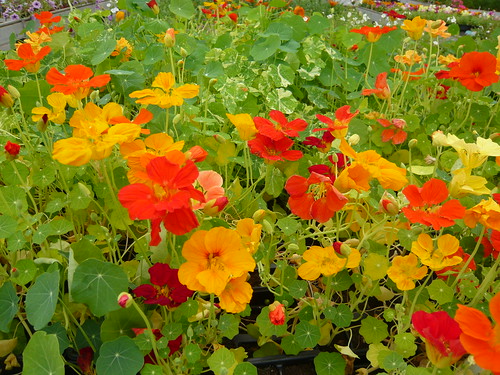
  • More Intensly coloured Nasturtiums

Nasturtium

Growing Veg in Winter for Spring Crops

Growing Veg in Winter for Spring Crops

Book Cover

Sowing and planting vegetable in Autumn will ensure produce can be harvested from next April in mild districts. Over wintered crops avoid the problems of insect and pest damage suffered by spring sown crops but beware of mice when planting seeds.

Winter Vegetables to Grow

  • Broad Beans can be sown in October or November. Most varieties should be hardy though I would select The Sutton which grows 2′ tall or Aquadulce Claudia.
  • Peas of round seeded varieties such as Felthams First, Pilot or Douce Provence are suitable for autumn sowing.
  • Mange-Tout should overwinter if you grow Oregon Sugar Pod.
  • Garlic and Shallots are best planted in November.
  • Carrots of the Nantes type such as Adelaide or Nantucket will mature in June if overwintered.
  • Winter greens can often be bought as young plants for putting out in your veg plot.

Growing Tips for Winter Vegetables

  • Protection is the name of the game if you want to boost crop yields.
    • In wet regions use cloches to protect seedlings.
    • Sow some seed in modules in a cold greenhouse for planting out in March to get an early crop.
    • Cover with fleece in really cold weather.
    • Shelter for strong winds where practical.
  • Great Preparation will help winter crops
    • Plan to get all your crops started before December by which time the soil will be too cold for sowing or planting out.
    • Good drainage will help so I use  raised beds.
    • Place crops to benefit from winter sunshine.

The Winter Harvest Handbook: Year-round Vegetable Production Using Deep-organic Techniques and Unheated Greenhouses.  Eliot Colman helps the Home Farmer (and the keen gardener) extend their growing season to cover   winter   as his techniques can easily be adapted.