Browsed by
Category: Flowers and Plants

Annual, perennial and interesting flowers with advice on culture, information, tips and recommended varieties

Rhodohypoxis for Massed Flowers

Rhodohypoxis for Massed Flowers

Tale Valley nursery hold a national collection of these floriferous plants.
Rhodohypoxis

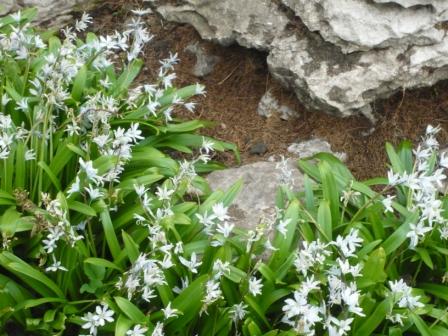
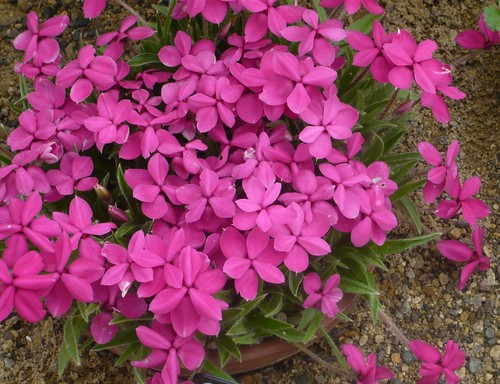
For a short intensely coloured alpine or pot raised plant there is little to touch Rhodohypoxis. The flowers are thick and wax-like white or shades of pink to purple. Interesting doubles are now being bred such as ‘Lilly Jean’,  ‘Hope’ or ‘Kiwi Joy’.
Rhodohypoxis grows to 2″ in height although Rhodohypoxis deflexa only reaches 1″ or less depending on position in your garden and Rhodohypoxis ‘Tetra White’ can be 4″ tall.

Cultivation Tips

Regular dead-heading of the spent flowers helps to improve flowering performance.
Grown in plastic or terracotta pots, they are best re-potted every year.
Add a high potash slow release fertilizer into the compost at potting time.
Compost should be relatively free draining by adding from 30%+ grit to the growing media
Around May the first lance-shaped leaf growth appears. They are quite short and form a spikey matting until covered in flowers for the rest of summer.

Watering and Feeding

Rhodohypoxis will happily withstand freezing cold provided the plants are kept almost dry through winter.
Their chances of survival outdoors can be enhanced by placing a pane of glass over the top of them during their dormant period.
‘Containerised plants require plenty of moisture in the spring and summer which is reduced as the leaves start to die down in August to October depending on the variety.’
Provide a liquid feed to build up the, small corm like, root stock during the growing period.
Trim off dead foliage and store corms through winter in a cool environment.
Propagate by division when dormant.

Rhodohypoxis

Species

Rhodohypoxis baurii
White flowers with shorter but wider leaves.

Read More Read More

Making A Rock Garden or Rockery

Making A Rock Garden or Rockery

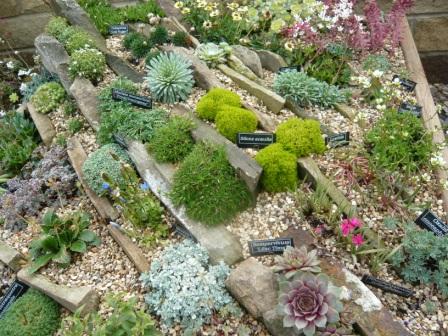
A rock garden is a grand place to display your alpine plants. You can shade them with rocks, provide deep root runs and provide rain cover with perspex roofs
rockery

In Alpine conditions plants can shelter behind rocks that give them protection from wind and rain and help with drainage. Try to give your plants similar conditions to there original habitat and they will repay you for your attention to detail.

Tips for Making a Rock Garden

  • A rock garden should be open and unshaded by over hanging trees
  • There should be a slope either natural or built up. This allows plants on the North facing slope to receive 25% of the sun (and heat) of those on the South slope so those delicate plants don’t fry.
  • Study the prevailing wind so you know where most rain will fall and plant the rain shadow area with plants that need to stay dry.
  • If in doubt about drainage improve it by adding grit. If the soil is clay, a pile of brick rubble 15 inches below the surface will aid drainage no-end.
  • The soil can be average soil but will not need extra nutrients or fertilizer except for special situations. Pack all crevices tightly with soil to prevent unwanted pests like mice.
  • Plan your rock positions and lay the grain or style of rock all in the same direction. Do not mix rock types or the harmonious effect can be lost.
  • Do not plant higgledy piggeldy but select plants that fit into a simple plan. Keep slow growing plants needing similar conditions together. Consider haveing zones in the rockery for different plant requirements.
  • Mulch new plants with pea gravel

Read More Read More

Alpine Growers Club AGS

Alpine Growers Club AGS


This is an update from my last report on the AGS in September 2009. After 7 years of happy membership I am letting it lapse and saving the money to spend in the garden. The local branch society never lived up to my aspirations as a club despite some great speakers, I never felt part of the in crowd. The national society provided an excellent magazine and a seed distribution service which I will miss until I decide to rejoin.

alpine-s

For my birthday I received membership to the Alpine Garden Society ‘The Big Society for Small Plants’. The package supplied with my membership is very impressive, in addition to my national membership card I received a membership voucher for 1 years local group membership and a list of 53 regional venues. As a special offer my first years membership will run from August to the end of next year and at £25 for 16 months, it seems great value.

Alpine Package

Competitions and shows are a large part of the society’s activities . A full programme (72 pages) for 2009 with rules and specifications was sent with my pack. This years remaining events include, 26th September 2009 Gillingham Autumn show, October 3rd Loughborough show and October 10th Newcastle.  A 2010 programme  is promised shortly. Whilst I am not likely to enter competitions it was interesting to see what plant varieties were consistant winners.

The Alpine Gardener Bulletin volume 77 no.2 is a superbly produced 140+ page book with stunning pictures. Whilst this is the 80th anniversary edition I hope the other quarterly books are to the same standard. ‘Alpine news’ lists books and holidays for sale and it is a good idea keeping these adverts on a separate leaflet, away from the main publication.

Seed distribution is also one of the services the society offer and you get more seeds if you collect and donate your own seeds.

So far so good the Society seems to be a great advocate for Alpine gardening and have a good membership package. As with all societies I guess the more you put in the more you get out so it looks like I will have to polish my Alpine gardening skills.

Membership details available here.

alpine 076

The Scottish Rock Garden Club links with The RHS and Alpine Garden Society on the joiny Rock Garden Plant Committee.

Growing and Floristry of – Peruvian Lily

Growing and Floristry of – Peruvian Lily

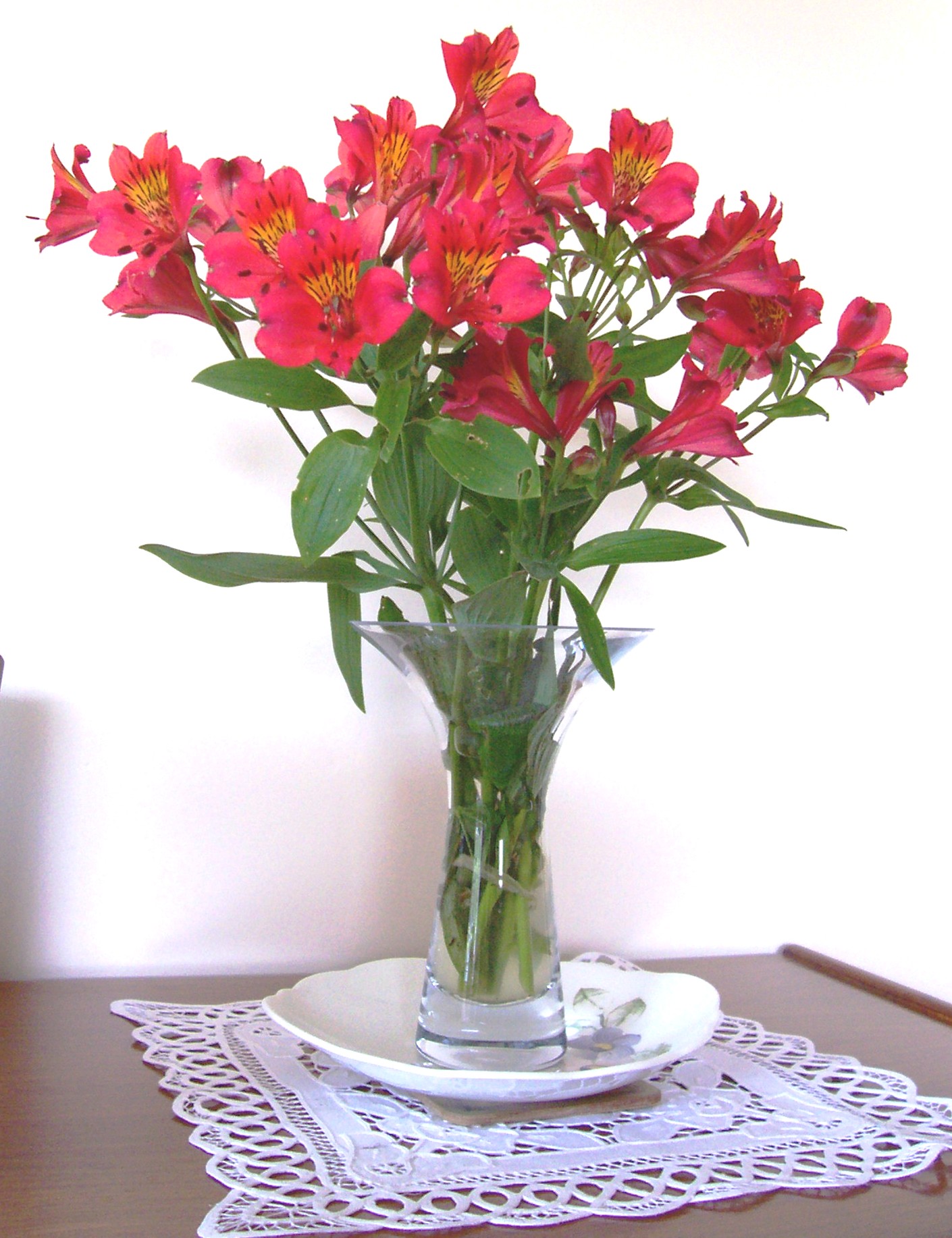
Alstroemeria is a beautiful flower also known as Peruvian Lily or Parrot Lily.

Cultivation of Peruvian Lilies

  • Alstromerias are tuberous perennial plants for the border and grow deeply in light soil.
  • If the conditions are dry when in flower give them a good watering to boost flower production.
  • Plant roots in the dormant season after November. They don’t like to be moved as the roots break easily, if you do transplant dig deeply as the roots are drawn down.
  • Propagate from finger length roots or with some skill grow from seed. Pull up old stalks to encourage growth from the roots.
  • Plants will grow in large deep pots and provide flowers for long periods.

Floristry

These stunning plants add an exotic touch to any flower arrangement with their elaborate blend of vividly coloured and intricately marked flowers. I like the red yellow and white varieties which are easy to grow once they get started forming a good clump in the border.

  • When picking for the vase pull the stalk up then cut to length as needed and they will last up to three weeks.
  • Remove all leaves as they yellow before the flowers die
  • Do not disbud
  • Many of the shop bought flowers are from Kenya and Chile but they are east to grow yourself

Varieties to Consider

·Alstroemeria pulchella the parrot lily and Alstroemeria aurantiacastrong orange shades and Alstroemeria aurea

·Alstroemeria Ligtu hybrids are shorter and may be used in containers. Also called the lily of the Nile

·Inca Hybrids are also on offer in some areas

·A. psittacina ‘Casablanca’ claims to being white, but the markings create a special effect.

Read More Read More

Growing Kerria in a Cottage Garden

Growing Kerria in a Cottage Garden

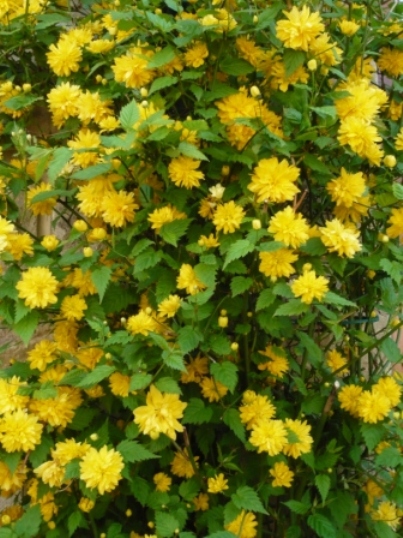
kerria

Also known as the Japanese rose, Kerria Japonica it is a cottage-garden regular that grows dependably almost anywhere. The flowers are a distinctive single or double yellow flowers in April and May. The arching stems are thin and the leaves serrated.

Varieties

  • The modern AGM plant, Kerria japonica ‘Golden Guinea’, has very large, single flowers up to 2.5in across and bright green, attractively veined leaves.
  • Gardeners who are not sure about yellow may actually prefer the single form, Kerria ‘Simplex’, AGM.
  • A silver variegated form Kerria japonica ‘Picta’ has single flowers 1.25 – 2in across and it grows 5ft in height with creamy white margins on grey-green leaves. This is a low, spreading cultivar
  • Kerria japonica ‘Pleniflora’  syn. ‘Flore Plena’ is a vigorous, upright form with double flowers. It grows to 10ft in height and has an AGM.

Book Cover

Read More Read More

Help with February Gardening Jobs

Help with February Gardening Jobs

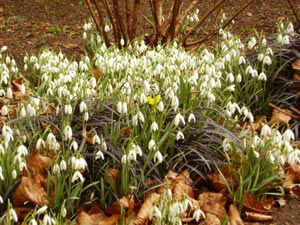
snowdrops

There are numerous jobs to start in February and most gardeners will be very busy. Perhaps too busy to read this article. Still Gardeners Tips tries to help new and experienced gardeners with a series of tips and job lists that should save time in the long run.

Jobs for New Gardeners In February

  • Do not rush, the season hasn’t started and there is a lot of time to catch up.
  • Complete any hard landscaping and design changes that you do not want to be doing when the growing season starts in earnest.
  • Plot and plan, February is a great time to be sorting out your thoughts and getting all your ‘ducks in a row’ ( do not mix ducks with an ornamental garden they eat and fertilize the wrong things.)
  • Read what the experts will be doing – plants want to grow for beginners and experts alike.

Jobs for Expert Gardeners In February

  • Sow seeds of Broad Beans and Sweet Peas in a cold greenhouse or outdoors with some protection.
  • Sow hardy annual seeds in trays
  • February is the time to dig in any green manure that has over wintered.

Fruit

  • Prune outdoor vines, blackcurrants and gooseberries using off cuts as cuttings
  • If you are troubled with moss on tree trunks use lime wash to remove it.
  • Spray peaches against leaf curl

Vegetables

  • Order any seeds and sow early carrots, parsnips or parsley
  • Draw up soil around spring cabbages
  • Plant out autumn sown lettuce and broad beans

Flowers and Shrubs

Scented Plants Not to be Sniffed At

Scented Plants Not to be Sniffed At

Book Cover


Scent and Scented Plant League Tables


What is your favourite smell in the garden? Crushed herbs of Rosemary and Lavender or newly cut grass perhaps. Well by the end of June we will publish a list of the most popular varieties of scented flowers. Here are some of the best plants with scent that we will track down to individual types and varieties in a league table of popularity. What will be in your premiership selection? We will try include your favourite aromatic or powerfully pungent plant in the league tables.


Some Contenders


Lilac

Violets


Night Scented Stock

Freesia


Lily

Mahonia


Hyacinth

Buddleia


Rose

Antirrhinum


Nicotiana

Carnation


Phlox

Alyssum


Sweet Pea

Honeysuckle


Wallflower

Jasmine


Viburnum


Dianthus


Quick Tips for a Fragrant Garden


  • Try provide shelter from wind, the stiller the better to appreciate some delicate scents
  • Look for plants with bits of Latin in there names, like Odoratus, Citriodorus, Fragrantis, Moschatus or Suavis, which mean sweet smelling in one way or another
  • Pungens implies a strong scent (but not always pleasant)
  • Use raised beds to be able to smell delicate flowers
  • Sniff out your plants at the nursery or get cuttings from friends who’s plants have impressed you
  • For Roses start with the ‘Old Fashioned’ varieties


Growing Hellebore in 2016

Growing Hellebore in 2016

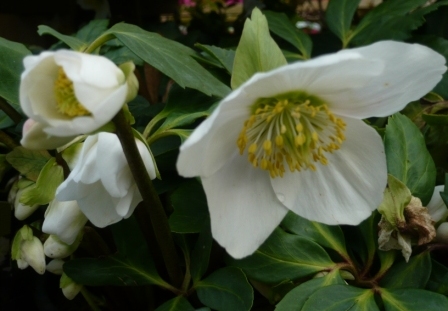
heleboris-niger

Hellebores are doing very well this year. The combination of the last cold winter, warm spring and now wet winter again has brought out the flowers in profusion. The Niger or Christmas rose is one of the earliest white flowers but many hybrids are now available.

Tips on Growing Hellebore

  • Buy plants in flower so you know what colour you are getting. Hellebore is very promiscuous and plants grown from seed may be crossed with other less suitable plants.
  • Try grow plants in a raised area so you can look up at the flowers which tend to have droopy flowerheads.

    Read More Read More

Growing Acer Palmatum

Growing Acer Palmatum

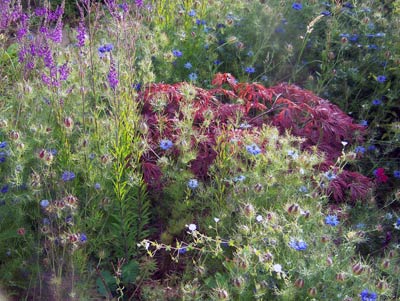
acer

The above Acer is actually dwarfed by Nigella, which will soon be taken up as they have finished flowering. The split leaves look like a spread hand hence the name palmatum.

Why Grow Acers

  • The colour and size of Acer Palmatum’s vary considerably depending on the variety. The leaves often turn a different colour in autumn giving a blaze of late season colour. The tree in my front garden goes a deep red for a few weeks in September
  • The acer Palmatum is a popular variety of hardy tree, ideal for growing in small gardens.
  • Acers can provide a focal point.
  • Acers are longer lived than many shrubs in a sheltered garden.

Read More Read More

Magnesian Limestone Gardening

Magnesian Limestone Gardening

Durham Botanic Garden
Durham Botanic Garden 1.3.09

Magnesian limestone grassland is uncommon in the UK but supports a wide range of plants and invertebrates. The dolomite or limestone has weathered to form thin lime-rich soils on which unique wildflower meadows have developed.

Looking at natural sites can give you ideas for your own garden. Early spring is a good time to visit when the cowslips and early orchids are in flower. By mid july the meadows should be at there peak with flowers and insects. Depending on the ph of your garden soil you will be able to plan where what and how to grow Lime loving plants. My natural clay soil errs towards acidic so I have long struggled to grow thymes, saxifrages and scaboius but I have happily grow Rock Roses. Having seen the plants in situe I can now modify my own garden conditions.

Book Cover

Plants from these Limestone Areas

  • Rock Rose  Helianthemum the only home for the eggs of the Northern Brown Argus butterfly
  • Small Scabious
  • Hay Rattle drains energy from normal grases preventing them from dominating the grassland
  • Dark Red Heleborine native orchid
  • Bee Orchid which has a flower which mimics bees to attract polination
  • Blue Moor grass found only in a few sites in North East England

Sites of Magnesian Limestone

  • Thislington Plantation – Castle Eden Dean, Stanhope Chase Co Durham A seed collection programme is managed at this site
  • Bishop Middleham Quarry Durham wildlife trust.
  • Natural England Trust manages several key sites
  • durham University botanic garden has a special interest in gardening with this type of soil

Comments on Chalk and Limestone Gardening Book

  • Many other works include sections on difficult gardeneing conditions but this is based on practical experience.
  • It advocates working with the soil rather than taking drastic measures to alter its nature.
  • Improve the soil as most gardeners would rather than fighting nature.
  • Contains many suggestions to cope with the inevitable lime induced chlorosis some plants might suffer.