Browsed by
Category: Flowers and Plants

Annual, perennial and interesting flowers with advice on culture, information, tips and recommended varieties

Top 10 Easy Flowers To Grow

Top 10 Easy Flowers To Grow

sunflowers
1. Sunflowers. One of the most rewarding plants to grow from seed is the sunflower. You can sow seed in March – May. April is a great time. For best results. Try sowing seed in 3 inch pots. Protect from slugs and keep well watered. After a few weeks the seedlings can be planted out. Sunflowers will need staking. But part of the fun is seeing them grow so rapidly. – Growing Sunflowers

2. Daffodils. Bulbs tend to be very easy to grow. The main thing is to plant at the correct depth in the autumn. If the bulbs are in good condition and disease free they will flower for several years. They can be helped by a liquid feed and dividing when overcrowded. Growing from seed requires great patience and expertise. Growing Daffodils

3. Sweet Peas. Sweet Peas aren’t the easiest to grow, but they are wonderful. You can sow direct outdoors but you will have to watch out for slugs. Sowing in 3inch pots will give better results. They also need something to grow up. They will soon reach 6 feet. The other secret of sweet peas is to keep cutting the flowers – this will give you wonderful cut flowers for the house and extend the flowering season. Growing Sweet Peas

4. Nigella – Love in a Mist. If you want a really easier flower to grow try ‘Nigella’ common name ‘love in a mist. You can just scatter seed in the garden and it tends to look after itself. You can sow the seed in either autumn or spring. Once it gets going, it will set seed. It is resistant to many pests as well.

5. Iris.
Spring Flowers

See: Growing Spring IrisBearded Iris

Read More Read More

Three Colours – One Flower

Three Colours – One Flower

Madiera mch11 374

As flowers age they can lose some of their colour.
The sun can have a bleaching effect and the pigment should already have done it’s job of attracting pollination insects.

Some flowers have petals that are a throw back to an earlier plant cross

Madiera mch11 375

Other plants may be programmed to produce flowers with a natural variety in their colouring.

Madiera mch11 376

Photographs can lie especially when it comes to the rendition of colour.
The colour temperature and light conditions can make the same pigments appear different in different conditions

Italian Lantana

Lantana camara often has three colours on one blossom in this case pink, yellow and red.

Growing Hollyhocks – Purple Malva

Growing Hollyhocks – Purple Malva

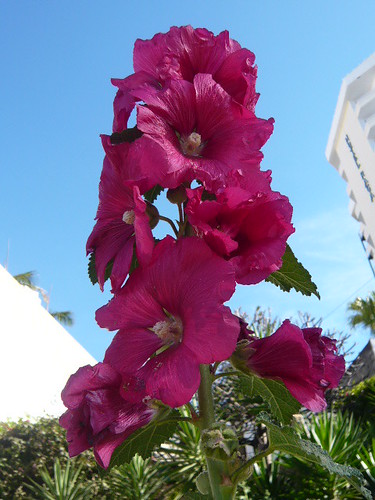
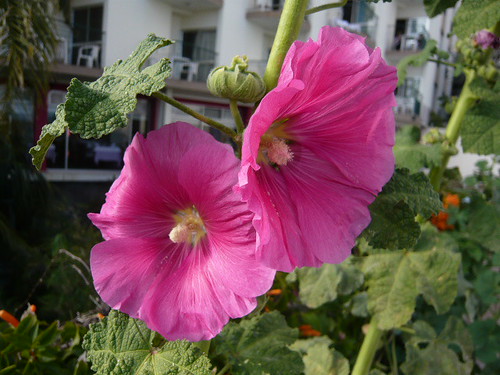
Madiera mch11 501

Hollyhock family are from the Alcea genus but I couldn’t find a UK supplier of the variety above..

Malva sylvestris Magic Hollyhock has beautiful rich purple pink flowers, veined deep glossy purple, some loosely double like Old Fashioned Roses. It thrives easily in most soils providing a magnificent display.
Book Cover
Cultivation

  • Sow from late winter to early spring 1.5mm (1/16in) deep in John Innes Seed Compost.
  • Make sure that the compost is moist but not wet and seal in a polythene bag until after germination, which normally takes 15-21 days at 21C (70F).
  • Transplant when large enough to handle into 7.5cm (3 in) pots.
  • Grow cool and later plant out 60cm (24in) apart into an ordinary but not rich soil in sun and some shelter. If windy tie to a stake or support.

Hollyhock Malva sylvestris ‘Magic’ is available as seed from Thompson & Morgan


Want to know if it is an Alcea or Malva read about Aroids


Read Growing Hollyhocks for Fun

Madiera mch11 350

Read More Read More

Poppy Companion Planting with Vegetables

Poppy Companion Planting with Vegetables

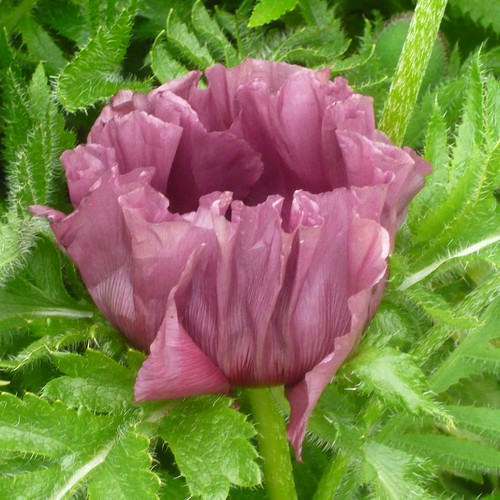
Opium Poppy

Think before you allow poppies to proliferate.
Poppies rob a lot of goodness from your soil.

Poppies and Vegetables

  • Poppies grown close to purple sprouting broccoli and other brassicas will inhibit the plants and reduce your potential crop.
  • Poppies that are planted close together have the ability to kill off other plants.
  • Odd self sown poppies may not have a dramatic effect but better safe than sorry.
  • Beans and Peas that ‘fix’ nitrogen back into the soil may not appear to suffer such an effect but take care with green leaf crops.

Poppies as a Weed

  • The large quantity of seed produced from a few plants can cause poppies to become weed like infestations.
  • If I could convert the latex into a useful crop as they do in Afghanistan it may be another story
  • Seed remains viable in your soil for many years. One years seeding = many years of weeding
  • Long tap roots make some poppies hard to weed. If you break the root you may get two plants next time.

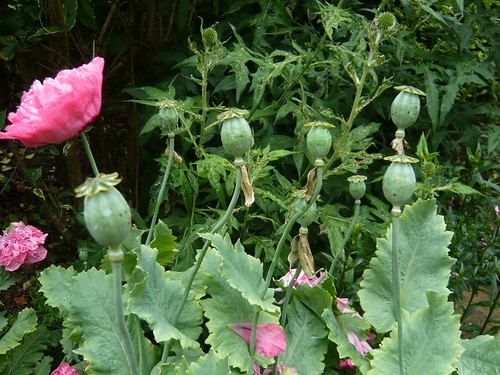
poppy seedheads

Uses of Poppies and Seeds

  • Seed from the opium poppy Papaver somniferum can be crushed to form seed oil.
  • Poppy seeds are used, whole or ground, as an ingredient in many foods such as bread and baked products.
  • Different varieties of poppy seed are used as a spice, a condiment, a decorative garnish and a thickener in food.
  • Seeds can be used in bird seed mixes
  • Poppy is popular in many different international cuisines.
  • The crop is grown for the production of opium, morphine, codeine and the alkaloid thebaine

Related try Growing Poppies from Seed

Growing Succulents And Hawarthia

Growing Succulents And Hawarthia

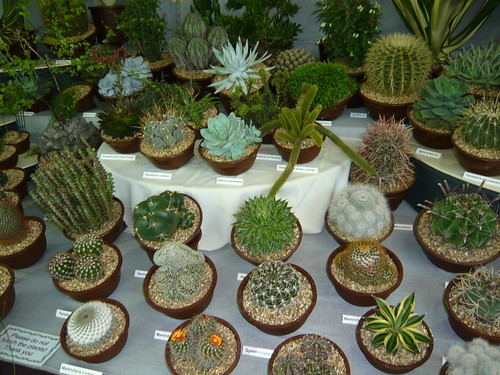
Cacti

What are Succulents

  • Succulents are a wide group of plants that have evolved from ancient tropical forests to combat the feast and famine of water supply.
  • Succus is the latin for juice.  Succulent plants have   stems,branches, roots, stalks, leaves or flowers that are juicy, fleshy or thick to retain moisture.
  • Parts of succulents above the ground act as reservoirs of water.
  • Succulents are varied plants not one or even related groups or families of plants.
  • All cacti are succulents but all succulents are not Cacti.

How do Succulents Preserve  Water

Read More Read More

Blight Buster Potatoes

Blight Buster Potatoes

Potatoes

Potato blight, also called late blight, is a destructive fungal disease that is caused by spores of Phytophthora infestans. Potato blight spores are spread on the wind and may also contaminate potato tubers in the soil. It can ruin a crop in 10-14 days and there is little that can be done to save an infected crop. It was the original cause of the Irish Potato Famine.

How to Recognise Blight on Potatoes

  • If you want to be a blight buster be aware that it is particularly prevalent during warm humid weather. It can be especially problematic in summer from June onward during wet weather.
  • Dark brown blotches appear on the leaves, particularly towards the leaf tips and edges. White fungal spores develop around these lesions on the undersides of the leaves, and further lesions develop on the stems.
  • Leaves and stems rapidly blacken and rot causing plant collapse.

Prevention of Potato Blight

  • Always plant healthy disease free seed potatoes from a reputable supplier.
  • Choose blight resistant potato varieties such as the Hungarian Sarpo range developed specifically for their superb resistance to late blight and other viruses.
  • Blight resistant varieties allow the gardener to produce reliable disease free crops without the need for constant spraying.
  • Always choose an open planting site with good airflow and leave sufficient space between plants. Better airflow will allow the foliage to dry quickly after rainfalls and therefore slows the spread of blight between plants.
  • Crop rotation will help to prevent a build up of disease, and will avoid infected plants springing up undetected from potato tubers that were missed during last year’s harvest.
  • Spray potato crops with a protective fungicide such as Dithane 945 before signs of blight become apparent.

Blight Resistant Potatoes

  • Maincrop Potato varieties Kifli, Blue Danube, Shona, Verity and Cara a pinkish red-eyed tuber.
  • First Early Potato varieties Orla and Lady Balfour
  • Potato ‘Sarpo Mira’ – Huge yields of tasty, floury tubers. A real all-rounder for all cooking purposes.
  • Potato ‘Sarpo Axona‘ – Sister line to the phenomenally popular Sarpo ‘Mira’. The tubers are more regular in shape and the flesh is slightly more creamy. Superb flavour for all culinary uses.
  • Potato Valor an oval white skinned tuber with eelworm and blight resistance.

Cultivation for Blight Buster Potatoes

  • If plants become infected they should be removed and destroyed not added to the compost heap.
  • Where potato crops have already developed tubers then these can be saved by cutting away the foliage and stems. Leave the soil undisturbed for 2/3 weeks to kill off any lingering spores so that they don’t infect the crop when it is lifted.
  • Given that old potato tubers can harbour blight spores over winter, it is important to destroy any unwanted or diseased tubers.
  • Spores may also be washed into the ground by heavy rainfall to infect tubers growing there causing a red-brown rot directly beneath the skin which slowly spreads towards the centre of the tuber.
  • The spores are released on the wind and quickly spread to infect neighbouring plants.

Credits
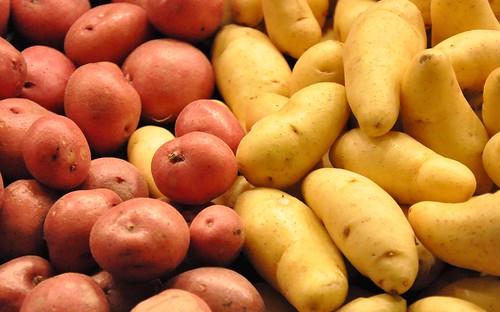
Potatoes by Buzz Hoffman CC BY-NC-SA 2.0


Growing Blue & White Delphiniums

Growing Blue & White Delphiniums

delphiniums

Delphiniums are stately border perennials which come in a wonderful variety of colours. Strong blues and clear whites are colours which are often hard to find in the garden. The delphinium is one of the few plants to give a true blue colour. The delphinium also adds greatly to the height of the garden. If well staked it can tower above the other foliage to give an eye catching display.

Growing Delphinium from Seed.

Delphinium seed is expensive. A packet may only have a few seeds in. But, they are good fun to grow from seed. Make sure you get a good variety from a reputable supplier.

delphiniums

Soil Preparation for Delphinium

Like many plants delphiniums like well drained fertile soil. If possible work in leaf mould / well rotted compost into the soil to improve the humus  / organic content. Top dresser with a general fertiliser. If the soil is clay based then drainage may be a problem, in this case work in sand or grit to the place where they will grow.

Staking Delphiniums. The flower stems of Delphiniums are so dominating they are unfortunately top heavy. Therefore, they need appropriate staking to prevent blowing over.
Book Cover

Read More Read More

Spiral and Cloud Pruning

Spiral and Cloud Pruning

Conifers can be kept neat and tidy by regular pruning.
Equally Conifers can become feature plants with there own personalities.

Spiral Pruning

  • Interesting patterns and shapes can also be created like this double spiral on a Golden Yew.
  • Two conifer types were used the low growing ball shaped shrubs to make the spiral at ground level. Abies balsamea ‘Hudsonia’ is a bun shaped, slow growing conifer.
  • The tall spiral was cut into a Chamaecyparis lawsoniana ‘Columnaris’ which can grow to 20′ high. Golden Yew could also be trained to grow in this shape.

Cloud Pruning

  • Cloud pruning was a fad some years ago but it takes dedication to keep up to it.
  • Ilex crenata, the small leaved holly is popular in Japan
  • Taxus Yew is without equal when clear geometric shapes are required.
  • Even Leylandii can be pruned into cloud shapes.
  • Pines are more difficult and time-consuming to prune this way.
  • Leylandii are forever needing extra trimmi9ng but if you enjoy pruning then it may be the plant for you.

Topiary Shears

brassy-gardener

I called this female statue ‘Lady Gardener’ due to the implement she was carrying that looks like Topiary Shears. In truth the shears are used in the woolen trade for shearing and working cloth. (The clue was seeing her in Dewsbury the Heart of the Woolen District of West Yorkshire.) She looks a bit too formidable to use as a garden statue but if my garden (and pockets) were big enough she could feature.

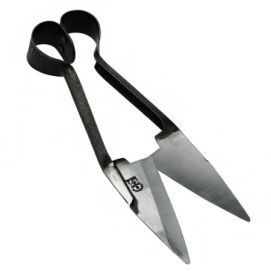
I have a large and small pair of these shears for light trimming and training of shrubs. I particularly use them to keep Lonicera nitada ‘Baggins Gold’ under control as trimming encourages new yellow leaf.

new-picture

Shears by Burgon & Ball

Growing Cacti

Growing Cacti

Cacti come in all sorts of shapes and sizes with differing textures and flowers. Desert cacti are usually covered in spines and jungle or rainforest cacti are often without spines.

Book Cover

Tips for Growing  Cacti

  • Getting the watering right is the key issue. All plants need regular water during their growing period in spring and summer.
  • I water weekly in spring and early summer cutting down drastically by autumn leaving winter almost watering free.  Provide a weak fertiliser solution in spring and early summer.
  • Good drainage is as important as watering. Most succulent prefer a free draining sandy or gritty soil. Do not stand in water.
  • Keep most varieties free of frost.
  • Plants can be grown from seed and many root well from cuttings or grafting.
  • Cacti are trouble free but like adequate light, warmth and ventilation in order to thrive.

Repotting Cacti

  • Cacti should be repotted as soon as roots show through the bottom of the pot.
  • Repot in the spring every 2-3 years for fast growing plants.
  • Water 2 days before repotting so the roots are moist but no saturated.
  • Remove from the pot and discard top dressing and any dead or damaged roots.
  • Increase the pot size only marginally and add slictly acidic compost.
  • Plant at the original depth and trickle a thin layer of grit on the surface which will help water drain quickly.