Browsed by
Author: hortoris

Perennial Begging

Perennial Begging

The Gardeners’ Charity is registered with the charity commission as no.1155156 – GARDENERS’ ROYAL BENEVOLENT SOCIETY. Most gardeners know it as ‘Perennial’. As befits a charity that has been helping horticultural workers for over 175 years it has built up some sizable reserves £43m plus 19 premises and two gardens at the last count. Rather a lot of investments to fund annual payments of only £3.6m or circa 80% of annual income from donations, trading and legacies. (Figures for 2016 are awaited.)

Flush with cash reserves and a conservative spending policy, poor gardeners and horticultural workers should be able to feel some comfort. In a recent mailing I was solicited to donate £25, £50 or £100 in addition to supporting the (expensive) product catalogue. This request wont germinate and bear fruit with me until they are more down to earth and do more for the horticultural workers and families.

The objects of the charity are
1.1.1 the relief and assistance by such means as the trustees shall determine to be appropriate in each case of gardeners or persons who are or who have been in like employment or occupation of those closely involved in gardening or related activities or those training to be gardeners or persons of like occupation and their spouses or widows/widowers or unmarried partners and/or immediate dependants in necessitous circumstances or in circumstances of poverty, illness, disability (whether mental or physical) or old age; and /or
1.1.2 the advancement for the public benefit of education and training in or relating to horticulture or gardening; and/or
1.1.3 the provision, maintenance or assistance in the provision and maintenance of gardens and open space for training, rehabilitation and other charitable purposes for public benefit and in particular the preservation and maintenance of gardens of historic and/or aesthetic importance to be enjoyed by and made available to the public at large;This can include debt advice and financial support to people employed in or retired from the horticultural industry who find themselves in difficulties arising from financial difficulties, ill health, disability, or old age.

The charity employed 38 staff and over 200 volunteers at December 2015.

Woodlice Problems and Control

Woodlice Problems and Control

Book Cover

Woodlice

Woodlice are generally seen as scavengers who eat rotting matter, they are not thought of as harmful to the garden. However, they do chew leaves and stems of tomatoes and cucumber in the greenhouse. They are not true insects but a species of crustacean.

Seedlings can be  eaten by woodlice before the seedlings become established. They can eat stems and leaves so woodlice are best destroyed.

Control and Problems

  • Woodlice and millipedes can be controlled using ant and insects powders historically Methiocarb with HCH lindane
  • Keep areas clear of any debris
  • Recycle woodlice you capture on to the compost heap.
  • Squishing and squashing woodlice is a common cure.
  • Woodlice like damp dark places with a source of rotting wood to lay their eggs.
  • Woodlice are unsightly particularly if they invaded the home where they like damp and rotting wood.

Notes

Methiocarb  is a molluscicide and insecticide for control of slugs, snails and many other pests. In 2014 the EU banned Methiocarb poison-baited pellets  due to their hazardous effect on grain-eating farm birds

Nippon Woodlice Killer based on permethrin

Pruning Deciduous Azalea and After Care

Pruning Deciduous Azalea and After Care

Azalea Mollis aka Rhododendron sinensis

This species of plants originate in central China. The closely related species R. molle japonicum come from Japan. Both these deciduous varieties are relatives of the popular Ghent and Knapp Hill hybrids.

They are one of our favourite flowering plants with bold, colourful, spring blooms that are not hidden by lime green leaves that appear around flowering time.

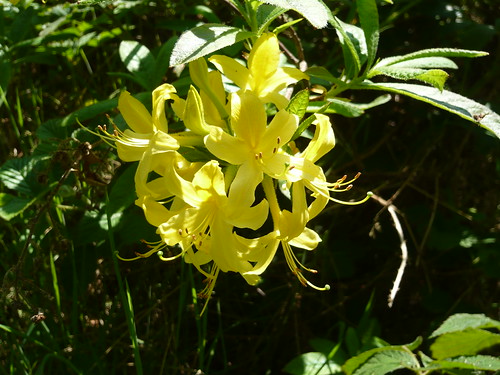
A North American variety R. calendulaceum is called the “Flame azalea” due its fiery orange colours and autumn leafs. R. luteum is not surprisingly yellow.

Pruning Azalea

  • Where possible avoid pruning but if needs must then wait until flowering has finished.
  • Water the shrub and keep it well watered through late spring until autumn.
  • Take out dead or damaged wood with sharp secateurs.
  • If reshaping or drastic pruning is needed expect to loose the flowing capacity for one or two seasons.
  • Thin water shoots from the base can be thinned in number to encourage the others.
  • Remove one older stalk to create light space and shape if you must.

Azalea

After Care

  • After care will help the plant recover from shock.
  • Apply an ericaceous acid plant fertiliserlike miracle-gro specially formulated for azaleas, rhododendrons, camellias, dogwoods and magnolias. Feed through summer.
  • Mulch around the base of the shrub.
  • Other acidifying feeds and treatments include vinegar, ammonium sulfate, iron sulfate or flowers of sulfur but take care as some may burn the shrubs.
  • Dress the top soil with peat or an ericaceous compost

Read more

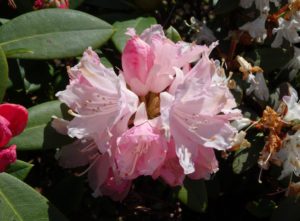
Rhododendron Pink Pearl

Wasps Problems and Control

Wasps Problems and Control

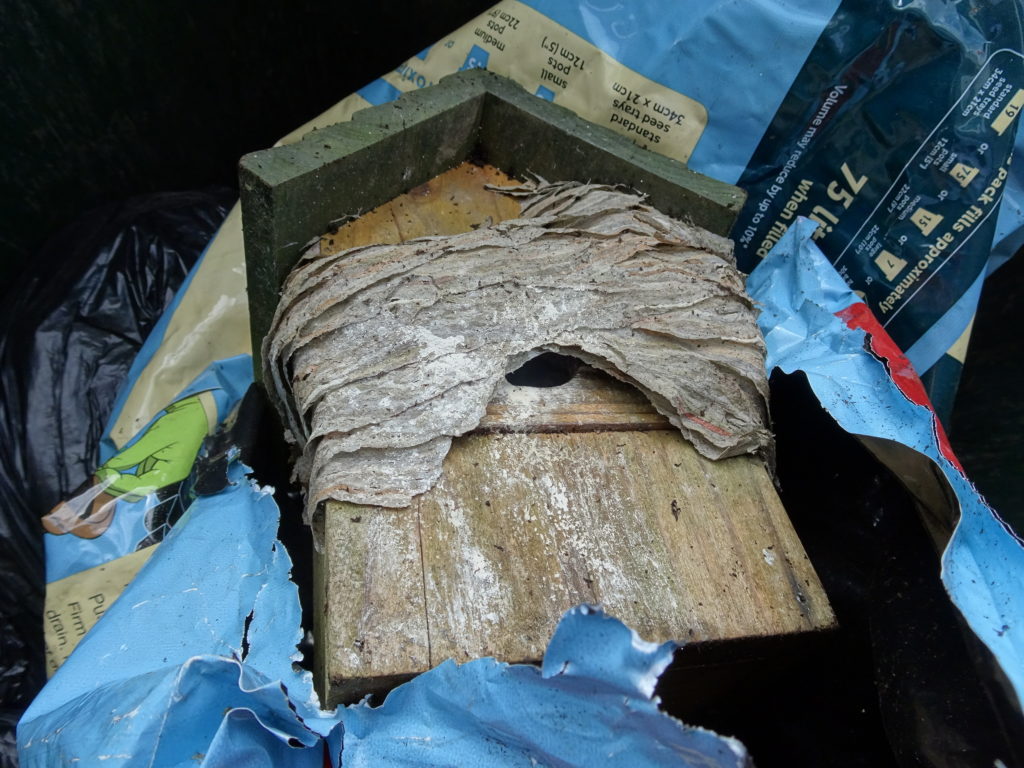
I thought this was meant to be a bird box but the wasps thought differently.

Wasps

Wasps are a large and diverse group of insects with tens of thousands of  species including Hornets, Yellow Jackets and solitary wasps. Some social wasps live together in a nest with an egg-laying queen but the greater numbers are solitary species.

Wasps like munching on ripen fruit Plums, Pears and Apples. They are not the main villain as they only attack fruit that is already damaged by birds or other insects. Their mouths are not usually strong enough to break the skin.

Grapes can be susceptible to damage but bunches of fruit can be wrapped in muslin or old nylons.

Wasp Control and Problems

  • Control wasps by destroying their nests with carbaryl dust.(see below)
  • The sting of a wasp is how they catch some of there food prey.  In late summer  humans may get stung as wasps start to mate for the following year. Wasps may sting more than once if people come close to them but the pain is less than that of most bees.
  • Wasp nests made from chewed wood pulp and saliva can be found in roof spaces, under eaves or in bird boxes  but are not generally a serious problem.
  • Wasps are predators and parasites so  can help in a garden as the larvae feed on aphids and caterpillars. Wasps are major pollinators in the UK and around the world.

Gall Wasps

Cynipids can form a variety of gall on Oak tree leaves, stems and roots. Some years the galls can be very numerous but no serious harm will be done and no control is required. The underside of leaves may get rust brown spangle galls or brown spot gall.

Notes

‘Carbaryl is a man-made pesticide that is toxic to insects. It is commonly used to control aphids, ants, ticks, spiders, and many other outdoor pests. It is also used in some orchards to thin out blossoms on fruit trees.’ Pesticide information center

Camassia Flowers and Food

Camassia Flowers and Food

Some Camassia species were an important food staple for Native Americans and settlers in parts of North American

  • Camassia quamash or wild hyacinth will naturalise in grass and is happy in moist ground.
  • These bulbs have a reputation of being tough and hardy and thrive in less than perfect soils.
  • Camassia leichtlinii is a spring flowering bulb with spires of creamy-white flowers although the more normal powder blue varieties are more often planted.
  • Camassia prefer to grow undisturbed and are not ideal for containers.
  • Flowers open in spring and attract bees for their nectar.

Death Camases are liliaceous, perennial herbs and are not edible.


Growing all Sorts of Stuff

Growing all Sorts of Stuff

Book Cover

Why You Might want to Grow Edible Stuff

  • Food stuff is top of the list in Mazlow’s hierarchy of need.
  • ‘Growing your own’ to feed the family has been a priority for centuries.
  • Farmers, market gardeners and smallholders all contribute edible stuff as do allotment holders and the majority of gardeners.
  • Windowsills, greenhouses, conservatories and sunny sheltered spots can be used to grow tomatoes and salad crops for example.
  • Herbs add taste to many dishes  and  basil, mint, parsley, rosemary and chillies,  are all stuff you can grow quite easily.
  • Stuff called Curcurbits such as courgettes, squash, pumpkins and cucumbers are comparatively easy to grow with a bit of shelter and warmth.
  • Tasty specialties are now more commonplace but Pineapples were grown in special stove houses in the 17th and 18th centuries.

What Other Stuff You Might want to Grow

  • Man can’t live by bread alone so aesthetic stuff needs to be grown to feed the inner man.
  •  Flowers and decorative plants come in all shapes and sizes. Cacti, Holly, Ivy and poinsettia are seasonal stuff you can try.
  • Stuff for indoors includes a range of bulbs and windowsill plants. Old Aspidistra and other evergreen leaved plants have a reputation of cleaning the air. A reputation probably earned when we all had coal fires.
  • Growing stuff in a formal manner from a large landscape to a small Knot garden can be time consuming but rewarding.
  • Organic and environmentally friendly grown stuff has its own reward.
  • Forestry, heath and heather, parks and pleasure grounds all serve a visual or emotional purpose.

How to Grow Stuff

You will have guessed it – read the book!

Botanical Gardens and Botanics

Botanical Gardens and Botanics

Definitions and Scope

Botany is the science of plant life. In other descriptions it is the study of plant science or plant biology. A botanist is one who studies botany.

A botanic is a drug or medicinal preparation obtained from a plant or plants. 

Botanic gardens are institutions holding documented collections of living plants for the purposes of scientific research, conservation, display and education.”

Oxford Botanic Gardens and Magdalen College Tower.

This garden, the oldest in the UK was founded in 1621 as a physic garden growing plants for medicinal research

The original Cambridge University Botanic Garden (CUBG) was founded in 1762  with the larger site opening in 1846. It provides inspiration for botanists, gardeners and the public with an array of 8000 plant species. As a university garden it has a resources for research and teaching based on a collection of living plants labelled with their botanical names. CUBG is one of 1600 heritage-listed gardens  which are based on ‘designed’ landscapes, rather than on planting or botanical importance.

Chelsea Physic Garden was established as the Apothecaries’ Garden  in 1673

Birmingham Botanical Gardens

Durham University Botanic Garden plus other University led botanic gardens at Leicester and Bristol

Ness Botanic Gardens

Royal Botanic Gardens Kew

Sheffield Botanic Garden has been restored  with  different garden areas with plants from all over the world, this 19-acre Gardenesque-style botanical garden is a diverse one to visit. As with other good botanic gardens it holds National Plant Collections in Sheffields case Weigela, Diervilla and Sarcococca.

National Botanic Garden of Wales

Belfast College Park, Botanic Avenue

Jardim Botânico, Rio de Janeiro, Brazil  contains exotic plants in a massive 137-hectare garden’

Singapore Botanic Gardens founded  in 1859 has Singapore’s  National Orchid Garden holding a collection of more than 1,000 species and 2,000 hybrids of orchids

Other large cities have notable botanic gardens including Sidney, New York, Kirstenbosch, Padova, Munchen and Montreal.

Botanic Labeling

cyclamen cilicium

Botanic label and specimen containing the  family name Myrsinaceae, or the myrsine family and origin S W Turkey. The species name Cyclamen Cilcium, the forma as two cultivars have been named but there are many similar wild forms. The number is the accession number 4 digits show the year the plant was first acquired  then last four numbers are sequential numbers.

Myrsinaceae is a rather large family from the order Ericales, that includes Cyclamen among 30+ genera.

RHS Plant label information downloadable

Book Cover

Book Cover

Hibiscus senensis

Hibiscus senensis

The flamboyant Hibiscus senensis is now readily available as a housplant from garden centres. This yellow flower was growing on an Italian road side.

In a conservatory this evergreen is a neat rounded shrub. Good drainage and light are required for good flowering but plants can have a very long life.

If you want to know more about the species of Hibiscus you could do worse than read a book ‘Hibiscus Hardy and Tropical Plants for the Garden’ by Barbara Taylor Lawton extracts of which can be found here.

Mowing Techniques & Tips

Mowing Techniques & Tips

When one man went to mow it was to mow a meadow. Do you want to let your lawn get into that state? If not here are some tips but probably not enough to get you a stately home lawn.

Technical Approach

  • Little and often is usually a good plan. One a week in spring, during dry spells and autumn but more frequently in summer.
  • Aim to cut about one third of the height with each mowing
  • An occasional cut during mild weather in winter with the blades set high.
  • Start the year with the blades set high, upto one and a half inches for coarse grass down to a quarter of an inch for a bowling green standard fine lawn.
  • The best cuts are made by cylinder mowers with a large number of blades. I now use a lithium battery model.
  • Rotary mowers, strimmers and hover mowers are best for long tougher grasses.

Mowing Problems

  • Remove clippings otherwise you may encourage worm casts, weeds, aeration problems and disease.
  • Some recommend leaving clippings in hot dry weather to reduce evaporation but I find it unsightly and ineffective.
  • Avoid scalping off the top surface by taking turns too quickly of dropping of the edge of the lawn.
  • Setting to low can scalp the grass.
  • Keep blades sharp and correctly set to avoid tearing the grass rather than cutting it.
  • Alternate cutting horizontally and vertically to get the football pitch chequered effect.

Mowing in Special Situations

  • Inspect the area for hazards such as sticks, stones and animal droppings.
  • On a slope always mow side-to-side, not up and down the hill.
  • Choose the right mower, ride-ons are not good for steep slopes. Electrict mowers can be dangerous in wet conditions.
  • On wet grass raise the mowing height and keep the speed down to reduce the load on the motor.
  • The stripes you see on a lawn or playing field is simply light reflecting off the grass blades that have been mowed in one direction then the reverse. A mower with a roller helps accentuate the effect.
  • Treat weedy or moss infested lawns with proprietary weed and feed 3 days before cutting and leave for 3 days after dressing.

Book Cover