Browsed by
Author: hortoris

Top 10 Spring Flowering Shrubs
Top 10 Spring Flowering Shrubs

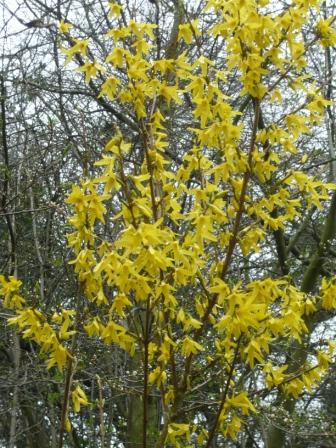
forsythia

Spring is known for colourful bulbs and primula but there are many top shrubs that provide great colour in spring.

Forsythia The yellow flowering twiggy shrub that can grow to 10 feet. It flowers before the leaves form and is a strong, bright  yellow. Large blossom varieties are now being cultivated but either way you get a mass of bloom.

Rhododendron Evergreen shrubs of many forms and sizes from 12 inches to 12 foot. Some bloom from March and some in May. Many sizes and colors exist and one range is named after Snowwhite’s seven dwarfs.

Ribes sanguineum Red Flowering Currant 6′ by 4’  This easy deciduous shrub flowers in panicles of red  or pink  in March and April.

Mahonia aquifolium ‘Compacta’Oregon Grape Evergreen shrubs with spiky leaves grow to several feet tall. Yellow flowers in February and March with good scent. It also produces black edible berries.

Read More Read More

Primula Kewensis One of the Worlds Top Ten

Primula Kewensis One of the Worlds Top Ten

Primula Kewensis

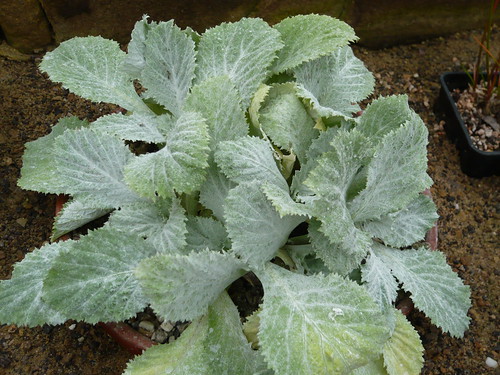
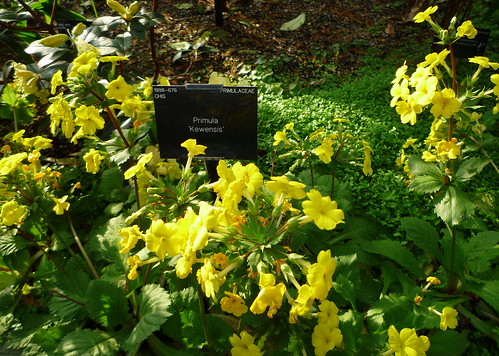
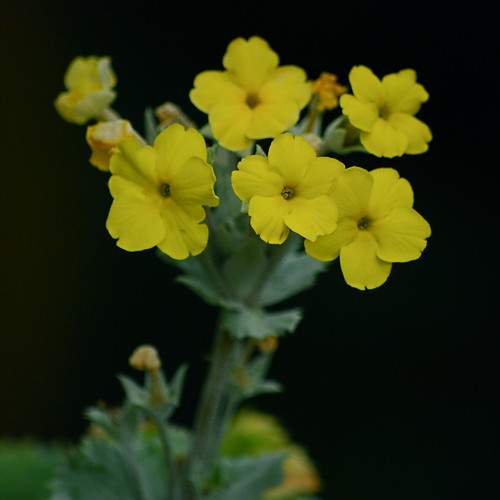
It is believed that the Kew Primrose, Primula Kewensis was bred from Primula verticillata and Primula floribunda around 1905. It should be high in the world’s top ten Primula varieties. It flowers yellow or lemon-yellow and has these attractive leaves when grown in the cold Alpine house.The downy powder is called meal or Farina and gives a grey-green appeal to the leaves similar to some show Auriculas. The seeds grow true and do not hybridise.

Primula

There are approaching 500 species of Primulas and numerous societies who specialise in the genus. The National Auricula and Primrose society Northern branch, The American Primula Society
Primula Kewensis to start the week
As seen in the exotic green houses of the Belgian National Botanical Garden.

More Primula seeds from Thompson & Morgan

Credits
Primula by Badly Drawn Dad CC BY-NC-ND 2.0
Primula Kewensis to start the week by Vainsang CC BY-NC-ND 2.0

Top Ten Round Courgette Varieties

Top Ten Round Courgette Varieties

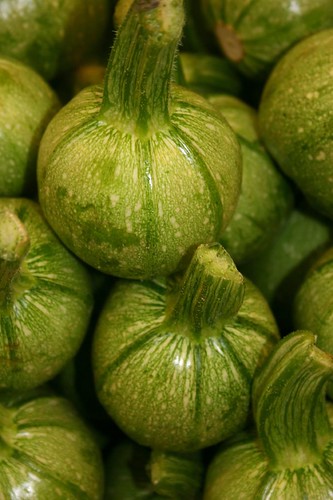
If you are getting round to ordering your new vegetable seeds try a round courgette and have a ball
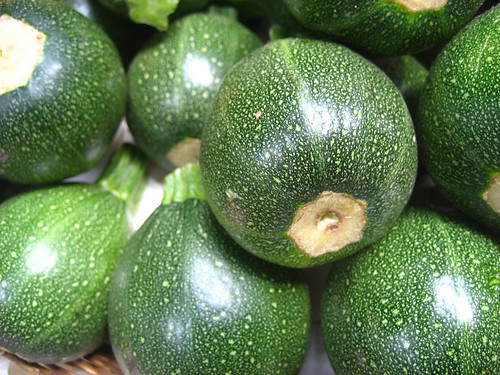
Round courgettes

Curcurbita pepo may have been cultivated for upwards of 5,000 years but I bet they have not always been called Courgettes. We already call them Courgettes, Zucchini, Squash or Marrows.
Below are some of the named varieties of round or ball shaped courgettes now available in the UK and elsewhere.

Top Ten Round or Ball Shaped Courgettes

  1. De Nice a Fruit Rondo – pick from golf ball size upwards.
  2. Tondo Chiaro di Nizza
  3. Florido a yellow fruit
  4. Summer Ball
  5. One Ball another yellow round variety, grow with Eightball.
  6. Tondo di Piacenza a dark green italian variety
  7. Brice a light green skinned ball shaped courgette
  8. Eight Ball is a snooker ball sized courgette OK as a marrow
  9. Zucca Marina sweet skin, yellow flesh and upto 20lbs in weight.
  10. Tricolour F1 hybrid round Courgettes available from Thompson & Morgan

Round Zucchini / Courgette / kishu'im / קשואים

Other sources Marrows – Watering, Pollinating and Harvesting
Seed suppliers list

Top photo Attribution 2.0 Generic (CC BY 2.0) by adactio.
Second Attribution-NonCommercial-NoDerivs 2.0 Generic (CC BY-NC-ND 2.0) by marcusfrieze

Growing Sprouting Seeds for Salads and Stir Fry

Growing Sprouting Seeds for Salads and Stir Fry

Seeds that have germinated and grown roots (radicles) and sprouts (plumules) can add flavour and texture to your meals. They do not take up space in your garden and can be grown all year round.

Bean sprouts in Chinese restaurants are crispy additions to the flavours and textures of your meal. The trick to growing long crisp sprouts is to grow them under pressure. In a dark, free draining container put a half inch layer of bean seeds, cover with a damp cloth and put a one pound weight on top. Rinse daily under a tap and 4-5 days later they will be ready to eat.

Open sprouting can be done like our childhood mustard and cress on a foam base covered with layers of paper towels or on moist cotton wool. Cover with tin foil to exclude the light and germinate in a warm spot.  Method 2 Put some seeds in the bottom of ajar and cover with water to soak for twelve hours. The seeds will expand a lot as they grow. Half to one inch (1cm – 2cm) of dried seeds will usually fill a jar. It varies between seeds – radish expand more than sunflowers.
After twelve hours rinse the seeds in room temperature water then drain the water leaving seeds damp. Repeat every 12 hours for 3-4 days until ready to eat.

There is a wide variety of seeds that can be eaten as sprouts or seedlings but do not eat legumes to excess. Legumes, particularly  Broad beans and French beans are  slightly toxic. Corriander, Leeks and Onions can be eaten as seedlings. Cereals are only eaten as very small sprouts. All Brassicas can be eaten as seedlings.  Buy from health food shops or specialist suppliers and keep seed cool and dry until ready to use. Below is a table of some suitable plants for sprouting.

Common Name Days to Sprout Length when edible
Lima beans 3-5 12-25 mm
Mung Beans 3-5 12- 75 mm
Fenugreek 3-5 12-50 mm
Lentil 2-4 6-20 mm
Alfalfa 1-4 very tiny
Clover 2-5 very tiny
Buckwheat 3-5 tiny
Radish 2-4 12-25 mm
Barley & Rye 3-5 very tiny
Sunflower 1-3 12-38 mm
Sweet Corn 1-3 6-12 mm


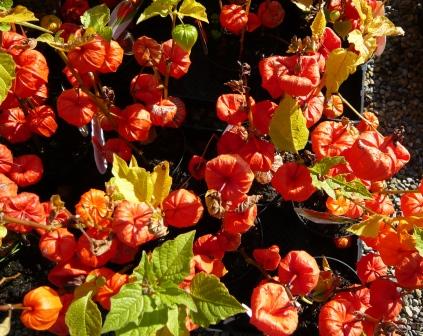
Papery Flowers of Orange Physalis

Papery Flowers of Orange Physalis

physalis
Chinese lantern, Physalis franchetii, grows from seed and is a very short lived herbaceous perennial. It will grow two feet tall and bear small, white flowers followed by large, balloon-like papery husks in July and August.

Growing Chinese Lanterns

  • The Chinese lantern plant is valued for its inflated orange-red seed coverings or calyx which resemble miniature Chinese lanterns.
  • Inside each 2-inch long husk is a small edible but often tasteless red fruit. The lanterns are not edible
  • The leaves are long pointed and heartshaped.
  • The plant can tolerate very cold conditions, flower quickly from seed and like full sun.
  • For winter bouquets, cut the stems in Autumn just as the lanterns turn color, remove the leaves and hang them, right side up, to dry in a shady, airy place.
  • They are related to the Cape Gooseberry Physalis peruviana and other species to try include P. Alkekengi
Top 10 Vegetable Seed Suppliers

Top 10 Vegetable Seed Suppliers

Last year we reviewed seed companies for general seed supply and offered a deal with Unwins. Now we have an arrangement with Thompson Morgan which has just been rated by the Daily Telegraph as having the best overall range from a review of 8 seed catalogues. They have many unusual veg varieties and are good on potatoes and salad leaf mixes. This review is of Vegetable and Herb seed suppliers.

Edwin Tucker & Sons did not feature in our general seed review and scored highly with the Daily Telegraph. ‘very wide range, best for oriental vegetables with clear informative catalogue. Good value for money’.

Suttons good for beginners but the range is sadly getting smaller and smaller.

D T Brown are good value for money with a range that ‘is dependable in harsh climates’.

Chiltern Seeds emphasises heirloom varieties and has good selection of oriental veg. I like the quirky catalogue descriptions and buy some products from them.

Simpson’s Seeds seem to specialise in tomato and chillies seed with umpteen varieties on offer. Good for selling young vegetable plants.

Organic Gardening Catalogue has many unusual varieties of vegetables and herbs but a limited range.

Wallis Seeds remains one of our favourites with 32 pages of densly packed listings of all traditional veg and a few surprises. They supplied me quite a lot of seed this season.

The RHS have a members distribution scheme but only a small number of veg and herbs are offered. It would be an opportunity to increase the cultivation of heritage varieties if they could source adequate stock.

Royal Fern Osmunda Regalia

Royal Fern Osmunda Regalia

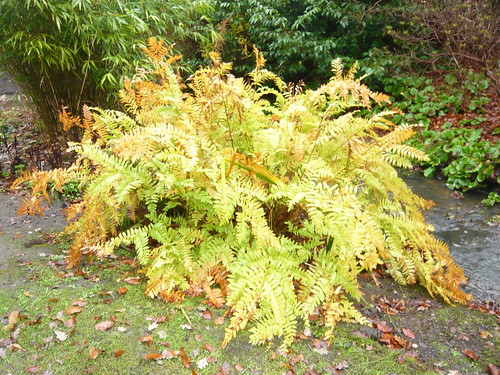
Osmunda Regalia

Some ferns are at their best as the Autumn sun shines through the colouring fronds. This Royal Fern looks bright and cheerful despite the overcast sky and the semi-shaded position. That may be due to the wet streamside location where it can grow to 4 feet tall.
Other members of the Osmunda family include Osmunda cinnamomea cinnamon fern and Osmunda claytoniana the interrupted fern.

The fronds of ferns can be either fertile or sterile and usually grow side by side from the same plant. On the underside of fertile fronds small brown dots or ‘Sori’ contain spores from which ferns reproduce. Osmunda can also propagate via root division.

For Hart’s Tongue evergreen ferns  see

Leucogenes Leontopodium – New Zealand Edelweiss

Leucogenes Leontopodium – New Zealand Edelweiss

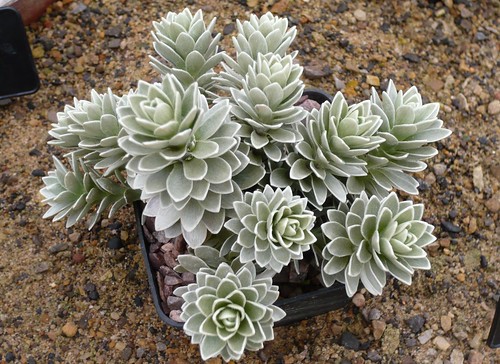
Leucogenes Leontopodium

Growing inside an alpine house in a three inch pot this “Leucogenes Leontopodium” is also called the New Zealand Edelweiss. It is a herby plant similar to its European Edelweiss cousins. In the Northern Hemisphere I expect this plant will produce white flowers around June.

Leucogenes Leontopodium is a small perennial herb with a woody base. The leaves are densely covered in silky hairs giving it a grey appearance. Clusters of flowers are surrounded by woolly bracts in summer.

Leucogenes grandiceps is a similar plant from the South Island of New Zealalnd

Leontopodium alpinum or Edelweiss grows amongst the rocky limestone mountains of Europe. The plants can be grown from seed but are protected when in the wild.

Attract Bees in Organic Gardens

Attract Bees in Organic Gardens

insects

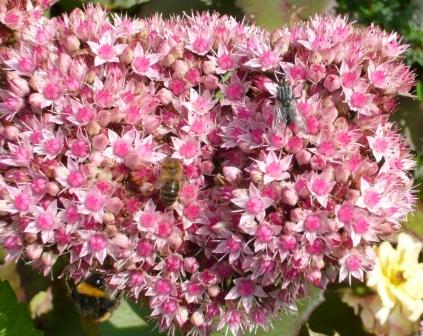
Bees, Flies, and Wasps all display their liking for the nectar from this Sedum spectabile. Insects are attracted by colour, fluorescence and iridescence and by pollen which gives them proteins and fat.  Scent is only one form of attraction for Bees. In the following selection of plants there are many attractions for the apairian population and you can grow them  to help your Bee population

Plants to Attract Bees

  • Flowers with open structures like Rudbeckias, Erigerons, and the early Doronicum
  • Most daisy like flowers and Calendulas, Asters and Cosmos
  • Bees seem to swarm together around Monarda, Verbenas, Echinops, Teazels, Scabious and of course the Sedums.
  • Natural gardens of indigenous species are one of the key food plants for bees
  • Flowering  herbs like Thyme, Sage and Lavender are bee magnets.
  • Ceanothus, Heather, Pyracantha, Broom and Hebe also attract Bees

Experiment with other plants and flowers  in addition to this list as the population of bees has been struggling in the UK in recent years.

Organic Seeds

How to make your garden ec0-friendly

Skimmia for Buds and Berries

Skimmia for Buds and Berries

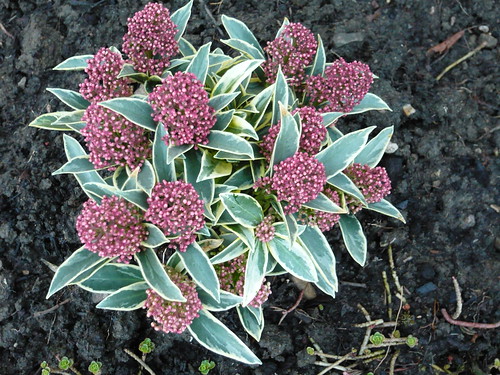
Variegated Skimmia Magic Marlot

Skimmia is a slow growing, aromatic, evergreen shrub with a compact habit. Skimmia Japonica grows in a dome shape with leathery leaves and the flowers can be followed by red or black berries. Skimmia laureola has dark green leaves which smell when crushed. The flowers on this variety are clustered on the end of the shoots.

How and Where Can I Grow Skimmias?

  • They are tolerant of shade and seaside conditions though some cultivars do not like an alkaline soil.
  • The flowerbuds look like pink flowers (above) and slowly develop during late autumn before finally opening to reveal the small white flowers in late winter.
  • Most Skimmias are single sex plants therefore, if you want berries (below), you will have to grow both male and female plants.
  • Skimmias are slow growing and should not need pruning
  • Plants are hardy and would fit in too a low maintenance area
  • Skimmias can be grown in containers

Read More Read More