Archive for May, 2009

Tips for Good Lawns

Lawns, particularly when the grass is newly cut, can provide the most evocative of garden scents. Lawns act as a natural soak a-way for rain and in so many ways are preferable to hard landscaping.

Improve the look of your garden by cutting the grass and trimming the edges. A neatly mowed lawn sets off the rest of the garden.

  • In June you can lower your mowers  cutting blades if you wish but leave 1 inch of grass or it will looked scalped and get bare patches.
  • If you have too many daisies or weeds in the lawn it is OK to give it a ‘feed and weed’ treatment. I find it easier to use a liquid combo for this job but there are also several granular applications you could use. I also have a spot weeder for dandelions and one off weeds.
  • Do not worry if the lawn is dry and starting to go brown it will soon green up again after rain. It is a waste of time and effort to water the lawn except in the most extreme conditions when hosepipes will be banned anyway.
  • It isn’t too late to rake over the lawn scratching the surface to remove dead grass, moss and other debris.
  • On bare patches brush in some sand and lawn seed.
  • If edges are crumbling and damaged  cut out a length about 10 inches wide and turn it around so the damaged part is in the centre of the lawn and the new edge is crisp. water the new piece and it will knit back together.

Enjoy the grass on your lawn, walk barefooted or lay out to get a sun tan. Do not be a slave to your lawn or garden but enjoy.

Comments

Container Gardeners Tips

container-gardening

Silver champagne buckets or plain galvanised steel, there is a container for every purpose. These Pansies contrast with the brick wall and almost cover the container.

Gardeners Container Tips

  • Wether using a pot, tub, bowl, trough or urn make sure there is a drainage hole to allow rain and water to escape. Plants can drown far too easily.
  • Select the material for the container to complement the garden design and chosen plants. Stone, wood, plastic and metal containers are freely available.
  • For a conservation garden ‘found materials’ can be made into a container. A  hollowed out log, old barrel or any container coated in a slurry of concrete and yogurt or peat can look and do good.
  • You may plan to use a containers for one season or several years. Use compost that will suit the conditions eg John Innes no 3 for trees and shrubs or peat substitute for annuals.
  • Plan the planting to soften the edges of the container with plants spilling over. Do not leave a lot of soil showing as it will look sparse.
  • When planting from a pot use the current pot to make a suitable sized hole shape in the container so you can drop the plant straight in and firm it easily.

Comments

Grow Bearded Iris

falg-iris

Iris Flowers

The Iris family contains over 200 species and all Iris flowers have 3 outer and 3 inner petals with 3 stamens. The outer petals protect the inner petals as sepals do on other flowers. An inner petal is called the ‘Standard’ and the outer is called the ‘Fall’ which bends backward and hangs down. The fall is normally patterned with distinctive markings and a bearded iris has central line of pollen bearing hairs. The Standard is often a different colour to the Fall, in the example a mauve with a deep purple fall. Buds are protected by insignificant papery bracts.

Iris Classifications

Reticulata Iris grow from a bulb or corm like the Dutch Iris.
Bearded Iris grow from a rhizome with roots on the underside.
Iris Japonica is a stoleniferous variety sending out roots to make new plants.
Juno Iris have a bulb like structure with a tuberous root.
Siberian or Pacific Coast Iris root from the flower stem in a cross between the other methods of rooting.

Read the rest of this entry »

Comments (1)

Legumes and Pea Flowers
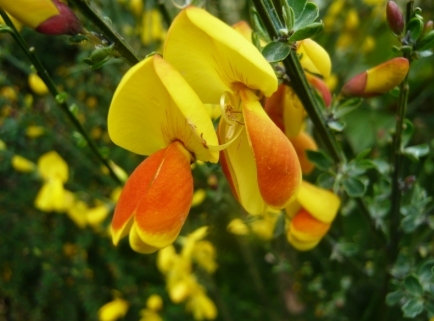
pea

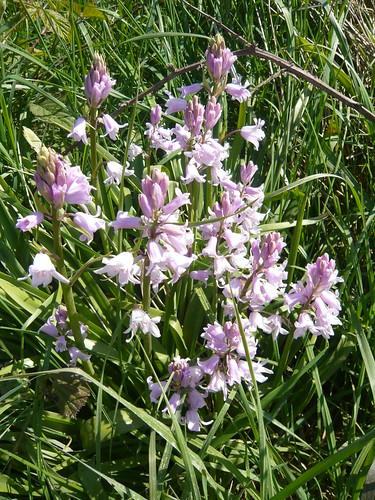
I am kicking myself for not noting the name of this alpine flower captured on my camera during a recent garden visit. The familiar pea shape and colour are reminisent of Cytisus or Broom but with 727 genera of Legumes I can’t be sure.

Gentle Reminders

  • Inspect plants close up to discover the natural beauty and make associations and links to other plants as the old plant hunters used to do.
  • The next reminder to myself is to make a note of a plants name when you have the chance to do so. My memory is totally fallible.
  • My vegetarian children eat the growing tops of Peas and I have resolved to  try eating them as well.

Legumes of the World is an authorative text on the range of leguminous plants but it comes at a price of £56 even from Amazon.
Comments

Azalea Growing Tips.

azalea

How do you tell an Azalea from a Rhododendron? Most Azaleas have only 5 or 6 stamen while most rhododendrons have 10 stamen. Azalea leaves tend to be thinner, softer and more pointed than rhododendron leaves. In a subjective way I think Azaleas produce more flower cover per plant.

Tips for Growing Azaleas

  • Azaleas are relatively pest-free  and easy to grow plants but may need a fungal spray if leaves are attacked in spring.
  • Azaleas like some shade  but deciduous varieties do well in full sun. Sun can produce more compact plants with more blooms but not as long lasting.

Read the rest of this entry »

Comments

Aquilegia Growing

aqu2

Aquilegia are growing and flowering in all parts of my garden at the moment. This Aquilegia canadensis or red columbine hybridises very easily and will self sow if left to its own devices. This Aquilegia Kansas looks very striking in tight groups.

aqu-honeysuckle

When I saw this photograph of Aquilegia colombine growing with  Honeysuckle the significance of the names escaped me. The Honeysuckle will flower a bit later than the Aquilegia which I will cut down after it flowers in the hope of a second flush of flowers later in the year.

horns

The horns of a dilema are shown on this close up of an Aquilegia flower. It pays to take the time to inspect individual flowers as well as the whole plant.
Read the rest of this entry »

Comments (1)

Conservatory Flowers for Winter

strelitza

Start six months ahead of time to plan for winter flowers and colour in your Conservatory or Glasshouse.

Growing Exotics

Streltzia regina or Bird of Paradise flowers are as exotic as they come. Keep them dry and remember that as part of the banana family Strelitza are ‘heavy’ feeders.
Succulents and Cacti are becoming popular again and the Schlumbergera or Rhipsalidopsis are worth persevering with.
Anthurium thrive at temperatures between 60-72 degrees and at lower light levels than other house plants.

Forcing Bulbs for Christmas

Narcissus Paperwhite are one of the most popular bulbs for indoor growing. Try White Ziva variety from Thompson Morgan.
Hyacinth bulbs give off a tremendous scent that can fill a room. I would certainly give them house room. Start them off in the dark and allow the roots to develop in the cool. Stagger the planting time and grow several varieties so you can have them in bloom from Christmas to April.
Another plant that continues to grow in popularity is the Amyrillis with very showy flowers.

Read the rest of this entry »

Comments

Berberis Varieties to Choose

berberis-orange

Berberis is a colourful low maintenance foliage plant with flowers, berries and prickles! Good Berberis are  prickly flowering shrubs often with fragrant flowers ranging in colour from pale primrose to pumpkin orange.

Choose your Berberis

  • One of the more attractive garden varieties shown above is the Berberis darwinii, with bright orange flowers in mid-spring.  An evergreen preferring full sun and a moist soil it grows slowly to around 8 feet. The flowers are followed by berries that feed birds and wild life through Autumn and Winter.
  • There is also the pink-flowered Berberis x stenophylla ‘Pink Pearl’.
  • The purple-leaved Berberis thunbergii loses its leaves in winter.
  • Look for Berberis thunbergii atropurpurea ‘Nana’ if you want to grow an attractive prickly hedge.
  • Berberis ‘Georgei’ AGM is a good specimen plant but it may be hard to find in nurseries because there are so many others on offer. In the wild there are 450 species and add to that the many hybrids and cultivars on offer.
  • Red leaved and asiatic species are often deciduous with red berries and good leaf colour in Autumn. Evergreens tend to produce blue-black fruits and are more shade tolerant.
  • Berberis thunbergii ‘Rose Glow’ is an eye-catching cultivar which has young leaves that are purple as they emerge and within a few weeks begin to show pleasing swirls of pink and cream variegation. Pale yellow flowers in spring are followed by small, shiny red fruit later in the year.

Read the rest of this entry »

Comments (1)

New Guinea Impatiens Failure

ng-imp

I have had a disaster with New Guinea Impatiens this year. Rather than grow from seed I bought a pack of half a dozen plants to grow on. The only trouble is they haven’t grown on but got sickly and hardly survived.

Errors and correct treatment

  • I used a peat based compost to pot them into. I should have used a faster draining soil based John Innes No 2.
  • The leaves have gone brown and limp because they were on a windowsill getting too much hot sun before they were strong enough. I should have given them less direct sun whilst young.
  • Once or twice I must have let the soil dry out. New Guinea Impatiens must have moist soil at all times and I regret not standing them on some gravel to help humidity.
  • I have not fertilized the plants but as they have barely grown in 6 weeks it is due to other health problems. Feed when growing.
  • I have not got red spider mite – at least I have saved them from that problem.

I gave some of the lilac flowered plants away so  am interested to see if they have done any better. I also put some of my sickly plants in a plastic zip up greenhouse outside so I am now off to see how they have done.

Comments (4)

Growing Heliotrope Plants

purple-haze

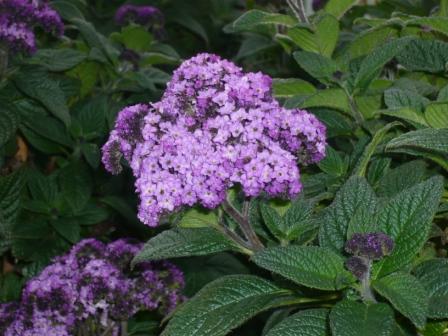
Heliotrope usually has dark green crinkled leaves and deep purple flowers. The flowers are among the most fragrant in the garden. I grow it as an annual from bought plants (a bit extravagant). Heliotrope were prized by our grandmothers in traditional cottage-gardens. There are several varieties with flowers in white and pale lavender. But I prefer the old-fashioned kind with dark green, crinkled leaves and deep purple flowers. It is quite dependable both in ease of care and reliable fragrance. Reminiscent of vanilla, the heliotrope’s scent gave rise to its common name ‘ the cherry-pie plant’.

Growing Tips

  • If over crowded they may suffer from mildew but are generally pest free.
  • Plant in plenty of sunshine.
  • Heliotrope needs pinching out when young . Pinch back the tips all over the plant early on, which forces lots of new side growth. You wait longer for flowers but get more of them eventually.
  • Removing faded blooms promptly results in a continuous show of pretty flowers starting in July.
  • Heliotrope  turns its flowers and leaves toward the sun over the course of each day. And at night it readjusts itself to face eastward, to be ready for sunrise. That tendency is at the root of the name heliotrope. It means to move with the sun.
  • Heliotrope is a member of the Borage family

Heliotropium arborescens or peruvianum are the species to consider growing but there are many species of Heliotrope not all of which are suitable for the UK.

Winter Heliotrope Petasites fragrans is native to the Mediterranean. As its name implies it produces attractive heads of fragrant, mauve flowers early in the New Year  however, the true character of the plant is thuggish. It is a large-leaved rampant perennial spreading by means of underground stems and is very invasive.

Comments

Next Page »