Lawns in Winter

Lawns in Winter

Don’t smoke your grass but cultivate it as a lawn.
January Lawn

You might get sent to the Tower of London if you damage your Lawn during winter. One gardener must be there as the picture of their lawn in January after the snow is shown above. You can start your own business with the book and tips below.

Winter Lawn Care

Do not walk on frozen grass the leaves and stems will snap and damaged patches will show when the frost has gone.
Do not walk on very soggy grass or when covered in snow as this will also damage turf and soil structure.
Do not be afraid to smarten up your lawn on a fine dry day. Trimming the edges and removing any dead leaves or debris always gives a lawn a lift.
If you want to cut the lawn set the blades on the mower at the highest level and give it a light trim not a short back and sides.

Preparation for a Summer Lawn

Read More Read More

Polygala chamaebuxus grandiflora

Polygala chamaebuxus grandiflora

Bastard box has colourful scented flowers and dubious parentage.

Polygala chamaebuxus grandiflora

Polygala chamaebuxus grandiflora is a low maintenance, hardy, evergreen sub-shrub also known as Creeping Milkwort, Chapparal Pea or Bastard Box. It bears racemes of purple-pink and yellow, pea-like flowers. Flowering is fragrant and profuse in late winter to very early spring, often with further blooms in summer.

Polygala chamaebuxus grandiflora is capable of forming a hump up to ten inches tall, but is generally flat to the ground and only two or three inches tall. Spread is  slow up to 2 feet but not fast enough for serious ground cover. This makes it useful in an Alpine garden setting.

They are underutilized plants for flowering early in the new year. It is worth finding some of these small plants and looking closely at the flowers as shown here.

Read More Read More

Bottlebrush Callistemon and Kunzea

Bottlebrush Callistemon and Kunzea

A red wine coloured bottlebrush flower
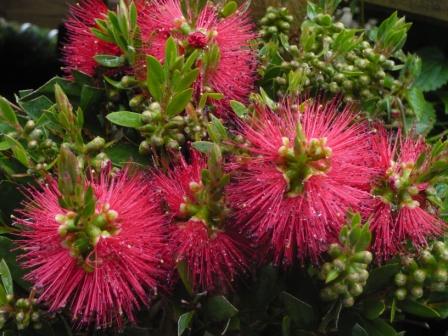
Callistemon is a native genus of Australia, with around 30 species of woody evergreen shrubs and small trees. They are commonly known as Bottlebrushes or the Bottlebrush plant because of the striking appearance of the flower spike. The flowers on the ends of branches are available in numerous colours including yellow, purple, pink and occasionally white.

Cultivation Tips
Callistemon are members of the Myrtaceae family and similar to Calothamnus, Kunzea and Melaleuca.
Callistemons can be propagated either by cuttings (some species more easily than others), or from the rounded seeds.
Callistemon ‘Splendens’ is not the hardiest of the genus and needs a warm, sunny wall to do really well.
Plants can be lightly pruned after flowering to keep them in shape.
A low-phosphor fertiliser should be applied in spring and autumn.
Mulching will help retain soil moisture and reduce weed growth.
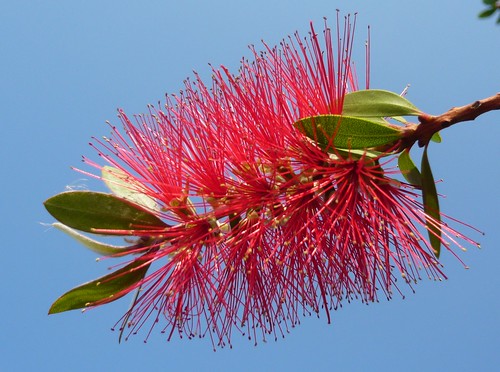
Bottle Brush
Varieties of Bottlebrush
Callistemon pallidus or the Lemon bottlebrush has flowers of pale yellow with cream stamens. There are many cultivars including Austraflora Candle Glow, a low growing spreading plant. Suitable for the coast they are hardy down to 20º F. Callistemon citrinus has been grown at Kew since the 18th Century.

Callistemon viminalis or Weeping bottlebrush has silky hairs on the branches and bright red flowers. The best forms commercially available are Hen Camp Creek and Luster Creek implying a need for summer watering.

Callistemon pityoides – Alpine Bottlebrush is a hardy and attractive bottlebrush is available in alpine form that grows as a compact bush to about 3 feet tall.

Kunzea Baxteri has dark greyish green leaves and bright scarlet bottlebush like flower spikes. It is less frost hardy than C. Pallidus

Start Gardening by Getting your Soil Right

Start Gardening by Getting your Soil Right

Where there’s muck there’s brassed off gardeners unless they have the right soil to take the extra nutrient.

Book Cover

‘The Gardeners’ Book: For the Gardener Who’s Best at Everything’ is really grand for novice gardeners taking up gardening for the first time or those seeking to grow some green fingers.

Improve Your Own Soil’s Consistency

  • Great soil contains air, water and nutrients appropriate for the plants you want to grow.
  • Digging soil over introduces air then weather breaks it down into a fine tilth.
  • Worms aerate soil and improve the texture. They feed on humus or rotting vegetable matter so encourage worms by feeding the soil with humus.
  • Sandy soil needs more humus to help it retain water. Clay needs more humus to hold the soil open for delicate roots.
  • Soil should drain excess water away so some stones are not a problem. If there are lots of stones and rocks remove them or grow plants that like those conditions.
  • Do not walk on very wet soil. Use a plank or duck board.

Bought Soil and Compost

  • Compost in bags can be perfect for pots and containers. It usually has some fertilizer, some wetting agent to make it easy to water and is of a consistancy that helps plants grow. It is not economic for larger garden areas although I use it in the greenhouse beds.
  • Peat, as well as being out of favour as unsustainable or eco-unfriendly, has no nutritional value and is hard to water once it dries out.
  • Top soil can be bought in various quantities but may contain stones, weeds and poor soil so beware.

The Right Soil Chemical Content

  • Plants need Nitrogen, Phosphates and Potassium (NPK) as food from the soil. Sun is the enegy to turn this food into growth through photosynthesis.
  • Hearty soil will have accessible NPK that can be augmented, for heavy feeding plants, with a balance fertilizer such as Growmore or Blood, Fish and Bone.
  • Some plants prefer a slightly acid soil from which to extract the nutrients and animal manure and peat mixed with your soil will increase the acidity.
  • Vegetables often prefer an alkaline soil so you can add a dusting of lime.

I thought my humus was a funny bone until they gave me the elbow.

Growing Monkey Flowers Mimulus & Musk

Growing Monkey Flowers Mimulus & Musk

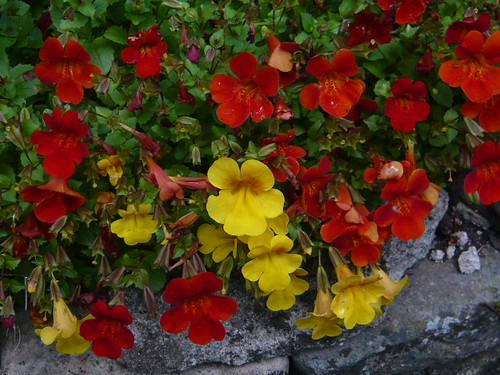
Not a relative of Monkey nuts nor peanuts when it comes to colour.

Musk

You can learn strange facts about nature from Gardener’s names for the different plants. Monkey-flowers are so named because some  flowers are shaped like a monkeys face and others have painted monkey faces.  Some species of Monkey flower (Latin name Mimulus) have a wet aromatic smell hence another gardeners name ‘Musk’.
However the item that caught my attention was Monkey flowers provide for for the Mouse Moth.

Growing Monkey Flowers

You can easily grow annual Mimulus from seed and they flower in 7-8 weeks.
You can also grow perennial Mimulus cupreus or M. luteus and in mild areas another Mimulus, the Scarlet Faced Monkey flowers may be hardy.
Most Monkey flowers grow in moist or wet soils with some growing in bogs or shallow water.
You can grow from plug plants called Magic rainbow
Monkey flowers grow well and bloom in partial shade.
Mimulus genome is being studied in depth and you can find out more at the Mimulus Community.

In the meantime I wait for the newspaper headline ‘Mouse eats Musky Monkey’

Musk

Plant Thickly for Maximum Effect

Plant Thickly for Maximum Effect

‘…when all at once I saw a host a host of golden daffodils’…

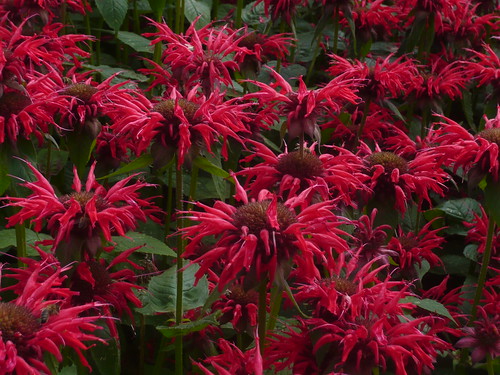
Monardia Gardenview Scarlet
I do not want to look at soil so I try get plants that will do an effective job!
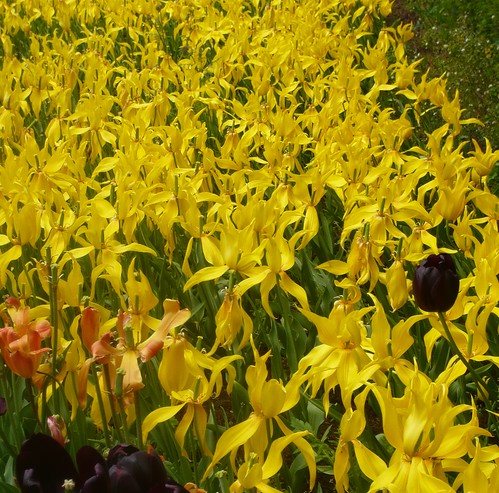
Why sow one when 100 will create a staggering display?
Why plant in small numbers when a surplus can be used for a flower arrangement or given away to friends and neighbours?
Why not garden to ‘shock and awe’ by maximising the impact of colour in a bed or border?

tulip pattern

Why read this idiot if you don’t agree with his views? (Oh I see from Google analytic s you are no longer a reader – shame)
Why use the penultimate letter of the alphabet to pose these queries?

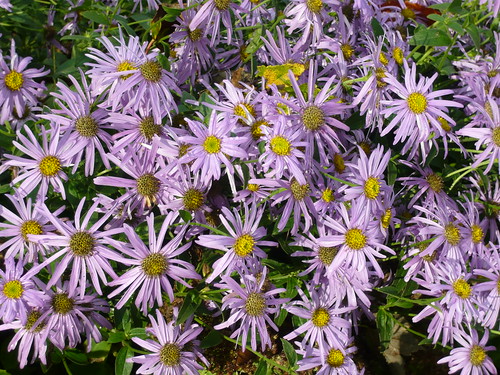
Aster

10 Parks Around the UK

10 Parks Around the UK

Park yourself on a bench in one of Britains top parks.
Book Cover

Top 10 most beautiful parks compiled by Rae Spencer-Jones extracted from 1001 gardens for the Daily Telegraph. If you can cope with 1001 garden visits then good on you…. but read the book first.

  1. Royal Botanic Garden Kew has a tropical plant festival in the glasshouse until March 2010
  2. Virginia Water – Saville garden and Valley garden have a varied and exotic woodland, landscape and garden to visit.
  3. Hylands Park Essex has a wide variety of interesting flora, fauna. There is also a large variety of mature trees including oak, ash, hornbeam, and field maple, plus an additional 25,000 new trees.
  4. Clumber Country Park Nottinhamshire is ideal for long walks or cycling so you need to be fit.
  5. Talkin Tarn Cumbria nestles in a 165 acre site, containing a glacial tarn surrounded by mature woodland and gentle meadows
  6. Coed y Brenin Gwynedd is Forestry commission land with lots of bike tracks.
  7. Healey Dell Nature Reserve Lancashire sits in a picturesque part of the Spodden Valley on the outskirts of Rochdale. It is rich in wildlife, with a fascinating archaeological history
  8. Stanwick Lakes Northampton is a unique countryside attraction in the heart of the Nene Valley very good for wild life.
  9. Normanby Hall Museum and Country Park Lincolnshire with a walled garden, house and farming museum to complement the Park
  10. Vogrie Country Park Edinburgh has 250 acres of natural trails, a walled garden and ponds. The 19th-century landscape includes trees brought to Scotland by plant collector George Forrest. Great for walking.

Lister Park
Lister Park Bradford.

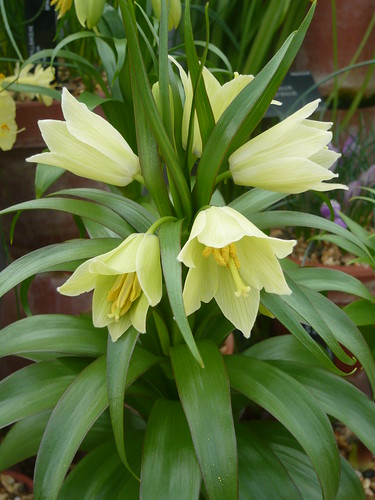
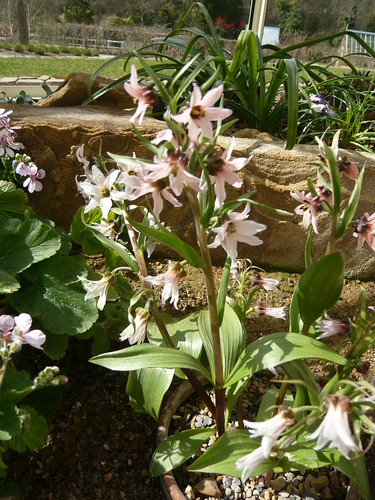
Fritillaria or Fritillary Flowers

Fritillaria or Fritillary Flowers

Good Frits for pot culture
Fritillary

Fritillaria is a genius genus of over 100 species of bulbs from the lily family with an attractive and graceful habit. They generally grow about 4-12 inches in height and have pendulous bell shaped flowers of yellow, orange, purple, green or white in the spring. they often have a chequered green or brown colouring.

In Germany this handsome flower is also called Lapwing-egg, Chess Flower and Boardgame Flower (in German I suppose) Some common English names include Fritillary, Toad lily, Snake’s Head Fritillary, Guinea hen flower and Crown Imperial.

  • If these Fritillaria are grown from seeds sown fresh they will yield more bulbs than one would have obtained from offsets of the old bulbs but they can be slow to produce plants of flowering size.
  • Many of the species are suitable for the frame or Alpine house but are also grown in borders and grass (Fritillaria meleagris the Snake’s Head is seen like this in Magdalen College Oxford).
  • Other species to look out for include the small Fritillaria tubiformis and its hybrids, Fritillaria verticillata with white bells on a taller plant and Fritillaria camschatcensis (the Black Sarana) with a very dark maroon almost black flower.
  • The Crown imperial or Kaiser’s Crown Fritillaria imperialis can grow to an imposing 3 feet and is best planted at least 10″ deep.
  • For information on Fratillaria gentneri see the National collection of imperiled plants

Lady Margaret Hall April 2010

Frittilary

Conifers for Winter

Conifers for Winter

Conifers are not just for Christmas! For shape and colour a winter garden needs conifers.

These conifers match our colour scheme and show up well in the winter garden.
If you buy small conifers in pots they will give you years of pleasure.
Be warned if they grow 10% a year they will double in size in 7 years and be 8 times the size in 20 years. From my experience many varieties grow at more than 10% per annum.
Special dwarf conifers, ofter from alpine nurseries have been selected from sports of larger conifers and can remain stunted without looking awkward

Read More Read More