Browsed by
Category: Environment & Green Gardening

Tips for ecologically friendly gardeners and gardens that green and protect the environment.

Wild Garden Must Haves

Wild Garden Must Haves

If worms live a a wormery where do bugs live?
RSPB Wildlife Stack
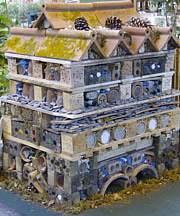
If you want a haven for wild life in your garden Mick Lavelle has ten ‘must haves’ for you to incorporate. This picture of a wildlife palace from the RSPB archive shows how to create food for birds by protecting insects – see construction details below.

Wildlife Shelters

  1. Log piles mimic fallen trees and provide shelter for wood boring beetles insects and amphibians.
  2. Hedgehogs need shelter in daytime and for hibernation. A Habitat stack can provide these if you create a mixed environment with a wood pallet basement followed by a brick pile and layers of tiles, rubble, twigs and logs.
  3. Leaf piles are usually rich in overwintering insects and form a loose structure for lots of wildlife.
  4. Bee and Bumblebee boxes can be as simple as bundles of open ended garden canes to provide a resting spot for Bees.
  5. Rock piles provide nooks and crannies for shelter and security. A mixed herediment will offer the best overall shelter with a bit of everything for lots of creatures

Wildlife Feeding Environments

  1. Wildflowers and grasses provide seeds as food and ‘escape cover’ for amphibians moving from a pond.
  2. Bird feeders are more commonplace than ever but make sure they are filled with appropriate food and kept clean.
  3. A clump of nettles provides food for leaf eating caterpillars and nectar for other insects.
  4. A pond should be at least 18 inches deep to prevent over heating. It provides drink, food and a living space.
  5. If space permits a bog garden of wet mud will be a habitat for invertebrates and provide mud for nesting swallows and swifts

Gardeners’ World”: 101 Ideas for a Wildlife-friendly Garden

Read More Read More

Purple Flowers that Attract Bees

Purple Flowers that Attract Bees

Is it the nectar, pollen or colour that attracts bees to flowers. May be it is all three!
Just watch bees swarm over Thyme when in flower.

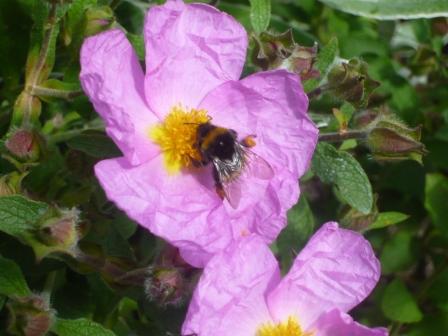
b-cistus

Cistus only seem to flower for one day then the petals drop. Resting in the sun this Bee seems content with life.

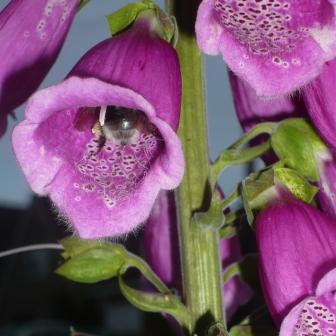
069

Foxgloves have long tubular flowers so the Bee has to crawl right in to get the nectar. This moves pollen from flower to flower and Foxgloves then produce thousands of small powdery seeds.

Read More Read More

Container Gardeners Tips

Container Gardeners Tips

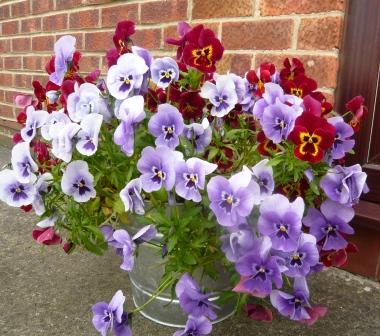
container-gardening

Silver champagne buckets or plain galvanised steel, there is a container for every purpose. These Pansies contrast with the brick wall and almost cover the container.

Gardeners Container Tips

  • Wether using a pot, tub, bowl, trough or urn make sure there is a drainage hole to allow rain and water to escape. Plants can drown far too easily.
  • Select the material for the container to complement the garden design and chosen plants. Stone, wood, plastic and metal containers are freely available.
  • For a conservation garden ‘found materials’ can be made into a container. A  hollowed out log, old barrel or any container coated in a slurry of concrete and yogurt or peat can look and do good.
  • You may plan to use a containers for one season or several years. Use compost that will suit the conditions eg John Innes no 3 for trees and shrubs or peat substitute for annuals.
  • Plan the planting to soften the edges of the container with plants spilling over. Do not leave a lot of soil showing as it will look sparse.
  • When planting from a pot use the current pot to make a suitable sized hole shape in the container so you can drop the plant straight in and firm it easily.

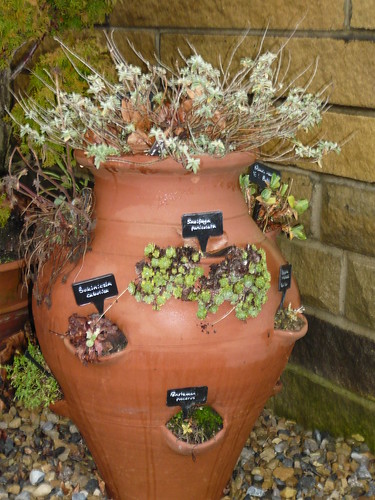
Alpine Strawberries

Outdoor containers made from terracotta or pottery need to be frost proof to avoid cracking. It is also advisable to lift them off the ground so they do not freeze to the path. A hard frost can see the base left behind when the pot is moved. To prevent this you can buy small pot feet, put the container up on bricks or stand it on some gravel or bubble wrap.

Winter Container Care Tips
Keep winter containers out of cold drying wind for the best results. Any shelter will be appreciated by plants that have to do battle with winter conditions.
Winter can often have dry spells so keep an eye on pots that may need some watering. This is also true of pots under roofs and eaves.
I like to use a woooden tub or half barrel and start by lining the container with a few bits of broken flowerpot or polystyrene for drainage.
Plant pre-grown bulbs before adding the other plants with trailing plants at the edge of the container. You can bury small pots in a larger container and change them as necessary.
Plants grow more slowly in winter so pack them in fairly close together to get a quick effect.
If you have special plants that do not like their crowns to get wet put a glass cover over the pot.

Berry Bushes for Birds

Berry Bushes for Birds

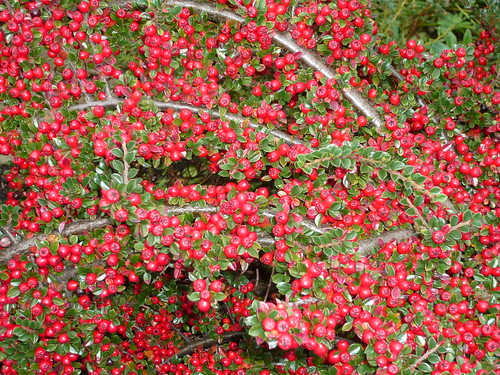
cotoneaster berries

If you like birds in your garden encourage them with appropriate plants.

Some birds like the seeds in the berry others are keen on the fruit as a whole. Fieldfare, redwings blackbirds thrush and sparrows are just some birds that like a berry good feed.

Deciduous Berry Bushes

  • Berberia thunbergii will thrive in full sun producing small flowers and long lasting red berries.
  • Dog woods like cornus alba will produce creamy white flowers followed by grey coloured berries. Cornus florida is a tree rather than shrub with red berries.
  • Malus floribunda or Crab Apples are potentially very decorative and produce an abundance of fruit.
  • Mountain Ash or Sorbus aucuparia is a small tree with sprays of orange or red berries in autumn.
  • Viburnum trilobum has glossy leaves turning red in autumn. The berries are bright scarlet.
  • Most of these berry bearing bushes have good autumn leaf colour. They all earn there place in the garden.

Read More Read More

Wildflower Seed Suppliers

Wildflower Seed Suppliers

new-picture-3

In addition to our sponsors, Thompson Morgan click on advert to buy your seeds and sundries, the following companies supply Wild Flower seeds and plants.

Reputable suppliers will not take plants from the wild or endanger any threatened species. Most offer advice and will help select a range of seeds appropriate for the location and region where they are to be grown. Native species will perform better and be more use to wildlife. Seed mixtures are usually available and are an economic and successful way to buy.
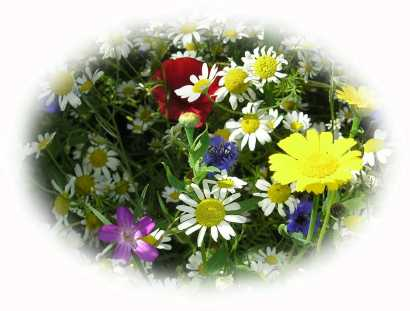
wild flowers

Top Suppliers

  • British Seed Houses Ltd  01925 654411
  • John Chambers 01933 652562
  • Landfill Flowers Ltd 0151 7371819
  • MAS      01249 819013
  • Emorsgate Seeds  01533 829028
  • Naturescape  01949 851045
  • Natural Surroundings  01263 711091
  • HV Horticultural   01747 811778
  • Yellow Flag Wildflowers   01452 311525

Website for Wildflower Plants

Green Roof Of Sedum or Grass

Green Roof Of Sedum or Grass

Bear the weight of wet soil in mind but enjoy the fun of a green roof. Try maintain easy access to make life simpler.

grass-roof

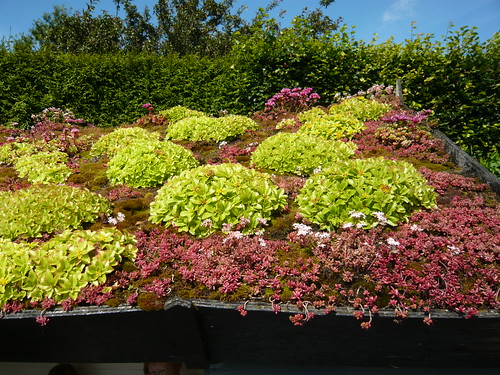
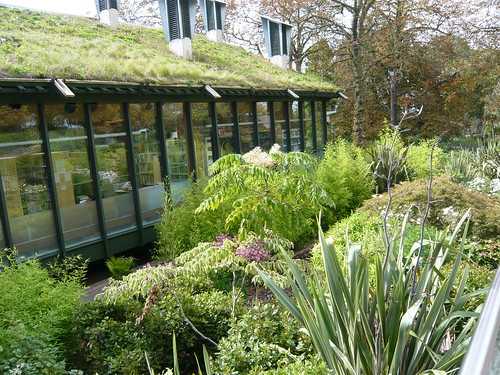
The Ecology Building Society as befits it’s brand values has a green roof on it’s HQ building. Green roofs can be a mixture of grasses or Sedums or both and all have similar benefits.

Benefits of Green Roofing

Golden Acre green roof

  • Improves energy efficiency with a natural thermal insulation.
  • Green roofs remove CO2 from the atmosphere to maintain the area of green plant growth.
  • Providing a natural and safe area for insects and a aesthetically pleasing wildlife habitat.
  • Good sound insulation is provided by the layers needed for a green roof.
  • Water and run off drainage control is increased.

Further Tips

  • The independent Green Roof organisation ‘livingroofs’ has more information.
  • Seed mixes are available containing plants able to withstand the rigours of a roof top environment species such as Chives, Oregano, Blue fax, White Stonecrop, Tunic flower and Ornamental grasses.
  • Sheffield University hosts the Green Roof Centre

Green roof

Gardening for Wildlife

Gardening for Wildlife

Book Cover

This book is a joint publication between RHS and the Wildlife Trusts and covers a surprising array of subjects in an easy to follow manner. I have picked up some quick tips to put on my Twitter feed.

The Wildlife Trusts

  • With 765,000 members The Wildlife Trusts are the largest UK voluntary organisation dedicated to conserving the full range of the UK’s habitats and species, whether they be in the countryside, in cities or at sea.
  • Wildlife Trusts manage 2,256 nature reserves covering more than 90,000 hectares. They stand up for wildlife, inspire people about the natural world and foster sustainable living.
  • Wildlife gardening is much more than just making friends with the local birds, hedgehogs and dragonflies. It’s a way of connecting to the whole web of life. Years ago the countryside was rich in wild plants and animals but today that’s no longer true. Many of the creatures that thrive in gardens – for example frogs, goldfinches and sparrows are having a hard time in their old haunts.
  • Gardeners can make a real difference. Key garden features are trees and hedges, dead wood, water, and a real variety of plant shapes and sizes. Once we provide these simple needs, we can see gardens not just as our outdoor rooms, but as an interconnected network of green patches that together amount to a very special nature reserve whether in the heart of the metropolis, or within the wider countryside.

Tips for Wildlife Gardening

Read More Read More

Scented Wild Flowers by Family

Scented Wild Flowers by Family

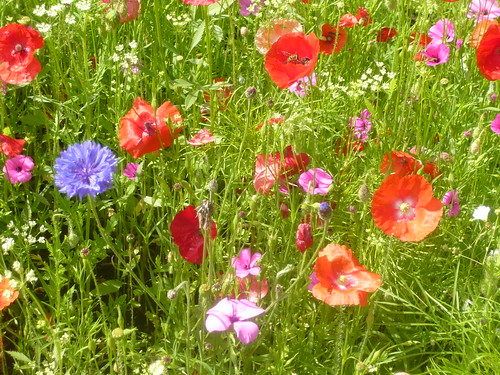
Opium may be a perfume that owes it’s history derived from wild poppies.
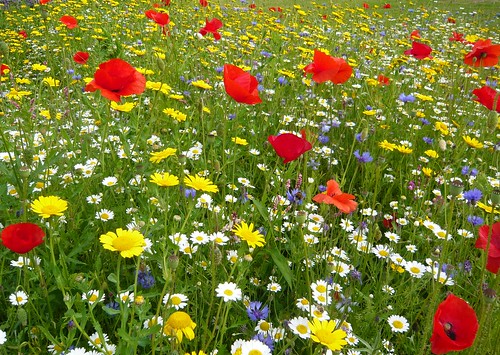
Wild meadow

Masses of wild flowers can produce a scented atmosphere that is second to none. Many plant families have scented species so sniff out your favourite.

Explanation why Wild Flowers are Scented

  • Scent is the oxidisation of essential oils of flowers and leaves.
  • Oils are mainly found on the upper surface of petals.
  • The most scented flowers are those with thick velvet like petals which slow down the evaporation of the scent.
  • Double white flowers like the rose are especially fragrant.
  • Oils are produced in inverse proportion to colour pigment which is why orange and scarlet flowers tend to have less scent.
  • Scent is classified into 10 and more groupings.

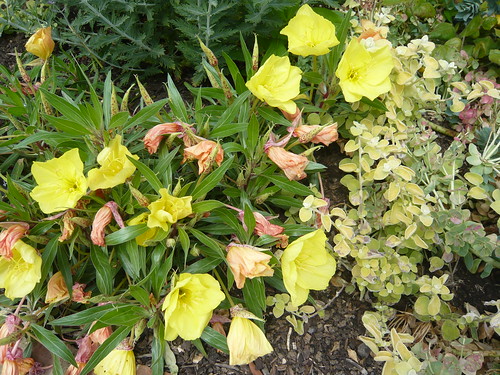
Evening Primrose

Read More Read More

Gardening for Birds

Gardening for Birds

Where have all the blackbirds gone?

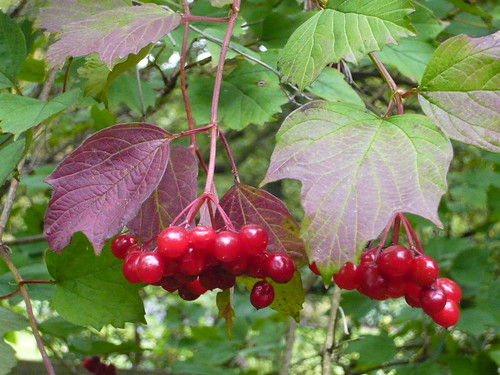
Viburnum opulus xanthocarpum

Are you bird friendly letting insects thrive, growing berried shrubs and trees and leaving a natural area in your garden? If so then you know the way to attract more birds into your garden is via the birds appetite.
I have been encouraged by the sight of Redwings and Fieldflares during this snowy winter gobbling up the many berries in the garden. The first to go were these Viburnum followed before Christmas by the Holly berries which never seem to last on the trees until Christmas.
Perhaps the birds are attracted by the red colouring because Crab apple Red Sentinel is also pecked to death later on in winter. The Redwings were the gross feeders on my Cotoneasters but there is still a snack or two left for the next snowfall. The Pyracantha are well sorted probably by Thrushes but I never seem to catch them eating.

If you want to give birds a supplementary feed then high energy foods are best in winter. It is no use feeding something that needs a lot of energy to consume so Sunflower hearts, crushed Peanuts, Fat balls, Nyjer seed and even raisins are popular.

Read More Read More

Top Ten Vegetables from Gardeners Tips

Top Ten Vegetables from Gardeners Tips

A million gardeners everyday pick up a spade and thank the beans.

organic-vegetables

Every list of top ten vegetables to grow your own would probably differ, mine would vary based on season, current successes and even personal hunger. Most of this top selection of ten varieties are part of the RHS vegetable collection available from Thompson & Morgan amongst other seed merchants.

Broad Bean Bunyards Exhibition
One of my all time favourites, Bunyards Exhibition has a very good flavour and is excellent for freezing. They prefer a well-drained, moist, rich soil. A reliable performing heavy cropper with of long pods it will grow in most soils.  Pick regularly once pods are full to promote further pod production. Support the plants as they grow by placing a cane or stout stick at each corner and tying in with string. Keep well watered particularly when flowers are setting. Pinch out growing tip when first flowers set pods to deter blackfly.

Read More Read More