Browsed by
Category: Articles

Gardening articles that may not include tips

Evergreen Climbers

Evergreen Climbers

Not to everyone’s taste but Ivy or Hedera species are the most frequently grown, year round, climbing plants. Try these alternatives.
Kew 056e

5 Top Evergreen Climbers

Solanum crispum ‘ Glasnevin’ is a shrubby climber that needs to be tied in to wire supports. It will repay with prolific blue blossom with yellow stamen during summer and autumn.
Lonicera henryi has purple flowers followed by small black fruit. It is a good twining and climbing plants to grow up vertical supports.
Lonicera japonica variety Halliana is another honeysuckle this time with scented yellow flowers. It will only loose the leaves if the winter is exceptionally harsh and cold.
Trachelospermum Jasminoides is heavily scented when in flower. It grows aerial roots and like most scented climbers prefers a warm south facing wall.
Clematis armandii flowers in late winter and covers a large area such as a wall or fence clinging with twisting leaf stalks.
Ivy

Evergreen Ivy Tips

Try a variety other than common Ivy such as Hedera colchica ‘penata variegata’. You get better colour or leaf form but retain all the benefits.
Ivy provides food and shelter for wildlife and a year round backdrop for your garden.
The aerial roots should not damage a sound wall but the young rootlets may loosen bad mortar.
The leaves can be plaited to create wreaths or used as a filler in decorations.
Ivy can be grown on steep sloped as ground cover that protects soil from erosion.
Ivy

Photo credit
Kew 056e by Michelle Bartsch CC BY-NC-ND 2.0
Ivy by R~P~M ‘Ivy leaves at sunset, Lower Salden Farm, Mursley’ CC BY-NC-ND 2.0

All a Gardener Wants for Christmas

All a Gardener Wants for Christmas

What should you give your gardening relatives for Christmas?
Not an out of season plant that will doubtless die after a short indoor performance.
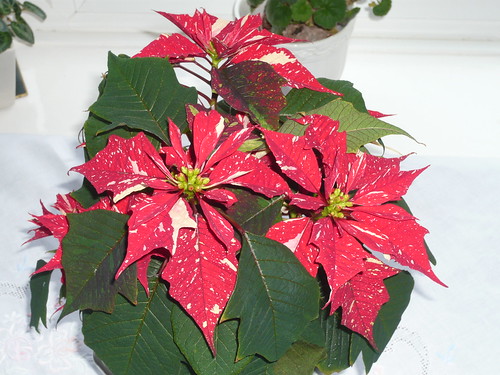
Nor in my mind a Poinsettia that will shed its leaves no matter how good a gardener they are (because it has already stood in a draught.)

Poinsettia

As a keen gardener I would be happy to receive vouchers at anytime and at Christmas it beats a shirt, tie or socks into a cocked hat. No I do not need a cocked hat either unless it keeps the rain off.

Vouchers for Gardeners

Amazon vouchers. The range of garden and outdoor products is now quite large and I love gardening books into the bargain.
National Garden tokens are accepted by lots of garden centers and some nurseries.
Seed and supplies are available on tokens from Thompson & Morgan They also accept Tesco Clubcard voucher, Copella voucher, Woodland Trust voucher or Garden News Society vouchers.That is just as well as their vouchers are hard to order on line!
Local nurseries and garden centers often sell vouchers which are bespoke to one nursery (I can always use them for dry goods if there are no plants I want)
Larger multiples – B&Q Gift Cards can be spent on anything at all UK B&Q stores, including the massive range of gardening goods. From sheds to shears, they make a great garden gift. Argos Gift Cards can be spent on the catalogue store’s complete garden range including barbecues, garden decoration, garden power tools and lawnmowers
RHS gift vouchers make great presents and are accepted in any RHS shop, along with HTA vouchers.


Alternative Garden Gifts

If it is a close family member we often make our own homemade gift vouchers. The gift may be cash, time or a service and is often well received as it is very personal.
You can make your own voucher from garden material or the back of a flower photograph. It is the thought that counts.
If you promise some labour don’t forget to deliver on your promise.
Small gifts can be found in cheap ‘pound’ shops – garden twine always comes in and a favourite Aunt may be amused by a plastic snail or garden ornament.

Book Cover
36 Great Christmas Presents for Green Thumbed Friends and Relatives [Kindle Edition] by R.J. Ruppenthal

Top Ten Styles of Garden

Top Ten Styles of Garden

Garden design and style is influenced by Gardeners, Location, Objectives and Resources. No two people would design the same garden for the same space nor would that garden grow and develop in the same manner.
Style is a personal choice made by the gardener but influenced by nature.

Top Ten Garden Styles

  1. Alpine or Rock garden
  2. Cottage garden
  3. Wild or Environmentally friendly garden
  4. Walled or Victorian garden
  5. Family and traditional garden
  6. Fruit and Vegetable plot
  7. National garden, Italian, Japanese, English, Swiss, Spanish, New Zealand or Mediterranean
  8. Sculpture garden
  9. The Peace garden
  10. Water garden

There are so many gardens that could be designed that a top 10 list is subjective in the extreme. The content of the garden then goes to the heart of the gardens style.
A woodland garden came very close to inclusion in out top ten and is a natural feature that many want to cultivate.
We could have selected a ‘garden of rooms’ but that is often a ‘technique’ used in many of the above types of garden.
Specialist plantings like Rose gardens or Herbaceous gardens could have had there own spot but I had to finish somewhere.
Top of the shop should have been my garden (or my wife’s and our garden).

Strawberries Growing on Trees

Strawberries Growing on Trees

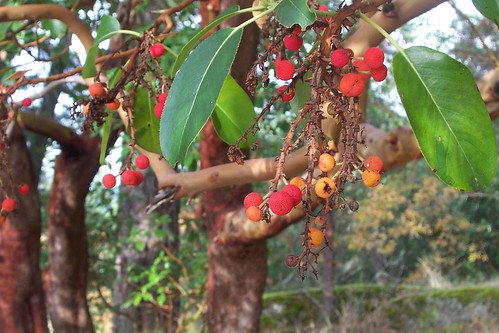
With knobbly fruit that are all dimpled and uneven Arbutus unedo is a group of trees and shrubs that fruit with strawberry like red berries.

Variegated Arbutus unedo
Variegated shrubs such as ‘Ukigumo’ are successful grown in shade.
Fruiting is less dominant on variegated forms. The round knobby fruits gradually ripen to strawberry red.
The evergreen glossy foliage can be quite beautiful. The cinnamon-colored bark is also attractive.

Arbutus berries

Arbutus unedo ‘Compacta’, Killarney Strawberry Tree from Thompson Morgan
‘This striking shrub makes a superb focal point for year-round interest. Its leathery, evergreen foliage and peeling, cinnamon brown bark form a superb backdrop for the clusters of small, white, urn-shaped flowers in autumn. The dainty blooms give way to scarlet red fruits that only fully ripen in the following year, as a new set of flowers emerge. The edible fruits of Arbutus unedo ‘Compacta’ have a sharp aftertaste when eaten raw, but can be made into jams and preserves for a sweeter, guava-like flavour. This neat, compact variety is an ideal specimen shrub for a sheltered position. Although perfectly hardy once mature, Arbutus will appreciate a layer of fleece for winter protection when young. ‘

Arbutus andrachneor the Greek Strawberry Tree is less hardy in the UK as it is native to the Mediterranean.

Arbutus unedo

Photo credit
Arbutus berries by GerryT CC BY 2.0
Arbutus unedo by Xevi V CC BY-NC-SA 2.0

Osmanthus Shrubs and Uses

Osmanthus Shrubs and Uses

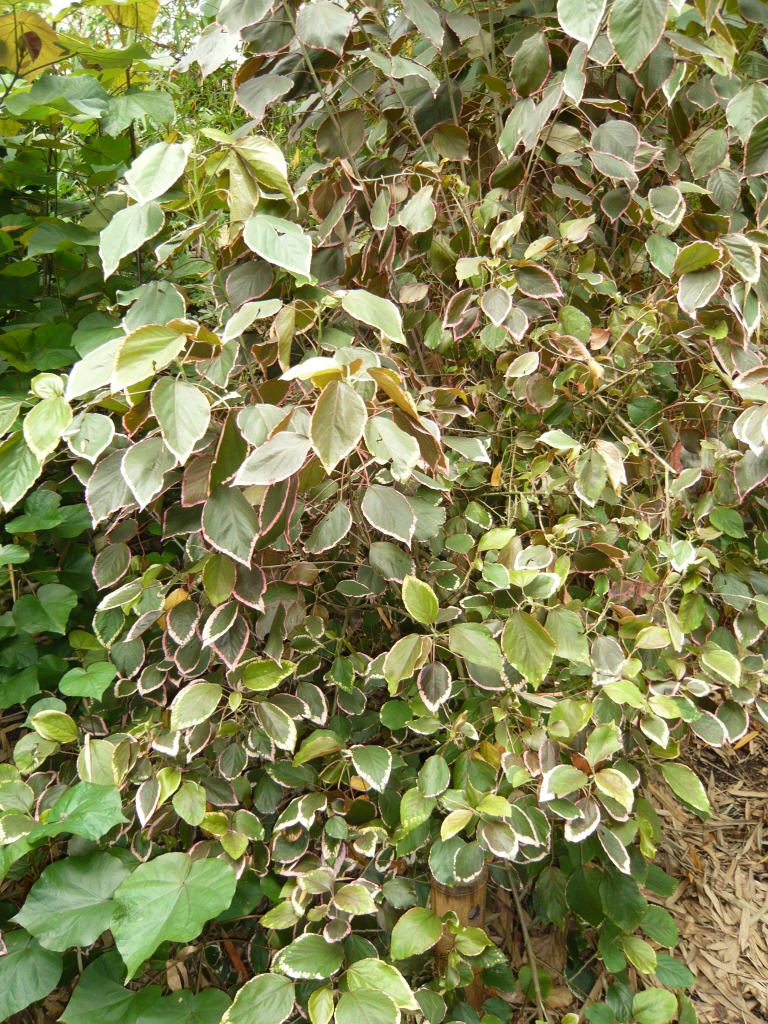
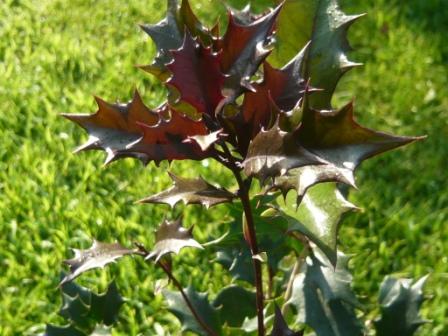
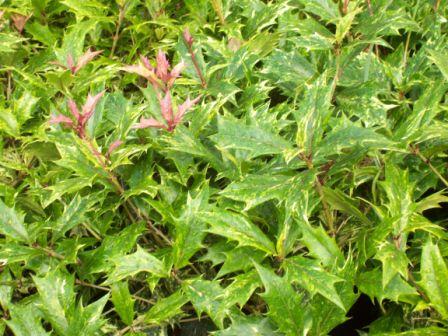
Osmanthus is an attractive genus of evergreen shrubs. The leaves are holly like with a leathery texture and spikes. The young leaves are green, red, cream or purple and below is a variegated example.
This variety O. hetrophylus is slow growing but can make a dense hedge or small tree. The flowers are sweetly scented in autumn.

Other Osmanthus and Uses

  • Osmanthus delavayi grows upto 6 foot tall and wide with fragrant white april flowers. It can be grown as a small tree.
  • Osmanthus yunnanensis ‘New Zealand Holly’ a fast growing large shrub with olive green leaves with flowers that can be a bit of a let down.
  • Osmanthus americanus ‘Devil Wood’ is a bit tender in the UK.
  • Osmanthus x burkwoodii which has small leathery leaves and fragrant white flowers in late spring. It can make a good hedge.
  • Osmanthus heterophyllus ‘Variegatus’ can be used as ground cover.
  • Osmanthus heterophyllus ‘Goshiki’ is an evergreen compact, fairly slow-growing shrub with dark-green, holly-like leaves.

Gardeners Top Tip
Osmanthus are cheap to buy when small, easy to grow and care for and are strongly recommended for a mixed border or ornamental woodland.

Gardeners Tips Favourite Links

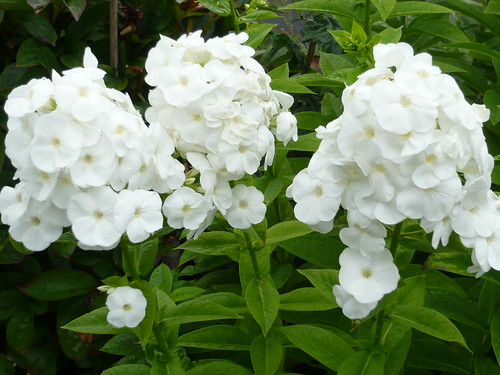
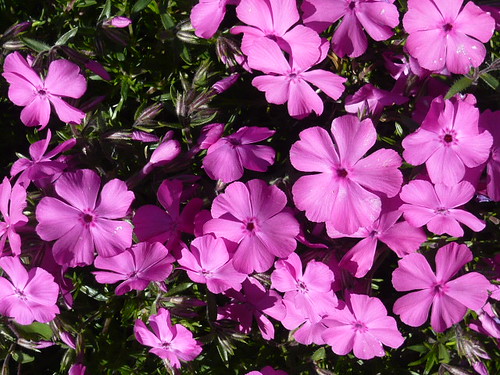
Photos of Phlox Species

Photos of Phlox Species

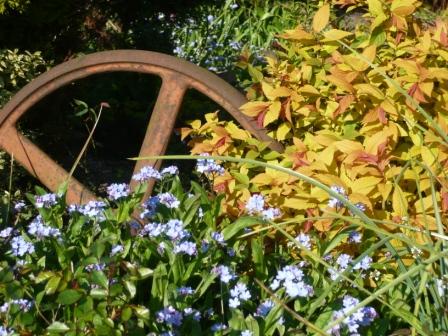
Phlox 'wagon wheels'
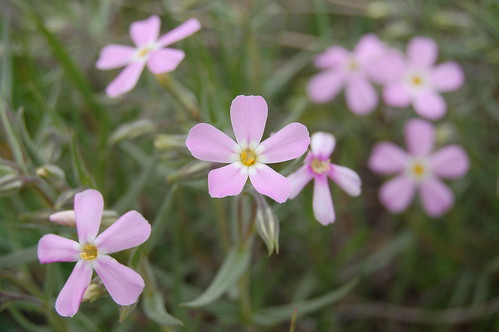
Phlox adsurgens a mat forming evergreen with a cheery springtime display of star-like flowers in pale pink.

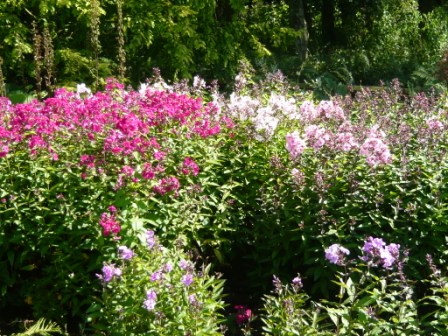
Phlox paniculata
Phlox paniculata

Phlox
Phlox subulata a rockery favourite

Various Phlox are available from Thompson & Morgan Including:-
Phlox drummondii ‘Phlox of Sheep’ an annual
Phlox subulata,
Phlox douglasii or Moss Phlox for fragrant ground cover.
Phlox divaricata ‘Clouds of Perfume’ also known as Wild Sweet William, Blue Phlox or Woodland Phlox
Phlox Hybrida Compacta ‘Peppermint Candy’
Zaluzianskya capensis Night Phlox with a honey fragrance in the late evening

Book Cover
Phlox: A Natural History and Gardener’s Guide by James H. Locklear

Downy phlox
Downy Phlox pilosa

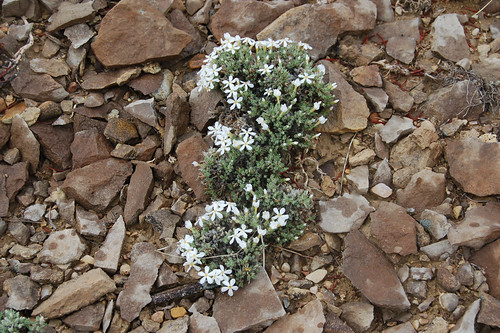
Phlox hoodii var. canescens (Carpet phlox)
Phlox hoodii var. canescens aka Carpet phlox

Phlox stolonifera (Photo Credit: Dexter Hinckley)
Phlox stolonifera at UDA National Museum of Natural History’s Butterfly Garden.

Phlox longifolia closeup DSC_0320
Phlox longifolia

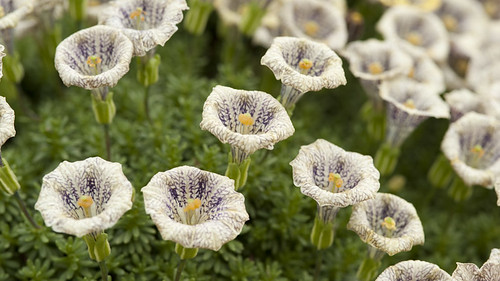
Opal phlox in the Alpine House
Phlox opalensis flowering in the Davies Alpine House and in the wild in Wyoming and Utah.

Photo and other Credits

Downy phlox by eleanord43 CC BY-NC 2.0
Phlox hoodii var. canescens (Carpet phlox) by Tony Frates CC BY-NC-SA 2.0
Phlox stolonifera (Photo Credit: Dexter Hinckley) by samantha.schipani CC BY-NC 2.0
Phlox longifolia closeup DSC_0320 by Tony Frates CC BY-NC-SA 2.0
Opal phlox in the Alpine House by Kew on Flick CC BY-NC-SA 2.0
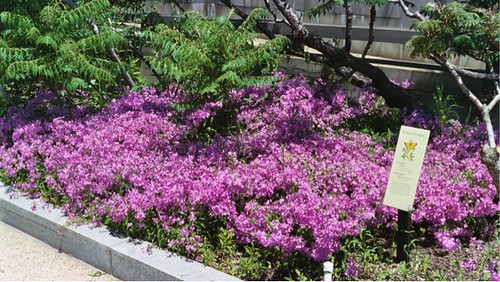
moss phlox シバザクラ by microwalrus CC BY-NC 2.0

moss phlox シバザクラ
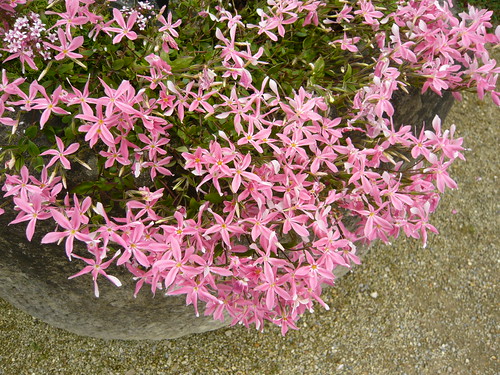
masses of Moss Phlox subulata

Google Killed my Seeds

Google Killed my Seeds

My garden tips web site is being killed by Pandas and Penguins. These alien species have been imported by Google and are destroying the search rankings.

The search rankings were the main way to access the circa 2,000 pages of tips, hints and photographs on this web blog. Thousands of amateur gardeners read one or more pages every day until Google changed the rules. This new garden pest is called an algorithm and they breed at the expense of smaller web sites. 80% of the traffic has disappeared even though we try to comply with all the Google rules.

If you want most of your searches to take you to the BBC, Wiki, RHS or big businesses selling you a product then Google is the tool for you!

I can’t claim to be growing seeds of wisdom nor germinating the next great garden writings but Google used to give me and other bloggers an opportunity to share and shine.

For the Future

If you like idiosyncratic observations from a practicing gardener, with a warts and all approach, then sign up for our RSS feed. (I do not understand what sort of fertiliser this feed is but my son recommends it.)
The 5,500 photographs of gardens, plants and flowers, many or which feature on one or more pages, are still available to view on Flickr.

Euphorbia atropupurea

Why chose to illustrate the article with a Euphorbia? Well the sap is irritating but it won’t kill you.
Despite Google I will keep planting blogs and hope they grow in popularity.

Colour Can Con Gardeners

Colour Can Con Gardeners

Colour is a complex science and not a subject for the colourblind to take lightly.

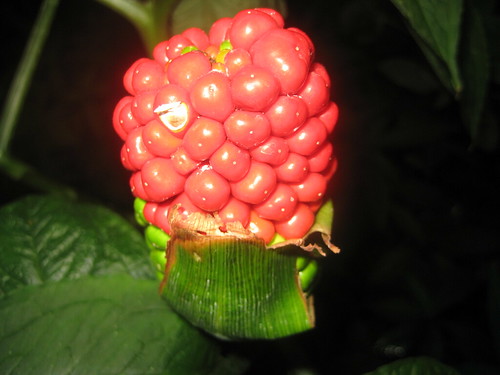
Kew Gardens September 2010
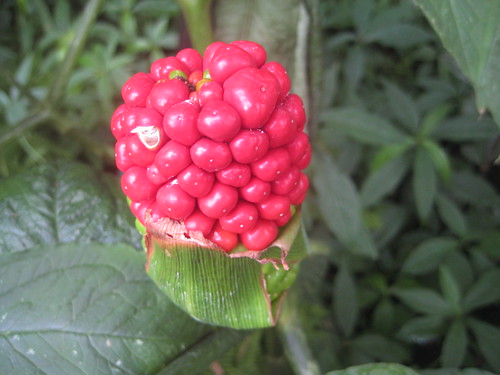
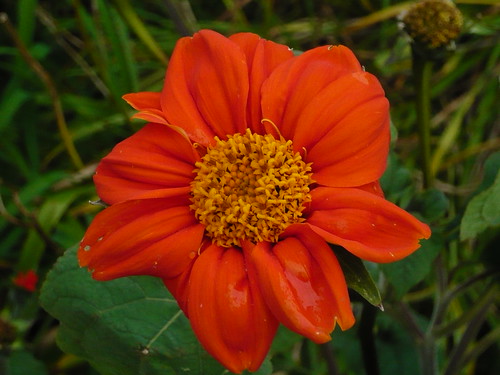
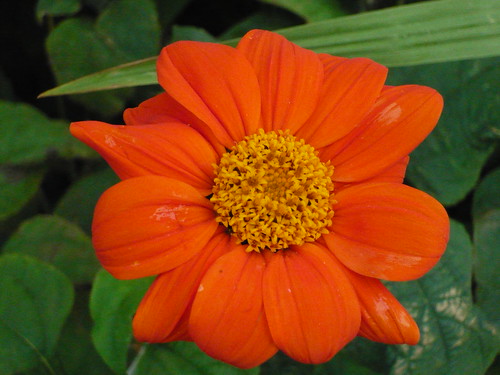
Both of these images were taken virtually at the same time and of the same plant. Is it red or orange seed capsules that are right. If the plant is Arum maculatum a Lords and Ladies plant then orange would be the favoured colour.

Kew Gardens September 2010

Light has a temperature and like a ‘white hot’ metal it can look dark red through orange to a burnt out white.
See the ‘Fearless Colour Gardens: The Creative Gardener’s Guide to Jumping Off the Colour Wheel

Harewood 052
It comes as less of a surprise when sun and shade affect colour perception as in this pairing.
Harewood 081

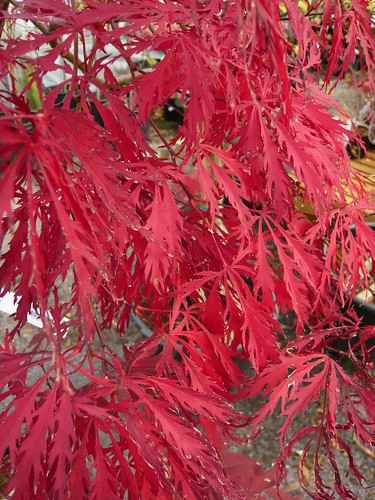
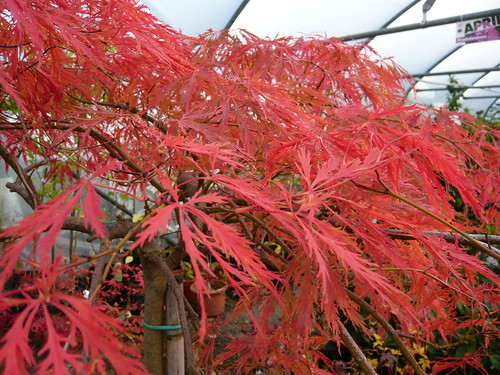
Acer palmatum disectum

Colour saturation can vary with the tone of pigment but is more likely to be a function of the camera and photographic settings.

Acer palmatum disectum

Frost 005
Reproduction is the last variable we are considering in this set. Electronic screens ipads, phones, Tv’s etc vary more than printed matter. Even print can often look quite different as plates and blankets wear.
Frost 006

For more on colour visit the The Society of Dyers and Colourists Colour Museum in Bradford

Hosta Flower Photographs

Hosta Flower Photographs

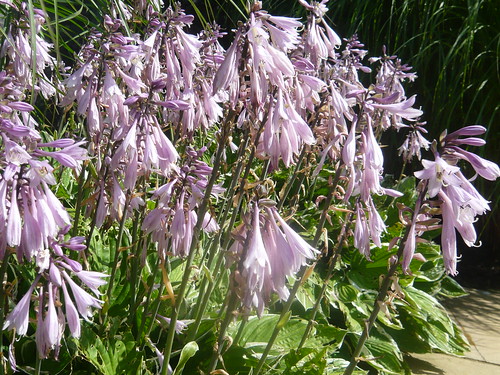
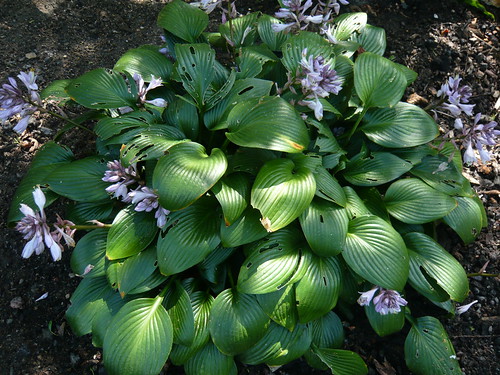
Hosta flowers
A mass of purple flowers show that Hosta can produce the goods. They are also good for flower arranging.

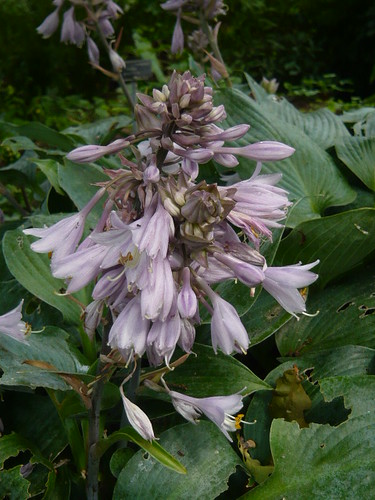
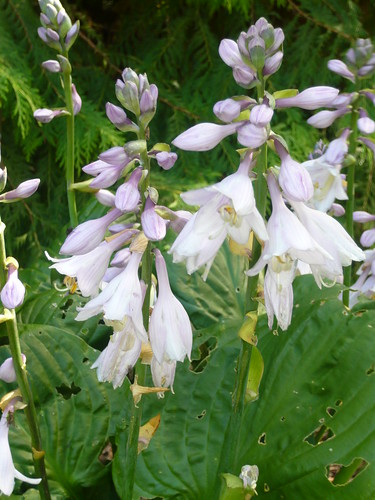
Hosta slug fest

These flowers stand proud of the leaves which are just beginning to suffer slug damage. Flowers from June to October with funnel or bell shapes.

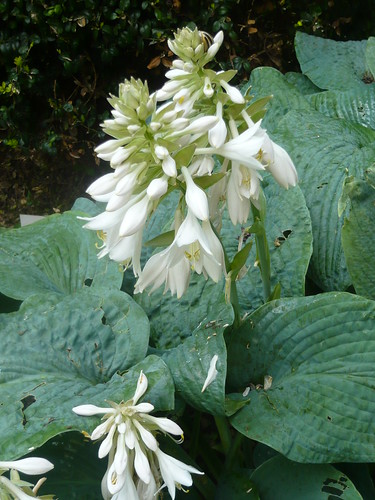
Hosta flower slugged

White flowers on this larger leafed Hosta are shown off by the blue-green leaves.

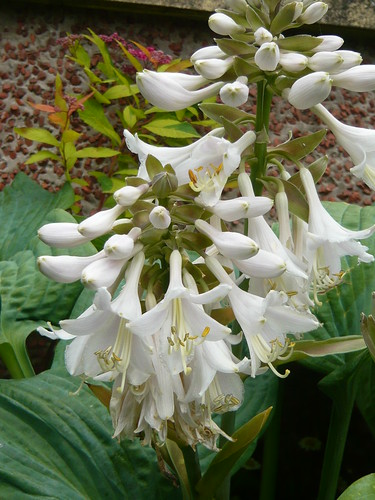
Jedburgh hosta

Another clear white flower – I am thinking I should consider Hostas for flowers not just the shape, form and colouring of the leaves. White flowering Hosta  plantaginea is strongly scented.

Old Hosta

Flowers are not as succulent as the leaves and snails and slugs go for the easy meal. Hosta flowers  are   members of the lily family and some folk say they are edible (but I will leave them for the slugs).

Hosta slug fest

Not as floriferous as many varieties the stems are shorter and few in number.
Hostas can be worth growing for the flowers alone – look at these flowers and see if the leaves are just useful extra features.

Gardeners Promises

Gardeners Promises

Last winter I recorded some of the promises I had made myself about the garden and gardening. Nine months on some have worked, some have been ignored and the jury is still out on others.
This review may tip you off or give you some hints for your own set of promises.
These gardeners promises were recorded on the computer so I couldn’t escape. I also put some in a garden log book which I ‘promised’ to keep up with but seldom did – I blame the weather!

Daisy
‘Inula hookeri’

Garden Promises

  1. Get more scent from flowers particularly for the house. Fair progress with good Sweetpeas, that produced umpteen bunches and from strongly scented Phlox. Spring was a bit slow so I have just planted some ‘Narcissus Cheerfulness’ for next year.
  2. Create a plant and seed nursery. I have again failed to dedicate even a small area to sow seeds direct into the ground or a plant nursery spot for growing-on plants or taking cuttings. I am a plonker, that is I plonk in anything anywhere. The promise for next year must be to stop being a plonker.
  3. Take more care of chrysanths. I see these great flowers as high maintenance and I do not do right by them. I forget to pinch out, failed to pot on or stake as soon as needed and do not deserve to do well; nor do I.
  4. Fruit area design & order. I have reduced the veg patch and ordered more raspberries, red currants and bought a thornless blackberry. This is one promise that is well on the way.
  5. Rambler rose. I lost my rambler some year ago and intend growing another but haven’t found the space or variety yet.
  6. Lift crown on the bamboo clump. I must look out the variety of the well behaved bamboo that I grow as part of a mixed hedge. I wanted space underneath the green canopy and so pruned out some of the lower growth leaving the top untouched. Early days yet and I have probably been too cautious. 50% of a job well done I guess.
  7. Allow plants to grow old. I want to move on in the garden before plants have matured and given us the best. Again I am chopping down to early and loosing potential specimen plants before they can look old. I know I am impatient and missing out.
  8. Keep a better record of names and varieties. Failed
  9. Give plants appropriate space. Failed I still cram everything in
  10. Use more hard landscaping. Failed still clearing more ground for more plants.

Daisy