Daisies can be Yellow
Daisies are a large group of flowering plants under the family name Compositae. Included in the daisy family are well known groups such as Rudbeckia, Osteospernum, Helianthus, Coreopsis, Helenium even the cornflower and Globe Thistle.The Compositaes (Asteracea) are recognisable through their compound blooms consisting of many tiny flowers. A daisy has a yellow “core” of 200 disc florets, surrounded by 50 marginal, white ray florets with a conspicuous limb (these are the petals also called ligules). A single daisy “flower” contains about 250 separate flowers! Each central floret, a flower in its own right, has a style, anthers, corolla, pappus and ovary. The Daisy is one of the “core families” on which research at the Royal Botanic Gardens, Kew concentrates.
Perennial Yellow Daisies
The RHS produced a bulletin on this subject and an interesting pdf can be down loaded. …
Green Euphorbia & Wisley Handbook
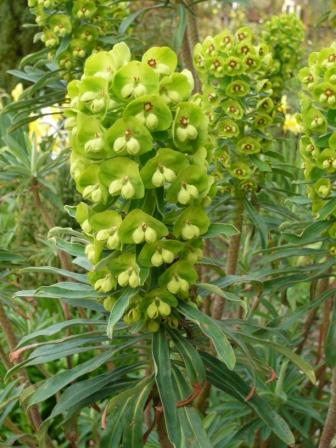
The lime green bracts on this Euphorbia are looking very bright in the spring sunshine. The plants are evergreen and easy to manage and form a good clump after 2 or 3 years. This clump has 17 flowering stems about 3 feet high but is only 2 feet in diameter.
- New stems are being formed at ground level for future years but the plant isn’t invasive. Any dead stems are pruned out at ground level to keep the plant healthy and the growth fresh all year around.
- Euphorbia come in all shapes and sizes so choose a variety from a gardene centre that fits your planting scheme. This plant is growing in poor soil in a sunny bed raised from the surrounding garden and forms the back drop for alpine plants.
Sedums and Saxifrages

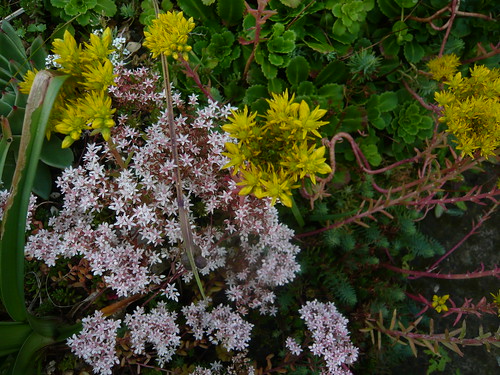
A pleasant mix of Stonecrop Sedums and Saxifrages or Saxifraga, as some would have it, are in flower at the moment. Stonecrop has taken my interest after reading about green roof plants. I also have a friend who has created a Sedum Seat on an old dining chair by planting up the padded seat area to good effect.
The grand-daddy of books on the subject of Sedums is Ray Stephenson’s ‘Sedum Cultivated Stonecrops’.
Tips
- Plant Sedums and other insect attracting flowers near vegetables that need pollination to set fruit. I have some near my Courgettes and Marrows and am getting a grand crop without worrying about fertilisation.
- Do not plant London Pride Saxifrage urbinus unless you want ground cover as, in my opinion, the flowers are weak in colour and form.
- Borrow expensive monographs and special texts from the RHS library. It is free for members.
Other Resources
Royal Horticultural Society RHS ‘Gardening for All’
National Council for Conservation of Plants and Gardens ‘Conservation through Cultivation.’
Garden Organic National Charity for Organic Gardening.
BBC Gardening
Best Shade Loving Plants

Beth Chatto believes you can transform a shady spot with easy-care planting that includes foliage and flowers for a brighter Spring garden. Illuminate a shady spot under trees with a range of flowers and plants.
Beth Chatto has an extensive list of plants for shady areas for all year round interest
Top Ten Spring Shade Lovers
- Honesty purple or white forms are good when in flower but also produce airy white seedheads
- Forget-me-nots are flowering all over my back garden at the moment from self-sown plants.
- Bluebells can be white as well as blue or even pink. They normally grow in shady woodland and will flower without sun. They also spread quite quickly particularly the thuggish Spanish variety. Do not take wild bulbs from there natural habitat.
- Hellebore the Lenten Rose is another shade loving plant that is happy under trees although the flowers tend to hang down and be hard to inspect.
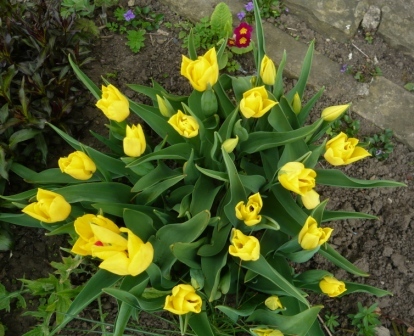
- Tulips can brighten the darkest spot. I plant them in pots so I can move them to where they will have the greatest impact. I can then replace them with other plants later in the year.
Natural Garden Tips

Available from Amazon ‘for anyone wishing to take an ethical and sustainable approach to gardening and garden design.’
One Gardener’s natural garden is another’s pile of logs and collection of compost bins. These tips are based on my view of a design led natural garden that is full of plants and informality.
Natural Garden Tips
- There are virtually no straight lines in nature so why should gardens seek to formalise everything in rows like a demented Italianate showpieces. For me sweeping curves and waves are the natural way to garden.
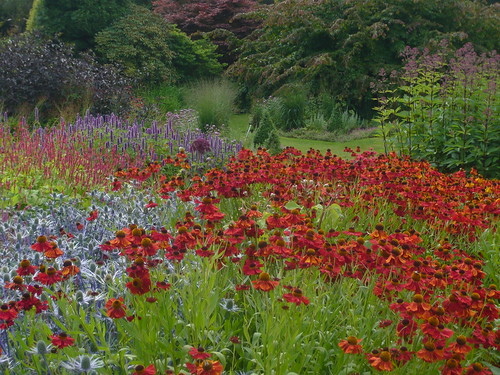
- Plant groupings can achieve an impact that even the best individual specimens can’t achieve. The Helenium Moerheim Beauty in the foreground of this picture provides that sweeping effect that a large perennial bed can withstand.
- Thinking in 3 dimensions encourages the use of height and depth of view particularly in the backdrop of this picture. The trees and shrubs range from low ground cover to tall screeners and statuesque trees.
- Planning your planting to help nature gives added choice. Foliage, berries and bark can be as inviting as flowers in the right season and location.
- Space and the gaps between can be an important feature in a natural garden. Not everything needs to be piled high like your local supermarket. The grass in this picture fulfils that role but you may want to think of alternatives for your own natural garden.
- The bones of the garden are as important as the floral flesh. Trees and major plants should have space and opportunity to grow naturally to fulfill their total promise.
Other Resources
Royal Horticultural Society RHS ‘Gardening for All’
National Council for Conservation of Plants and Gardens ‘Conservation through Cultivation.’
Garden Organic National Charity for Organic Gardening.
Grow Bright Azaleas
A lazier shrub with exciting blossom I have yet to find.

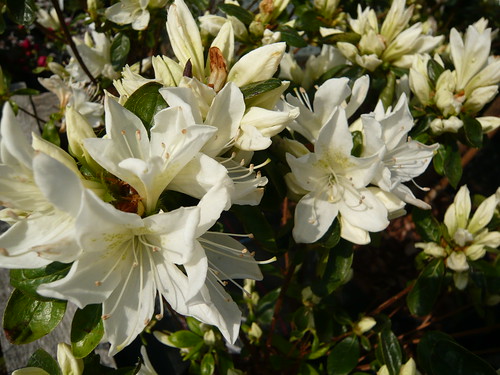
How do you tell an Azalea from a Rhododendron? Most Azaleas have only 5 or 6 stamen while most rhododendrons have 10 stamen. Azalea leaves tend to be thinner, softer and more pointed than rhododendron leaves.
In a subjective way I think Azaleas produce more flower cover per plant.
Tips for Growing Azaleas
- Azaleas are relatively pest-free and easy to grow plants but may need a fungal spray if leaves are attacked in spring.
- Azaleas like some shade but deciduous varieties do well in full sun. Sun can produce more compact plants with more blooms but not as long lasting.
Capability Brown Landscape Gardener

Lancelot Brown 1716 – 1783
Lancelot Brown is the most famous gardener who popularised English landscape design. Lancelot Brown’s nickname ‘Capability’ came from his saying about an estate he was commissioned to work on ‘It has great capabilities’ .
During his life he was Sheriff of Huntingdon, gardener to King George III, architect and innovator of ‘Landskip’ gardening. At the age of 24 he went to Lord Cobhams garden at Stowe where he learnt from William Kent who had studies Italian and Grecian gardens and John Vanbrugh. In 1764 Lancelot Brown was appointed Master Gardener at Hampton Court.
Lancelot Brown described himself as a ‘place-maker’ not a ‘landscape gardener’. He didn’t want a series of tableaux within a garden, he wanted a piece of countryside. Formality and straight lines had to go and to avoid fences he created the Ha-ha a sunken version. Flowers were cosigned to walled gardens and trees imported to suit his design.
Some of his designs were elaborate and involved changing hills and lakes and some thought them lavish. After his death the strong vision he had carried through in his work fell out of favour and only in the last century was he fully rehabilitated.
Capability Brown is believed to be responsible for over 170 gardens surrounding the finest country houses and estates in Britain. He never worked in Ireland saying ‘he hadn’t finished England yet. His work still endures at Blenheim Palace, Warwick Castle, Harewood House, Milton Abbey and below is a further edited list of his work. Get out and visit some of these 18th century landscapes:-
Old-Fashioned and David Austin Roses
Old-Fashioned and David Austin Roses by “Barbara Lee Taylor
Instead of the usual division into Gallicas, Damasks, Albas, Centifolias, Moss roses etc. the chapters are divided into History, once-flowering old-fashioned roses, Repeat-flowering old-fashioned roses, David Austin roses, Cultivation, Landscaping with old roses and the book contains over 160 rose varieties. As you read this book you can virtually smell the scent of your successful roses as though it were a warm June evening.
‘Discovering old-fashioned roses is often the beginning of a love affair that lasts a lifetime. These beautiful plants offer you not only fragrance and beauty, but also a fascinating link with the past. In this beautiful yet practical book, some of the most popular old-fashioned roses are described in detail and illustrated in full colour. There is a complete chapter on the work done by David Austin in the 1950s and 1960s to create new English roses. Topics include species roses; Gallicas; Damasks; Albas; Centifolas; Moss roses; Ramblers; China roses; Portlands; Noisettes; Bourbons; Hybrid perpetuals; Teas and early hybrid teas; Hybrid musks; Climbers; Shrub roses & ramblers; Rugosas; David Austin roses; Cultivation; Pruning; and Landscaping ideas.
Gardeners Tip
Plant an Old Fashioned Rose or two as near to your bedroom window as practical. Enjoy the evening scent.
Try Just Joey HT Rose
Gardening with Water Features
Water water every where and not a drop to drink unless you are an aquatic or part of garden wildlife.
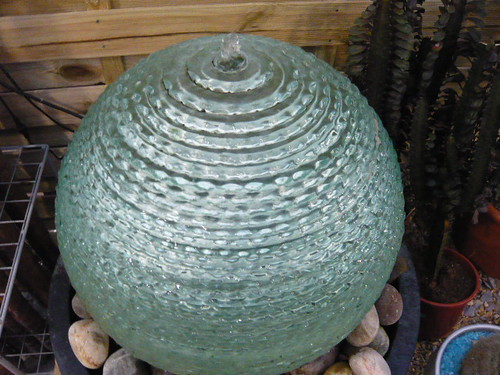
February may be a bit cold to think about water features in your garden. Be ready as soon as the hard frosts are over to redesign your garden with an appropriate fountain or continuous flow of water like the powered globe above. Water features in this context are the prefabricated devices you can buy ready made, ponds streams and your own designs come under DIY
.
Benefits of Water Features
- Water plays with the light and can enhance any visual appearance. Water often reflects the changing colours and light temperature in your garden.
- Running or trickling water can add the dimension of sound to a landscape and as long as it keeps running it wont smell stagnant.
- Landscaping and water features can improve property values make it stand out from the rest.
- Water is restful and a feature can create a place for contemplation or a focal point in the garden.
- Some water features are designed to successfully attract wild life.