Browsed by
Author: hortoris

Help with January Gardeners Jobs

Help with January Gardeners Jobs

The new year gets gardeners all enthused but it is also a time to show patience. The gnomes wont rush to help you anytime soon Hi-ho.

Helpful Tips

  • Beware experts – book learning may not translate into a better garden.Most experts make me worry.
  • Worry less about experience. Applied experience as a result of your own gardening is better than the secondhand variety.
  • Maslov’s hierarchy of needs applies to garden plants as much as gardeners. The basic needs of food, water then shelter in an appropriate home need to be taken care of first. No need to rush into being an exotic all knowing gardener.

Guardians of the Mint


Jobs left from Last Year

  • Clean pots, ornaments and seed trays, insulate outdoor taps and do those maintenance jobs you have avoided.
  • Build compost heaps, raised beds and hard landscaping when weather permits.
  • In dry weather treat wooden furniture and structures.

Plant Matters

  • Prune soft fruit bushes and apple/pear trees.
  • Force rhubarb by covering with a bucket filled loosely with straw.
  • Sow alpine seeds and plant winter flowering clematis cirrosa or napaulensis.
  • Check over wintering tubers, cold greenhouse plants and pinch out the tops of sweet peas to get bushy well rooted plants.
  • Prune grape vines before the sap rises to avoid bleeding.

Crops

  • Keep taking the green and look after the sprouts.
  • Bring hyacinth bulbs indoors for scent and flowering.
  • Gather leeks and root veg roughly clearing the ground.
Olympic Standard Brazilian Gardens

Olympic Standard Brazilian Gardens

Going to the Olympics in 2016 – then combine your visit with a few garden trips.

Book Cover

Competitive gardening may not be an Olympic sport but the standard of gardens in this facinating country has to be seen to be believed. Based more on design and architecture than planting there are some modern features in Rio, Copacabana and San Paulo

Simple Brazilian Gardens

Buy a book on the subject and browse while others compete for gold medals. New Brazilian Gardens presents over thirty gardens and landscapes located across Brazil.

Visit the nearest Brazillian garden like the one at Naples botanic garden Florida. This honours Burle Marx who is considered one of the most influential landscape architects of the 20th century. He drew inspiration from the beautiful plants and exuberant landscapes of Brazil. Through his passion for native plants, he introduced a wide range of native Brazilian plants to gardeners.

View your perfect garden selection on Gardenvisit.com

Amazon Rain Forest

  • There are reputed to be over 50,000 species of plant endemic to Brazil.
  • Coffee, rubber trees, Brazil nuts and numerous palm species are key crops.
  • Mahogany is now protected although this hardwood tree is still felled and sold in Brazil.

Floral Brazil

  • The national flower is the Orhid and there are many delicate species.
  • Flowere familiar to UK gardeners include -Papaver Rhoeas, Freesia, Camelia,  Begonia,
  •  Cyclamen persicum, Gloxinia,  Nymphaea odorota,
  •  Sclumbergera truncata, Billbergia distachya-Bromeliads,
  • Amarilis, Primula obconica, Hibicus, Mangolia, Cynara,
  • Quesnelia Testudo is endemic to eastern Brazil and contains 20 different species each with bright green leaves covered in unique scales.

Read More Read More

Beetles that Help Gardeners

Beetles that Help Gardeners

Beetles that are soil dwelling can be good friends to the gardener. Rove beetles stahylinids and ground beetles or carabids are both useful. In adult and larvae form they eat insects, slugs and other invertabrates.

Ground Beetles

  • As predators of invertebrates and many pests these black or brown beetles are considered beneficial.
  • Most feed at ground level but some will climb to eat aphids.
  • Carabus is a larger carabid and will feed on slugs, leather jackets and cutworms. (Mmmm juicy)
  • The caterpillar hunters Calosoma are famous for their habit of devouring insect larvae and pupae in quantity.
  • A few beetle species are herbivorous pests like Zabrus.
  • Poecilus cupreus is shiny black with long legs and powerful jaws.
  • One for the goulish kids, many ground beetles eat by vomiting on their prey and waiting for their digestive enzymes to make their food more fluid and easier to eat.

Rove Beetles

  • Devils coach horse or Staphylinus olens is one of the larger rove beetle at up to 30mm. It is often found under pots or rotting logs.

Read More Read More

Prune Witch Hazels for more Flowers

Prune Witch Hazels for more Flowers

Witch Hazel

The Witch hazels are great winter flowering shrubs and small trees. If your garden is on the small side the Witch Hazels or Hamamelis can be kept in check by judicious pruning. Take care not to prune off and stop the scented winter flowers. Careful annual pruning can encourage the formation of more flowering sideshoots.

Witch Hazel Cultivation before Pruning

  • Witch Hazels are slow growing and can take 10 years to reach 10-12 feet.
  • Cultivars prefer full sun and in deep shade they grow sparse with few flowers.
  • If space is at a premium they can be pruned annually. Other pruning should be restricted to removing dead or damaged growth.
  • Do not plant too deeply and thus cover the grafting point.
  • Watering, feeding and mulching encourages a strong Witch Hazel

Pruning to Restrict Size

  • Prune in early spring as the flowers fade but before the leaves open.
  • As with other pruning remove congested, crossing growths, diseased wood and weak shoots.
  • To restrict an established plant cut back only two or three longer branches to a well placed side branch.
  • This thinning of the longest branches reduces height and spread.
  • Annual pruning should encourage a dense shrub that flowers well.

Harder Pruning and Suckers

Dragon Tree – Root and Branch Review

Dragon Tree – Root and Branch Review

Dragon's Blood trees
A very distinctive and primitive tree. Legend has it that the tree sprang up from the spot where a dragon and elephant spilled blood and battled to death.

Key Features of the Dragon Tree

  • Latin name – Dracaena Cinnabari – other common names inside-out umbrella tree’ or Dragon Blood Tree
  • Height – up to 50 feet
  • Type of tree – evergreen
  • Leaves – Broad based spiky leaves in clusters at the top of vertical branches
  • Flowers – pale yellow clusters
  • Fruit – Yellow berry ripening to black
  • Bark – Rough textured silvery grey
  • Family – Dracaena

Origins and Distribution of the Dragon Tree

  • Unique to the Indian Ocean island of Soqotra .
  • The island is home to over 200 other plant species that are unique to the island.

Haghier massif and Diskum plateau

Read More Read More

Samurai Garden – Fighting for a Japanese Garden

Samurai Garden – Fighting for a Japanese Garden

My ‘Samurai garden’ is a small homage to a full blown Japanese garden.
I was attracted to Japanese gardens when I attended a talk at our local garden society. (They are often good events to pick up tips or special plants. I belong to a couple but only attend if there is something of interest.)
After starting on my project I was surprised how many Japanese gardens there were to visit or spot when walking around.

Menston

Samurai Garden Features

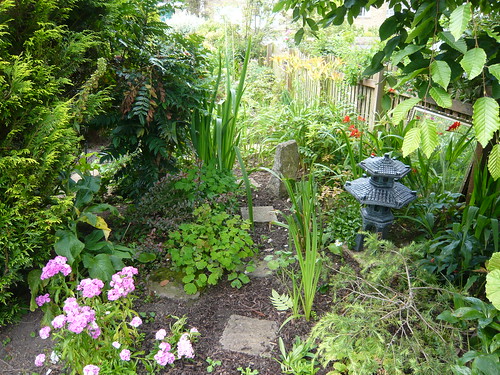
  • Sword shaped leaves feature in my garden to provide a green back drop and a military feel. Various Iris and Hemorocallis are getting established. It is surprising how well they do after a couple of seasons to expand the clumps.
  • I have bought a stone Japanese shrine and an interestingly shaped pyramidal stone. There are all sorts of ‘features’ to chose from at most large garden centres.
  • I have cheated and planted bonsai trees in their pots. I hope to partially restrict the growth without having to do bonsai pruning of roots or branches.
  • Acers and Tree peonies are two of my favourite species and they are long term investments.
  • The largest expense was a white chipping/pebble path edged with two kerbs. Despite a weed proof membrane the chippings get dirty, mossy and allow some weeds to root above the membrane.
  • For one year only I ‘planted’ a large framed mirror to reflect images from the garden. I am happy with the result and may clean the mirror and use it next year.

Menston

Garden Samurai Code of Honor

Whilst researching my Samurai garden feature I came across a cancer charity website with the following code of Samurai honor.

1. The most important Garden is finding peace in your heart, soul and mind.
2. Honor and respect the tool that can injure you, especially the tool of your thoughts.
3. Have courage to fight the weeds of life.
4. Bless your garden and curse it not.
5. Perfection cannot be reached but precision can be practiced.
6. Know your enemies, bees can be one of the good guys.
7. Love your garden for hate can lead to destruction.
8. Remember you can plant seeds of joy; but only God can make them grow.

Japanese have regarded places surrounded by natural rocks as dwelling places of the gods. So too with dense clusters of trees and water that have traditionally encircled sacred ground.

Samurai at Banzai Tattoos new location (2 doors down)
The Samurai gardener fighting the devil slug?
by Samurai at Banzai Tattoos new location (2 doors down) by NASA CREW,CC BY-ND 2.0

Japanese Garden at Giggle Alley at Eskdale

Japanese Garden at Giggle Alley Eskdale

Japanese Garden at Giggle Alley Eskdale

Japanese Garden

Features to Expect in a Japanese Garden

  • In Giggle Alley there are winding pathways, stone steps, rockeries and pools of water.
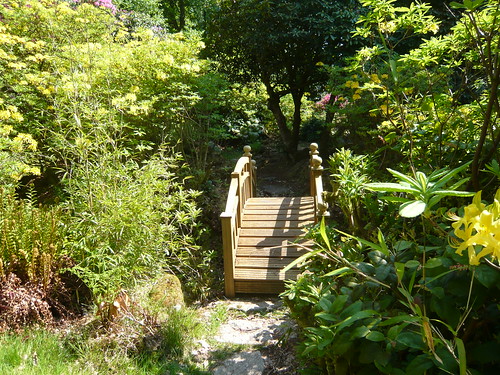
  • The Japanese style bridge over a gurgling stream is pictured below.
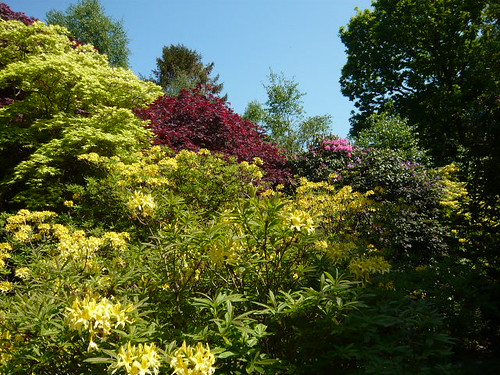
  • The planting includes excellent Maples and colourful leaf combinations.
  • Azaleas waft scent around the glades and provide further colour and a sense of harmony.
  • A venerable old Magnolia looks half dead but is flowering at the top of several 20′ high branches.

Giggle Alley Design

  • Designed in 1914 and left to become overgrown since 1949, the garden at Eskdale is currently being renovated.
  • The Forestry Commission created a Design Plan for the Japanese garden 2006-2011 see it on this pdf. You can contribute ideas and comments to the next plan and phase of renovation.
  • This Japanese Garden, in Giggle Alley forest, was the jewel in architect James Rea’s horticultural crown.
  • There are thickets of bamboo, a stunning display of Japanese maples and the heady scent of azaleas in the spring.
  • The whole forest is open to the public.

Japanese Garden

Wild Life in Giggle Alley

Read More Read More

Japanese Garden a Gardeners Project

Japanese Garden a Gardeners Project

043

Despite my garden being full to overflowing after the spring rain I have decided to create a new area for a Japanese Garden. When starting a new project I was advised to have a name that may colour the end result. I opted for the grand title of ‘Japan Land’  This will be a long term project and I won’t rush it as I have on other projects in the past.

Action Plan for my Japanese Garden

  • Read up on the various forms and the nature of Japanese gardens.

Book Cover

  • Decide which area is going to be sacrificed to provide space for the Japanese garden.
  • Draw a rough plan  on a piece of paper and list the features to be incorporated.
  • Walk the patch and see if any plants need to be left in situ. I have a couple of Azaleas that I want to keep.
  • List the gardening problems I have caused in the past that I hope to avoid on this project.

Past Problems to Avoid

  • I generally leave too little space for paths and access.
  • Forgetting  to label or record the location of a particular plant  has meant I do not give any individual treatment until it is too late.
  • Many Japanese favourites are long lived such as Acer, Wisteria and Peonies so I must leave enough space for them to grow and develop.

    Read More Read More

Exotic Gardens to Visit in the UK

Exotic Gardens to Visit in the UK

Baby Myrtle

In the cold wet winter it is a good time to plan where to visit as the year improves. The South West is the obvious place to start your visiting tour of gardens containing exotic plants.

La Seigneurie in Sark has tall walls to protect from wind. The Australian Bottlebrush and New Zealand Tea Tree thrive alongside the oldest surviving 19th century feature of the original layout, the formal rose garden edged with box hedging.

Trebah Garden near Falmouth in Devon benefits from a micro climate created by a deep valley. Tree ferns, gunneras, bamboo and tall Chusan Palms. The camellia collection looks good in spring and Camellias have justly earned their title as ‘Queen of the Winter Flowers’. These beautiful blooms range from deep red to white with all shades of pink in between.  They can be found along Camellia Walk, Petry’s Path and Badger’s Walk.

Abbotsbury Tropical Garden near Weymouth is a 20 acre garden filled with rare and exotic plants from all over the world and was established in 1784. The gardens are well regarded for the  Rhododendron and Hydrangea collections plus the charming Victorian Garden and Swannery.

Abriachan Garden is at the other end of the UK near Loch Ness. The garden and nursery is full of plants from the countries where the owners have previously lived and gardened…….Olearias, Pittosporums and Flaxes from New Zealand; Tea berries and Diddle-Dee from the Falkland Islands.

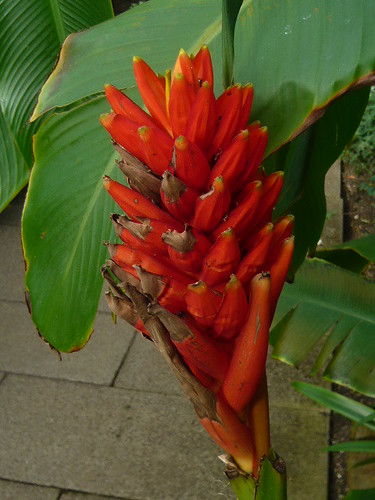
The Exotic Garden in Norwich becomes quite magical in spring full of hidden corners and riotous colour. ‘The air is filled with the intoxicating scent of Jasmine, Brugmansia (Angels trumpets) and different varieties of Hedychiums and Alpinias. (Gingers). The ridiculously large leaved Elephants Ear, Colocasia esculenta, ‘Mammoth’ with luscious green leaves 2×3 feet in size on long stems. Towering bananas such as the purple Abyssinian banana Ensete ventricosum ‘Maurelii’, form massive canopies to walk under as do the root hardy banana Musa basjoo.’

Musa coccinea Red banana

Read More Read More