Browsed by
Author: hortoris

Relaunch of a Back to Basics Gardener

Relaunch of a Back to Basics Gardener

I am not new to gardening (I have had over 60 years exposure). Yet every year I return with fresh hope and seek out an occasional idea. As we approach 2019 I am looking for the inspiration that will lift me and the garden to new heights.

So I am going back to the basics of an absolute beginner and hope to start afresh on 1st January. Some plans are already in place with seed orders actioned and tools cleaned afresh. But first I am now going to visit our nearby RHS garden at Harlow Carr to walk the talk around a good garden, visit the plant shop with my Christmas present vouchers and return my library book on trees.

Book CoverThe RHS library was closed even though the website said it was open even on bank holidays. Do not believe everything you read on a website – learn by experience!  There were many interesting winter trees but sadly most name plates were missing. How can beginners learn if the RHS can’t be bothered.

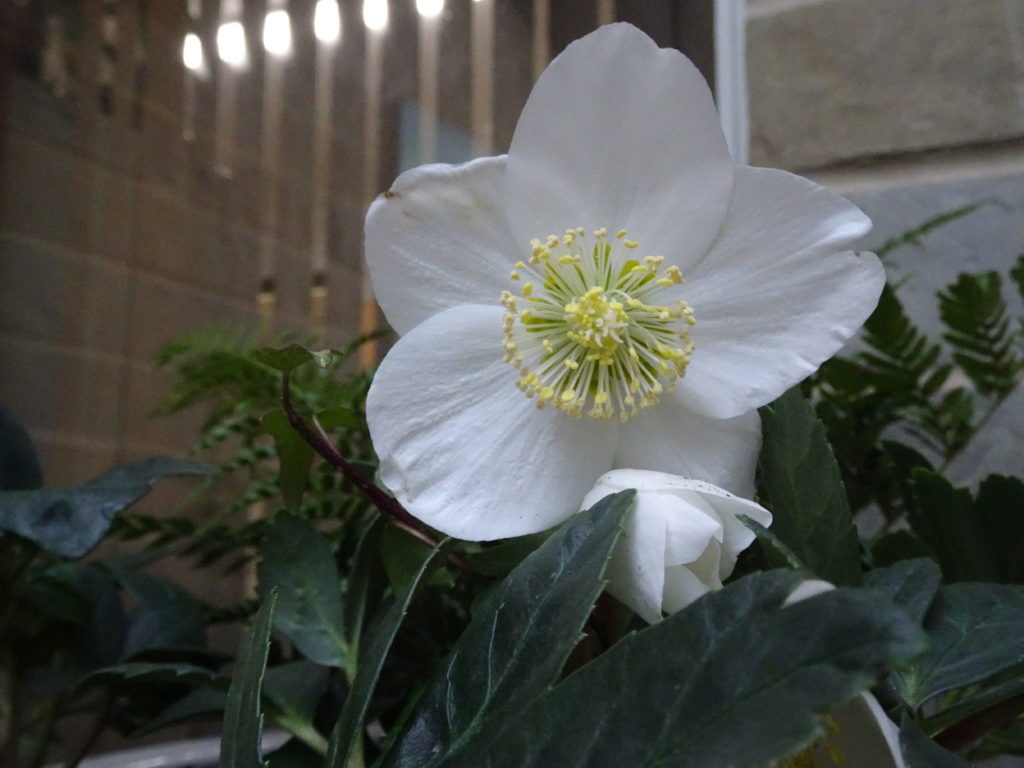
This was a crystal clear flower on a Christmas Rose ( Helleborus niger) growing in a 2 foot high pot. The raised pot made it easier to see and photograph as these Hellbores tend to have flower head droop.

So that is one new inspiration – to use height in all manner of ways to enhance my garden experience and reduce my back ache.

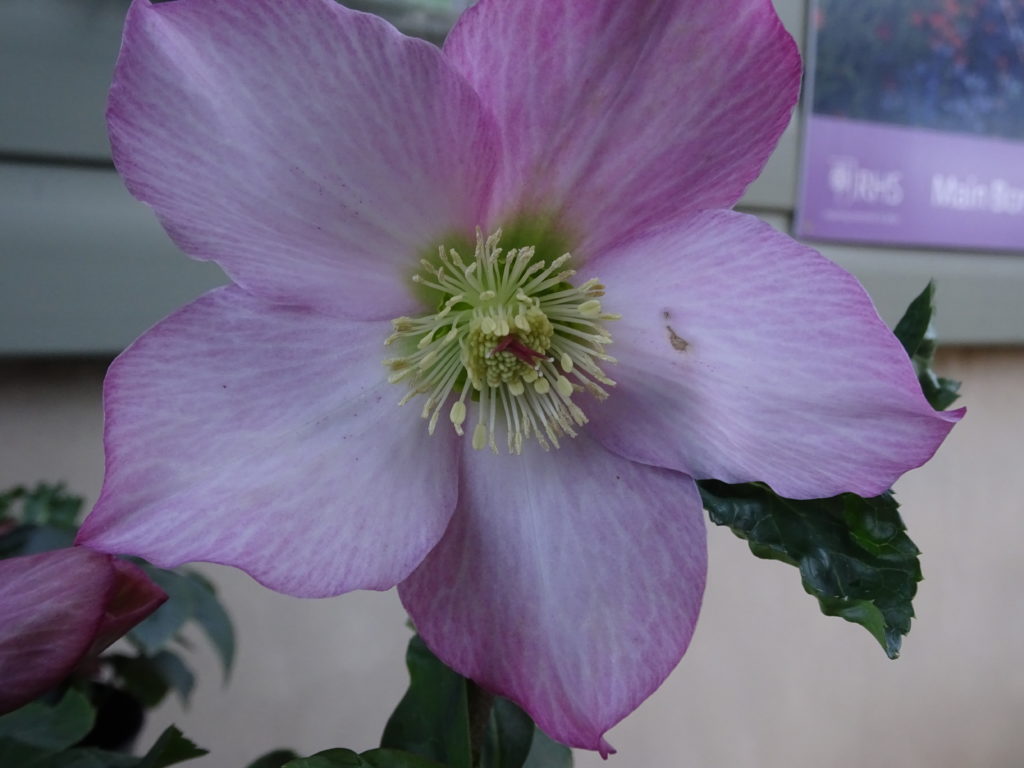
I was lucky to get another upright flower although I cheated a bit by lifting it up with a finger.

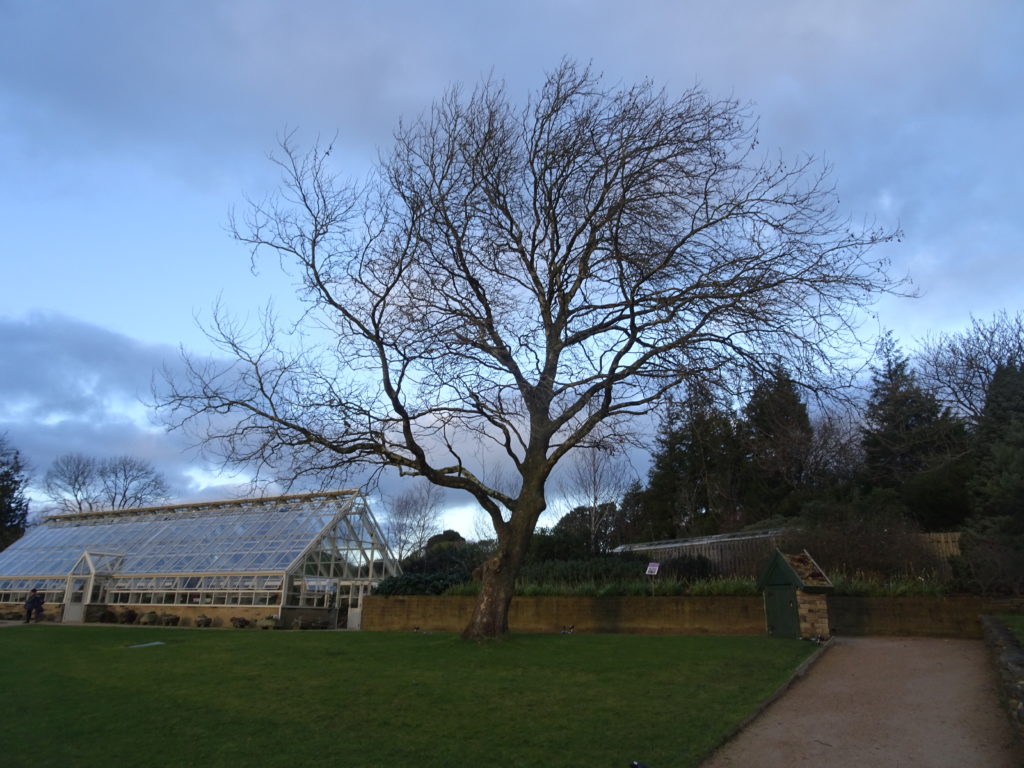
This tree ‘Platanus orientalis’ did still have a label, it was damaged and growing into the bark. It is a better more impressive specimen than my picture shows.

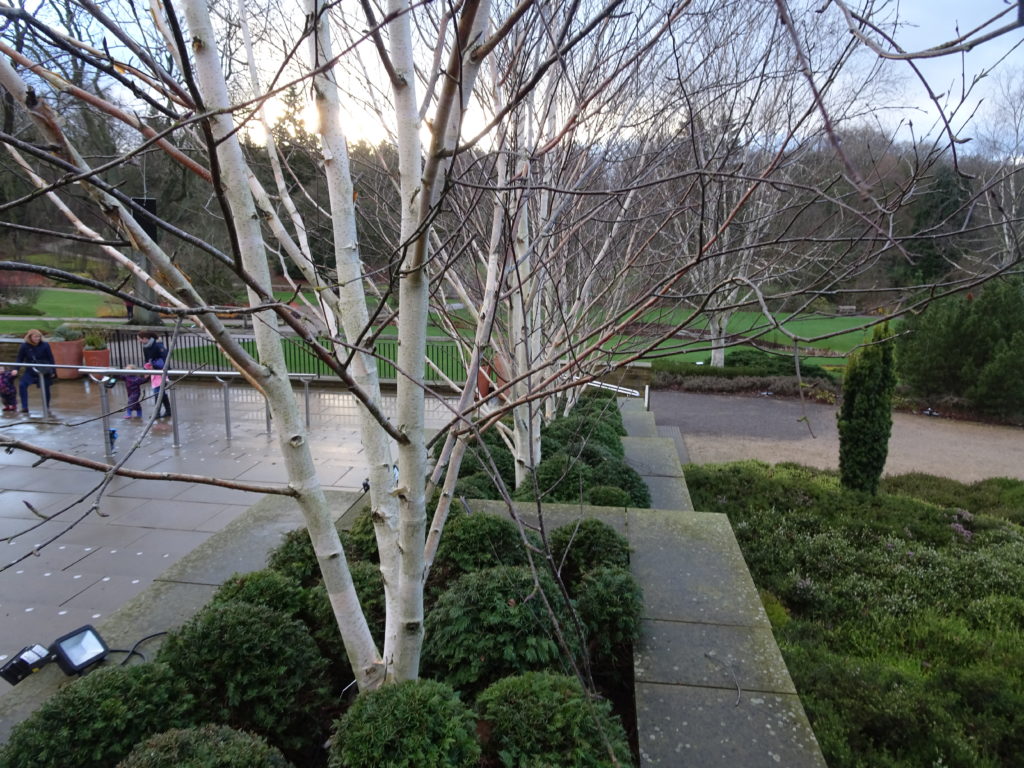
Silver birch Jackmanii, I think, although I didn’t see a label or sign. The mix of straight lines and ball shaped plants was attractive.

Gardening as A Stress Buster

Gardening as A Stress Buster

Gardening is good for you not just physically but mentally and emotionally acting as a stress buster and promoting optimistic activity.

Book Cover

Meditation

  • A garden can and should be an oasis of calm so a specific quiet area is worth creating.
  • Make paths long and curving  to extend the journey through the garden. If paths are  narrow you will need to concentrate on where you put your feet and hopefully forget your problems.
  • A solitary seat placed with a calm view can help your contemplation.
  • Water helps with it’s light reflective nature and the gentle sound of moving water can be soothing and calming.

Colour

  • Green is a natural neutral colour often found in Hospitals for its therapeutic effects. It is not hard to combine  foliage like Bamboos, Ferns and Mahonia for shape, texture and the green colours.
  • Red is the most stimulating colour and can increase your heart rate and stimulate your appetite.
  • Blue has the opposite effect generating calm and lowering blood pressure.
  • The colour effect can be enhanced by including a small quantity of the complementary colour orange with blue, green with red.

Aromatherapy

  • Stimulating all the senses means you need some good scent. Lavender is calming and not stressful to grow.
  • Herbs like Basil, Rosemary, Mint and Thyme can have a stimulating effect.
  • Relaxing or balancing aroma comes from Camomile, Clary Sage or Marjoram.
  • There is an added bonus from herbs as they can have culinary and medicinal purposes in addition to the scent.
  • Floral scents are a matter of taste but the power of  Lilies, Phlox, Hyacinths and Roses can sweep away all my moody thoughts.

Physical Therapy

  • It may be a cliche to say ‘exercise is the best therapy’ but it may be a cliche because it is true.
  • 10 minutes in the garden can lead to hours disappearing as you find you are drawn to more garden jobs  because you can always make a further impact.
  • Vigorous digging can be as  therapeutic as along walk or run and your garden is improving at the same timedue to your activity.
  • Grass cutting and lawn edge trimming seems to work well for my wife (I am happy to let her do this job as my therapy).
  • My physical therapy is standing over the compost heap chopping down stems and twigs so they rot quicker and more comprehensively.

‘The Healing Garden a Practical Guide’ from Amazon

Newer Garden Terms and Garden-pedia

Newer Garden Terms and Garden-pedia

Garden terms with  Japanese Roots

There are many interesting terms that may have uses in our UK gardening.
We  have probably all experimented with Bonsai aiming for the perfection of small trees in small pots as a demonstration of bonsiers art. I have used the root restriction technique to get miniature or smaller shrubs for a smaller garden but stopping short of root pruning.

  • Yohaku is the use of empty space found in art forms such as garden design especially dry gardens.Such space is common in other art forms like flower arranging as well as Japanese and Chinese painting and calligraphy,
  • Two words are used by the Japanese to indicate Japanese maple species and cultivars, and these words reveal something of the reverence they evoke: Momiji (usually refers to maples which have leaves with deeply separated lobes) and Kaede (usually refers to most other maples).
  • “Kaede” stems from the ancient language term “Kaerude” – (Kaeru = frog, de = hand). The lobed leaves of maples brought to mind the webbed hand of a frog. As the centuries passed, this was shortened to “Kaede.”
  • “Momiji” may literally be translated ‘baby’s hand”, but it is not correct in this case to apply the meaning directly. Instead, one may apply it as “Little baby extends his tiny hands which are like the leaves of momiji (maple).”meaning “becomes crimson leaves.
  • Practiced in Japan for centuries, the art of tea ceremony –also called Chado, or The Way of Tea– is imbued with harmony, respect, purity, and tranquility. 16th-century master Sen no Rikyu refined Chado, and the Wabi-Sabi aesthetic of simplicity with a yin/yang balance.
  • Feng shui  harnesses the invisible energy or chi dragons breath –
  • Tong Shju the thousand year calendar takes a the longer term view try that in your garden
  • Shar chi is a term that implies ‘the killing breath of straight lines’
  • Japanese topography enhances natural good features and seeks to diffuse bad

Garden terms from Art and Design

  • Perspective both aerial and linear are practiced in art that cam be studied in many local galleries.
  • Topography optimises natural and introduced features to be seen from many points.
  • tromp oiel  create the optical illusion often of 3D imagery.
  • chiaroscuro is light,  shade and shadow  a gardeners staple tool
  • Ha ha is not to be laughed at as it creates a natural barrier without spoiling a landscape view

Book Cover

Garden terms from Life and Nature

  • Allergenicity or a substance such as pollen that causes an allergic reaction
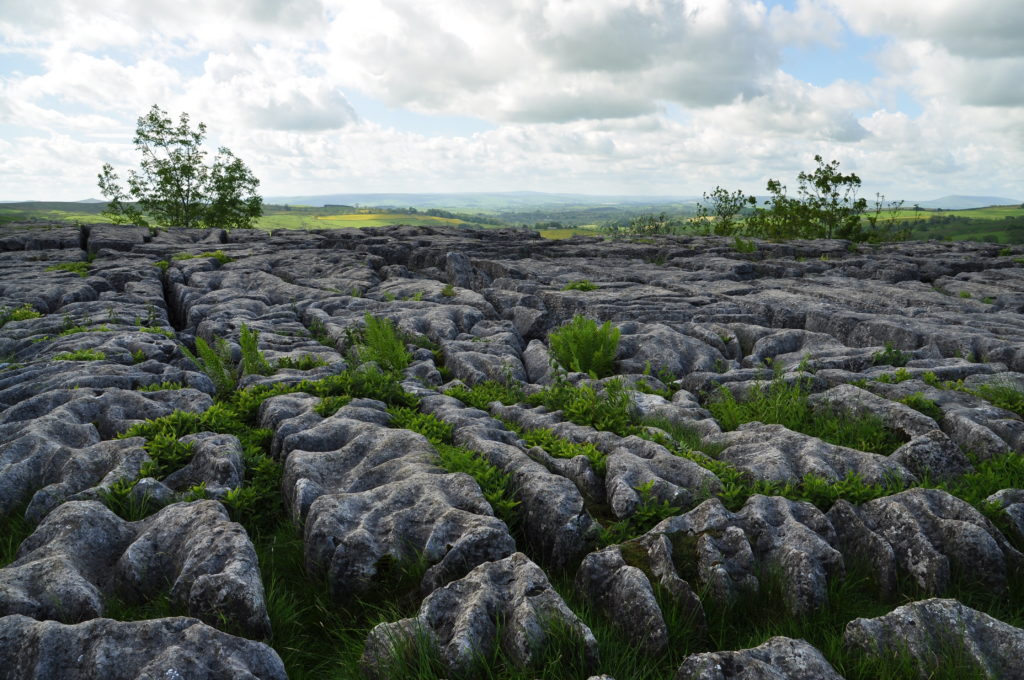
  • Clints and grykes are fissures or gaps in limestone pavement. Typically ferns and mosses with the occasional stunted tree can just about get a foothold in these cracks.

From Old Gardeners

  • Epigeic  worms are living at the soil surface to breakdown leaf litter. Endogeic worms live underground and help aerate the soil by making horizontal burrows.
  • New vegetables  ‘pot 8 eau’
  • The pigment Delphinidin is not produced by  roses, lilies, tulips, carnations, chrysanthemums and gerberas so these plants never produce blue flowers.
  • Achines a small, dry one-seeded fruit that does not open to release the seed.
  • Monocarpellate seed formed from one carpel.
Tree Books – More than Three Books

Tree Books – More than Three Books

2018 has been a remarkable year for tree books and the publishing trade has done a good job listing new and older titles. There is now a forest of books to acquire and collect and I hope they have been printed on paper from sustainable sources.

Book Cover

A ubiquitous book that has been a star seller on the shelves this year. The bright cover and eclectic mix of poems has hopefully started many saplings on a journey with trees.
Book CoverA compendium of National Trust History & Heritage. We can take pride in our tree history.

Book CoverFascinating facts that are hard to comprehend until you study what is going on with trees in groups. A clever update of another edition, a sort of sucker from the parent tree.

Book CoverWe are not alone in venerating trees and if you want an excuse to travel the world then this book will provide some inspiration.

Read More Read More

Where to See Trees

Where to See Trees

Trees can be individually inspiring but when trees are gathered or clumped together they can range from the majestic to the commercially relevant.  Over centuries trees have provided the largest social impacts from shelter, sustenance and products from timber.  Through changing seasons the aesthetic benefits of the wide variety of trees also give a significant amount of personal pleasure.

Despite problems of disease in some species and Sheffield council contracting to chop down trees close to highways, trees are  ubiquitously visible throughout the UK.

 Tree Zones and Areas Where You See Trees

  1. Woods in all shapes and sizes
  2. Forest – now applied to conifers but historically area where forest laws applied
  3. Copse – broad leaved woodland
  4. Spinney
  5. Stand
  6. Park  – traditionally containing more widely spread trees
  7. Arboretum
  8. Clough or Ghyll
  9. Gill or Dingle – wooded valley
  10. Ancient Woodland
  11. Carr – usually alder & willow on wetland
  12. Chase or firth – a hunting area
  13. Enclosure – once land held in common
  14. Glade
  15. Plantation
  16. Hanger   -wood on a  steep slope or bank
  17. Ride
  18. Shaw-  small wood
  19. Spring  – coppiced woodland
  20. Wildwood- original forest from the last ice age
  21. Landscapes
  22. Orchard
  23. Woodlot
  24. Jungle
  25. Thicket
  26. Memorials -  graveyards crematoria  and special areas
  27. Swamp
  28. Grove
  29. Nurseries and specialist tree vendors
  30. Woodland Trust
  31. National Trust Properties
  32. Botanic gardens
  33. Wild in nature

If you wish to take issue with my selection or know where I have ignored a favourite ‘tree zone’ then send us a comment.

Forty Garden Types

Forty Garden Types

There are as many types of garden as there are gardeners but they can be grouped into families you could also say genera, species and hybrids but that is getting picky. The two most important garden types are your garden and my garden which is a definite hybrid.

If you take issue with my selection or know I have ignored a favourite garden type then send us a comment.

 A Selection of Garden Groups or Types

  1. Peace
  2. Zen
  3. Taoist
  4. Islamic
  5. Monastic
  6. Mythical
  7. Spiritual
  8. Rain
  9. Topiary
  10. Serene
  11. Secret
  12. Inspirational
  13. National Trust
  14. International and any specific country or continent garden
  15. Romantic
  16. Unusual
  17. Memorial
  18. Italianate
  19. French
  20. Water
  21. Seasonal
  22. Climatic
  23. Landscape
  24. Rock
  25. Sunken
  26. Vegetable
  27. Cutting see also flower gardens
  28. Fruit
  29. Public
  30. Private
  31. Children’s
  32. Wild
  33. Tropical
  34. Forest
  35. Indoor
  36. Species gardens -rose, heather etc
  37. Herb
  38. Knot
  39. Botanic
  40. Healing
  41. Walled
  42. Heritage or historic
  43. Era indicative – Edwardian, Victorian, WWII etc
  44. Weather constrained – sunny, shady
  45. Dry
  46. Bog
  47. Alpine
  48. Royal

See our list of tree related areas.

Peace Gardens as Memorials

Peace Gardens as Memorials

There are many gardens and monuments dedicated to Peace and they are worth seeking out when you are on your travels.

London

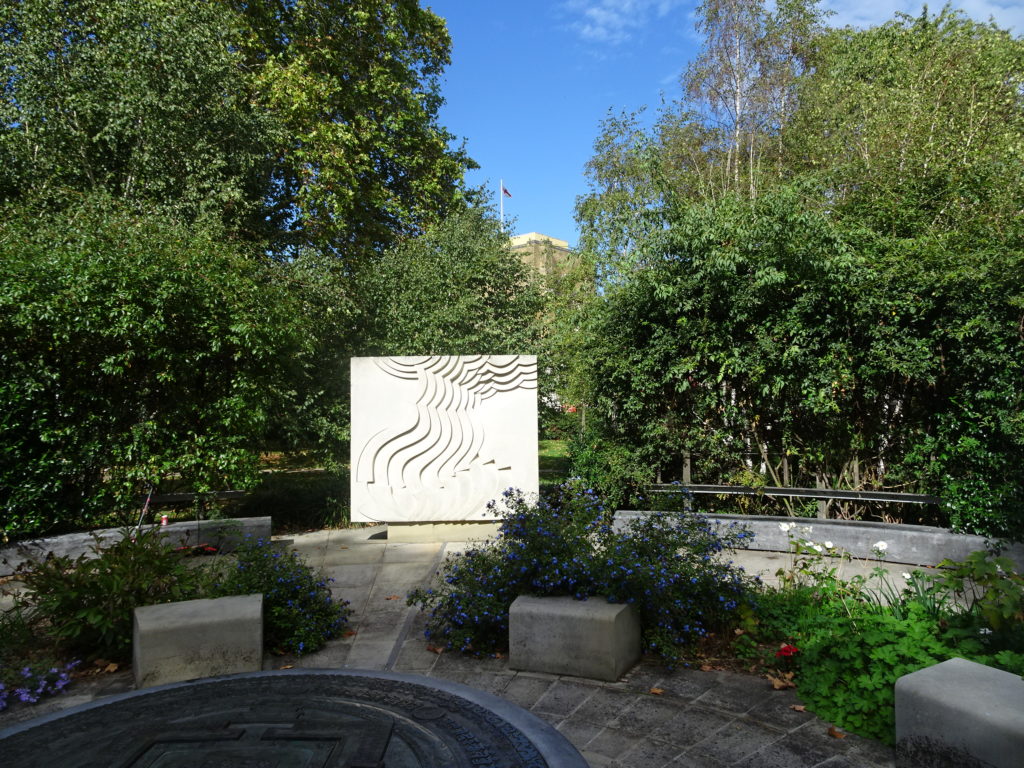
In May 1999, His Holiness the Dalai Lama opened and consecrated the Tibetan Peace Garden next to the Imperial War Museum, London, UK and it has been enhanced by Arabella Lennox-Boyd. The original contains Buddhist features including a language pillar and at its heart the Kalachakra Mandala associated with world peace. Eight meditation areas surround this main monument. Four modern Western sculptures representing Air, Fire, Earth and Water have been carefully located to the north, south east and west. If this all seems a bit too much and you just want a quiet, soothing walk, head for the inner gardens which are scented with herbs, jasmine, honeysuckle and roses. An outlying landscaped area is also great for ambling around.
There is now a circular paved space surrounded by double rows of Hornbeam Carpinus Betulus and a number of Betula ermanii and B. Utilis in numbers important to the Buddhists and the concept of peace and tranquility. 6,7,8,12,16,21,37 & 49.

The International Peace Garden dedicated in 1932 is a memorial to World Peace. It lies along the world’s longest unfortified border and encompasses a 2,339 acre Botanical Garden. Between the State of North Dakota and the Province of Manitoba this garden is a well frequented site maintained jointly by USA and Canada. There is another International Peace garden in Salt lake City Utah.

Read More Read More

Kelp Forest and Seaweed Growing

Kelp Forest and Seaweed Growing

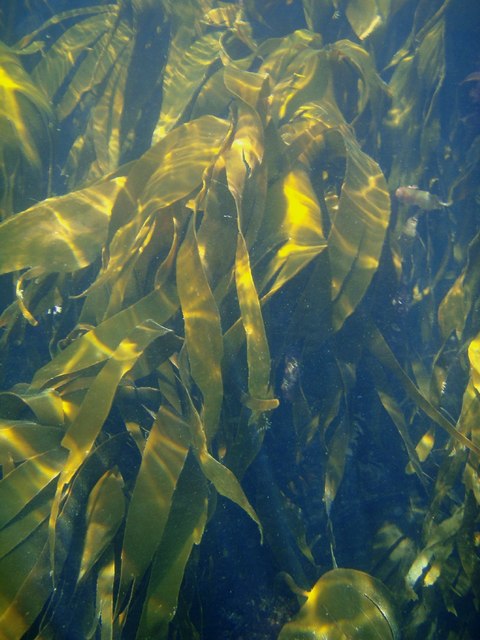
It may seem unusual to feature a subsea area in a  series about gardens but this post may provide some food for thought. The oceans and seas are still capable of surprising us with a bountiful harvest including new and exotic eating experiences.

A Kelp Forest

Kelp Facts

  • Kelp is part of the brown seaweed family phaeophyceae or laminariales. There are many different genera and species that grow in shallow, temperate saline water.
  • All Kelps are seaweeds but not all seaweeds are Kelp
  • Kelp captures and stores carbon
  • Kelp provides shelter for numerous fish species. It is also a breeding ground for juvenile sea creatures and a key part of the ecostem. The fronds or leaves sway in the temperate waters across the globe including thearound the UK.
  • The stipe or stalk stretches down to root in the seafloor anchoring the plant around rocks and boulders.
  • Iodine is present in Kelp along with many other important minerals. There is dramatically more calcium in Kelp than a similar volume of milk.

Is Kelp Good For You?

  • Kelp, produces a thickening agent used in ice cream, toothpaste and other products.
  • Some kelp species are eaten in salads and as edible decorative wrapping for sushi rice.
  • Kelp is used to produced Soda ash by burning.
  • These uses makes it a progressively more valuable commodity. Harvesting these sea-vegetables by hand sustains several coastal communities. Mechanical kelp harvesting is too intrusive, damaging of future crops and the ecosystem but it is on the increase.

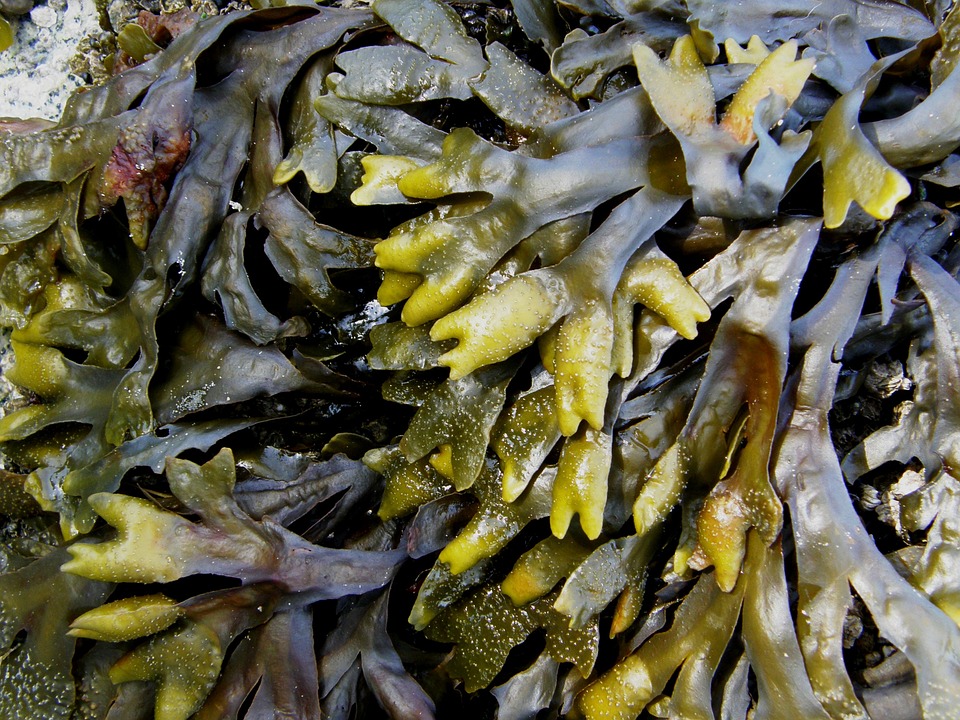
Seaweeds are primitive sea plants

  •  There are at least 10,000 different species of seaweed
  • Salads can be made with Sea Lettuce or Purple Laver.
  • Laver bread is made from seaweed.
  • Agar and Carrageenan can be extracted from seaweed for use is used in the production of  paper and toothpaste.

Zen of Holland Park Japanese Garden

Zen of Holland Park Japanese Garden

Holland Park has some Zen like features but fails my Zen test. The classic elements of a successful Zen are stone, sand or gravel, water, plants and space. Then there is a question of balance between yin and yang. Cramped or cluttered gardens inhibit the flow of spirit so space is potentially the key ingredient of a Zen garden.

Stone is a solid yang element to be contrasted to the yin of raked gravel and or water. Stones have personality and should be placed carefully. Plants are not intended to be functional but are integral to the yang of design. Dry gardens replace water with gravel sometimes with stepping stones inset

In Holland Park London not far from Notting Hill is a peaceful Japanese garden. There are numerous features that can inspire your own plans although I draw the line at bringing in a dozen Peacocks to my plot.

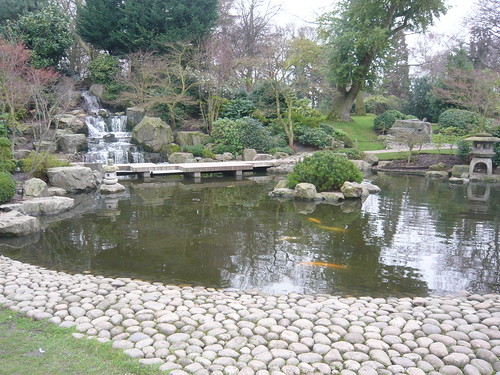
Kyoto beach London

One feature I took note of was the beach effect for this pond. It allows birds and invertebrates easy access to the waters edge. Being in the process of installing another pond in my own garden I have built in a beach not dissimilar to this. I bought some butyl line with shingle already attached and shaped it to run down into a preformed pond.

Read More Read More

Taoist Gardens of the Immortal

Taoist Gardens of the Immortal

Chinese Taoists or Daoists sought to recreate the vision of immortals who they believe live in the Mystic Isles. This perfect land was envisaged as a route to eternal life.
Taoism is a religion of nature where everything has its own spirit and deities reside in natural objects. So Taoists gardens reflect landscapes and gardens that are ‘works of nature’.

Components of a Taoist Garden

  • Water is the core focus of these gardens. A central pool and or a stream and waterfall  provide a focal point.
  • Pools should be a natural shape without straight edges or hard lines.
  • Mountains are featured from rocks often one large rock. Each rock is carefully place to optimise its own spirit. Pitted stones and those worn with age are prized for use in grottoes.
  • Buildings are important as a place to view nature from the best angle. Generally the buildings are clean simple or rustic structures. Imperial gardens were, not surprisingly, elaborate structures.
  • Types of building and structures include verandas, pavilions, gazebos, covered walks, dry boats to extend over water and of course bridges.
  • Borrowed views created by windows and pruning emphasis near and distant views.
  • Contrast is key to providing good feng shui.

Objectives of a Taoist Garden

  • Tao intention is to be the way the path or the road to truth.
  • The ‘simple path’ to return to to the simplicity and naturalness  of the inner pulse of the Tao.
  • The pools often contain Koi to help harmonise the mind to be at peace.
  • If contemplating your own Taoist garden keep it as simple as practical and use nature in its basic and simplest forms.

Kyoto beach London

Flowers and Plants are not Crucial

  • Flora are chosen for shape and scent rather than colour. Plum or cherry trees for blossom and pine trees for height.
  • Plants are used in symbolism. Peach trees represent immortality. Chrysanthemum long life and contemplation. Magnolia beauty and gentleness. Water lily truth and purity and bamboo represents the steps to enlightenment.