Browsed by
Month: October 2010

Acidanthera or Gladiolus callianthus Growing Tips
Acidanthera or Gladiolus callianthus Growing Tips

Acidanthera Gladiolus callianthus

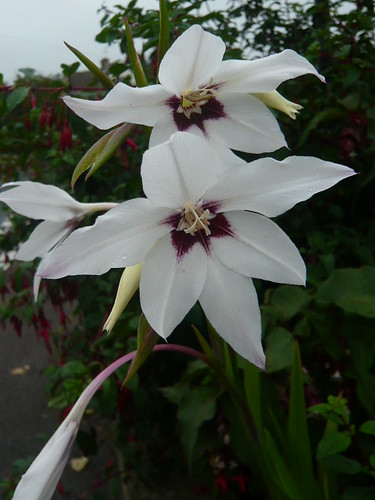
Corms of Acidanthera or Gladiolus callianthus are sold as summer bulbs but they flower best in autumn. Less colourful than other members of the Gladioli family these white flowers have a dark purple eye and look stunning in late autumn sunshine.

Acideranthera Facts and Growing Tips

  • Acidanthera are scented with flowers arching from a long pollen tube with tall green pleated leaves.
  • Can flower up to 36-48″ high.
  • Not hardy enough to be left out in winter they dislike waterlogged soils.
  • Great in well drained sunny situations, these were planted in my garden wall.
  • Acideranhtera are also called the Peacock Flower
  • Water and fertilise when flowers begin to develop.
  • Plant 4 deep in clay soils or upto  6 deep in other soil.

Read more about Gladioli in 100 days from planting.
Growing Begonia from Seed

Growing Begonia from Seed

Begonia

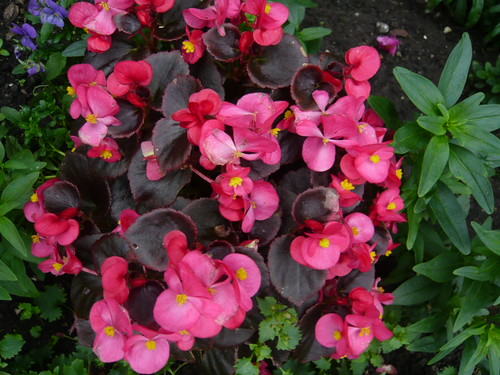
Begonias provide lots of colour per plant.

  • Begonia Semperflorens is probably the most widely grown begonia and is also called “wax type” because of the waxy look to the leaves. They are grown from seed mostly as bedding plants and annuals and last until frosted.
  • The larger flowering Begonia tubers are currently bringing summer to a colourful finish. The tubers can be dried and stored for next year
  • The indoor Begonia rex are demonstrating some strange and colourful leaf shapes. These are Rhizomatus types.
  • Cane or Angels wing Begonias are a bit out of favour but make a robust house plant.

Begonia

Growing Begonia as Annuals from Seed

  • Begonia seeds are very small, so it is best to mix the seeds with fine sand and sow onto the top of the moist compost.
  • Do not cover the seeds with more compost but cover the container with cling film.
  • Place the container in a shaded or dark position at 68 – 72F.
  • Check the seeds daily for emerging  seedlings, this normally takes about two weeks.
  • As soon as the seedlings appear remove the polythene and place the tray in a light position. Seedlings require a great deal of even bright light.
  • If the window sill is cold cover the container with a cardboard box at night.
  • When the seedlings are large enough to handle  prick them out from the seed tray and pot them on into 3 inch pots.

A useful none commercial resource is Brads Begonia guide.

Thompson & Morgan supply a wide range of seeds. The normal colours of red white and pink have now been extended by orange and yellow additions and at the last count there were 50 products to consider growing. Thompson & Morgan

Tips for Pruning Climbing and Rambling Roses

Tips for Pruning Climbing and Rambling Roses

Rambling Rose

Differences between Ramblers and Climbers.

  • Rambling Roses flower only once per year generally around June or July. Climbing Roses repeat-flower from June through to autumn.
  • Rambling Roses are pruned in late summer whilst Climbers are pruned from late autumn through to late winter.
  • Climbing roses are not self-clinging and need support. Ramblers may need some tying in but are better at finding their own support.

General Rose Pruning Advice

  • Use sharp secateurs so cuts are clean. For larger stems, use loppers or a pruning saw.
  • Aim for well-spaced stems that allow free air flow.
  • First remove dead, diseased or dying branches. Prune dieback to healthy white pith.Then tie in any new shoots needed to fill supports.
  • Prune climbers side shoots back by two thirds of their length and tie in.
  • If the plant is heavily congested, cut out a third of old branches from the base to promote new growth. Shorten excessive growth by removing one in three of the oldest stems entirely.

Pruning Young Rose Trees

Read More Read More

Garden Photos in the Morning

Garden Photos in the Morning

morning

When thinking of when the garden is at its best, we often imagine the sun at its peak -  a hot summers day in the middle of June. However, for taking photos, this can be difficult.

garden

As well as bright sun, there are also some magical moments at other times of the day and year. Early in the morning, the sun light is soft. It’s angle throws a fascinating light onto the garden. The whole garden can be transformed by the different light and angle. Even when the garden is at its quietest, there are still some fascinating and beautiful aspects.

garden

Try setting the alarm and viewing the garden at a different time of the day, you may be surprised.

garden

Early Morning mist highlights this spiders web amidst Verbena bonariensis

Read More Read More

Tips for Growing Garlic

Tips for Growing Garlic

Garlic is hardy and needs a spell of cold weather. Plant it with the first frost to trigger its splitting mechanism. This encourages good roots and helps the bulbs to form.

Keys to Success with Garlic

  1. Good quality Garlic sets
  2. Autumn Planting
  3. Good drainage
  4. Fertilise during growing season

Tips for Garlic Culture

  • Pick a well drained sunny spot and rake down to a fine tilth.
  • Split the garlic into individual cloves – you will get about 14 cloves from a good head.
  • Dibble the cloves in every 6″ covering lightly.
  • Leave the plants to slowly root and shoot over winter.
  • From March onward liquid feed every month.
  • For bigger cloves pinch out any flower heads.
  • Harvest and dry in July august as soon as the tops start to wither.
  • If planting late ie February or March then leave the tip of the clove above soil level and feed and pinch out regularly.

Today I have planted a row of Cristo a strong flavoured garlic and one of Solent Wight. For information on more varieties read Top 10 Garlic
For more read Tricks to get great garlic
To buy a selection of Garlic at Thompson & Morgan click here.