Archive for House & Greenhouse plants

Snowdrops on display at the Harrogate Orchid Show

Snowdrop woods

At the weekend I visited Bramhope and the local Orchid show. I guess I could post quite a few pictures of Orchids but the grounds of the hotel were full of Snowdrops hence the photo above.

Wether it is growing naturally outdoors or displayed indoors the visual impact is one of the key areas where we seek perfection.The way an item is displayed or shown to others is one of gardening’s greatest skills.

So I have succumbed with these display shots

Orchids show 2010
The host societies display in the main room.

The display case below had a deep recess but with a matt black backing it looked more like a picture frame. Also ideal for Auriculas I would imagine.

Orchid display case

For me and many others visitors to the show it was the scented Orchids that seemed to attract the most attention. For me the star of the show was Dendrobium kingianum with a very strong hyacinth-type scent to the flowers. The flowers were less than an inch across and pure white with a hint of purple.
Dendrobium like plenty of bright filtered sunlight but not direct sunlight that may burn the leaves. They can be difficult to re-flower if they do not receive sufficient light.

Comments

Growing Dried Flowers

I guess when they are growing they are not dried flowers so the real title should be growing flowers for drying. As the display above shows you can get colour and texture into a bunch of dried flowers. The display is likely to last longer than a bouquet of fresh flowers and will be available when other material is expensive or in short supply.

There are 5 stages of development when a plant can produces flowers for drying.

  1. In bud as colour appears, examples being Helichrysum (Straw flowers) and Ammobium ( Everlasting flowers).
  2. As the buds open, with Echinops (Globe thistle), Eringium (Sea Holly), Lavender and Ornamental Grasses.
  3. In full bloom, with Achillea (Yarrow), Alchemilla mollis, Gypsophillia and Alliums (ornamental onions)
  4. After seeds have formed, like the Honesty in the bunch above and Antirrhinum, Poppy and Digitalis (Foxglove)
  5. Just before the seed pods open, but after spraying with hair lacquer to prevent seeds scattering, Nigella and Scripus ( Bulrush)

The best way to dry flowers is to pick them  in mid morning when the dew has evaporated.

  • Group them into small bunches and hang them upside down to dry.
  • To preserve the colours, hang them in a dry well ventilated space with little or low levels of light.
  • Large heads like Alliums and Artichokes need to be dried standing up. Make a chicken wire frame to separate and hold each bloom.
  • Read the rest of this entry »

Comments

Growing Hibiscus Indoors

Hibiscus
Hibiscus rosa-sinensis

Hibiscus is a large genus of over 200 species. One species Hibiscus cannabinus, is extensively used in paper making. Another, roselle Hibiscus sabdariffa is used as a vegetable and to make herbal teas in the Caribbean but it is as an extravagantly coloured flower that we know it best.

If your hibiscus has flowers of red, pink, orange, yellow, salmon, peach, orange, or two coloured double or single flowers, it is probably a tropical hibiscus. Hardy hibiscus do not come in these colors or in doubles! If it is a perennial, hardy hibiscus they need very little care over the winter, they are root hardy and die to the ground each year.

Houseplant Hibiscus

  • Chinese Hibiscus are shrubby plants that make fine indoor exhibitions if given plenty of light.
  • Bought plants will have been treated to keep them small and compact. You can prune them to keep in shape.
  • Short lived, trumpet shaped flowers are available in many colours and there is a regular supply of new buds.
  • Keep in a constant temperature to avoid bud drop.
  • Don’t over-water, keep on the dry side but water in summer.

Hibiscus

The American Hibiscus Society lists the following links

Comments

Top Ten Orchid Families

Cattleya

Orchids are the largest known family of plants and it is invidious to select a top ten. Each genus below has several or even thousands of species and numerous hybrids so treat this list as a taster to the world of top Orchids.

  1. Phalaenopsis or Moth Orchids
  2. Dendrobium
  3. Cymbidium Boat Orchids
  4. Cattleya
  5. Paphiopedilum – Slipper Orchids
  6. Oncidium – Dancing Lady Orchids
  7. Ponerorchis hardy orchids
  8. Ondontoglossum Tiger Orchid
  9. Miltoniopsis
  10. Pleiones -  Windowsill Orchid

See also Wild Orchids in Britain

Comments

Growing Dendrobium Orchids

Dendrobium

Dendrobium is an extremely large and varied genus of Orchids containing both deciduous and evergreen types. They originate from India, China, Malaysia and Australasia with nearly all being epiphytic (growing on trees). They typically develop pseudobulbs, which are small storage bulbs that house the plant’s energy.

How To Care For A Dendrobium Houseplant

  • The ideal temperature to keep them is between 75 and 85 °F, as they like it hot but at night the temperature can be between 60 and 65 ° F.
  • Dendrobium orchids like morning sunlight but during the bright hot times of day they need to be shaded so their leaves don’t burn.
  • Keep dry in winter and water sparingly until the buds are set. Allow the soil to dry out between the watering and then feed. As these types of orchids grow naturally on trees they’re used to becoming dry between rains.
  • Repot every couple of years, in spring, after flowering or when a new growth cycle starts. Do not over pot but restrict the growth of roots.
  • Weigh down the pot with heavy stones or set it in a container as the rapid growth can make the plant top heavy.
  • Dendrobium like all orchids require some care but for true orchid lovers the reward is well worth the effort!

Growing Dendrobium Species

  • Dendrobium noblis is one of about 1000 species of Dendrobium that have been hybridised to produce plants with massive quantities of flowers in a wide range of colours. The white with yellow eye is fragrant.
  • Read the rest of this entry »

Comments (1)

Easy Carnivorous Pitcher Plants

Sarracenia exornata

Sarracenia or Pitcher Plants are ideal for an unheated greenhouse, cool windowsills or a conservatory if grown in sphagnum moss with a little sand and peat. They are some of the easiest carnivorous plants to grow.
These carnivorous plants attract insects with nectar on the edge of the pitcher then the trap features a deep cavity filled with digestive juice. This provides Pitcher plants with sustenance from dissolved insects that are digested in a liquid known as a pitfall trap.

North American Pitcher plants belong to the genus Sarracenia and form upright, tubular leaves. The species in the genus Sarracenia readily hybridise, making a wide range of cultivars available.

Sarracenia species to grow:-

Yellow Trumpet Sarracenia flava
Hooded Pitcher Plant Sarracenia minor
Sweet Trumpet Sarracenia rubra
Purple Pitcher Plant Sarracenia purpurea
Pale Trumpet Sarracenia alata rubra below
Alabama Pitcher Sarracenia exornata above

Read the rest of this entry »

Comments

2010 Tips – Grow Mandevilla Jasmines

Mandevilla Brazilian Jasmine

There are over 100 species of Mandevilla but the best to grow in 2010 are often sold under the name Dipladenia. I rate these climbers from Central America as the type of plant you can expect to see in far greater numbers in the coming years.
Mandevilla generally have waxy, fragrant, showy, trumpet-shaped flowers during the growing season in early spring. They are fast growing woody vines that can reach heights of 10 feet so need support. Mandevilla growth is not frost proof and need winter protection although roots may survive.
The fragrant flowers of pink, red and white compensate for slightly sparse foliage.

Top Species to Grow in 2010

Mandevilla boliviensis from Bolivia and Equador flowers white
Mandevilla dodsoni Equador
Mandevilla equatorialis Equador
Mandevilla jamesonii Equador etc
Mandevilla sanderi, Brazilian jasmine vine Aphrodite shown above
Mandevilla scabra
Mandevilla splendens, Brazilian Dipladenia
Mandevilla suaveolens,
Mandevilla laxa, Argentina and Chilean jasmine white flowers

Cultivation
Does well in tubs, conservatories and hanging baskets. Repot as little as possible.
Requires a sunny position but tolerates partial shade.
Needs a well drained mulch or potting mix, with slow release fertiliser as it is a heavy feeder. Feed every two weeks with a fertilizer high in phosphor.
Keep moist but do not allow to stand in water.
Propagate from sturdy wood cuttings in spring.
Look out for cultivars Red Riding Hood, Alice du Pont (pink) and Yellow which has wide, bright yellow flowers. They are lower growing and shrubbier than the species and superb in hanging baskets.
Beware if you grow one as a houseplant as the sap or latex can be caustic and is reputed to remove warts (and all).

Comments (1)

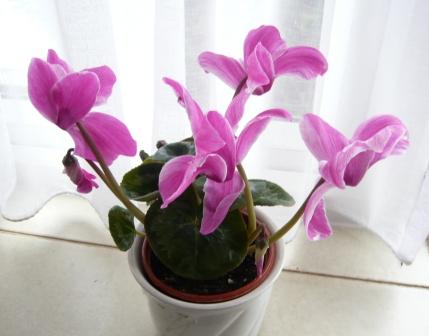
Cyclamen’s Top 22 Species

Wentworth Castle Cyclamen

There are now 22 recognised species of Cyclamen. It is said that at least one variety is in bloom for every month of the year.
Cyclamen grow in a range of areas and environments from beech woodland, alpine meadows and windowsills through scrub and rocky areas. This tuberous family of plants are predominantly from North Africa, Turkey and Mediterranean areas.

Top Cyclamen Species

C. balearicum
C. colchicum
C. graecum
C. africanum
C. cilicium
C. colchicum
C. coum
C. creticum
C. cyprium
C. hederifolium
C. intaminatum
C. libanoticum
C. mirabile
C. parviflorum
C. persicum
C. pseudibericum
C. purpurascens
C. purpurascens
C. repandum
C. rohlfsianum
C. somalense
C. trochopteranthum

If you are interested in studying further the Cyclamen Society has a good web site

Book Cover
Or an authoritative text Cyclamen: A Guide for Gardeners, Horticulturists and Botanists by Chris Grey-Wilson

Comments (1)

Red Leaves on Begonia Rex

red begonia rex

Even red leaved plants will photosynthesize. Pigments such as the red anthocyanins will mask the green chlorophyll pigments of some plants. Usually it is is the chlorophyll which is the stronger colour hence the green which predominates but not in these cases. Later in the season chlorophyll breaks down which then allows the other colours to show through. This provides one reason for the Autumn colours in many trees and shrubs.

This Begonia Rex is grown for its strongly coloured foliage and the spikes of light blue/white flowers are inconsequential. They can be propagated by leaf cutting, rooting in water or perlite. As house plants begonias like high humidity. There are many interesting Hybrid Begonias with red leaves and they do look a bit different when massed in the garden or grown indoors as a house plant.

Comments (1)

Holly for Christmas

Seasonal Berries

Get out and pick your holly for Christmas decorations now. As the berries ripen the birds descend and scoff the lot just when you are not looking.
You can condition the stems, leaves and berries and placing stalks in a glycerin solution. They will take up the liquid and become supple and longer lasting. Crush the stems and use warm glycerin then leave for a couple of weeks.

Hollies

These variegated Holly trees are part of a holly hedge grown for decorative purposes not cutting for Christmas.

Holly in the Wild

These berries look like they have already had the glycerin treatment but this is just how they were growing in a local Yorkshire field.
I dis leave the berries for the birds in case it is a cold winter.

Home & Garden Blogs

Comments

Next Page »