March 30, 2009 at 12:29 pm
· Filed under Gardening, Trees and Shrubs

Spring is known for colourful bulbs and primula but there are many top shrubs that provide great colour in spring.
Forsythia The yellow flowering twiggy shrub that can grow to 10 feet. It flowers before the leaves form and is a strong, bright yellow. Large blossom varieties are now being cultivated but either way you get a mass of bloom.
Rhododendron Evergreen shrubs of many forms and sizes from 12 inches to 12 foot. Some bloom from March and some in May. Many sizes and colors exist and one range is named after Snowwhite’s seven dwarfs.
Ribes sanguineum Red Flowering Currant 6′ by 4′ This easy deciduous shrub flowers in panicles of red or pink in March and April.
Mahonia aquifolium ‘Compacta’Oregon Grape Evergreen shrubs with spiky leaves grow to several feet tall. Yellow flowers in February and March with good scent. It also produces black edible berries. Read the rest of this entry »
Permalink
March 28, 2009 at 2:45 am
· Filed under Books

A cheap tip for members of the RHS is to borrow books from their libraries. I am reading the entertaining Techniques and Tips for Gardeners from the BBC Gardeners Question Time Team. A well produced book of over 300 pages contains a wealth of information and ‘nuggetts that rarely find there way into practical books’
Nuggets and Gardeners Tips
- Create shady areas for underplanting by puning off the lower stems of shrubs to create a trunk with a head of top growth.
- If a tender shrub like Callistemon ‘Bottle Brush’ or Pittosporum is cut down by frost leave it until summer as it may grow back from the base. Once new growth starts you can cut away the dead stems.
- Don’t be upset if windbreaks take a hammering during wild winters, that is the job they are supposed to do.
- Read the rest of this entry »
Permalink
March 27, 2009 at 2:05 pm
· Filed under Flowers and Plants

Even William Wordsworth probably saw fewer daffodils at a glance than appear in this shot. Intensive planting in grass land have now naturalised into producing a fine spring display(with some litter).
‘I wondered lonely as a cloud that floats on high o’er vales and hills
When all at once I saw a crowd a host of golden daffodils’
Tips for Buying Daffodils
- Visit a Daffodil Show this Spring – Your local or regional spring daffodil show is a perfect place to view many different types of daffodils. You can easily find out which varieties do well in your part of the world.
- Order Early – This is not a marketing gimmick. Early orders generally get the pick of the crop. Your chances are better of getting exactly what you order with no surprises. Catalogues are generally sent in spring and early summer.
- Compare Prices - Prices are not the same. Our opinion is that you do get what you pay for. Cheap bulbs are generally cheap for a reason. Smaller bulbs generally give smaller and fewer flowers. If it seems too good to be true it probably is!
- Be Aware – Some General Bulb Merchants routinely change bulb names and some may even substitute varieties without your knowledge. Ask other gardeners on Web forums about their experiences with specific suppliers. Try choose a specialist supplier.
- Read the Fine Print - Check the guarantee. Terms vary widely. Will they replace or refund in case of problems. Are the bulbs guaranteed true to name?
- Choose a variety – make sure you variety is fit for purpose. If you want cut flowers or varieties for naturalising seek out appropriate types
Read the rest of this entry »
Permalink
March 27, 2009 at 1:53 am
· Filed under Pests, Problems and Health

Organic Gardening by Geoff Hamilton
Covers many ideas about your own Organic Garden.

Pot Marigolds may help attract hoverfly
1. Encourage Ladybirds.
You can encourage ladybirds by providing suitable places for them to hibernated. You can buy ladybird boxes from specialist retailers.
2. Encourage Hoverflies.
Hoverflies are voracious eaters of greenflies. You will hopefully attract hoverfly without any effort. But, you can increase the hoverfly population by providing boxes to overwinter them. Geoff Hamilton used to encourage hoverfly and used to even harden off the hoverfly boxes like you would young saplings. It is also said that having a bunch of nettles encourages hoverfly because nettles provide an early season supply of aphids which encourage hoverfly populations for later greenfly infestations.
You can also encourage hoverfly through companion planting. E.g. Marigolds are said to attract hoverfly.
3. Hose off Aphids
You can use a power water spray to shake off aphids which have are eating off the leaves and buds. This will reduce most of the population, but, some are likely to survive. This is a good strategy if you are waiting for hoverflies to do their business.
4. Kill them with your fingers.
Not practicle for large swathes of plants but if you have a prize rose, close inspection and killing off aphids with fingers can be an effective way to keep them clear of insects.
5. Organic Sprays.
If all else fails you can try an organic spray which can kill greenfly without breaching organic standards.
Related
My Brother Geoff by Tony Hamilton

Permalink
March 27, 2009 at 1:15 am
· Filed under Flowers and Plants, Garden Design, House & Greenhouse plants

17th Century Newby Hall & Gardens
“Newby Hall and Gardens is well known in the gardening fraternity as an impressive example of well designed and extensive range of garden features, expertly decorated with a diverse range of plants. The truly magnificent herbaceous borders are the central feature of the gardens but are by no means the only feature of quality. Garden rooms and themed planting provide a range of style’s that can easily be incorporated into most gardens large or small. Of particular value is the work on plant conservation and Newby boasts the best collection of the genus Cornus in the Country.” I would also add the acid lovers Azaleas, Camellias, Rhododendrons and Magnolias so recommend visiting in April or May.
Ripley Castle & Gardens
Walking along from the castle terrace you get fantastic views over the lakes and deer park beyond. There is a woodland trail and an extended walk for the energetic. The large herbaceous borders create such a riot of colour between June and October each year but for me the old hot houses containing a highly impressive collection of tropical plants, ferns and cacti is the key feature. Ancient wisteria thrive on the high south-facing walls opposite the walled kitchen garden. This is maintained in neat order with the Henry Doubleday Research Association and contains an extensive herb bed and collection of rare vegetables.
RHS Garden Harlow Carr
The former home of the Northern Horticultural Society prior to merging with the RHS, Harlow Carr is in Harrogate less than 10 miles from the other gardens in this series. The garden is in a state of flux with many new design and development features on display. But despite the modern features as the RHS says ‘Harlow Carr is a garden dominated by water, stone and woodland and is very much part of the surrounding Yorkshire landscape’. Of interest to serious gardeners and specialists is the range of auxiliary special interest groups:-
Read the rest of this entry »
Permalink
March 26, 2009 at 2:12 am
· Filed under Trees and Shrubs

Apple Blossom on Oxford High Street by University Church

Close up of Apple Blossom against the Sky
Permalink
March 26, 2009 at 1:47 am
· Filed under Flowers and Plants

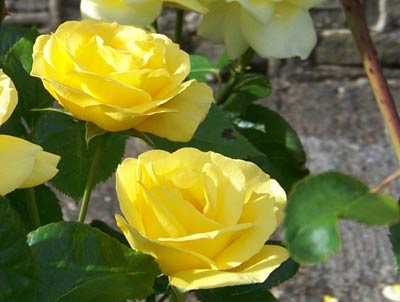
Yellow Roses
Roses enjoy a rich well fertilised soil. They have deep roots, but, in dry weather they may need a heavy watering to avoid drying out – especially when in flowering season.
Roses are prone to a variety of diseases such as black spot and more serious fungal diseases. The most common cause of disease is infestation by greenfly or black fly. To keep roses clear of disease it is important to tackle any greenfly problems.
Blackspot is a common problem, you can diminish this problem by picking off leaves and keeping area free of any fallen leaves.
Before Planting Roses
Before planting roses it is important to prepare the soil with a good organic mulch. This will feed the soil and improve water retention.
Roses need to be planted at the right depth. Make sure the hole is big enjoy so that the crown of the plant is above the soil level. In colder climates it is advised to plant roses a little deeper than usual
After Planting
- In the first few weeks make sure they are well watered to help them bed in.
- Feed with bonemeal.
- Roses like full sun or at least sun for part of the day. So choose a spot which is not too crowded or shaded by overhanging branches.
Permalink
March 25, 2009 at 8:38 am
· Filed under Flowers and Plants

The Pulsatilla is also called the Pasque flower or meadow anemone and although related to the anemone it is a separate part of the buttercup family Ranunculus.
- This clump forming herbaceous perennial is 6 inches tall and the flowers can be red, purple or white and have six velvety petals with curled, pointed tips surrounding a ring of bright yellow stamens. Flowering around Easter they have the alternative native British name of Pasque flower.
- All plant surfaces are covered in fine, soft hairs as can be seen in this images.The attractive seed heads which follow are spherical with silvery plume like styles raised on elongated flower stems.
- The plant is best treated as poisonous although it is occasionally used in herbal medicine.
- Protect from excessive wet winter weather. They tolerate alkaline soils and are found naturally in the wild.
- They dislike root disturbance and can be difficult to establish. They can be grown from seed or propagated by root cutting but try not to disturb the main plant as they take several years to flower at their best. Plant when small and leave undisturbed.
- Pulsatilla vulgaris Red Cloak is a great variety to grow from seed.
Permalink
March 25, 2009 at 5:00 am
· Filed under Flowers and Plants

Hellebores are doing very well this year. The combinbation of a cold winter and warm spring has brought out the flowers in profusion. The niger or Christmas rose is one of the earliest white flowers but many hybrids are now available.
Tips on Growing Hellebore
- Buy plants in flower so you know what colour you are getting. Hellebore is very promiscious and plants grown from seed may be crossed with other less suitable plants.
- Try grow plants in a raised area so you can look up at the flowers which tend to have droopy flowerheads. Read the rest of this entry »
Permalink
March 24, 2009 at 10:35 am
· Filed under Flowers and Plants

Oriental vegetables are at the heart of a good stir fry and are quite easy to grow from seed. Here we look at Pak Choi, Japanese Onions, and Lemon Grass but peppers are also easy to grow in a cold greenhouse.
Pak Choi can be grown as a baby leaf or left to mature into thick, succulent stems of white and green. These quick maturing Oriental vegetables are rich in Vitamins A and C and also contain calcium and iron. They also can be ornamental in a garden.
Three unique hybrid Pak Choys or Chinese cabbage for salads or stir fries come from Thompson Morgan.
- Purple – An eye catching reddish-purple top leaf contrasts with the green undersides and the bright green stems. Purple F 1 ’s purplish colour is enhanced by cooler autumn weather. Also found as purple Choy Sum.
- Green – Produces vibrant apple green stems. Ready to harvest in 30 days from sowing as baby leaf or 45-70 days as semi-mature to full size heads. Earlier and later sowings can be made under cloches or fleece to produce a supply of baby leaves.
- White – Produces pure white, juicy stems. Also ready in just over a month and flowers leaves and stalks can all be eaten.
Japanese Onion Shimonita is a novel Japanese salad onion with extremely thick tubular foliage. Plants given a wider spacing can achieve huge stems similar to leeks. The flavour is unusually sweet lower in the stems and more pungent towards the leaves. The plants are winter hardy.
Lemon grass Cymbopogon citrates is harder to grow as a half-hardy perennial needing a minimum temperature of 50F. The wonderful lemon-scented grass is a real delicacy that is essential in oriental dishes and an excellent addition to soups, curries, sauces and fish dishes. Germination can be slow but it grows surprisingly tall in the right conditions up to 5 ft.
Permalink