What is New for Ponds in 2010

I may be behind the times but here are three new ideas to enhance your garden pond this summer.

Pond Liners

Now you can cover black PVC liners with a stone coating. This makes the black edge of a pond look natural with a pebble or stone finish. Sold in various widths it could be used to finish off a butyl lined pond or as a run off into your garden proper. The brand I have seen is Oase Stone Liner

Islandscapes and Floating Planters

‘The Next Big Wave In Ponds’ (Oh please) ‘enhance the beauty and biological health of ponds, providing innovative filtration and a lush growing environment for terrestrial plants. lslandscapes offer food and fun for fish, frogs and other wildlife’ according to the blurb on Freedomponds.com
Velda do several floating planters made in covered styrofoam.


Ecopond Tadpole Food

I have to admit to never thinking of feeding tadpoles but if I did here is the answer. Ecopond Tadpole Food provides the nutrition that tadpoles need up to the point where they develop back legs (4-6 weeks after free swimming begins).

All these products are available from the links above or Bradshaws of York
See also frogspawn tips on Gardeners Tips

Comments (1)

Spring Spraying Fruit Trees Against Pest and Disease

Spring spraying of apple and pear trees is essential to avoid various troubles. Leaf, blossom and fruit problems need tackling with controlled spraying at the right time. It is a mistake to wait until you see signs of attack because it will be too late to remedy the problem, prevention is better than cure.

The first spray against scab and fungal problems should be made around mid-April. Traditionally Lime sulphur was used to control fungi, bacteria and insects living or dormant on the surface of the bark. That tends to burns leaves so it is not used on evergreen plants. Modern methods spray with Copper Sulphate, Bordeaux mixture or a fruit tree recommended systemic fungicide such as Dithane.Start spraying in April, again after petal fall and at the end of June, failing that read the instructions on the bottle.

To control fruit tree pests such as sawfly and caterpillars spray with an insecticide like ‘Bug Clear for Fruit & Vegetables’ This controls by contact greenfly, whitefly, blackfly and other aphids, scale insects, mealy bugs, red spider mites caterpillars and other common pests.
Spray at bud burst then wait for pollination. Then spray when the petals have fallen.

Book Cover Available from Amazon

A new portable sprayer operated by pumped compression such as the Killaspray will hold 7 litres of solution enough for several fruit trees with some left over for Roses.

Comments

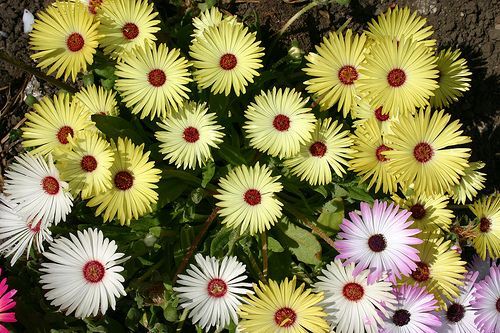
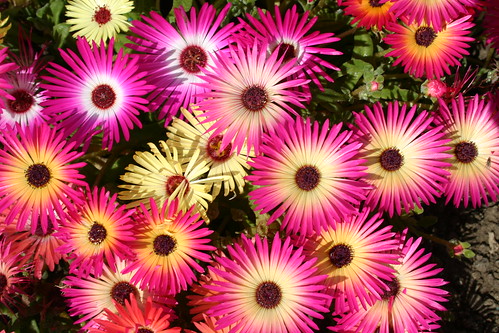
Osteospermum a Winter Survivor

My Osteospermum has survived through one of our coldest winters for some time. It grows in poor dry soil and gets no attention except for an occasional prune if it over spreads its welcome.

If I gave it TLC like I did to my various Cystus then I may be reporting yet another fatality.

The BBC recommend Osteospermum jucundum a variety with an RHS AGM (that is enough initials for now ed.)

I can’t do better than the Osteospermum website for more information.

A blaze of annual colour is available from Thompson Morgan

See also Gardeners tips

Comments (1)

Growing Scilla mischtschenkoana or Squills

Scilla mischtschenkoana
Scilla commonly know as Squills are a group of bulbs for outdoor and Alpine house growing. The ice-blue flowers of Scilla mischtschenkoana open out almost flat, first appear in February and continue well into March. Sunshine and a well-drained soil will make them at home in a bed or in thin grass.

Other members of the family include

  • Scilla bifolia -one of the earliest bulbs to flower, often with the snowdrops. It has a raceme of small, intense blue starry flowers.
  • Scilla sibirica ‘Spring Beauty’ is taller and has nodding flowers of intense royal blue during March or April.
  • Scilla peruviana has large heads of deep violet-blue flowers with strap like leaves.
  • Scilla lilio-hyacinthus. prefers woodland habitats with broad, fleshy leaves and pyramidal heads of sky-blue excelling in a cool, humus rich soil.
  • Scillia bifolia

    Scilla bifolia above and Scilla mischtschenkoana growing outdoors in a gravel bed below

Scilla mischtschenkoana

Comments

Dealing With Ants

ants

Photo by David Dennis CC

Ant at work. You have to admire the industry and organisation of ants.

Ants will be a common feature of any garden. To some extent, there is not much you can do about ants. In the garden they are a nuisance, but, sometimes it is just easier to live with them. Ants are more of a problem when they come into the house.

In the garden, you will notice ants, when areas of fine soil are created. (This actually makes very good topsoil). They are unlikely to do much lasting damage to your plants.

Generally, in the garden, I prefer to just tolerate ants, it isn’t really necessary to start using chemicals to kill them.

In the house they are more of a nuisance. But, before resorting to chemicals, simply try to block their entrances and keep areas clean of food.

Ants and Aphids

antsaphids

Photo by Martin Labar CC

This image shows ants and aphids working together. Ants are often attracted by aphids for the juice they excrete. In return, ants help protects aphids from predators.

How to Deal With Ants

  • Ants follow trails of food. Make sure you don’t have trails of food to your house
  • Ants do not manage to cross sticky substances. Using a jelly or slippery grease will prevent ants climbing in.
  • Often the easiest and most effective way of preventing ants entering in the house is to locate the hole where they are managing to enter. (Often ants follow a trail and you can see them returning out the same way they came – carrying food with them.)
  • If you find a colony of ants in a plant pot, you could drench the pot with water. (though make sure you don’t drown your plants.
  • Boiling water on an ant hill may also kill many of the ants in their. Though in the garden it might not be worth it.
  • Use Chemical pesticides.

Book Cover
Ant Spray at Amazon.co.uk

Comments

Top Tips for Cut and Come Again Leaf Crops

Grow leaf crops from seed and use the leaves as needed. When the leaves are 2-5 inches  high, which will take four to five weeks, they’re ready to eat. Loose-leaf lettuces need to have leaves harvested regularly.  In the fridge they’ll keep for three days or so.

Vegetables raised as cut-and-come-again crops can be planted much closer together than you normally would since the veggies are not going to be maturing into full sized plants before harvest time.

It’s better to stagger your sowing and planting to avoid a glut and so that you can maintain a continuous supply of harvestable leafy greens.

Harvesting is as simple as using a pair of scissors   to cut the plants after they reach a height of about two to six inches. Leave behind about a half-inch of stubble and the cotyledons 2 outer leaves on to resume growth.

Grow in containers to stop slugs and pests. Alternatively grow in a raised bed to make cutting easier. Most leaf crops like cool moist roots but do not appreciate too much overhead watering.

A range of salad and leaf crops can be grown as Cut and Come Again see below:

Common Name No of Cuts Lasts in Months
Perpetual Spinach 3 plus 6 plus
Texel green 2 2-3
Red Mustard 2 2-3
Salad Rape 3-4 3-4
Kale 2-4 6 plus
Pak Choy 2-3 2-4
Mizuna greens 3-4 4
Curly Endive 2-3 3-4
Sugar Loaf Chicory 2-3 3-4
Salad Rocket 3-5 2-3
Salad Bowl lettuce 2-3 3-4
Radish 2 1-2
Corn Salad 2-3 3 plus

Comments

How To Harden Off Seedlings

At this time of the year, we can start thinking about hardenening off our young seedlings. Depending where you live, the last frosts will be still around until the start of May, but, some seedlings can still be hardened off.

They Key to harden off seedlings for outside planting is to get them gradually used to the difference in temperature.

  • Allow at least one week of hardening off. Preferably two weeks.
  • Make Use of the Greenhouse, a cold frame or improvised insulation method.
  • During the day, especially when sunny make sure the windows are opened to allow sufficient fresh air. Under glass, seedlings can easily get too hot.
  • At night simply close the lid to prevent any frost.
  • During the hardening off period, feel free to keep the lid open for longer.
  • Keep an eye on the temperature. If a particularly frost night is expected, extra insulation such as a blanket may be necessary.
  • If seedlings were grown away from the glare of the sun. Make sure they get accustomed to the rays of the sun gradually as well.
  • When finally planting out. Choose a day with relatively mild temperatures and not too sunny. This makes for an easier transition.

Notes

Even frost resistant plants like Sweet Peas need hardening off. If they are suddenly moved from inside to outside, the change in temperature can be enough to stunt growth.

Comments

Plants Around a Birdbath

Attracting wild life and birds in particular is achieved by providing food, water and safety. Your bird-bath has provided the central issue, water, and your plants can help in the other two areas. There is no need to sacrifice colour or the ability to grow flowers for cutting if you choose wisely.

Aiming for a Cool Effect
Vebascum bombyciferum the Mullein has yellow floral spires on grey green foliage and lots of seeds later in the year.
Lamb’s Ears or Stachys byzantiana have mauve flowers with hairy grey leaves.
Yarrow is easy to grow and Achillea Moonshine is the lacy leaved variety I would go for to add to the grey leaved scheme.
Grass is popular with birds and Fountain Grass ‘Pennisetium alopecuroides’ produces late summer floral spikes and winter seeds.
White flowering Rosa Nevada has pale green foliage and the Foxtail Lily Eremurus stenophyllus has white racemes.

Other Plants and Tips
Birds will be attracted by insects who visit flowers like Thyme, Sedum, Sweet Rocket (also called Hesperis matronalis) and Heather.
Background plants can overwinter insects in Virginia creeper and Ivy and also provide nesting sites.
A mixed hedges provide a place of sanctuary.
See also Gardening for Birds on Gardeners Tips or Trees and Shrubs for Birds.
Purchase a good mix of plants of varying heights including some low lying creepers for the edges.
For plants in the shade read

Photo Credit normanack flickr creative commons.

Comments

Daffodil Details and top Twelve Tips

Daffodil Exhibition display
Now is the time to look closely at your Daffodil flowers and identify details of the parts you can see. Then learn to classify the flower into one of the Divisions experts use when showing or selling Daffodils. Finally remind yourself of the top tips for growing great Daffodils.


Detail Parts of a Daffodil Flower

The spathe is the protective green bract that covers the flower before opening time – cheers when it becomes papery.
The neck or pedicle is the section of stem that carries the flower whilst the main stem carries the chemicals from the bulb to the bloom.
The seedpod or ovary is close behind the developing flower, after pollination it begins to swell.
The petals, normally six in number, are the showy part of the flower also called the perianth.
The Corona is the central part of the daffodil flower. Also known as the trumpet or the tube it can be found in many shapes and colours.
The Stamen and stigma are the male and female organs that are surrounded by the corona.

Divisions of Daffodils

Division 1 – Trumpet Daffodils The cup is as long or longer than the petals. There is one bloom per stem.
Division 2 – Large-Cupped Daffodils The cup length measures more than 1/3 of, but less than or equal to, the length of the petals. There is one bloom per stem. Read the rest of this entry »

Comments

Pressure Washers Versus Chemical Patio Cleaners

I have previously only used chemicals to remove moss and algae on paths but this winter has left more problems than usual and I am looking to buy a Karcher pressure washer . There are a range to choose from at Focus see pressure washers at Focus.

The chemical alternatives

  • The strongest chemicals I have used are Trichlorates as used by farmers to clean milking parlors. They are strong alkalines and you must avoid run off onto your soil.
  • Path clear Moss & Algae Killer destroys moss, algae and lichens on all kinds of hard surfaces including decking, brick paving, patios, fences, sheds, glass, perspex, garden furniture, walls, paved areas and driveways.It is available from most garden centers and Amazon.
  • I have not tried patio magic, a concentrate for cleaning decking and patios also from Amazon

Book Cover

Comments

Next Page »