Hydrangea Aspera Shrub

Hydrangea Aspera Shrub

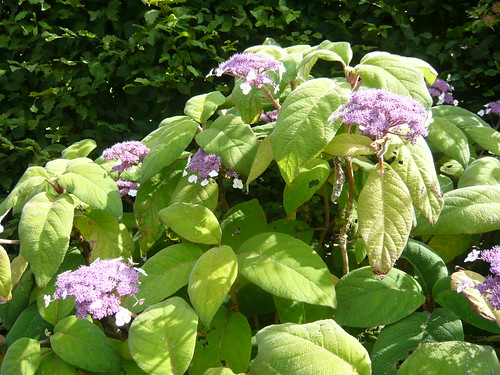
The leaves of this Hydragea Aspera are one of its key features. As with other Aspera subspecies the branches and leaves are ‘strigose’ which botanically means ‘beset with appressed straight and stiff hairs’ that means rough and furry to me.

This  specimen shrub is 4-5 feet tall and whilst it comes from the Himalayas some plants can be a bit tender.

The Purple flowers open to a clear white (that is almost burned out on this photo) but the overall effect is pleasing. The flowerheads make good internal decorations.

The colouring of Hydrangea Aspera is not affected by aluminium or acidity of the soil.

Other Hydrangea species that are closely related include H.Involucrata, H. Strigosa and H.  Villosa.   H. Sargentiana is a taller more leggy coarse shrub brought from China by E H Wilson with a low growing H. Longipes and H. Galbripes.

For Complete Hydrangeas book click here and for cheap colourant click this link
Book Cover

Hydrangeas available from Thompson & Morgan

See Help to change Hydrangea colour

Tips for Growing Geraniums (Pelargonium)

Tips for Growing Geraniums (Pelargonium)

Pelargonium

There are two great uses for Geraniums that make it worth growing these fine flowering plants. Outdoors they make fantastic border plants and the red varieties are very popular in formal bedding schemes. The second use is as a long flowering houseplant and if you deadhead and feed you plants you will get lots of geraniums from one windowsill plant.

Geranium Cultivation

Grow from seed, plug plants or cuttings. They root quite easily from spring cuttings.
Plant out when the danger of frost has gone.
Geraniums can go straight into a border/bed or be put in containers, troughs or baskets.
Pinch-out the growing tip in April to encourage bushy plants.
Feed in summer with a high potash fertilizer to encourage more blooms.
Geraniums can survive with little water so can be planted in dry conditions but they do appreciate a drink like the rest of us.

Tips and Ideas for Planting Geraniums

Use one variety or colour and plant together to get a bold swathe of colour.

Read More Read More

Gardeners Question Time

Gardeners Question Time

Book Cover

A cheap tip for members of the RHS is to borrow books from their libraries. I am reading the entertaining Techniques and Tips for Gardeners from the BBC Gardeners Question Time Team. A well produced book of over 300 pages contains a wealth of information and ‘nuggetts that rarely find there way into practical books’

Nuggets and Gardeners Tips

  • Create shady areas for underplanting by puning off the lower stems of shrubs to create a trunk with a head of top growth.
  • If a tender shrub like Callistemon ‘Bottle Brush’ or Pittosporum is cut down by frost leave it until summer as it may grow back from the base. Once new growth starts you can cut away the dead stems.
  • Don’t be upset if windbreaks take a hammering during wild winters, that is the job they are supposed to do.
  • Read More Read More

16 Exceptional Gardeners and Seven Christmas Books

16 Exceptional Gardeners and Seven Christmas Books

Book Cover

If gardeners are exceptional people then buy them a copy of this book for Christmas. It contains 20 stories and profiles about encounters with gardeners and a day in their life to provide reading matter for dark garden-free evenings.

Amongst those covered are these sixteen:

Roy Roberts Landscape Gardener
Roy Lancaster from Gardener’s Question Time
Book Cover
Tony Schilling Asian Heath Garden at Wakenhirst
Thomas Pakenham Meetings with Remarkable Trees
Book Cover
Geoffrey Dutton the Concrete Gardener
Beth Chatto Essex girl gardener
Book Cover
Howard Donald Waterer
Anthea Gibson ‘The Cotswold Gardener’
Lady Salisbury writer of a Gardener’s Life
Book Cover
Dan Pearson ‘Guardian of Gardeners’
Kim Wilkie ‘Reality is a condition induced by lack of imagination’.
Ronald Blythe Outsiders Gardener Friends.
Book Cover
Lucinda Lambton President of Garden History Society
Richard Mabey of Food for Free
Book Cover
Hugh “Wine Atlas” Johnson
James “Gaia Hypothesis” Lovelock.

Click on the book cover to buy from Amazon

Commercial Compost Critique

Commercial Compost Critique

Commercial compost is a range of products sold in plastic wrapping in garden centres, DIY shops and sundry retailers. This is not to be confused with your own garden compost made from decomposed plant matter.
The contents of these types of commercial compost vary and can affect the growing result considerably. All have a base which has no or negligible nutritional value plus additives that make it useful for a specific purpose.
Typical Compost Constituents – Base
Peat base of small fibers of bog peat is excellent for many purposes but now seen as none ecofriendly due to the over extraction of peat and lack of replenishment of the resource which isn’t sustainable.
Coir as a peat substitute for the base. Coir is made from the hairs & fibers of coconuts and such compost are widely available. There are special organic compost products approved by the vegan society .
Wood pulp based composts and partially composted bark are other bases the industry is trying to develop into retail products but mixes and formulas keep changing
Steralised loam based composts, generically called John Innes after the guy who first formulated them, tend to be heavier.
Composted green waste is becoming popular if you can find a reliable supplier who uses undiseased raw materials
Typical Commercial Compost Constituents – Additives
Most composts are mixes of some of the base ingredients and possibly sand or vermiculite to open up the compost and improve drainage
Fertilisers are added that are appropriate to the end use. seed compost needs less fertiliser than a container planting compost where a plant has to live for at least a season
A wetting agent is often added as peat is very difficult to get wet and you need an even moisture in a pot or seed tray.
Water retaining gels may be added for hanging basket compost.
Typical Compost for Special Uses
Rooting and cutting compost is usually just a mix of sand loam and peat
Seed compost has crushed limestone and phosphates added to help drainage an promote root growth
John Innes No1, 2 & 3 has varying quantities of fertilisers; hoof and horn, superphosphate and potassium sulphate . No 1 Potting Compost is for pricking out young plants, No 2 Potting Compost is for potting on and No 3 Potting Compost is for established plants and shrubs.
Ericacious compost is for acid loving plants like Rhododendrons and lime hating plants like Mahonia and has flowers of sulphur added to the peat based mix.
Cactus compost, Bonsia compost, Orchid compost, Citrus plant compost even African Violet compost are all available from a range of suppliers. One brand with a range available in many outlets is Westland http://www.gardenhealth.com/latest-news.php
Bulb compost used to be called bulb fibre and has no fertiliser . It is used for bulbs like Hyacinths that have already got a store of energy to produce a flower.
Tips On Compost
As it is an organic product the quality can be variable but there will be a brand you like so try some out – currently I am using Arthur Bowers and B&Q own label.
Mix in a bit of grit, sand, vermiculite or water preserving gel depending on how you plan to use the compost
Try keep it uniformly moist.
Add a drop of liquid soap to the water to restrict the growth of moss on seed compost used for slow germinating seeds.
Grow bags contain compost and are a cheaper way of buying compost than small bags.
Compost deteriorates with age so buy fresh compost from a commercial supplier with a fast turnover.

Month by Month Gardening for Guru & Novice

Month by Month Gardening for Guru & Novice

Book Cover

The Royal Horticultural Society produce many books and this one, RHS Gardening Month by Month by Ian Spencer contains over 1,300 seasonal tasks. Covering tasks for every part of the garden, expert plant advice and lists of star plants from January to December it is a great confidence booster. When you have finished those tasks it will be time to start a new year!

Whether you are a green-fingered guru or are just starting out enjoy 12 months of successful gardening. With help on what to do when to ensure your plants are well cared for and your garden blooms all year round.
Easy-to-follow, this guide not only tells you what to do when, but shows you how to do it.
You only need to browse and not follow slavishly.

Read More Read More

In Praise of Rhododendrons

In Praise of Rhododendrons

Rhododendron group

Rhododendrons have many praiseworthy characteristics.

Why Grow Rhododendrons

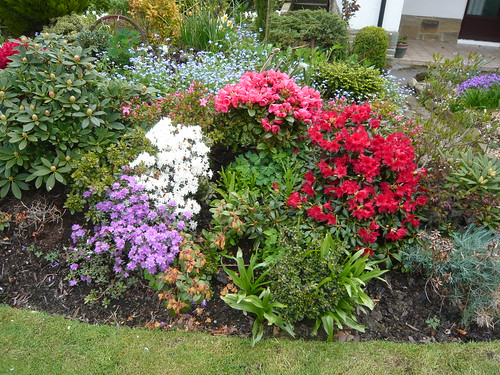
  • They are some of the most colourful spring and early summer flowering shrubs. Red, white and blues with yellows, pinks and shades to suit all tastes.
  • Rhododendrons are generally evergreen and provide structure through the year.
  • Modern hybrids are easy to maintain, slow to outgrow their allocated space and need little attention.
  • There are 1000 species to select and learn about. Prostrate and miniature rhododendrons suit a rock garden whilst some varieties can fill a woodland.
  • Scented Rhododendrons are shorter lived but have great aroma.

Where to See Rhododendrons

Book Cover

Book Cover

Further information

Early Rhododendrons

Housekeeping for small Rhododendrons

Rock Gardens in Miniature

Rock Gardens in Miniature

Kew 330

Your own rock garden does not have to be as large as that at Kew. You do not need to demonstrate every regional zone on the planet. Nor do you need specimen plants that grow in all the range of soil conditions and climates.
Better to concentrate on doing one or two things well.

Alpine house

On the same theme growing small plants can be an absorbing hobby. As with Kew gardens you will be very fortunate if you can replicate the alpine house at Harlow Carr shown above. However these two national gardens can give you inspiration for your own feature Rock Garden.

As it says in ‘The Rock Garden Plant Primer: Easy, Small Plants for Containers, Patios, and the Open Garden’ by C Grey-Wilson

Read More Read More