Ideas for a Purple Patch
Ideas for a Purple Patch

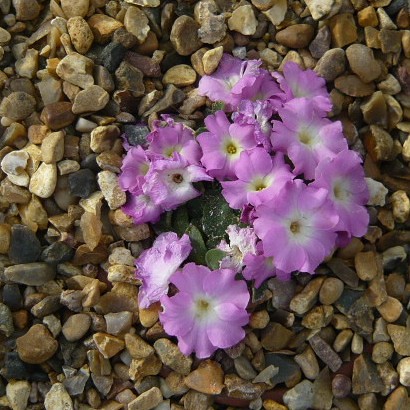
Primula 'Elizabeth Burrow'

This delicate little Primula ‘Elizabeth Burrow’ is not the best example of a purple patch plant as it is little bigger than a £2 coin. Primula Denticula however can be a real stunner with lilac or purple flowers on lollipop stems. This is just an example of the range of purple colourings available on modern plants ranging from deep violet to lilac.
Also from the Primula family come the Japonica and Harlow Carr Hybrids that often sport a purple hue to the flower-heads.
Kew 365
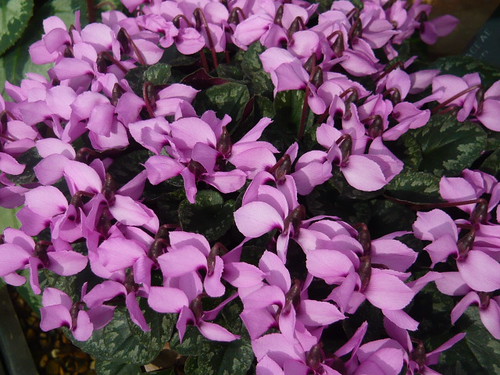
At the red end of the purple spectrum this cyclamen make a strong colour statement and it could be paired with the 18″ high Allium hollandicum ‘Purple Sensation’. There are also many purple Rhododendrons for early flowering like the compact Ramapo.
Read More Read More

Tips for Flowering Shrubs in Your Border

Tips for Flowering Shrubs in Your Border

Tips for Designing Shrub Borders

  • Create a tiered effect in your border by using shrubs of different heights.
  • Plant low growing types at the base and later flowering ground cover.
  • Select flowering shrubs who’s colour will lead the eye from one plant to the next.
  • Only bother to prune to take out dead wood or if the shrubs become unruly or too high.
  • Grow flowering shrubs to make a partially shaded plot for delicate flowers.
  • Plant larger trees or shrubs off-center to avoid a too formal appearance.

Plant selection for an Acid Soil Border

  • Camellia japonica can be planted at the back as it will grow 6-12 feet tall but only spread 3-5 feet. Red, white and pink are the most common colours to buy and the thick leathery leaves are evergreen.
  • Azalea Knap Hill hybrids or Mollis are very floriferous decidious plants that flower in spring before the leaves grow. Mine are now 4 feet tall after 5 years. Depending on the size of you border I would use 3, 5 or 7 of these great plants in various colours.
  • Callicarpa bodinieri produces stunning purple berries in Autumn 3-6 feet tall and wide.
  • At the front you may need some shade loving plants like Epimedium with copper tinted leaves. Trillium sessile has ivy like leaves and white, red or brown springtime flowers.
  • For shape it may be appropriate to add some Box (Boxus Sempervirens) near the front. 12-36″ tall.

Other Selections

  • The scheme above is strongly spring flowering and Mahonia x media ‘ Charity’ or Pieris japonica could also be incorporated into the planting.
  • For summer interest you may substitute or add Escallonia ‘Apple Blossom’, Hydrangea macrophylla or a hardy Fuchsia magellancia.
  • Ceanothus ‘Autumn Blue’ will fit in a sunny spot and a variegated Ilex aquifolium at up to 12 feet adds berry interest late in the year.
  • For general all year round cover the Elaegnus pungens Maculata has good colour in the leaves, Euonymus can grow to 10 feet and Skimmia has cream flowers in spring followed by red berries.

Banana Growing in England (no seriously)

Banana Growing in England (no seriously)

Kew 276
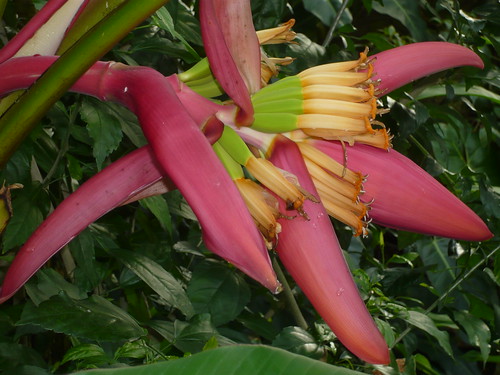
The cultivated banana comes from the genus Musa. Musa acuminata is the dessert banana and Musa balbisiana is the plantain that generally needs to be cooked. There are about 300 varieties, many of the edible varieties of which, do not produce seeds. Bananas are vegetatively propagated by means of ‘suckers’ which develop from buds on the underground rhizome.

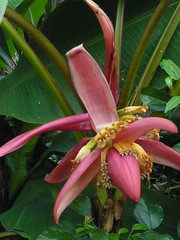
Banana hand

Cultivation Under Glass.

  • Good drainage is crucial since saturated roots will kill and bananas will not tolerate water-logging.
  • The banana plant is a very heavy feeder. Soil should be nutrient rich, slightly acidic, and loamy enough to retain moisture and keep nutrients from leaching below the shallow roots of the plant.
  • Good organic compost and seaweed will help maintain the banana plant’s high mineral requirements.
  • A fairly well-drained soil with a high organic matter content is ideal, and plenty of water should be provided throughout the growing season.
  • Banana plants grown under glass in this country will bear fruit, particularly under warm humid conditions. Fruit should be left on the plant until fully developed and then removed for ripening.
  • Cutting the plant back to soil level after fruiting will encourage suckering.
  • Bananas can also be grown successfully as foliage pot plants if the temperature and humidity are high enough.
  • Dry air in houses is one of the main causes of leaf getting brown tips and edges.

Kew 272
Edible bananas, such as the cultivar ‘Dwarf Cavendish’ can be grown under glass although they require a large area and plenty of height. High atmospheric humidity is essential and temperatures of at least 18°C during winter nights and 24°C during summer days are required. The plants also need full sun, possibly with some shading in the summer to maintain the requisite high levels of humidity.
Musa Williams Hybrid is a banana plant grown for the large banana heads with sweet, delicious bananas from a plant only growing 6-8 feet tall.

If growing for foliage it is   important to shelter the banana plant from heavy winds that can tatter the foliage.

Read More Read More

Crocus corsicus or Corsican Crocus

Crocus corsicus or Corsican Crocus

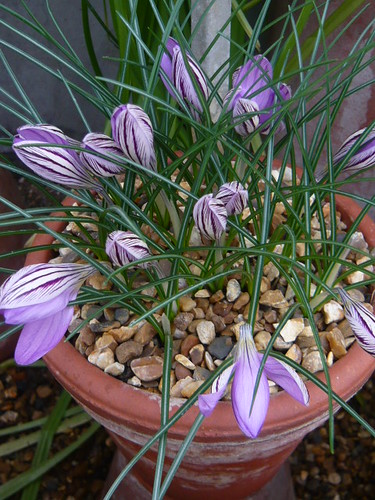
Crocus corsicus

Collectors of Snowdrops are named Galanthophiles so should crocus lover be called Iridiaphiles. Perhaps there are already Iridiaphile clubs collecting the numerous Crocus species including the Corsican Crocus shown above. Wikipedia list 80 plus species.

Gardeners Tips for Corsican Crocus

  • I like the idea of growing crocus in pots in the alpine house so it is easier to inspect the blooms but they ‘go over’ quicker and the water control needs to be spot on. This pot is stood on an inverted pot to get more height on the bench.
  • Corsican crocus are best in a rockery not being robust enough to grow through grass.
  • A sandy well drained soil even in an exposed site should be fine.
  • Outdoors they go on flowering for longer than many spring crocus.
  • In early spring is a delight to see the striped buds poking up followed a few days later by the open buds showing a contrast of purples and lilacs plus the sepals, styles and anthers in orange and yellow. .

Read Crocus Tommasinianus and Crocus Planting Depth

Plant Label for Madagascar Periwinkle

Plant Label for Madagascar Periwinkle

Kew Lable Catharanthus roseus

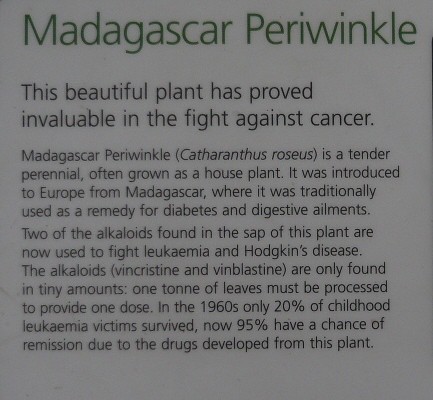
If you want an informative label on your plant you can do a lot worse than go to Kew gardens. This fulsome label informs and educates the visitor about the periwinkle or dogbane that is currently in flower. Catheransus roseus or Madagascar Periwinkle’s alkaloids have contributed to 70 different drug formulations from this one plant species.

Catheransus roseus

Below is the more normal horticultural label for the same plant. The family name is top right – Apocynaceae or dogbane is a family of flowering plants that includes trees, shrubs, herbs, and lianas. often found in tropical rainforests, and most are from the tropics and subtropics. Some are perennial herbs from temperate zones and many have milky sap that make them poisonous if ingested. Vinca major and minor are part of this family.

Paphiopedilum at Orchid Shows 2010

Paphiopedilum at Orchid Shows 2010

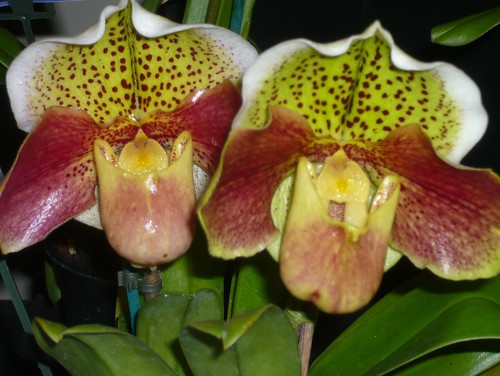
Paphiopedium

If you ever doubted that Orchids were an International passion just look at some of the speakers who have visited The British Paphiopedilum Society recently.

Dr Phillip Cribb (Royal Botanic Gardens, Kew, UK), Frank Smith (Krull-Smith Orchids, USA), Masayoshi Takahashi (Tokyo Orchid Nursery, Japan), Jerry Fischer (Orchids Ltd., USA), Dr Guido Braem (Schlechter Institut, Germany), Roelle Van Rooyen (Van Rooyen Orchids, South Africa), Prof. Leonid Averyanov (St. Petersburg, Russia), Jim Clarkson (University of South Florida Botanical Gardens),Joan Elvin from South Africa spoke about Paph. fairrieanum and Ernst Gunzenhauser based in Gelterkinden, Switzerland, which has been running his own company since the 1930s.

Societies and Shows

American Orchid Society  www.orchidweb.org
British Orchid Council  www.british-orchid-council.info
Orchid Society of Great Britain  www.orchid-society-gb.org.uk 24th April 2010 Spring show

Read More Read More

Crocus Planting Depth

Crocus Planting Depth

crocus

These crocus photos were taken at St Johns College, Oxford. Raindrops add a bit of interest though it is tempting to wipe the mud off.

Best Planting depth

  • Plant the corms about 4 inches deep, with the wider bottom of the bulb at the bottom.
  • Plant Bulbs about 3 to 4 inches apart.
  • For best effect plant in drifts and mass plantings of at least a dozen.
  • When Planting crocus, the best time is September or early October.

crocus

This same bunch of crocus has just been taken from a higher angle.

Notice how it gives quite a different effect to take photo from ground level.

crocus

Crocus In bloom.

crocus

An uncollected leaf adds a touch of colour.

Read Crocus Tommasinianus

Small is Beautiful in Gardening with Conifers

Small is Beautiful in Gardening with Conifers

‘Do not forget to pause and smell the flowers’ is an injunction oft repeated but it could also apply to pausing to inspect the flowers. It is easy to see the brash flowers of Dahlias, Peonies of Delphiniums for instance but close inspection of the petal-pattern or the individual florets can open up a new view of gardening.

One flower that fascinates me is the Cyclamen with the nodding head that straightens to a twist of petals what slowly untwist to reflex the petals back towards the stem. A fascinating natural process to observe. Look out for other dwarf bulbs including Crocus chrysanthus, Eranthis hyemalis (yellow aconite), Oxalis and Grape Hyacinth.

For structure in a miniature garden you can do a lot worse than Dwarf Conifers but be wary of slow growers that will eventually dominate like Juniper horizontalis and Chamaecyparis lawsoniana ‘Ellwoods Gold’.

Dwarf Conifers under 18″

  • Juniper communis Compressa is recognised as one of the best conifers for creating a miniature landscape with its slender spire of tightly packed grey-green foliage.
  • Abies balsamea Hudsonia grows to 12″
  • Chamaecyparis lawsoniana ‘Minima Aurea’ has wonderful golden foliage in a dense conical bush. Chamaecyparis lawsoniana Pygmaea Argenta also tops out at a similar 24″ but is blueish green with creamy white tipped shoots.
  • Juniper squamata Blue Star is a spreading 10″ high contrast to yellow leaved conifers.
  • Thuja occidentalis Danica is a neat bush with bronzed winter tints.

It pays to think small and to look closely. If you are limited for space it may pay to create a garden in miniature selecting all the small species you would like to see in Acres of space.

Cottage Garden for Edible Crops

Cottage Garden for Edible Crops

The traditional Cottage Garden was a working garden for the growing ornamental and edible crops. Planting included fruit, vegetables and herbs mixed with flowers such as Peonies, Delphiniums and Aquilegia to produce a haven for insects, an eye opener for gardeners and crops for the house.

Cottage Fruit Garden

  • Rhubarb would be one of my key plants in any cottage garden. In addition to the fruit pies from the pink and red stalks I would allow some plants to throw up the striking flower stalk. The Sutton or Victoria from Thompson Morgan would be appropriate varieties.
  • Gooseberries remind me of grandparents garden and Lancer is a green mid season fruit that crops well. Whinham’s Industry is a neat red.
  • Raspberries like Malling Jewel with some wire support near a wall or strung from two stout posts would also go into the cottage fruit patch.
  • Currants smell so good when the leaves are slightly crushed and redcurrant  Red Lake and the blackcurrant Wellington XXX would fill up the patch.
  • An old Apple tree in the corner may be supplemented by new ballerina columnar trained small trees.
  • If there is space for a Plum tree it will be an eating variety like Czar fan trained against a wall.

Cottage Vegetable Garden

  • Runner beans can hold there own amongst many flowers and I am growing Painted Lady variety this year.
  • French beans and broad beans are popular in my household so I will grow more of these than the brassicas which do not get eaten.
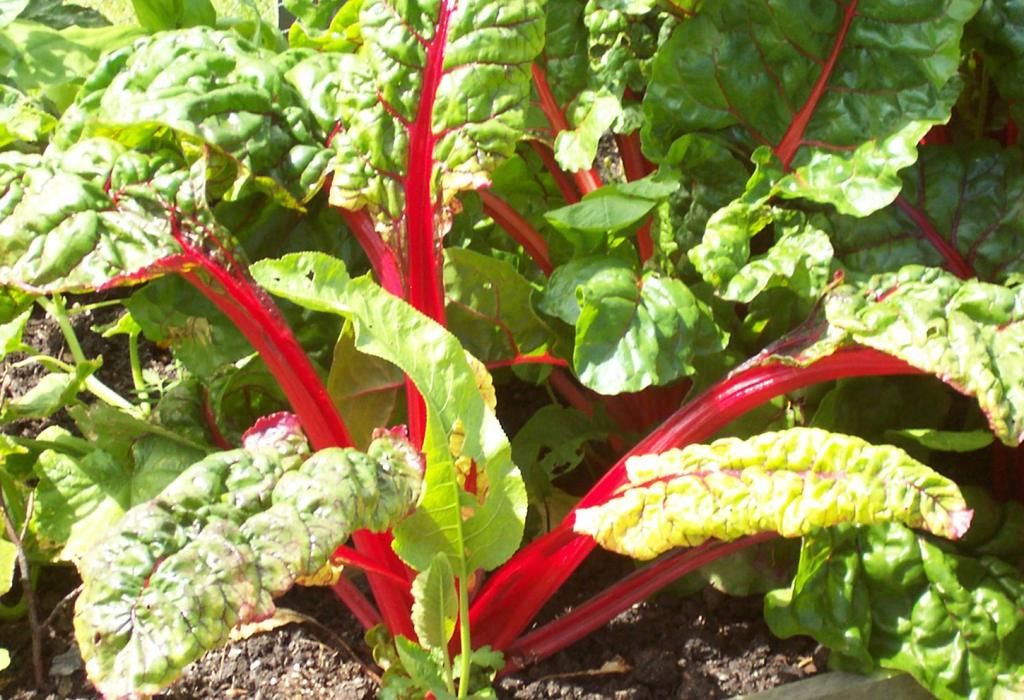
  • For colourful vegetables I will plant some Swiss Chard ‘ Bright Lights’.
  • I grow a mix of mangetout and garden peas that need regular picking.
  • You can also get away with a Tumbler tomato or two in a front garden.
  • Leeks look flamboyant when grown with  large flags and a good leafy marrow will provide lush green growth.

It is hard to agree on a range of flowers for a cottage garden so I have ducked the issue a bit. Nasturtiums are edible and cottagy and where would a garden be without Sweet Peas.

Swiss Chard
Growing Dried Flowers

Growing Dried Flowers

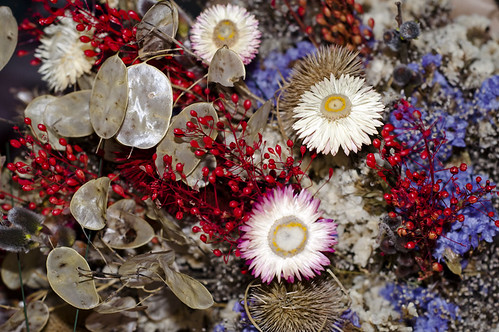
I guess when they are growing they are not dried flowers so the real title should be growing flowers for drying. As the display above shows you can get colour and texture into a bunch of dried flowers. The display is likely to last longer than a bouquet of fresh flowers and will be available when other material is expensive or in short supply.

There are 5 stages of development when a plant can produces flowers for drying.

  1. In bud as colour appears, examples being Helichrysum (Straw flowers) and Ammobium ( Everlasting flowers).
  2. As the buds open, with Echinops (Globe thistle), Eringium (Sea Holly), Lavender and Ornamental Grasses.
  3. In full bloom, with Achillea (Yarrow), Alchemilla mollis, Gypsophillia and Alliums (ornamental onions)
  4. After seeds have formed, like the Honesty in the bunch above and Antirrhinum, Poppy and Digitalis (Foxglove)
  5. Just before the seed pods open, but after spraying with hair lacquer to prevent seeds scattering, Nigella and Scripus ( Bulrush)

The best way to dry flowers is to pick them  in mid morning when the dew has evaporated.

  • Group them into small bunches and hang them upside down to dry.
  • To preserve the colours, hang them in a dry well ventilated space with little or low levels of light.
  • Large heads like Alliums and Artichokes need to be dried standing up. Make a chicken wire frame to separate and hold each bloom.
  • Read More Read More