How To Harden Off Seedlings

How To Harden Off Seedlings

At this time of the year, we can start thinking about hardenening off our young seedlings. Depending where you live, the last frosts will be still around until the start of May, but, some seedlings can still be hardened off.

They Key to harden off seedlings for outside planting is to get them gradually used to the difference in temperature.

  • Allow at least one week of hardening off. Preferably two weeks.
  • Make Use of the Greenhouse, a cold frame or improvised insulation method.
  • During the day, especially when sunny make sure the windows are opened to allow sufficient fresh air. Under glass, seedlings can easily get too hot.
  • At night simply close the lid to prevent any frost.
  • During the hardening off period, feel free to keep the lid open for longer.
  • Keep an eye on the temperature. If a particularly frost night is expected, extra insulation such as a blanket may be necessary.
  • If seedlings were grown away from the glare of the sun. Make sure they get accustomed to the rays of the sun gradually as well.
  • When finally planting out. Choose a day with relatively mild temperatures and not too sunny. This makes for an easier transition.

Notes

Even frost resistant plants like Sweet Peas need hardening off. If they are suddenly moved from inside to outside, the change in temperature can be enough to stunt growth.
Plants Around a Birdbath

Plants Around a Birdbath

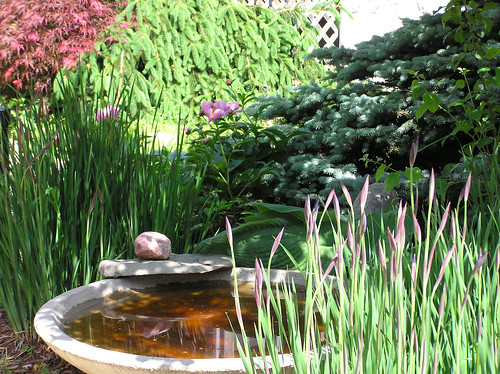
Attracting wild life and birds in particular is achieved by providing food, water and safety. Your bird-bath has provided the central issue, water, and your plants can help in the other two areas. There is no need to sacrifice colour or the ability to grow flowers for cutting if you choose wisely.

Aiming for a Cool Effect
Vebascum bombyciferum the Mullein has yellow floral spires on grey green foliage and lots of seeds later in the year.
Lamb’s Ears or Stachys byzantiana have mauve flowers with hairy grey leaves.
Yarrow is easy to grow and Achillea Moonshine is the lacy leaved variety I would go for to add to the grey leaved scheme.
Grass is popular with birds and Fountain Grass ‘Pennisetium alopecuroides’ produces late summer floral spikes and winter seeds.
White flowering Rosa Nevada has pale green foliage and the Foxtail Lily Eremurus stenophyllus has white racemes.

Other Plants and Tips
Birds will be attracted by insects who visit flowers like Thyme, Sedum, Sweet Rocket (also called Hesperis matronalis) and Heather.
Background plants can overwinter insects in Virginia creeper and Ivy and also provide nesting sites.
A mixed hedges provide a place of sanctuary.
See also Gardening for Birds on Gardeners Tips or Trees and Shrubs for Birds.
Purchase a good mix of plants of varying heights including some low lying creepers for the edges.
For plants in the shade read


Getting birds in your garden

Photo Credit normanack flickr creative commons.

Dionysia curviflore tapetodes & other Dionysia

Dionysia curviflore tapetodes & other Dionysia

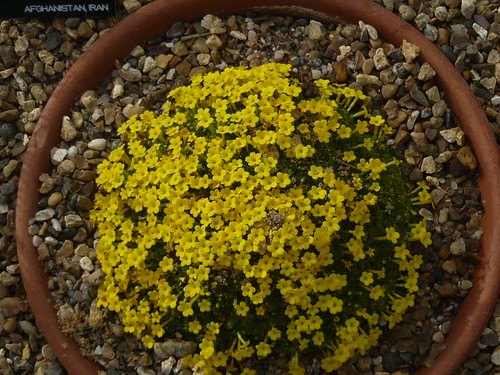
Dionysia curviflore tapetodes

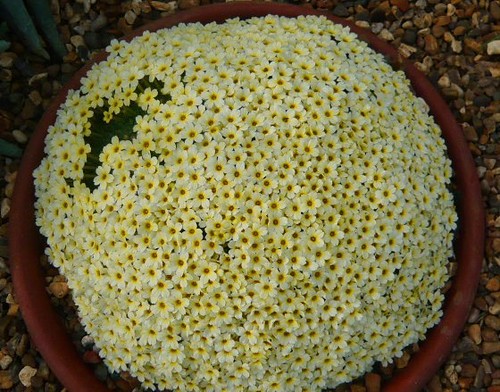
Dionysia are a group of plants containing 50+ species found in mountainous areas in Afghanistan and Iran. Dionysia are the ultimate alpine plant producing a mass of, often fragrant, bloom on top of a perfect dome. However they are tough to keep alive without alpine house conditions. These plants are not for the novice and need care particularly with watering.

Dionysia

Dionysia are cousins of the cushion Androsaces but differ by having a long narrow tube to the corolla. They like a gritty scree with some humus and plenty of water in the growing season.

Dionysia are part of the Primulacea family and have many similar genes particularly when it comes to colour. For example, hirsutin has been identified as the violet pigment in flowers of Dionysia archibaldii, D. bryoides, D. curviflora and D. microphylla. Yellow pigment in flowers of D. aretioides is now reported also in D. bornmuelleri and D. paradoxa.

Dionysia

Download a pdf article on 5 new Dionysia species or visit Rock Garden database for a list of the Dionysia species.

Bluebells a Gardening Friend or Foe

Bluebells a Gardening Friend or Foe

Bluebells are brilliant plants for woodland and glades but in my garden they are a bit of a nuisance. I would like to think my Bluebells are pure English but I think they may have hybridised somewhere down the line. They are scented but are light blue! I can’t remember
my flowers but English Bluebell flowers are narrow bell shapes hanging on one side of the stems, unlike the Spanish which are upright and wide open bells.

The reasons I find them a nuisance is the soft leaves become floppy and messy as soon as the flowering is finished. For years I have pulled up the leaves and composted them and thereby starts my problem. I have inadvertently spread the bulbils via compost to many unsuitable parts of my garden. The bulbs are deep and hard to eradicate so I am stuck with them.

See more Bluebells in Flower and ‘Tidy Up Bluebells’

It is illegal to dig up wild Bluebells but spring is a good time to plant them in the green. If after all this you wish to buy Bluebells you can do so from Thompson Morgan

Grow Edible Flowers For a Salad

Grow Edible Flowers For a Salad

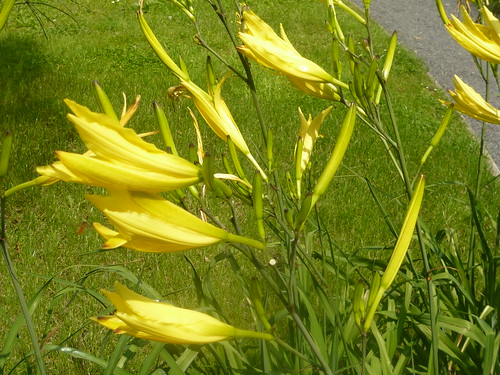
Day Lily

Do you like flavour and fragrance in your salad or would you like some more colour? If the answer is ‘Yes’ then I suggest you grow edible flowers in your own garden.

Harvesting Edible Flowers

It is normally the petals that are eaten but small flowers may be eaten whole.
Gather the flowers early in the day when the dew has just evaporated.
Cut with a small pair of scissors
Handle them gently and carry them in a basket to avoid bruising .
Leave them aside so any insects and beetles can escape. Only wash them if necessary then pat dry with a paper towel.
Keep in a closed plastic bag in the refrigerator until required and refresh with cold water before use.
Scatter over a salad in modest proportions.

Popular Salad Flowers

Pot Marigold or Calendula petals have a vibrant range of colours and can be used fresh or dried. They add seasoning as well as colour.
Nasturtium are popular as they are easy to grow and have been eaten for centuries. Buds flowers and seeds are all peppery to taste.
Pansy and Viola have little flavour but the colour can be made available virtually all year round with winter flowering varieties.
Primroses used to be collected from the wild but it is more PC to grow your own mild flavoured flowers.
Old fashioned Roses add colour and scent but test the variety first as the base of some petals can leave an after taste.
Dianthus such as Pinks and Sweet Williams can be strongly flavoured and scented.
The flowers of herbs;  Lavender, Sweet Bergamot, Sage, and Borage are suitable to eat in moderation.

Gardeners Tips

  • Pick young, small flowers and use with subtlety to enhance a salad not over power it.
  • Check the plants are identified correctly to avoid toxic flowers.
  • Add dressing to a salad before sprinkling with flowers to avoid discolouration.
  • Experiment with a wider range of flowers, there are lots to choose from. See Whats Cooking  America ‘Edible Flowers in salads’
Home Made Plant Protection

Home Made Plant Protection

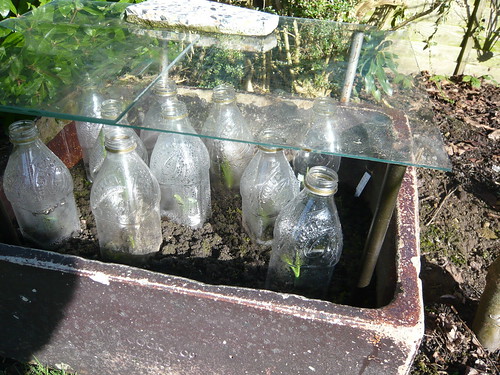
Bottle Glass House

This ‘double glazing for plants’ is getting these early onions off to a good start at the beginning of March.

Each plant has its own baseless pop bottle for individual cover. Then there is the glass sheet that will keep off the snow and the sink sides to keep out some frost. Intensive care for plants that can be treated as individuals may be worth the effort when our local vegetable show comes around (no wonder I have lost to this neighbour before.)

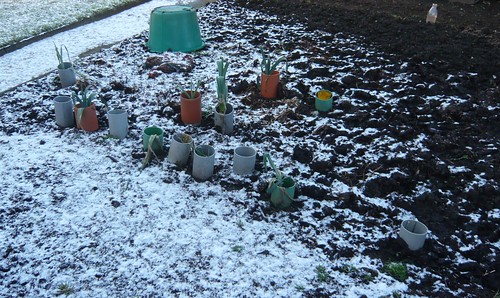
Winter Protection

This is another of the local money free protection schemes where the Leeks are grown in lengths of drain pipe. I guess this helps with blanching  but more importantly extends the cropping season. Talking of Leeks, yesterday I bought some seed of Swiss Giant Zermatt to pick from July as baby leeks and some Blue Green Autumn Neptune for resistance to Leek rust disease.

Tree Prevailing Against the Wind

Tree Prevailing Against the Wind

Prevailing wind

I was facing due North when I saw this tree in a local field. It shows how the prevailing wind is blowing from the West and I found it fascinating that other trees had grown in a way that supported the elongated branches.

It is not a garden sized tree, unless you have many acres, but it is a reminder that these great carbon capture devices are to be prized and cultivated.

Winter Aconites Light Up Under Trees

Winter Aconites Light Up Under Trees

March 2 Winter Aconites
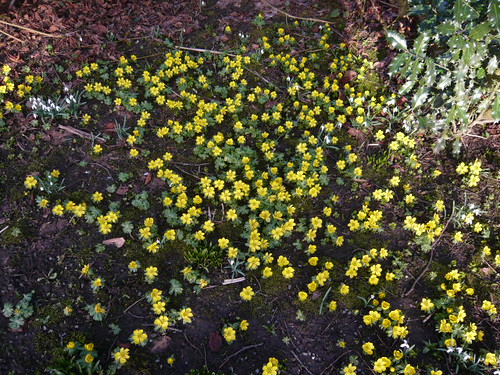
With a shaft of winter sun through the branches of a decidous tree the Winter Aconites glow gold and bright yellow. The low level of the sun catches the flowers and opens the simple petals to flash the stamens at the early insects.
In the wild Aconites do exactly what bulbs are supposed to do they grow, flower and seed while light penetrates the bare branches of the trees above them.
Winter aconites grow only 3 inches high and have upturned yellow cup shaped flowers around 1 inch across. The flowers sit stalkless on a ruff of bright green leaves and they can flower for up to six weeks.
A member of the buttercup family the leaves are deeply cut and disappear back into the soil by May.

Growing Winter Aconite Tips

Read More Read More

Cornus Chop – Dogwoods Bark Red

Cornus Chop – Dogwoods Bark Red

Cornus Alba Siberica

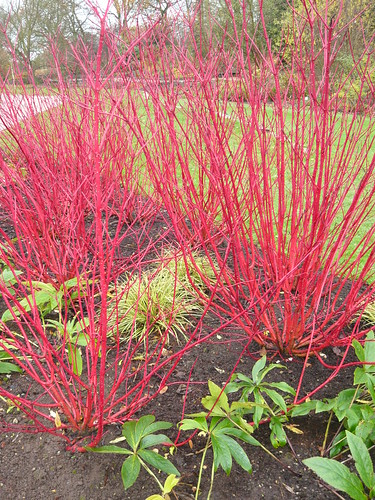
The first week of March and it was time for me to chop the Cornus Dogwoods down to size. The red stems that have shown up so well during winter will never be the same again if left on the shrub so they are ‘out for the chop’.

Pruning Cornus

  • Cut all the upright stems down to within 3 – 4 inches of the ground.
  • Water well and mulch the stump with good compost or manure to encourage new growth. Dogwoods like water!
  • New stems will grow, show leaf, flower and be ready for another winter display come Autumn.
  • Some pencil thick stems, 6 inch long, can be used as cuttings for growing new plants.
  • Check around the stool of the plant as you may have several new plants available from the layering of the old stems – any with roots can be severed from the main plant and relocated.

There are many other interesting Cornus trees and shrubs or new Cornus Alba Sibirica plants can be bought via Amazon
Follow the full story of Bark on our other pages

Growing Sweet Rocket or Dame’s Rocket

Growing Sweet Rocket or Dame’s Rocket

I planted some seeds of Hesperis Matronalis also called Sweet Rocket or Dame’s Rocket, and the plants came up like grass in next to no time. I should have reacted to the advice on the packet ‘scatter thinly when sowing …..thin out as necessary. Plants will self seed in following years after flowering. Sow outdoors in May to June, transplant in autumn.’ Well now I have a veritable forest to prick-out and keep under cover until the frost goes.

Growing up to 3 foot high the open airy plant flowers in shades of purple and lilac to white.The fragrance is as sweet as a violet’s, and most pronounced in the evening. It looks good in a border or a cottage garden and is attractive to wildlife. Some plants may bloom until August but warm weather shortens the flowering period.

Treat the plant as a biennial although it can often be perennial. When established it can be invasive and seeds freely.

Seeds are available from Thompson Morgan Sweet Rocket

Photo by nicoretro on flickr