Browsed by
Category: Gardening

General gardening tips and hints

Japanese Anemone – Autumn Wind Flowers

Japanese Anemone – Autumn Wind Flowers

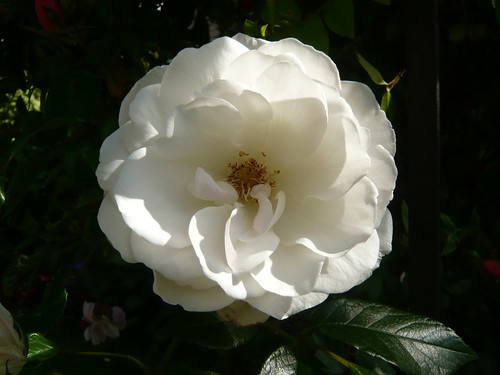
Anemone japonica are not the cheap and cheerful flowers from corms but a special group of autumn flowering perennial plants that grow  3-4 feet high. Planted in June they will flower this year on long stately stems in a range of rose, pink and the clear white with yellow boss of Honorine Jobert (see below).

The leaves are dark green and new growth breaks through in June to produce ever increasing sized plants. The large, long lasting blooms float above the deep green foliage which dies back in winter.

Honorine Jobert

Tips for Japanese Anemone

  • Increase stock by taking root cuttings. A 3”-4” length of root laid horizontal on compost and lightly covered will root and sprout a new plant.
  • Read More Read More

Agapanthus White African Lily

Agapanthus White African Lily

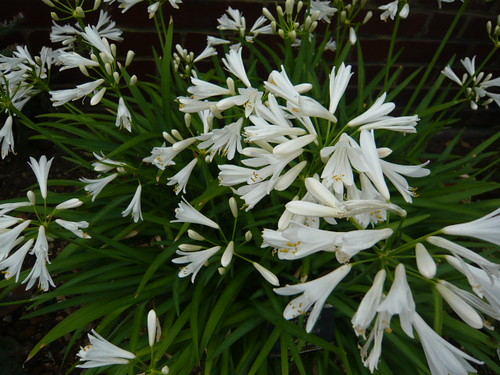
Agapanthus 'alba'
Agapanthus are one of the trendy flowers of this decade. The ball shaped umbrels are masses of tubular flowers in blue, violet or white. The deciduous sword shaped leaves grow from a bulb and root clump. Since new vvarieties have been bred to be hardy it has been practical to move Agapanthus from the cold greenhouse into pots and now into the border.

Gardeners Tips about Agapanthus

Read More Read More

Arum and Calla Lily – Zantedeschia

Arum and Calla Lily – Zantedeschia

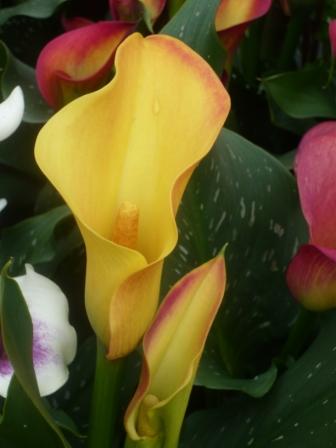
Lily the pink and many other colours amongst the Zantedeschias
zantedeschia

Arum lily or Calla Lily called Zantedeschia are available in an increasing number of shades and varieties. This Zantedeschia rehmannii can be grown to advantage in a terracotta pot that will show off the perfect spathes or funnel shaped petals.

Zantedeschia Tips

  • Arum Lily is the common name for the hardier outdoor variety. Usually white or pink.
  • Calla Lilys are often the less hardy but colourful varieties in white, yellow, pink, red or purple and are easy to grow from bulbs.
  • Zantedeschia have heart shaped leaves often with decorative spots.
  • Zantedeschia will flower for long periods throughout the summer with dramatic and exotic shaped flowers.
  • They are not frost hardy so they should not be planted out until after the end of May in the border or pots. I bury the pots to fill odd gaps and can easily bring them indoors in winter.
  • Grow them in one and a half litre pots with loam-based compost such as John Innes No 2 and plant the rhizomes just showing at the surface of the container with the eyes of the rhizome uppermost.
  • Water freely through the summer and feed with a balanced liquid fertiliser every two weeks until the flowers have faded.
  • They make exotic houseplants as well as summer border or container plants.
  • Read More Read More

Dealing With Weeds in Ponds

Dealing With Weeds in Ponds

To combat Algea, Blanket Weed and Invasive aquatic species you need to be on your guard.

Pond Weed
Pond Weed

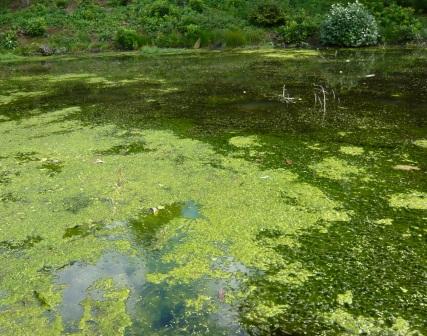
A small wild life pond doesn’t have to be weedy in either sense. This pond in our park for example is a fairly large size. However as you can see it is ‘Weedy’ in the gardening sense.

Removing Blanket Weed

  • Oxygenating plants are the best and organic method but may fill half the pond.
  • For a small pond you can try the winding it around a stick method but roots regrow and small critters may be thrown on the compost heap with the weed.
  • Read More Read More

Gardeners Tips for Choisya

Gardeners Tips for Choisya

You pays your money and you takes your Choysia- ternata, pearl or sundance it is up to you.

Choysia

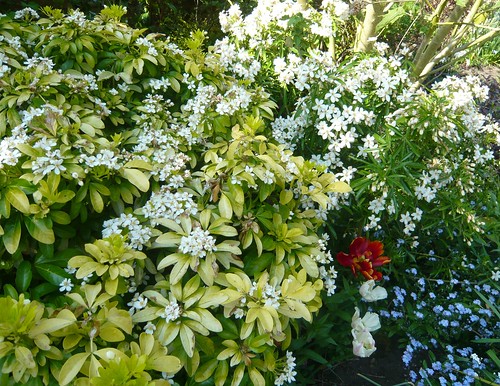
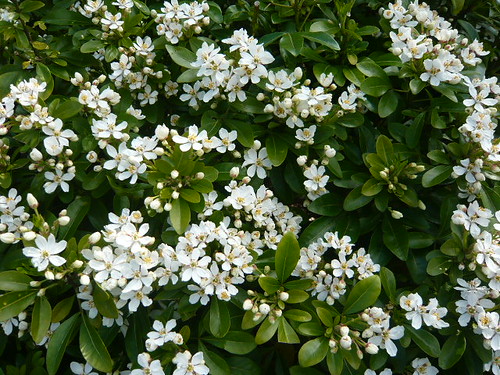
This Choisya ‘Sundance’ is an evergreen shrub grown from a young shoot cutting. The plants are trouble free and create a dome shape 4-5 feet high and spread in a similar number of years.

  • Grown mainly for the bright yellow of the new leaves they can be nipped brown with late frosts. Such damaged, scorched or wing burnt leaves should be cut off.
  • The small star shaped white flowers in April and May are very aromatic. A second flush of flowers may be obtained in Autumn.
  • Leaves also smell of basil or a bit citrusy if crushed
  • Choisya ternata ‘Aztec Pearl’ commonly called Mexican Orange blossom has narrower divided leaves and I find it is a bit thin in habit. The flowers are more numerous.
  • Choisya ‘Sundance’ is quite dense and the leaves, even when they have turned green, remain attractive and glossy.
  • Choisya will stand partial shade and can be used as part of an informal hedge
  • Propagate in Summer or Autumn, cuttings are easy to grow
  • Prune to keep in shape and cut out a third of the branches to renew from the base when needed.

Gardeners Tips 2011 Choysia

Duchy Originals and Organic HDRA

Duchy Originals and Organic HDRA

Rose Yorkshire Day 1st August – Organics for southern softies.
Rose

The Daily Telegraph report that a new range of Organic Seeds are to be available from Duchy Originals. This announcement coincided with Prince Charles visit to Ryton the Garden Organic establishment (HDRA).

It amuses me to see amongst the range of tools on sale at Duchy Originals a Dutch Hoe but may be I am confused somewhere with the Prince of Orange.

Organics is as organics does and the move to chemical free gardening has been highjacked by the organic movement. We and our food is all organic in some form or other. Some organic compounds can be most dangerous including some poisonous plants.

Thoughtful gardening will enable a sensible regime to coexist within a garden without slavishly following a proscribed ‘Organic’ regime.

Moss in Your Lawn ? – You Are Not Alone

Moss in Your Lawn ? – You Are Not Alone

The dry spell may have stopped your moss in it’s tracks but beware once mossy always mossy.

Lawn Leaves

After a wet winter it is a good if your lawn has no moss but it is unlikely. The yellower green patches on the photo above are where the moss is beating the grass.

Moss Thrives in Lawns

  • If the ground and soil under the lawn is compacted
  • Waterlogging or poor drainage encourages lawn moss (and moss in other areas too)
  • The grass that has been scalped by the lawn mower which cuts too short is an open invitation for moss to grow
  • If moss has previously been growing it is likely to return.
  • Where the lawn is old and a thatch of dead grass has built up and not been raked out or aerated
  • Moss will grow if the lawn is in the shade or overhung with trees, if the soil is impoverished or if you are an unlucky gardener.

Book Cover

Treatments and Tips

  • Don’t try to compost old moss – a normal compost heap won’t help as moss wont rot it just goes into suspended animation. So the moss will be returned with the compost
  • Read More Read More

Cold Gardens and Winter Tints

Cold Gardens and Winter Tints

With gardens still sweltering in the summer heat it seems too early to plan for cold winters but better safe than sorry.

    Cold Garden Locations
    A survey of gardens which had the lowest temperatures that most frequently dipped below freezing point include Norfolk and Suffolk, Lanarkshire and Highlands and surprisingly Letchworth, Watford and Royston in Hertfordshire. Perhaps it is not a surprise to those who live there.

    The mildest gardens were in Cornwall, Devon, Somerset and Bath – no surprise there. More surprisingly St Andrews, South Uist in the Hebrides and Newcastle would not have featured in my list of mild gardens. The mildest only had three weeks when temperatures fell below freezing.

    Winter Tints – Top Five

  1. Not all evergreens actually stay green through winter but they do tend to keep the leaves like Mahonia japonica which has coppery tints and early white blossom.
  2. Read More Read More

Best Pond Tips

Best Pond Tips

Water Lilies
If you are thinking and planning to get the best out of a new or rejuvenated pond than consider these quick tips

Design Tips

  • Design your pond so there are shelves around the edge of the pond for shallow and marginal plants. Water Lilies need to be planted at least 18″ deep.
  • If your pond has sheer sides you may want to grow marginal plants by submerging some staging (a weighed down inverted box). This can also be used as an escape route for amphibians to get out of the pond.
  • Keep good pond hygiene by preventing leaves and debris falling in the pond. Every two or three years have a good clean out reintroducing a small quantity of sludge at the bottom to get the process going again.
  • Locate the pond where you can see it preferably in a sunny position well away from any Pine trees. Koi fish need a shaded location.
  • Ornamental ponds may be best located in an elevated position to avoid run off filling the pond.

Book Cover

Planting Up

  • Plant in containers that you can hook out for plant maintenance. You can use a wire coat hanger on a stick if you use a basket with open loops. Invasive plants are constrained by the basket and you can rearrange the planting during the year.
  • Use good garden soil or special compost for planting and put a heavy layer of gravel on the top of the soil.
  • Unconfined plants can look more natural and are often wild life friendly but less showy as ypour best plants need to be containerised.
  • Consider a mix of Deepwater, Floating, Marginal and Oxygenating plants. Deepwater plants like cooler water and the floating leaves create this in a way that supports more life forms and restricts blanket weed.
  • Water hyacinth absorbs pollution particularly from fish waste. Skim off and compost excess plants as they multiply.
  • Bog plants and waterside plants are optional depending on your design and space. For a bog look in drier soil use Hostas and Bearded Iris or Iris Pallida that look like Bog Iris.

Book Cover

Cheap Perennials

Cheap Perennials

A well stocked garden is a treasure chest of potential new perennial plants. Divide clumps, take cuttings or collect seed and you can increase your bounty of hardy long lived plants to give away or replant.

Keep an eye out for new plants for your garden at reasonable prices as garden centers sell off old stock. I got 5 plants in 2 liter pots for a fiver at the weekend. It is a better form of recycling for me to renovate the plants for next year rather than see them composted.

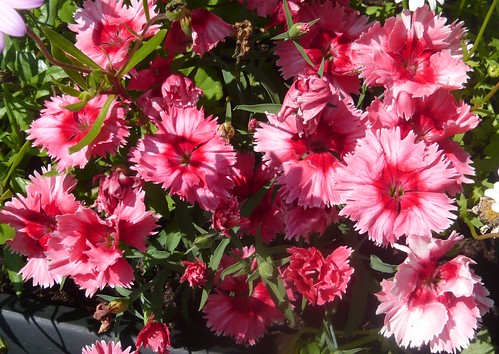
Dianthus ‘Kahori’ is an evergreen perennial with an erect habit. Its narrow leaves are greyish-green. In summer it bears scented pink flowers with a later flush in August if deadheaded.

Read More Read More