Browsed by
Category: Flowers and Plants

Annual, perennial and interesting flowers with advice on culture, information, tips and recommended varieties

Easter Flowers and Altar Decoration
Easter Flowers and Altar Decoration

Hols spain 572

On the first Sunday after the first full moon on or after March 21st churches are filled with Easter flowers.

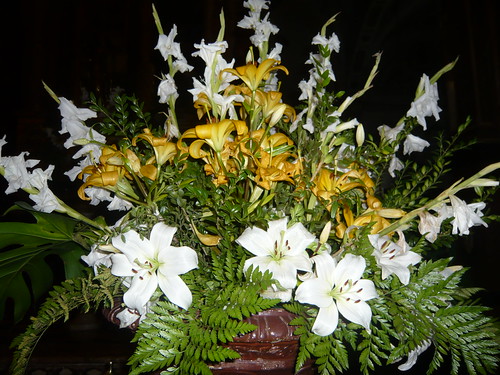
A fine display of altar flowers was arranged at this church. The white lilies of Easter in various species were popular this year, the traditional Lily longiflorum, these Asiatic hybrids and where available the Arum and Cala lilies fulfilled the Easter tradition of white lilies.
‘Often called the “white-robed apostles of hope,” lilies are said to have been found growing in the Garden of Gethsemane after Christ’s agony. Tradition has it that the beautiful white blooms sprung up where drops of Christ’s sweat fell to the ground in his final hours of sorrow and deep distress. At Easter time, Churches bank their altars and surround their crosses with masses of Easter Lilies, to commemorate the resurrection of Jesus Christ and hope of life everlasting.The pure white lily has long been associated with the Virgin Mary….. read more on Phillip’s florals.

In this arrangement there are white Gladiolus and yellow Lilies where we might of expected other yellows like Polyanthus, Chrysanthemum ‘Tuneful’ Pussy Willow catkins or even Orchids Oncidium varicosum for a bit of exotic. All the flowers have some longevity when cut for a vase and do particularly well in the cool shade of most churches.
Read More Read More

Spring Shrubs Forsythia and Flowering Currant

Spring Shrubs Forsythia and Flowering Currant

Forsythia

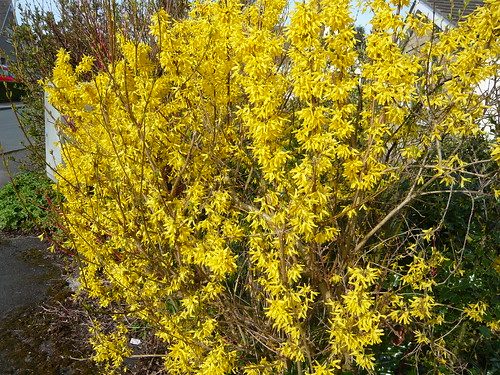
Forsythia is now in rampant bloom around our village. The sunny yellow flowers compete with the Daffodils for a place in the yellow spectrum of colour.

Blossom arrives before any leaves on the twiggy growth from earlier years. This cloaks the shrub in a mass of yellow blossom that really takes some beating. Only the very old wood has not got blossom this year and I will be tempted to encourage new twiggy stems by selective pruning when the flowering has finished. This will only be a light trim like they say at the barbers not a No 1.

Forsythia grows 1-2 feet per year from cuttings taken in late spring when the wood is green. Push 6 inch stems into a gritty soil preferably with some peat added as they like acidic soil. The shrub grows to 7-10 feet tall and almost as wide if left untended but it is then open and erring towards straggly, so I recommend the post flowering trim.

Flowering Currant

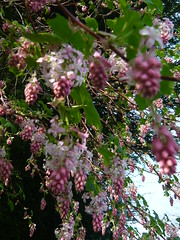
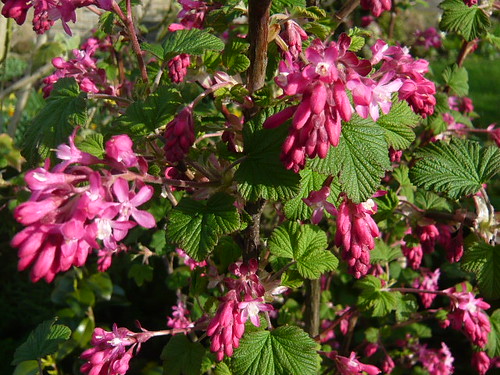
Flowering Currants also called Ribes sanguineum are also early spring blossoming shrubs. The sprays of flowers are like racemes of red or dark pink that are on show as the scented grey green leaves start to open. There is also a light pink variety that is a strong grower reaching 10 feet tall if left to its own devices.It is best kept at a 4-5 foot height.

Some better know varieties include ‘King Edward VII’, with red flowers, ‘Pulborough Scarlet’, also with red flowers and ‘White Icicle’, with white flowers.

Pink Ribes

Tips for Spring Shrubs

  • Prune after flowering. This encourages new flowering wood to grow for next year.
  • Take cuttings to propagate new shrubs in spring or early summer.
  • Mulch shrubs after summer rain or a good watering to see them through a dry summer.
  • Both Flowering Currants and Forsythia are east shrubs to grow.

Forsythia

Saxifraga in Well Drained Pots

Saxifraga in Well Drained Pots

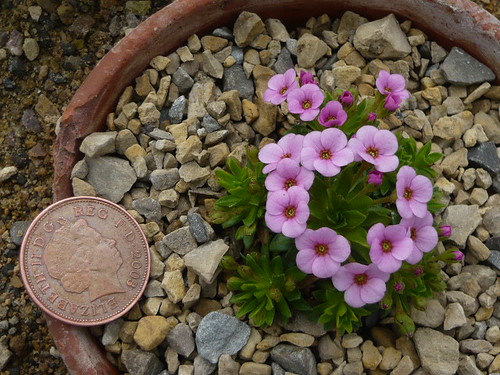
Saxifraga cranbourne

Small can be beautiful in the world of Saxifraga as can be seen with this Saxifraga Cranbourne one of the Kabschias series. This hybrid has a flat cushion bearing many rose pink flowers.

Saxifraga kellever suendermannii

Normally Saxifraga suendermannii has a solitary white flower but x kellever has these pink flowers. The hybridisation of Saxifraga is one of the pleasures of this plant.

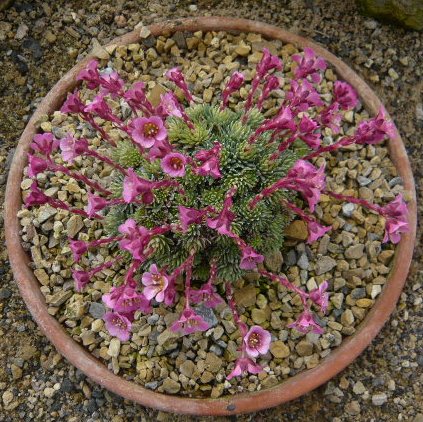
Saxifraga griesbackii

Saxifraga griesbackii from Englerias section has lime encrusted rosettes with tall arching sprays of pink flowers. The flower stalk is covered in deep red glandualr hairs show above. They look good over a long period whilst the inflorescence is growing and opening.

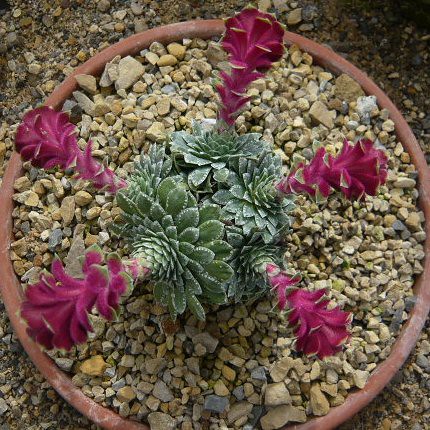
Saxifraga Sulphur

I have arrived late to the pleasures of Saxifraga but to see the range of plants I have been missing I looked at the Rock Garden Society of North America
If naming of varieties is still a difficulty for you at least you can find out what your variety probably isn’t by referencing this site.

Gardening for Maximum Flowers per Square Foot

Gardening for Maximum Flowers per Square Foot

What is the annual plant that produces the greatest number of flowers per square foot of ground? Despite the ‘Million Bells Petunias’ I still think it is the old reliable Sweet-Pea! Sweet Peas are loved for their scent, wide range of colours and as a cut flower.

  • Sweet Peas are easy to grow if you provide well manured ground. The roots are long so dig deep and compost well to provide food and moisture and you will be well rewarded.
  • Plant out, your seed raised, Sweet Peas in the first week of April or buy sturdy deep green plants from a nursery.
  • Take care not to damage or bend the long roots so they will need a deep hole.
  • Support each Sweet Pea with a twiggy stick and put some black cotton between the twigs to keep birds away from eating the tasty new plants. I also use a pea net.
  • After the plants have settled, about 7-10 days, nip out the growing tip to encourage branching and sturdy, bushy plants.
  • Feed weekly with a liquid tomato feed when buds start to appear.
  • Train up canes, removing tendrils, if you want long stemmed exhibition flowers.
Osteospermum a Winter Survivor

Osteospermum a Winter Survivor

My Osteospermum has survived through one of our coldest winters for some time. It grows in poor dry soil and gets no attention except for an occasional prune if it over spreads its welcome.

If I gave it TLC like I did to my various Cystus then I may be reporting yet another fatality.

The BBC recommend Osteospermum jucundum a variety with an RHS AGM (that is enough initials for now ed.)

I can’t do better than the Osteospermum website for more information.

A blaze of annual colour is available from Thompson Morgan

See also Gardeners tips

How To Harden Off Seedlings

How To Harden Off Seedlings

At this time of the year, we can start thinking about hardenening off our young seedlings. Depending where you live, the last frosts will be still around until the start of May, but, some seedlings can still be hardened off.

They Key to harden off seedlings for outside planting is to get them gradually used to the difference in temperature.

  • Allow at least one week of hardening off. Preferably two weeks.
  • Make Use of the Greenhouse, a cold frame or improvised insulation method.
  • During the day, especially when sunny make sure the windows are opened to allow sufficient fresh air. Under glass, seedlings can easily get too hot.
  • At night simply close the lid to prevent any frost.
  • During the hardening off period, feel free to keep the lid open for longer.
  • Keep an eye on the temperature. If a particularly frost night is expected, extra insulation such as a blanket may be necessary.
  • If seedlings were grown away from the glare of the sun. Make sure they get accustomed to the rays of the sun gradually as well.
  • When finally planting out. Choose a day with relatively mild temperatures and not too sunny. This makes for an easier transition.

Notes

Even frost resistant plants like Sweet Peas need hardening off. If they are suddenly moved from inside to outside, the change in temperature can be enough to stunt growth.

Dionysia curviflore tapetodes & other Dionysia

Dionysia curviflore tapetodes & other Dionysia

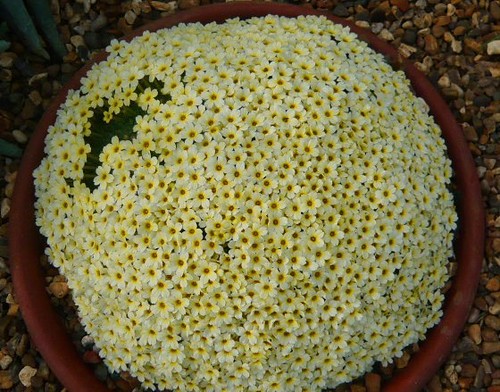
Dionysia curviflore tapetodes

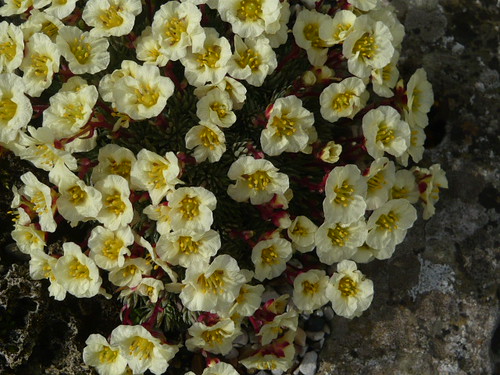
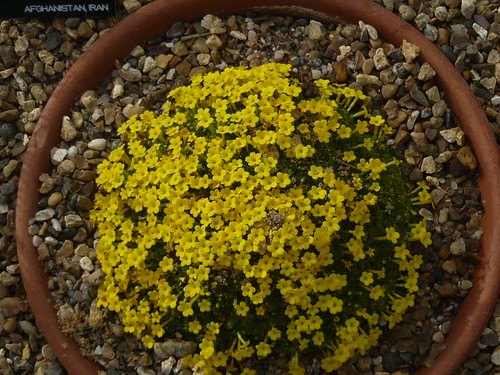
Dionysia are a group of plants containing 50+ species found in mountainous areas in Afghanistan and Iran. Dionysia are the ultimate alpine plant producing a mass of, often fragrant, bloom on top of a perfect dome. However they are tough to keep alive without alpine house conditions. These plants are not for the novice and need care particularly with watering.

Dionysia

Dionysia are cousins of the cushion Androsaces but differ by having a long narrow tube to the corolla. They like a gritty scree with some humus and plenty of water in the growing season.

Dionysia are part of the Primulacea family and have many similar genes particularly when it comes to colour. For example, hirsutin has been identified as the violet pigment in flowers of Dionysia archibaldii, D. bryoides, D. curviflora and D. microphylla. Yellow pigment in flowers of D. aretioides is now reported also in D. bornmuelleri and D. paradoxa.

Dionysia

Download a pdf article on 5 new Dionysia species or visit Rock Garden database for a list of the Dionysia species.

Bluebells a Gardening Friend or Foe

Bluebells a Gardening Friend or Foe

Bluebells are brilliant plants for woodland and glades but in my garden they are a bit of a nuisance. I would like to think my Bluebells are pure English but I think they may have hybridised somewhere down the line. They are scented but are light blue! I can’t remember
my flowers but English Bluebell flowers are narrow bell shapes hanging on one side of the stems, unlike the Spanish which are upright and wide open bells.

The reasons I find them a nuisance is the soft leaves become floppy and messy as soon as the flowering is finished. For years I have pulled up the leaves and composted them and thereby starts my problem. I have inadvertently spread the bulbils via compost to many unsuitable parts of my garden. The bulbs are deep and hard to eradicate so I am stuck with them.

See more Bluebells in Flower and ‘Tidy Up Bluebells’

It is illegal to dig up wild Bluebells but spring is a good time to plant them in the green. If after all this you wish to buy Bluebells you can do so from Thompson Morgan

Grow Edible Flowers For a Salad

Grow Edible Flowers For a Salad

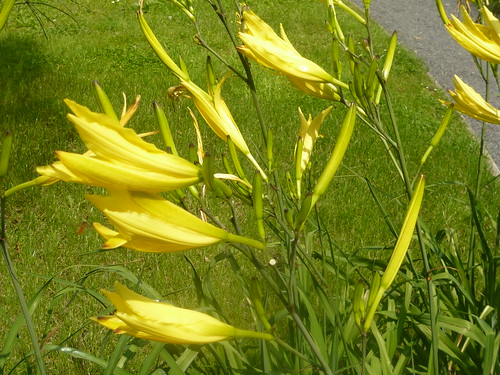
Day Lily

Do you like flavour and fragrance in your salad or would you like some more colour? If the answer is ‘Yes’ then I suggest you grow edible flowers in your own garden.

Harvesting Edible Flowers

It is normally the petals that are eaten but small flowers may be eaten whole.
Gather the flowers early in the day when the dew has just evaporated.
Cut with a small pair of scissors
Handle them gently and carry them in a basket to avoid bruising .
Leave them aside so any insects and beetles can escape. Only wash them if necessary then pat dry with a paper towel.
Keep in a closed plastic bag in the refrigerator until required and refresh with cold water before use.
Scatter over a salad in modest proportions.

Popular Salad Flowers

Pot Marigold or Calendula petals have a vibrant range of colours and can be used fresh or dried. They add seasoning as well as colour.
Nasturtium are popular as they are easy to grow and have been eaten for centuries. Buds flowers and seeds are all peppery to taste.
Pansy and Viola have little flavour but the colour can be made available virtually all year round with winter flowering varieties.
Primroses used to be collected from the wild but it is more PC to grow your own mild flavoured flowers.
Old fashioned Roses add colour and scent but test the variety first as the base of some petals can leave an after taste.
Dianthus such as Pinks and Sweet Williams can be strongly flavoured and scented.
The flowers of herbs;  Lavender, Sweet Bergamot, Sage, and Borage are suitable to eat in moderation.

Gardeners Tips

  • Pick young, small flowers and use with subtlety to enhance a salad not over power it.
  • Check the plants are identified correctly to avoid toxic flowers.
  • Add dressing to a salad before sprinkling with flowers to avoid discolouration.
  • Experiment with a wider range of flowers, there are lots to choose from. See Whats Cooking  America ‘Edible Flowers in salads’
Home Made Plant Protection

Home Made Plant Protection

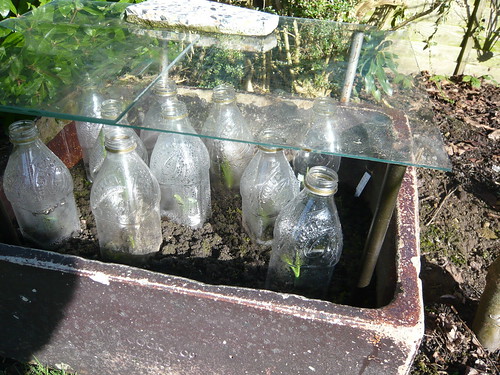
Bottle Glass House

This ‘double glazing for plants’ is getting these early onions off to a good start at the beginning of March.

Each plant has its own baseless pop bottle for individual cover. Then there is the glass sheet that will keep off the snow and the sink sides to keep out some frost. Intensive care for plants that can be treated as individuals may be worth the effort when our local vegetable show comes around (no wonder I have lost to this neighbour before.)

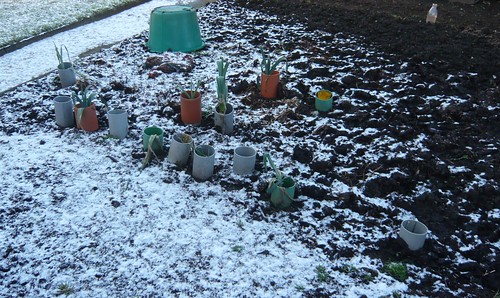
Winter Protection

This is another of the local money free protection schemes where the Leeks are grown in lengths of drain pipe. I guess this helps with blanching  but more importantly extends the cropping season. Talking of Leeks, yesterday I bought some seed of Swiss Giant Zermatt to pick from July as baby leeks and some Blue Green Autumn Neptune for resistance to Leek rust disease.