Browsed by
Author: hortoris

Islamic Gardens of Paradise

Islamic Gardens of Paradise

The seeds of Islamic gardens grew from Persian gardens that were created to be oasis in the desert. Islam spread the sphere of influence to India, Turkey, and Spain from the Taj Mahal to Alhambra.

Key Design Elements

  • The objectives were to create a haven of order amongst chaos.
  • A place to relax and understand the universe.
  • Based on the significance of four items most of the designs are quadripartile.
  • The four key elements include a boundary or enclosure generally of trees. Water channels dividing into 4 parts. A Gazebo or platform for poets to contemplate. Trees and flowers as a fourth element.
  • To readers of the Koran, paradise is a land of rivers running with ‘milk, honey, wine and water.’
  • In the Mogul gardens of India, Persian roses were one of the most sought after flowers

Moorish Gardens of Spain

  • After conquering parts of southern Spain the Arabs brought their distinctive style of gardening. One of the most famous is the Moorish gardens at Alhambra.
  • The entrances to Persian gardens often incorporated highly decorated buildings symbolising the gateway to paradise.
  • Buildings and gardens were often integrated into one experience.


Considerations for Your Garden

  • What symbolisation do you wish to convey. Plan accordingly.
  • It is quite acceptable to incorporate other gardening styles. Some Asian gardens adapted various Hindu influences and European influences may be dictated by growing conditions.
  • Think of a Persian carpet with neat squares combining into the garden space available.
Mythical Gardens and Antiquity

Mythical Gardens and Antiquity

Shangri-las

I will use Shangri-la as an all encompassing name for spiritually based gardens and areas of harmonious natural beauty stealing a name from James Hilton in his novel Lost Horizon.

To many Shangri-la conjures up a ‘place regarded as an earthly paradise, especially when involving a retreat from the pressures of modern civilization.oed’  a remote or an imaginary, beautiful place,  where everything is pleasant and life approaches perfection

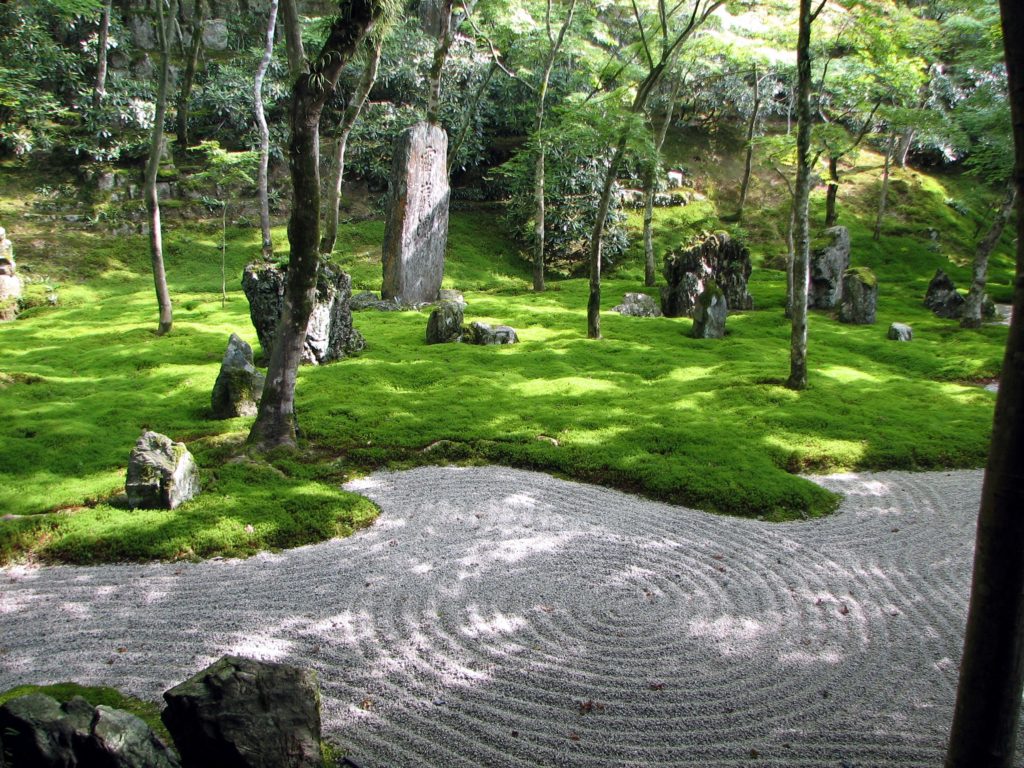
The essence of a spiritual, peaceful gardens is represented in different ways across the world by Buddhists from Tibet, Daoists from China or in Zen gardens from Japan. Some of these forms of a Shangri-la are known to feature in ancient literature from 200 BC.

Book Cover

Gardens with Spiritual or Religious Background

Persian Gardens over the last 5 millennia have soothed and calmed societies with the use of water representing the great rivers of the Tigris and the Euphrates. Building on this spiritual tradition Islamic Mogul gardens stretch across Asia. There have been examples of Hindu influences in India and other developments in Kashmir, Pakistan and Bangladesh together with gardens in other parts of the Mogul empire. Islamic Charbagh gardens are based on the four gardens of Paradise mentioned in the Quran.

Monastic gardens in the UK and Europe are now renown for medicinal  herb and vegetable growing. In the middle ages these gardens also acted as pleasure gardens, orchards and even cemeteries, in fact most of the aspects required to enjoy a healthy and spiritual  life .

Other Mythical Gardens

The Hanging Gardens of Babylon were reputed to have been built alongside a grand palace known as The Marvel of Mankind, by the Babylonian King Nebuchadnezzar II around 605 BC). This was  a gesture for his Median wife Queen Amytis, because she missed the green hills and valleys of her homeland.

 In the Oldest Gardens in the World CWS records claim that ‘The Epic of Gilgamesh, thought to have been written as early as 2100 BC contains the oldest mentions of gardens in surviving literature. Gilgamesh states that his city Uruk was ‘one third gardens’, and in the story visits the ‘Garden of the gods’, a garden with precious stones, pearls and jewel-laden trees.’

In the knights of the round table Avalon was  where King Arthur was nourished back to health after his battle with Mordred. Unlike Camelot Avalon was ‘a land of plenty, where wild apple trees and vineyards grow of their own accord no matter what the season.’

Tír na nÓg in Celtic mythology is the supernatural land only ever seen by a lucky few. Al0ong side the ‘Little Folk’ the slow pace of life has lush dwelling’s in peaceful trees with sumptuous flowers and landscapes that remain green all year round.


Your Own Garden of Eden

Your Own Garden of Eden

The Garden of Eden

When God became the first gardener after creating the earth and heavens he noted that ‘no shrub of the field had yet grown on the earth, and no plant of the field had yet sprouted, he had not caused it to rain on the earth, and there was no man to cultivate the ground.’

The Lord God planted an orchard in the east, in Eden and made all kinds of trees sprout from the soil, every tree that was desirable to look at and good for food. The tree of life and the tree of the knowledge of good and evil were in the middle of the orchard. So God commanded the man, ‘You may freely eat fruit from every tree of the orchard but you must not eat from the tree of the knowledge of good and evil.’

‘In the beginning’ of your gardening career you can access a large body of knowledge via media or if you are fortunate from experienced gardeners. All the experience will acknowledge the effect of the ‘tree of life’ or more prosaically the eventual death of trees and plants – reading Genesis may explain why. We know even long lived plants such as Ginko, Bristle Pines and Wollomia have a finite life although they will outlast generations of gardeners yet to come.

What can we Learn from The Garden of Eden

  • Gardens are a long term proposition. It possible that in the hands of a well meaning gardener they can lead to the Elysian Fields noted in ancient Greece.
  • God noticed there was ‘no rain’ and no cultivation of the ground so there are the initial couple of key jobs for any gardener.
  • With the concept of the ‘tree of the knowledge of good and evil’ being in the middle of the orchard you may think the evil part included rot and pestilence. So a third task for gardeners is to maintain a clean healthy utopian garden.
  • Adam needed help in the garden or was Eve the primary gardener as it is in my Arcadia.
  • The garden of Eden should have ‘dominion over the fish of the sea (or garden pond?) and over the birds of the heavens and over every living thing that moves on the earth’. A manifesto for an environmentally friendly approach to gardening.
  • The original biblical garden was planted in the east of Eden but there are few limits to where a modern garden can be situated nor what you can try to grow.


Gardens with Spirit – G.Tips New Venture

Gardens with Spirit – G.Tips New Venture

Nature is both constant and changing in that it is always with us but seldom remains static. In times of stress, poor health and personal pressure aspects of nature are there to fall back on. Meditation and mindfulness have grown in popularity and profile in recent year but the benefits of a garden have been acknowledged for centuries. Gardeners Tips is opening a new category within our pages to look at different types  of garden, our  relationships with nature and a spiritual approach to show how each  constructively helps.

New Venture

  • Over the last 10 years G. Tips has provided 2100+ pages of pictures, tips and sometimes idiosyncratic comment. We are not about to change the formula too drastically but hope the themed approach to new posts will be constructive.
  • There is a cathartic result for the author when a post is completed, published and even better when it is read. For those who garden or consider nature in almost any form we hope they derive health benefits and peace of mind. So for the next decade we hope G.Tips lives on as do all the precious plants in your gardens.
  • Tomorrow the first of our new posts will go back to the beginning and the Garden of Eden.

Just to break the ice and get going here is a short list of publications on the subject of ‘spirit’ that are available via at amazon.

Book Cover

Gardens of the Spirit 2019 Calendar: Japanese Garden Photography

A good photograph can lighten up your day and I have enjoyed various calendars over the years. You do not need to opt for an expensive version you can get as much satisfaction out of a DIY calendar. Do you remember the calendars we used to make at school with a small pad of monthly dates to stick at the bottom of a photograph or picture cut from a magazine. Good pictures and images invoke memory and can boost your spirit.

Book Cover

Contemplation may be at the heart of a spiritually orientated garden. Certainly it will involve landscapes and the ability to look and see. As the blurb on ‘Landscape as Spirit’ sets out:-

‘principles of Oriental and Western garden design to make bold and original statements in his landscapes. Mosko explains how to deploy the materials of the garden so that their arrangement reflects the contemplative mind. The chief paradigm he uses is the mandala, a symbolic picture of the ideal world used in some form in many of the world’s cultures. Rocks, streams, plants, paths, and structures of the garden each take their place in the mandala as one of its five elements: Earth, Water, Fire, Air, and Space. The means to produce a balance of these elements is the mind conditioned by meditation and a clear understanding of its own nature. Inner harmony is expressed as outer beauty.’

Book CoverSanctuary is one of the most basic human emotional need. We all need somewhere to retreat too when the need arises. Jessie Bloom’s book recognises this and adds:-

‘traditional plant wisdom to help readers find a deeper connection to the outdoor space they already have – no matter the size. Equal parts inspirational and practical, this engaging guide includes tips on designing a healing space, plant profiles for 50 sacred plants’

Read More Read More

Best British Trees Reviewed

Best British Trees Reviewed


Our series of tree reviews covers exotics and UK trees with a few specials thrown in. Each separate post covers;

  • Latin names and other common names
  • Height, uses and normal distribution. –
  • Type of tree – Evergreen/ Deciduous – dictoyledons, monocotyledon, Conifer etc
  • Description of Leaves, Flowers, Fruit and bark –
  • Family links, varieties and near relatives –

Below are links to a dozen British natives with short descriptions.

English Oak
Top of most lists for great British Trees. Our list of tree reviews is no different, Oak is the tops!

Rowan – Mountain Ash
The trees can be quite singular in appearance when shaped by wind on high moors and mountains.

Beech
From the copper coloured leaf to solid green hedges the Beech deserves a place in most gardens.

Silver Birch
Seem to be growing everywhere you look with some very distinctive varieties like Jacquemontii.

Horse Chestnut
Brought to England by William the Conqueror (no not really the conkers were there first).

Norway Spruce
Despite containing a foreign country name this Spruce grows freely on Forestry Commission land in the UK.

Hawthorn
Ideal for hedgerows and feeding birds. May blossom in May maybe.

Lime or Linden
a useful ornamental for parks and large gardens.

Hornbeam
Grows well in my garden and trains easily into a shapely tree.

Sycamore
Related to the other Acers but I would let someone else grow Sycamore on their land. (not my favourite)

Larch
A fast growing deciduous conifer good in forests.

Yew
Longest lived and slowest growing British tree synonymous with church yards and pagan worship.

Ash
Along with the Oak and the bonny Rowan tree the Ash is justly popular.

Notes

  • This completes our bakers dozen of British trees. If you want to learn more click on each link.
  • If you want to look for a different tree, type in the common or Latin name in our Google search box.
  • Please feel free to leave a comment or make a request on tree or garden related matters.
  • For more information of tree leaf shape design and function read this section.

Tree Organisations and Links
Woodland Trust

The Arboricultural Association
International Society of Arboriculture UK

Top Ten UK Garden Trees

Top Ten UK Garden Trees

homestead Ivy

Trees small enough for your garden can still provide a range of interest. That may be leave shape, blossom, berries, bark or colour changes.
This selection grow 15-50 feet high with a maximum spread of 30 feet.

Top Ten Garden Trees

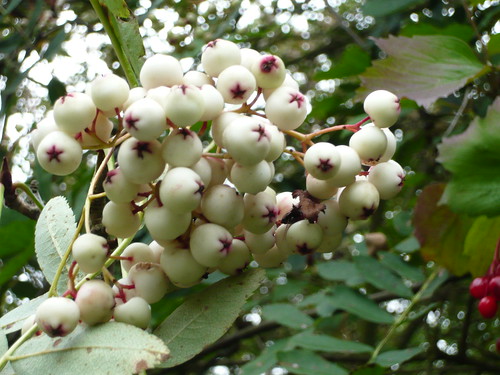
    1. Sorbus or Mountain Ash make fine specimen trees. Sorbus vilmorinii has creamy white flowers and a typical scent in spring. Clusters of red berries fade to white but the feathery leaf turns a dark red in autumn.
    2. Arbutus andrachne or unedo aka the Strawberry tree has  glossy evergreen leaves and white flowers. The trunk is also a feature on these 20′ trees.
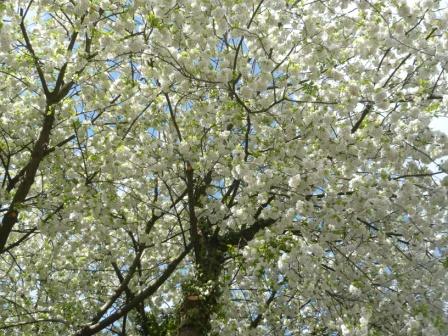
    3. Ornamental cherry trees have stunning displays of spring flowers. Try Prunus x subhirtella Autumnalis

Sorbus

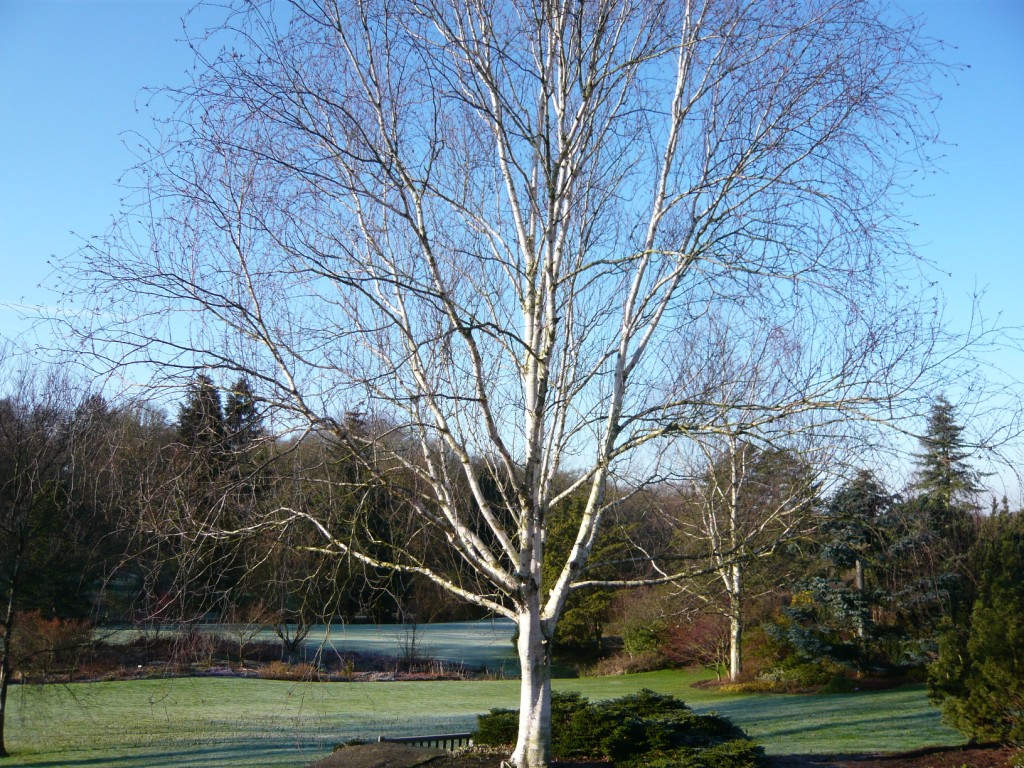
    1. Silver birches Betula jacquemontii Grayswood Ghost has yekllow catkins and good autumn colour.
    2. Ornamental Crab Apples have caught my attention recently and malus floribunda with pale pink flowers followed by golden fruit gives interest through until winter.
    3. Judas Tree, Cercis siliquastrum is covered in pink blossom before the leaves arrive in spring. This is followed by purple pods that can last through winter.
    4. Acers are ever popular and the palmatum varieties offer late season colour changes to the leaves. Osakazuki and sango-kaku are currently on offer.

Read More Read More

Crab Apple Trees for Fruit & Ornament

Crab Apple Trees for Fruit & Ornament

Malus Red Sentinel

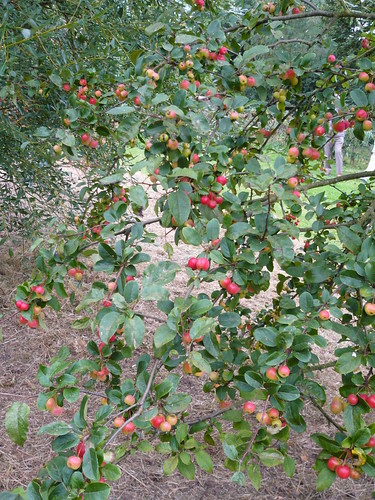
The flowering crab apples, Malus Rosaceae, are excellent floral trees with the added bonus of small usually edible fruit. The Malus Red Sentinel above has a profusion of small hard red autumn fruit that can be admired in the garden, left to feed birds, converted into a jelly or added to other food dishes. Crab apples generally contain a deal of pectin and are seldom eaten uncooked.

Favourite Crab Apple Varieties

  1. Golden Hornet is a small tree with white flowers producing a large crop of small yellow fruit.
  2. John Downie perhaps the best fruiting large conical crab apples of bright orange to red.
  3. Jay Darling is ornamental with large, deep red flowers and crimson tinted foliage.
  4. Eleyi has purpleish shoots and very decorative purpleish fruit in Autumn. Slightly later flowering and a good pollinator.
  5. Profusion is a fragrant hybrid with large wine red clustered flowers. Ox-blood red fruit make this one of the best Crab Apples.

Read More Read More

Grow Flowering Cherry Trees

Grow Flowering Cherry Trees

upright-spreading

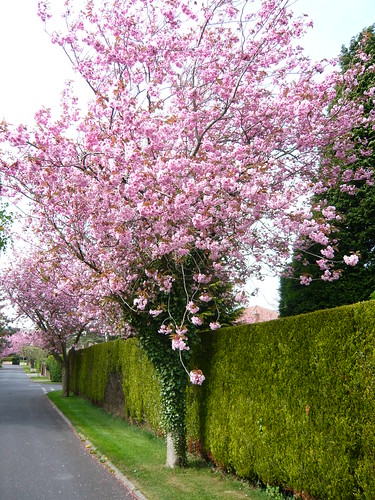
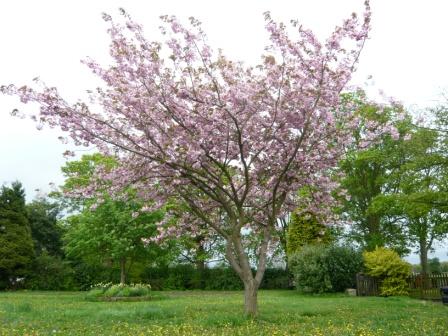
Flowering Cherry trees contribute most to the floral pageantry of spring blossom and they are easy to grow. Cherries are graceful and well shaped trees and many varieties have excellent Autumn colour. (Scarlet leaves of Prunus sargentii and pubesens, yellow of hybrids Pandora or Tai-Haku or coppery Ukon.)

Historically most varieties originate from China and Japan including the doubles called Yae zakura. Special parties and holiday trips are arranged to visit flowering cherries in Japan where they are revered as inspiration for artists and warriors as a symbol of purity.

Designing with Cherries

  • Double flowered varieties give the best effect when planted as solitary specimens or groups of 3 of the same variety.
  • Do not mix varieties that flower at the same time as they detract from one another.

    Read More Read More

Five Trees & Shrubs for Chalk Soil

Five Trees & Shrubs for Chalk Soil

The best trees for chalk soil conditions tend to be locally grown and not be Dutch imports. In fact they resemble shrubs more than trees but there are the odd exception that are tree like.

Syringia
Lilac

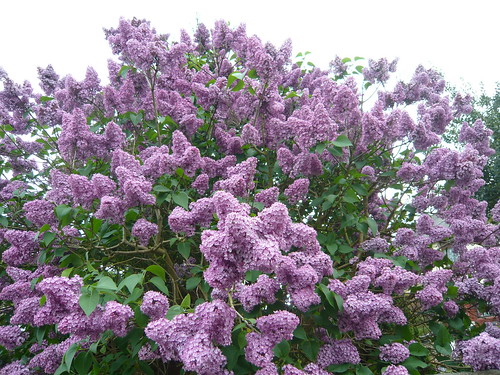
Lilac trees will tolerate limey chalk or clay soils. They are grown for the wonderful scent of the lilac blossom in spring and other than that they are not much of a feature. Syringia vulgaris Primrose is a white flowered variety and Syringia vulgaris Sensation has purple flowers with white edges. The flowers of the lilac make conical panticles which are useful in large flower arrangements.

Crataegus
Großkelchiger Weißdorn (Crataegus rhipidophylla)
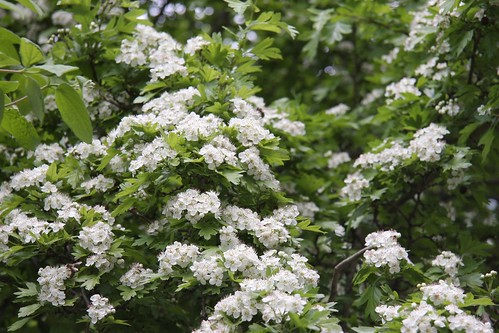
Generically called the thorn these small trees have a variety of flowers and berries depending on the species including the Hawthorn. All species seem to do well in chalk soil. Crataegus laevigata Crimson Cloud has bright red flowers whilst Pauls Scarlet is a round-headed tree with red haws in autumn.
They are hardy and will tolerate pollution and some shade but perform best in full sun.

Aesculus
Conker
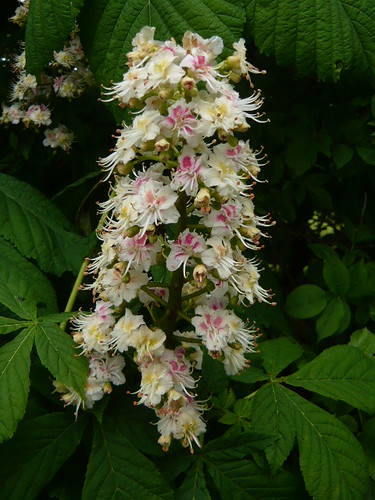
Horse Chestnuts produce conkers not edible chestnuts. They are stately trees needing room to grow to over 16 feet.
Aesculus parviflora is one of the smaller growing varieties that will suit a garden with chalk soil.

Carpinus betulus
Hornbeam
Hornbeams are a small genus of medium sized trees for chalk soil. Carpinus betulus Frans Fontaine is a slender fastigate form retaining its narrow habit with age. Carpinus japonica has many catkins, corrugated leaves and grows in a wide spread suitable for garden use.

Sambucus
Schwarzer Holunder (Sambucus nigra)

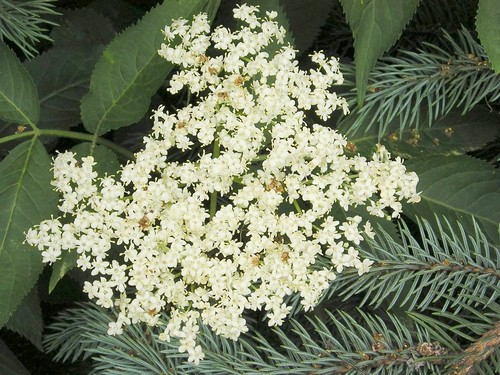
Sambucus is a hardy shrub or small ornamental tree for chalk soil or many other conditions. Sambucus nigra has black leaves and light pink to white flower bracts.

Cotoneaster
cotoneaster berries

Cotoneasters will grow in most soil conditions. They are invaluable for attracting hoverflies to the white flowers, birds to the red berries and gardeners to the shape and form of a good all-rounder.
Cotoneaster hybrid pendulus can be grown as a small weeping tree with arching branches. Cotoneaster horizontalis is commonly referred to as the Fish Bone cotoneaster

Read about our review of British trees with a bakers dozen links to our favourites.

Credits
Großkelchiger Weißdorn (Crataegus rhipidophylla) by blumenbiene CC BY 2.0
Schwarzer Holunder (Sambucus nigra) by blumenbiene CC BY 2.0

Roots Root For National Tree Week

Roots Root For National Tree Week

Lets get to the root of the problem, we seldom get to see roots in action but they are crucial to most plants and trees.

When it comes to trees their roots have two critical functions. Firstly they take up water and minerals. Secondly they help to anchor the tree often utilising a longer tap root. The solid root plate near the trunk normally extends as far as the leaf canopy. Thinner finer lateral roots can extend twice as far in search of water and nutrients. Other root functions for some species include storage of food or nutrients and  as part of a reproduction or regeneration system.

Book Cover

Even today, few places can rival an English oak wood in early summer for peace and beauty with its carpet of primroses and bluebells. Or the cathedral-like majesty of the autumn beech wood with the sun’s light filtering through the leaves. Or the brooding quiet of the ancient holly wood. Perhaps it is not surprising that our remote ancestors performed their acts of worship in forest clearings and woodland glades, for this is where they came face to face with ‘Nature’ – however they close to see it.

Myths About Tree Roots

  • Trees have long been held as part of the superstitions about witches
  • Roots do not penetrate solid objects like wall of drainage pipes that are in good condition.
  • Roots wont affect foundations except on clay soil where they help take away moisture and cause shrinkage.
  • After planting roots are not always keen to extend into surrounding soil unless it is broken up and loosened before hand.
  • Trees need watering even after the first year. Roots take time to establish and be able to supply the needs of of a growing tree. Make sure it is watered for the first 3 years and seldom allowed to dry out completely.
  • Not surprisingly roots will take the easy route if they find cracks in pavements or leaking drains.

Book Cover‘Throughout our long history, forests have been places of shelter, providing food for man and fodder for the animals; the wood for fuel (i.e. warmth and cooking) and for making weapons and other utensils. At the same time they have also been places of fear, where the temperamental Faere Folk, wood sprites and elementals lurked in the dappled shadows.’

Roots Near Buildings further reading

Roots in Pots

  • Pot bound’ is the phrase used when a containerised plant has roots that fill or over fill the pot and satrt going round and round in search of new soil. The pot below has not quite reached a critical stage as the rooot ball can be teased out.
  • If roots are left in a tight circle that is how they will stay and the plant will not thrive. I have occasionally dug out a poor plant to find the original compost is all that is feeding the plant and it is often bone dry. It is hard to rewet plants grown in peat coir and other similar substances.