Browsed by
Month: February 2016

Yew – Root and Branch Review
Yew – Root and Branch Review

Irish Yew


The slow growing Yew is one of the longest lived trees capable of living for thousands of years. Britains oldest Yew in Fortingall is believed to be over 3000+ years old.

Key Features of the Yew

  • Latin name – Taxus baccata other common names English Yew, European Yew or Common Yew
  • Height – up to 80 feet
  • Type of tree – Evergreen Conifer
  • Leaves – Flat sharp-pointed needles growing in a spiral around upright shoots
  • Flowers – Male spherical catkins beneath shoots, female tiny buds near shoot ends generally on separate trees
  • Fruit – Single seeds encased in a red berry
  • Bark – Grey-brown with scaly patches revealing purple-red bark underneath
  • Family – Taxacea

Yew

Origins and Distribution of the

  • Yews have survived for many thousands of years and have adapted to climate changes
  • Native to the UK, western, central and southern Europe and as far south as northwest Africa.

Uses and Attributes of the

  • All parts of the Yew are poisonous and should be treated with care. There are new compounds (taxol) being developed from the tree to fight cancer.
  • The wood is hard, elastic and resistant to water. It was used to make long bows.
  • The Yew is associated with folklore and is often found in churchyards.
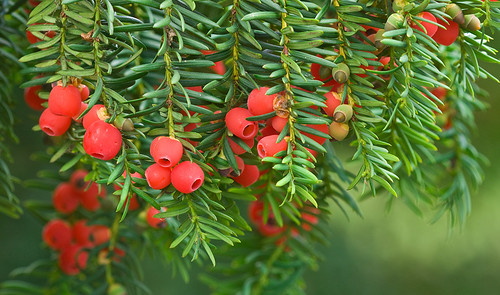
Yew - Taxus baccata

Gardeners Tips for the Yew

  • The yew can be clipped or pruned into topiary and makes a good hedge or wind break. As it is slow growing it is easy to keep it within bounds.
  • Old trees can have a girth of 20-30 feet.
  • Will grow on dry chalky soils and in the shade.
  • Taxus boccata ‘Erecta’ is a columnar form worth growing in your garden.

Other types of Yew

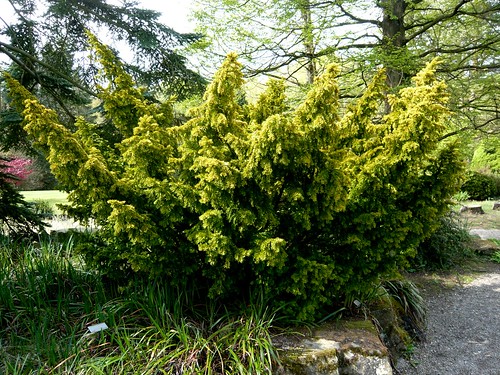
  • Taxus baccata ‘Fastigiata’ or the Irish Yew is one of over 100 cultivars and the several cultivars with yellow leaves are collectively known as “Golden Yew”.
  • Taxus brevifolia or the Pacific Yew is native to northwest America.

Yew comments from elsewhere

  • ‘The Yew is considered to be the most potent tree for protection against evil, a means of connecting to your ancestors, a bringer of dreams and otherworld journeys and a symbol of the old magic. In hot weather it gives off a resinous vapour which shamans inhaled to gain visions. Yew wood was regarded as especially magical to the Celts, due to its connection with the dead and the ancestors which were deeply respected. Archaeologists have recently found well-preserved Yew wood carvings at ancient sites of springs and wells which were probably votive offerings. ‘read the full story on White Dragon

Irish Yew

Read about our series on British tree reviews with a bakers dozen fact sheets

Credits
Yews, Stow on the Wold by 1967geezer CC BY-NC-SA 2.0 ‘A pair of yew trees flanking St Edward’s church door.’
Yew – Taxus baccata by lifeinthewild CC BY-NC-SA 2.0
English Oak Tree – Root and Branch Review

English Oak Tree – Root and Branch Review

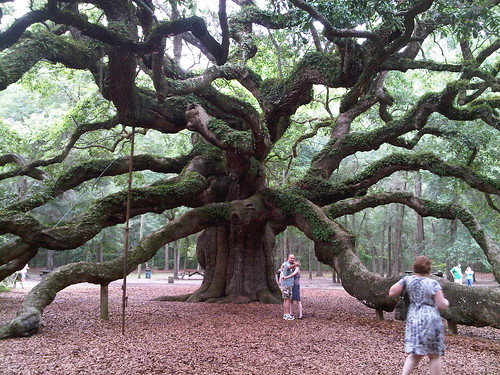
Angel Oak

Oak trees conjure up images of Robin Hood and mystical Oak forests. Britain has made good use of Oak trees down the centuries. ‘From little acorns great Oak trees grow’

Key Features of the English Oak

  • Latin name Quercus robur, other common names include Pendulate or Common Oak
  • Height 40m – 130 feet and can have a significant width and root spread
  • Type of tree – Most Oaks are deciduous, dictoyledons.
  • Leaves are green with irregular deep lobes. The shape of the leaf is atypical oak.
  • Flowers are on short stems and inconspicuous on the female and drooping catkins on the male. Both appear on the same tree.
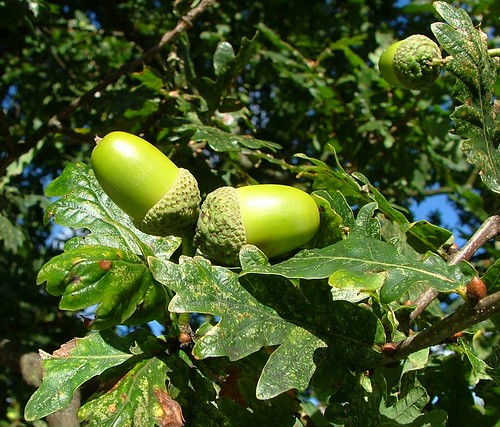
  • Fruit is called an acorn and is an ovoid nut one third of which is held in a half enclosed cup.
  • Bark is pale grey with deep ridges.
  • Family Quercus

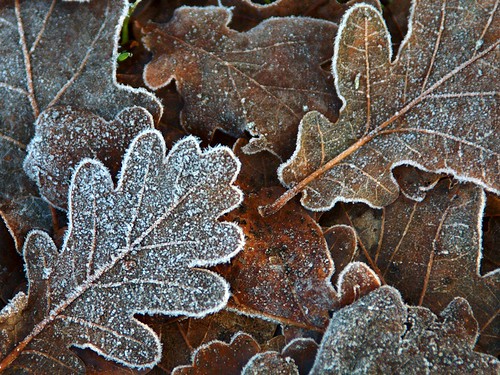
Oak leafs

Origins and Distribution of the Oak

  • English Oak is widely distributed throughout Europe.
  • The tree features in Norse and Greek myth and was worshiped by Druids.

Uses and Commercial Attributes of the Oak

    • Mature Oaks play an important part in a forests eco-system. They provide food with the abundant supply of acorns and shelter for birds insects and squirrels.
    • The bark has a high tannin content and has been used for tanning leather for many centuries.
    • The timber has long been prized and built many of the ships upon which Britain built it’s seafaring prominence
    • Oak was also used in house building to provide long strong timbers that are still visible today in many tithe barns and old properties.
    • Smoked fish and meat is cured over Oak chippings to provide tasty oak smoked products.
    • Oaks are often planted in memoriam or to commemorate historic events.

scottish acorns

Gardeners Tips for the Oak

  • Oaks are large trees and unsuitable for normal sized gardens. After about 8-10 years they are too large and can live 300+ years so they are not even beyond infancy before they bare too big.
  • Children love to germinate the acorns and it is quite easy. If you subsequently wish to plant the seedling in the wild ensure it is in a suitable environment like a mixed woodland, with appropriate permission.

Other Types of Oak and Species

  • The genus Quercus is currently divided into two subgenera, Quercus and Cyclobalanopsis.
  • Quercus ilex known as the Holm Oak or Holly Oak is the only evergreen Oak.
  • ‘Fastigiata’ or Cypress Oak – The popular fastigiate oak grows to a large imposing tree with a narrow columnar habit.
  • ‘Concordia’ or Golden Oak is a small very slow-growing tree with bright golden-yellow leaves. It eventually reaches 35’
  • ‘Pendula’ Weeping Oak is a medium sized tree with pendulous branches, reaching up to 50’
  • ‘Filicifolia’ Cut-leaved Oak
  • There are several hybrids including purple leaved and bi-coloured varieties.
  • Sessile oak has long stalks on the leaves and almost no stalk on the acorn

Oak Tree

Oak Comments from Elsewhere

  • International Oak Society link says the Subgenus Quercus is further currently subdivided into sections Quercus (the white oaks), Protobalanus (the intermediate oaks), Lobatae (the red oaks) and Cerris (the taxonomic position of which is currently under review). They also retain a database of all named Oaks.
  • ‘Whilst walking through the gardens at Kew today, and passing the extensive temperate oak collection along the riverside, I was reminded of the tropical acorns we found on a Kew expedition to Sarawak. These fruits look like acorns you might find on a walk in a British woodland but they are actually from the tropical rain forests of Borneo.’… Gemma Bramley Kew Gardens
  • ‘Mighty oaks from little acorns grow’
  • The Major Oak in Sherwood Forest is a giant tree loved by many visitors. It has a waistline of 35 ft, a height of 52 feet and weighing an estimated 23 tons. It is about 800-1000 years old but only cutting it down and counting the rings will tell how old a tree really is.

Book Cover

British Oaks: A Concise Guide by Michael Tyler and Bob Farley from Amazon

Credits
Angel Oak by Christmas w/a K CC BY-SA 2.0
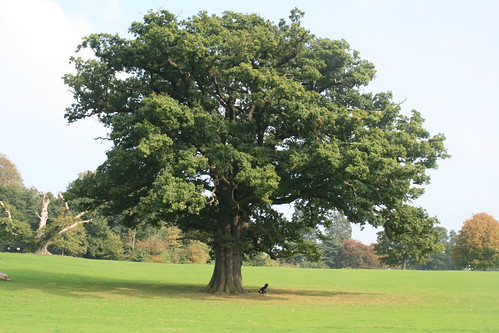
Oak Tree by MunstiSue CC BY-ND 2.0
Scottish acorns by PhylB CC BY-SA 2.0
“Oak leafs” by Peter Nijenhuis.CC BY-NC-ND 2.0

Special Oaks

  • Sessile Oak or Durmast Oak has stalkless acorns growing direct from twigs. It is common in Europe where it permits light to reach the ground encouraging other flora. Quercus petraea
  • Cork Oak is native to Spain and Portugal where the bark is harvested every 8-10 years to produce cork for wine bottles. Quercus suber
  • The Turkish oak has long whiskery buds and a ‘mossy’ cup on the acorn.Quercus serris In USA the Turkey Oak is called Quercus laevis

Read about our series on British tree reviews with a bakers dozen fact sheets

Norway Spruce Root and Branch Review

Norway Spruce Root and Branch Review

Norway Spruce

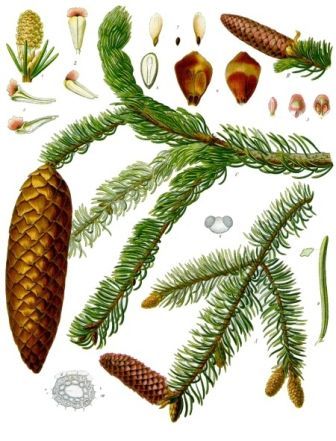
Key Features of the Norway Spruce

  • Latin name Picea Abies other common names Christmas Tree
  • Height up to 150 feet 50m
  • Type of tree – Conifer
  • Leaves Short dark green needles
  • Flowers red male and dark red female on upright clusters
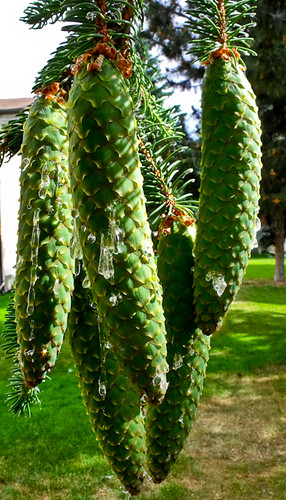
  • Fruit Cones are slender cylindrical and light brown. They hang down in a pendulous manner and have long jagged scales.
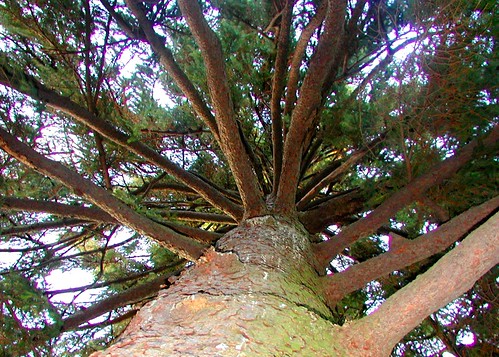
  • Bark Coppery pink when young turning purple/grey and cracking as it matures.
  • Family Picea

Origins and Distribution of the Norway Spruce

  • Widely grown through out Europe.
  • In USA the Norway Spruce is planted in the northeastern and Rocky Mountain states, as well as in southeastern Canada.

Uses and Commercial Attributes of the Norway Spruce

  • Norway Spruce is an important timber tree valued for long, strong and straight timber.
  • Norway Spruce is also grown for paper pulp and general carpentry.
  • Known for retaining it’s needles the Norway Spruce has long been a favourite Christmas tree first brought to the UK by Prince Albert in Victorian times.
  • Spruce are popular as ornamental trees admired for their evergreen, symmetrical, narrow-conic growth habit.
  • The scent of pine is redolent and natural oil can be made from the sap of this Spruce.
  • Norway spruce is used in the making of violins due to its lightness, flexibility, strength and tonal qualities

Norway Spruce Cones

Gardeners Tips for the Norway Spruce

  • Trees grow quickly but a rooted Christmas tree can be planted out after Christmas and brought back the following year. Keep it well watered indoors if you plan to plant your tree.
  • Some of the best shaped Christmas Norwegian Spruce are the top few feet of a larger tree sawn down for the purpose.

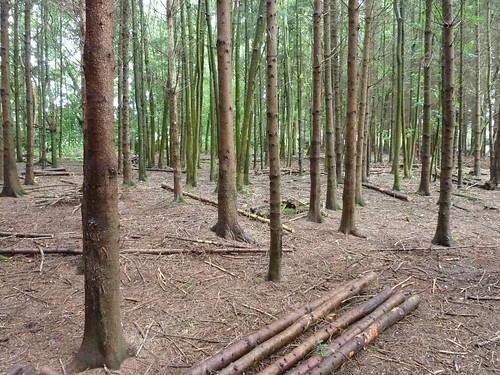
Norway Spruce plantation

Other types of Norway Spruce and key species

  • Siberian Spruce having cones about half the length of Norway spruce with smoothly rounded scales, and hairy shoots.
  • Trees hybridise successfully
  • Norway spruce is one of the most important species on the European Continent. More than 100 forms and varieties have been named.
  • * Picea glauca, White Spruce, Picea mariana, Black Spruce, Picea rubens, Red Spruce are all part of the Picea family.

Norway Spruce comments from elsewhere

From the National Christmas Tree Federation ‘For Christmas trees, overall color of Norway spruce is fair to excellent, but needle retention is considered poor unless the trees are cut fresh and kept properly watered. Growth during the first 10 years after field planting is relatively slow and 8 to 11 years are required to grow a 6-7 foot tree.’

Above in the public domain because its copyright has expired

Read about our series on British tree reviews with a bakers dozen fact sheets

Credits
“Norway Spruce by friendsofmountauburn, CC BY-NC-ND 2.0
Norway Spruce Cones by wolfnowl CC BY-NC-ND 2.0
“Norway Spruce plantation by The Heartwood CC BY-NC-SA 2.0

Juniper – Root and Branch Review

Juniper – Root and Branch Review

Best known in our household for flavouring gin the Juniper and it’s berries are multi-talented

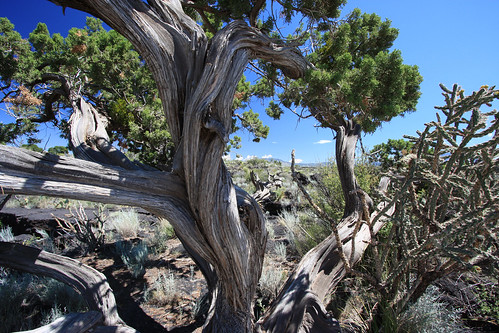
Juniper Tree, Valley of Fires

Key Features of the Juniper.

  • Latin name Juniperus communis other common names Rocky mountain juniper
  • Height up to 20 feet old trees can have a wide spread
  • Type of tree – evergreen conifer
  • Leaves – Short prickly blue-green needles growing in whorls of three
  • Flowers male yellow and female green on separate trees
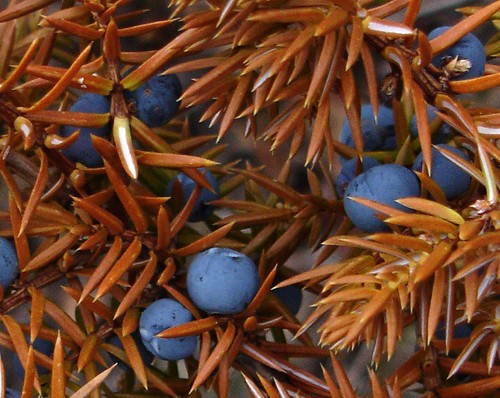
  • Fruit spherical fleshy berries taking 3 years to ripen from green to black
  • Bark grey-brown
  • Family Cypress family

Origins and Distribution of the Juniper .

  • Wide geographic spread in the northern hemisphere.
  • Prominent in USA, Canada, Europe and Japan.

Uses and Attributes of the Juniper .

  • The berries are used in cooking and to flavour gin.
  • The wood and branches give off a nice scent when burnt and are used in some smokeries to preserve meat.
  • As dwarf conifers and small shrubs they are very popular in gardens.
  • There are many documented medicinal uses. Tradition says the berries were used to end pregnancies.

Gardeners Tips for the Juniper .

  • Often confused with trees from the cedar family. The Red Cedar is a juniper virginiana but junipers are not from the Cedar family.
  • Junipers are very useful evergreens for use in rockeries and in providing winter interest in the garden.
  • Berries take 3 years and trees need a male and female so do not expect a big crop in the garden.

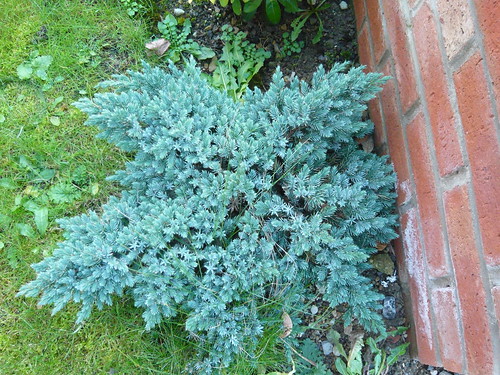
Common Juniper

Other types of Juniper and key species

  • There are over 50 species of Juniper with varying habits.
  • Juniper chinensis, Juniper virginiana Juniper squamata are available as many cultivars.
  • Juniperus chinensis the Chinese juniper variety ‘Blue Point’ has silvery-blue leaves
  • Creeping Juniper is low growing prostrate form of Juniper with gray-green foliage.

Juniper comments from elsewhere

  • In North America, the Micmac and Malecite Indians, native to the maritime provinces of Canada, used Juniperus communis for sprains, wounds, tuberculosis, ulcers both internal and external, consumption, and rheumatism. Their general belief was that the juniper hardened the body and made it better at fighting off illness. read more on planet botanica.
  • Juniper, an important understorey shrub or small tree in the Caledonian Forest, has declined recently and is now the subject of conservation concern. Common juniper has the largest geographic range of any woody plant in the world. It is circumboreal in distribution. Trees for Life
  • Juniper is often the first bonsai ever owned by a novice, due to its massive success in the mallsai market. The Juniper is well known and appreciated by all bonsai growers. Art of Bonsai

Prostrate Juniper

Read about our series on British tree reviews with a bakers dozen fact sheets

Credits
Juniper Tree, Valley of Fires by vambo25 CC BY-NC-ND 2.0
Common Juniper by bottomdollar99730 CC BY 2.0

Cultivating Japanese Maples -Acer

Cultivating Japanese Maples -Acer

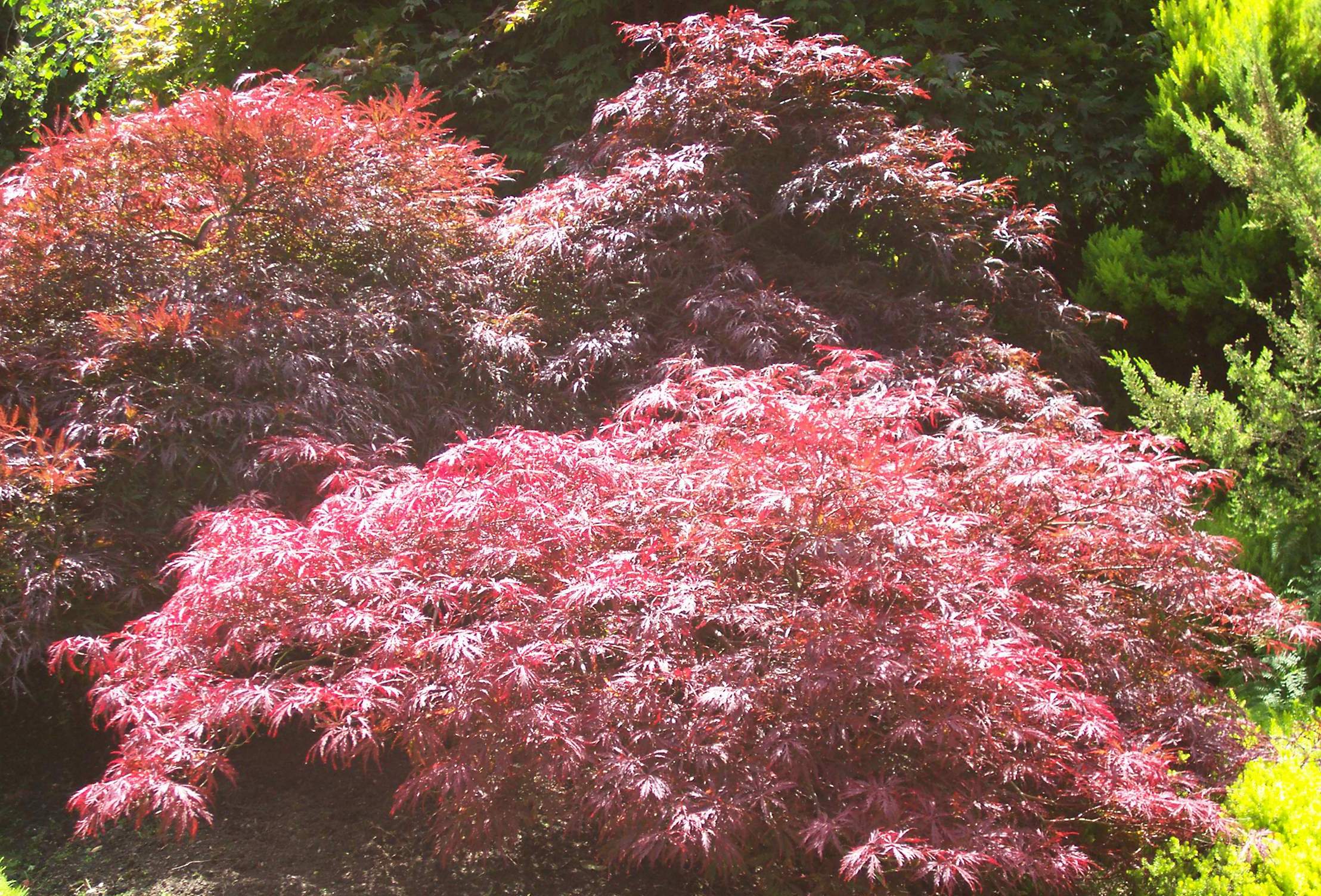
Acer palmatum dissectum atropurpureum

  • Acer is the genus for a range of trees that includes the Sycamore and some of the loveliest foliage trees for your garden.
  • palmatum the species name refers to the hand shaped leaves
  • dissectum or variety name reflects how the feathery leaves are finely separated and deeply cut or fringed
  • atropurpureum is the colour of deep purple leaves that turn bright red in autumn
  • Japanese Maple is a generic name for a range of Acers which have this semblance of age and dignity even when the trees are small and relatively young.

Hints on Cultivation

Read More Read More

Cedar of Lebanon – Root and Branch Review

Cedar of Lebanon – Root and Branch Review

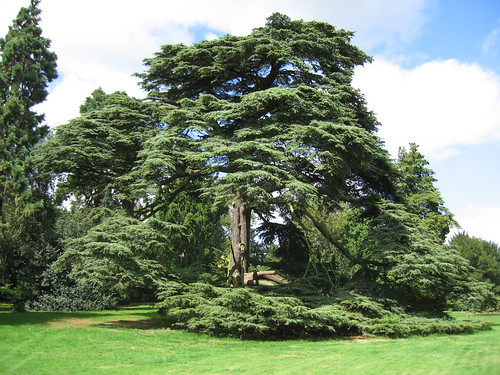
Cedar of Lebanon, wilton House
Cedar of Lebanon

In the eighteenth century Cedar of Lebanon became the fashionable tree to plant in gardens and estates of stately homes.

Key Features of the Cedar of Lebanon

  • Latin name – Cedrus libani
  • Height – up to 130 feet wide spreading – slow growing & long lived
  • Type of tree – evergreen conifer
  • Leaves – Grey-blue to dark green needles growing in whorls on side shoots and singly on main shoots.
  • Flowers – Male yellow-brown, female larger, (6″) bright green with purple tinge
  • Fruit – Erect barrel shaped cones of grey-green turning to purpleish brown
  • Bark – Red-browns with shallow fissures
  • Family – Pinacea

Origins and Distribution of the Cedar of Lebanon

  • Natural habitat Syria, Tarsus mountains and Mount Lebanon.
  • Examples of the tree are mentioned in several books of the bible.

Uses and Attributes of the Cedar of Lebanon

  • Used by the Egyptians and Phonecians for building ships.
  • The tree is the national symbol of Lebanon and features on the national flag.
  • Cedar wood is a beautiful color and is used in cladding due to it’s hardness, exquisite fragrance and resistance to insects

Gardeners Tips for the Cedar of Lebanon

  • During the first 30-50 years of it’s life the Cedar of Lebanon grows in a conical shape. It then starts to develop the magestic and distinctive levels like plates of foliage.
  • One theory is that the branch shape is determined by heavy mountain snow that weighs the branches down.
  • Cedrus libani Sargentii has a short trunk weeping branches and is ideal for the rock garden.

Cedar of Lebanon, Warwick Castle Grounds

Other types of Cedar of Lebanon

  • Cedrus libani subsp. libani – grows in Lebanon, Palestine, Israel, northwest Jordan, western Syria, and south central Turkey.
  • Turkish cedar or Taurus cedar Cedrus libani subsp. stenocoma is from Turkey.
  • Look out for the slow growing Golden Dwarf Cedrus libani Aurea Prostrata

Cedar of Lebanon comments from elsewhere

  • ‘The Forest of the Cedars of God’ is a World Heritage Site of old Cedrus libani.
  • Throughout history, cedar wood, and such byproducts as cedar oil, have proven to be worth far more money than living trees, however beautiful they were. At the time of Gilgamesh, Egypt has already cut (without replanting) large amounts of cedar for ship construction and for export. They continued the same tradition. Cedar cutting prevailed under various administrations, up through the time of the Ottomans. They finished off most of the remaining forests by using cedar wood as fuel for railway engines. They generally bypassed more easily obtainable oak wood, since cedar (because of its oil content) burned much better. The presently remaining cedar groves were spared mainly because their regions were relatively difficult to reach. Cedrus Libani has been famous in Lebanon since early written history. read more on Cedar of Lebanon info site

Credits
Cedar of Lebanon, wilton House by 1967geezer CC BY-NC-SA 2.0
Cedar of Lebanon, Warwick Castle Grounds by MichelleWalz CC BY 2.0

Trees Our Root and Branch Review

Trees Our Root and Branch Review

The British have a fascination with trees be they humble or ‘Remarkable’,’Ancient’ or saplings, ‘Great’ or just plain good.

Book Cover
I have collected facts on a dozen tree species to discuss over the next couple of days. I have tried to stick to a set format and apologise if I have missed your own personal favourite.

Book Cover
The book covers are just a small selection of books on the topic of Trees. As always you can buy them from Amazon by clicking on the cover.

Read More Read More

Snapdragons aka Antirrhinum majus

Snapdragons aka Antirrhinum majus

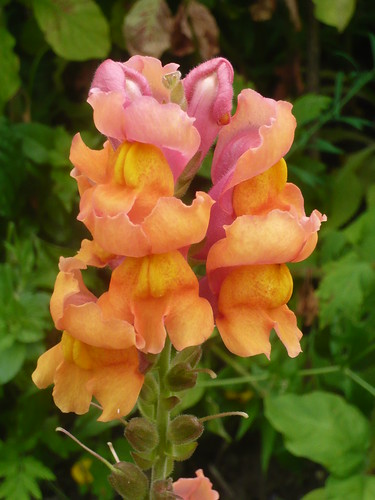
Antirrhinum

Snapdragons or better known as Antirrhinum are an easy flower to grow and they provide lots of colour with a distinctive scent. Good F1 plants can grow more than 2′ tall and if pinched out they bush out quite well.
Available in a wide range of colours I try and grow the same colours together to enhance the effect.

Where to Grow Snapdragons

These plants are good border flowers and can be planted in blocks, lines or singly.
Snapdragons do not need special soil conditions but flower best in sunshine.
Smaller varieties can be grown in containers.

How to Grow Snapdragons

I plant plug plants from the end of April to get quick flowers.
For raising Antirrhinums from seed read these tips
Pinch out the tallest growing shoot when it is about 3″ tall to encourage branching and thus more flowers.
Feed with a tomato fertilizer if you want extra blooms.
Water early in the day, plants should not be left wet overnight – distorted growth can result.

Snapdragons as Cut Flowers

Read More Read More

Spring Cleaning Your Garden

Spring Cleaning Your Garden

It may be boring but what better way to set off your garden than by getting everything neat, tidy, sorted,  spick and span. A tidy area will draw attention to the garden and plants not the bits that are out of place, dirty or untidy.  Here are my top ten tips.

London 7.10 057

Top Ten Tips to Spruce up Your Garden

  1. Clean your paths, pavings and slabs. Make them look bright and new with a pressure washer or scrub them with Swarfega Path and Patio cleaner or equivalent. If stepping stones have sunk below soil height raise them so soil isn’t easily washed on to them. Clean glass in cold frames and greenhouses.
  2. Remove any weeds growing in cracks and give all hard surfaces a good brush.
  3. Trim the edges of Lawns, it is one of the most effective face lifts for the green parts of your garden.
  4. Stain or repaint any wood decking, furniture of visible structures. You can go as far as spray painting support canes for your runner beans though hopefully they will grow and cover them very quickly.
  5. Keep empty or non-flowering pots and containers away from important areas until they are at there best. Then move them into position for the duration. Pots need to be clean to look good.

    Read More Read More