Browsed by
Month: October 2010

Growing Tagetes and Seed Collecting
Growing Tagetes and Seed Collecting

taggetee

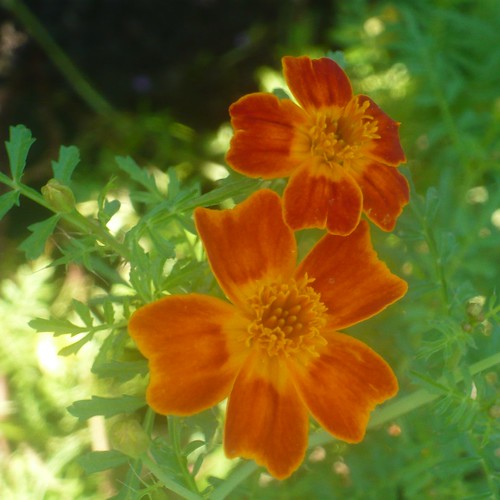
Tagete tenuifolia is one of my favourites of the marigold family. It generally has many small single flowers over a long period. Whilst the red,orange and yellow colour combinations are striking the French, African and Mexican Marigolds cousins are blousy and brash by comparison.

Growing Tagetes

  • The foliage has a musky, pungent scent. The smell deters some common insect pests and I grow them alongside my greenhouse tomatoes.
  • Tagetes are often used in companion planting for eggplant, chili pepper and potato.
  • Tagetes grow well in fertile heavy clay soils and in sandy soils
  • Plants are not  frost resistant and need to be grown as half hardy annuals.

Seed Collecting

  • Tagetes need a long growing season  to set seed in Britain. Sow  in March for flowering in  autumn
  • Removing dead flowers before the seed is formed will extend the flowering season but reduce seed production.
  • Each of the multitude of flowers will produce a clutch of seeds trapped in the soft semi open seedhead.
  • The seeds are like small, fine quills with a black section and an off white feathery end that protrudes from the clutch.
  • Collect when dry with the seedhead turning brown. The neck bends down prior to dispersing seeds.
  • Store in an old envelope and avoid trapped moisture that can cause rot.
  • I do not have any success with self-sown seeds so I collect my own seeds from the many produced.
Read More Read More

Growing Aconitum

Growing Aconitum

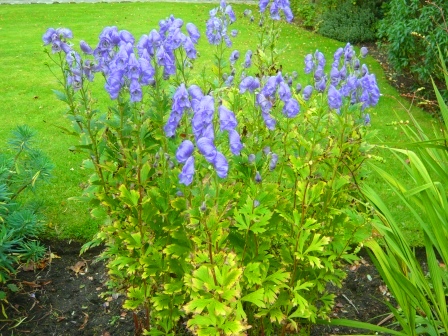
Aconitum is a good autumn flowering border perennial. They do not normally need staking and this variety grows to around 3′ tall. Strong blue or purple flowers predominate in the species but there are some yellow varieties pictured.

Growing Aconitum

  • Aconitum like deep fertile soil and will grow in deep shade.
  • Mulch the crowns in spring with good compost to help retain moisture
  • Cut back stems in late autumn after flowering to prevent wind rock
  • Divide large clumps in early spring as the plants start into growth. Use 2 forks bach to back to pull the plant into sections
  • Beware the plant is poisonous so wash your hands after touching any part of the plant
  • Hide lower foliage by planting at the back and growing lower plants in front

Other Aconitums

  • There are about 250 species of Aconitum
  • They are also known as aconite or monkshood.
  • As Banes they are also called wolfsbane, leopard’s bane, women’s bane.
  • Devil’s helmet or Aconitum is a genus of flowering plant belonging to the buttercup family.
  • Sparks Variety and Stainless Steel are a couple to look out for. However I am seeking  Aconitum x Cammarum a bicolour cross.
  • Try Cottage Garden plants for a selection of hybrids
Bargain Hunt Gardening Month by Month

Bargain Hunt Gardening Month by Month

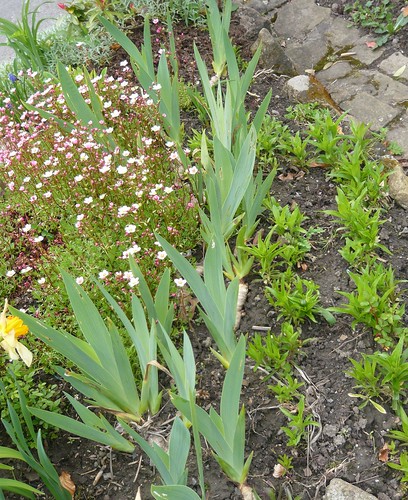
Iris in rows

Flag Iris all grown as cuttings from one large overgrown host plant

January

  • Check around the garden for ripe seeds to collect and dry
  • Start sowing perennials on a windowsill
  • Check out garden centre sales

February

  • Keep sowing seeds
  • Divide perennials to get more and better plants.
  • Coppice Hazel twigs or other branches to use as supports. They look more natural than brown canes and are free.

March

  • Plant out hardy perennials under cloches to save indoor space and heating costs
  • Look for free brochures on Open Gardens to visit

April

  • Buy bedding plants such as Fucshi, Verbena and Felicia. Take up to 10 cuttings from each plant. By June you will have a hanging basket full.
  • Sow last years collected annual seeds.

May

  • Take cuttings from your garden shrubs.
  • Visit other gardens and parks

French lavender

June

  • Look out for bedding plant sales at your garden centre
  • Swap plants locally
  • Sow winter ornamental cabbages and pansies from cheap supermarket seed packets.

July

  • Check for bargains at local fetes and plant sales.
  • Attend your local shows and join horticultural societies for seeds and swaps.
  • Pot up Strawberry plant runners to get more plants. When rooted sever from the host plant.

August

  • Take more cuttings of plants you enjoyed in summer.
  • Root cuttings of Lupins and Oriental poppies can increase your plant stock

Poppy

Read More Read More

Backgrounds for Flower Pictures

Backgrounds for Flower Pictures

When looking at flowers you need to consider the background. Honeysuckle is a good rambling climber that often allows you to see the flower against the clear blue sky (or cloudy one for that matter).

The pollen bearing, male anthers,  (stamen and filaments)   are clearly visible on this picture as is the female carpel in the centre and as a seed pod on the right.

Many  flowers are best inspected against a mass of greenery that forms the pattern of leaves and stems.

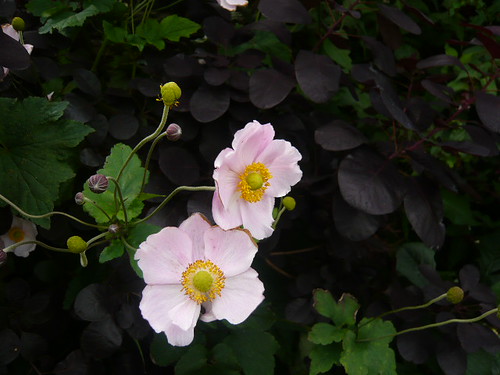
Careful planning can balance two or more colours such as pink flowering Japanese anemones with the purple leaved Cotinus. Grey leaved plants look good with dark flowers in the same way light flowers look good with dark leaves.

Rose anemony

Autumnal Compostables and Leaf Mold

Autumnal Compostables and Leaf Mold

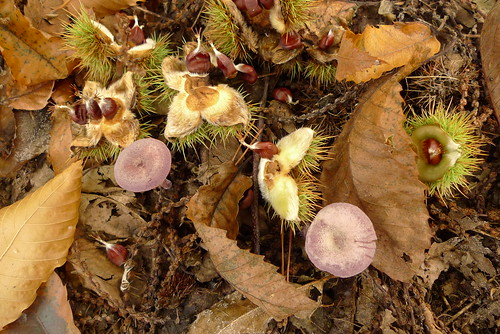
mushrooms, leaves and horse chestnuts

I am an avid composter but it is worth considering what is going into your compost this Autumn.

This photo contains several items that are not idea for my compost heap.

  • When I spread my compost I do not want lots of new saplings springing up in my garden. Some seeds and nuts are likely to survive composting as the heat will not be as great through winter.
  • Leaves particularly Oak,  Horse-chestnut and broadleaved trees will be slow to rot down.
  • Leaves do not provide much sustenance but are great conditioners if rotted down over a couple of years into leaf mold.
  • I have to admit to being uncertain about composting fugus. There seems to be little food value in these mushrooms and they may be spread via the composting process. On the other hand fungi are key parts of a soils organic activity and on balance I would compost these. I would not compost Honey-fungus or anything growing near my fruit trees.

Tips on Making Leaf Mold

  • Rake your leaves together into a pile. Bits of soil,  grass and a variety of leaves are not a problem but make the pile predominantly leaves.
  • Then there are a couple of options:
    • Put the leaves in a wire cage cover and leave to rot.
    • Put the leaves into a large plastic bag and puncture to allow air to enter.
  • Leaves should be damp and can be lightly watered but not left soggy. The rotting will not create heat like normal compost and decomposition will be slow.
  • It may take over a year for the leaves to breakdown and the volume will be a tenth of the leaf pile you started with.
  • Conifers and evergreen leaves will take   three years to compost and are best added in small quantities.
  • Shredding leaves or chopping with a lawnmower first  helps to speed up composting.
Mauve and Lilac Coloured Plants

Mauve and Lilac Coloured Plants

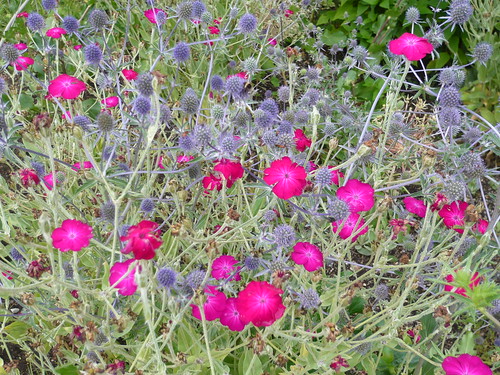
mauve & lilac

Lychnis coronaria also called Rose Campion and Eryngium ‘Superbum’ or Sea Holly blend well together in this late summer photo.The colour combination may be a bit too Barbara Cartland for some tastes.

Eryngium like Echinops have spiky leaves and bristly metallic blue flowers that make it a great architectural plant. The grey green unassuming leaves of Lychnis belie the strength of colour of their flowers.

pink & white

Read More Read More

Rhus typhina Sumach and Autumn Colour

Rhus typhina Sumach and Autumn Colour

Sumach
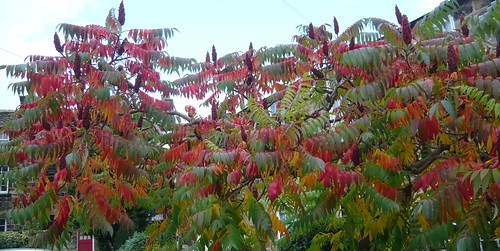
This autumn tinted, small tree, Sumac or Sumach is also called the ‘Stags Horn’ or botanically Rhus typhina.

Rhus Facts and Tips

  • Trees can grow up to 25 feet high, this specimen is only a third of that. Early pruning may have stunted the height and encouraged the large canopy.
  • Branches fork freely and are covered with thick velvety hair when young.
  • Leaves divide  into  narrow oval, toothed and softly hairy drooping leaflets. The leaves are bright orange and red   colours in autumn.
  • Male flowers are greenish  and female are red blooming on different trees
  • The cone-shaped, dull red, hairy heads  remain on the tree throughout winter.
  • Take care when touching the leaves and stems as the sap can be an irritant.

See picture of Sumach in spring

Tulip Festivals 2011

Tulip Festivals 2011

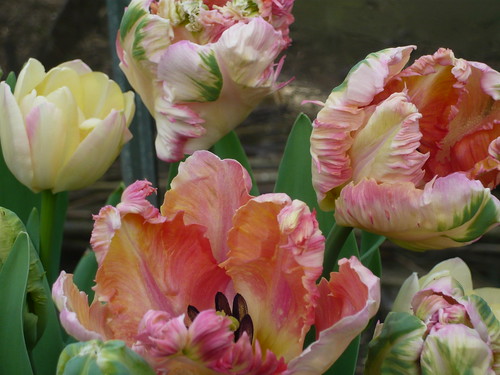
Parrot Tulips

‘When it’s Spring again I’ll bring again ………’
Tulip festivals spring up as often as the Tulip bulbs. Check out some festivals from the following or look out for your own local Tulip Festival.

UK Tulip Festivals 2010

  • The Alnwick Garden, Northumberland – Saturday 30th April   to Saturday 7th May;
  • Chatsworth, Derbyshire – Friday 6th May to Tuesday 10th May;
  • Constable Burton 1st – 3rd May 2010, plant over 6000 bulbs annually with special displays of cut blooms in the Hall.
  • Dyrham Park, Gloucestershire – Friday 1st to Saturday 15th May;
  • Powerscourt, Ireland – Friday 22nd April to Monday 2nd May;
  • Stourhead, Wiltshire – Monday 25th April – Sunday 8th May;
  • The Lost Gardens of Heligan, Cornwall – Saturday 23rd April to Monday 2nd May;
  • Waddesdon Manor, Buckinghamshire – Saturday 16th April to Monday 2nd May.

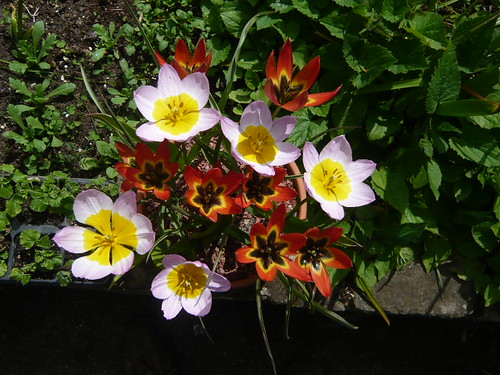
botanic tulips

Dutch Tulip Shows

‘If you are planning to travel to Europe or happened to be there in Spring 18 March-16 May 2010, you are so lucky. Why? You’ll be able to see millions of colourful tulips in the biggest tulips garden in the world! You have this opportunity of the year to witness the tulips blooming. Netherlands are always associated with Tulips and is the biggest flowers exporters in the world. Public can visit the Keukenhof Tulips Garden for tulips display during the tulips festival held between 18/3 until 16/5 every year. Soaking in the large tulips field would be an unique and refreshing experience to visitors.’

Blown Tulip

Other Festivals

Read More Read More

Growing Colchium as Alpine Pot Plants

Growing Colchium as Alpine Pot Plants

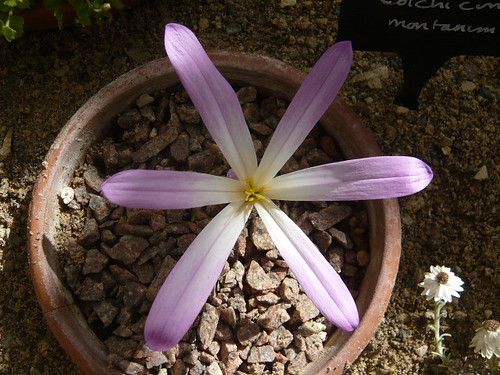
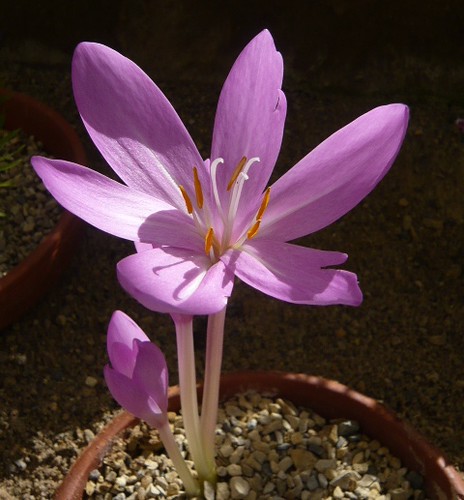
Colchium montanum

What is not to like about Colchium these autumn flowering crocus like bulbs always cheer me up.

Facts about Colchium

  • They have 6 stamens unlike crocus which have 3.
  • Colchium will flower without being planted, just leave them on a sunny window sill.
  • They are best artistically arranged in a shallow dish of pretty gravel and kept out of heavy rain.
  • Planted outside they will flower in autumn before the long, strappy, lanceolate leaves show through. They do best in a semi-woodland site.
  • Flowers are pink, lavender, rose or white.
  • Other species include Colchium agrippinum, Colchium speciosum, Colchium clicicum, Colchium autumnale and  Colchium alpinum.
  • There is also a spring flowering yellow variety Colchium luteum.
  • Colchiums are said to be poisonous to humans and most animals.

Colchium panonicum

Read More Read More

Autumn Vegetable Seeds & Sets 60% Off

Autumn Vegetable Seeds & Sets 60% Off

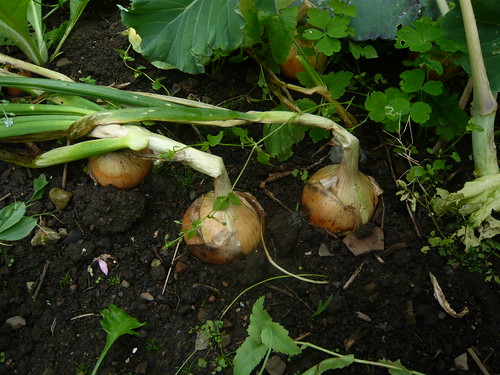
Green Onions

‘Many gardeners swear by planting Garlic, Onions and Broad Beans in the autumn. It’s a time of year when space on the plot becomes available and crops quickly establish before winter sets in. By planting in the autumn, many varieties are ready significantly earlier than spring sown alternatives – this allows you to harvest early and extend your season.

The best crops for autumn planting are Garlic, Onions, Shallots and Broad Beans . Peas such as Douce Provence can also be sown in the autumn for over wintering.’
So advertises a promotion by Thompson & Morgan. Buy your seeds and sets from Thompson & Morgan in the 60% off autumn offer.