Archive for Trees and Shrubs

Gardeners Tips for Choisya

This Choisya ‘Sundance’ is an evergreen shrub grown from a young shoot cutting. The plants are trouble free and create a dome shape 4-5 feet high and spread in a similar number of years.

  • Grown mainly for the bright yellow of the new leaves they can be nipped brown with late frosts. Such damaged, scorched or wing burnt leaves should be cut off.
  • The small star shaped white flowers in April and May are very aromatic. A second flush of flowers may be obtained in Autumn.
  • Leaves also smell of basil or a bit citrusy if crushed
  • Choisya ternata ‘Aztec Pearl’ commonly called Mexican Orange blossom has narrower divided leaves and I find it is a bit thin in habit. The flowers are more numerous.
  • Choisya ‘Sundance’ is quite dense and the leaves, even when they have turned green, remain attractive and glossy.
  • Choisya will stand partial shade and can be used as part of an informal hedge
  • Propagate in Summer or Autumn, cuttings are easy to grow
  • Prune to keep in shape and cut out a third of the branches to renew from the base when needed.

Comments

Senecio Silver Sunshine


This is an attractive shrub (sometimes called Brachyglottis) with small silver leaves. It grows to about 2′6″ and flowers with masses of small yellow daisy like flowers. This plant is overdue for a trim when it has flowered.

GardenersTips

  • It is evergreen or eversilver and can be grown as a foliage plant.
  • Grow this ‘Sunshine’ variety as an informal hedge planting every couple of feet
  • Prune to stimulate foliage and keep tidy. It will go woody quite easily
  • Don’t bother collecting the seeds, propagate by semi-ripe or hardwood cuttings in summer or autumn
  • Buy small plants and avoid ones that have a woody base

Comments

Variegated Leafed Shrubs

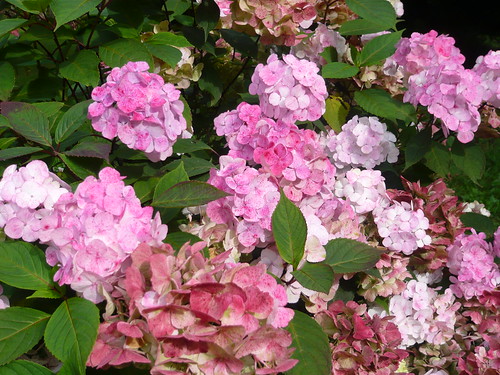
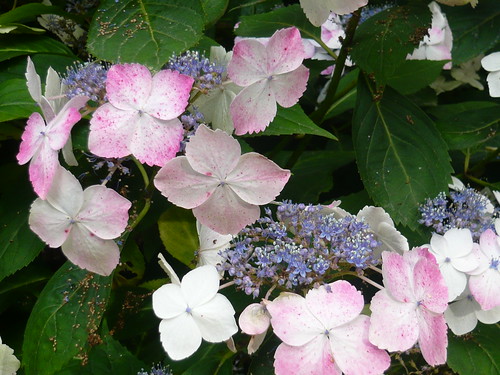
This variegated hydrangea had white and pale pink flowers. It was on display from a garden centre and I didn’t buy one because they looked a bit over bred, over the top and the flowers were weak stemmed.

For larger leaved Hydrangeas some shade is essential. Variegated plants often like shade but without sun they can loose colouring.

However my neigbours variegated Holly (Ilex aquifolium) catches the late evening sun and the yellow is quite strong. The glossy leaves and the three foot of growth make this a grand evergreen to have in the garden. If you get green shoots on a variegated shrub cut it at the branch. Young Holly bushes do not have as  many spikes to the leaves until they mature

I am also a fan of the Euonymus and the japonicus varieties. They have many colour schemes for their leaves and brighten a shady area at the back of my house. Silver Queen and Harlequin have whit and green foliage. Emerald ‘n’ Gold speaks for itself when it comes to colour schemes.

Comments

Hypericum - St John’s Wort, Rose of Sharon, Aaron’s Beard

Hypericum is a large family of perennial shrubs with creeping roots. This specimen is three feet tall and attracts lots of insects from mid June. Often called St John’s Wort it is named after St John’s day which is 24th June when it’s flowers are collected for medicinal purposes.

In mild climates the shrub can be evergreen with glossy leaves. With several varieties having an award of garden merit this is a shrub that is well worth growing.

Flowers and Cultivation

  • The single yellow flowers are often quite numerous as on this Hidcote variety. It is also known as the Rose of Sharon.
  • Flower colour varies from pale lemon yellow to an umber or burnt orange-yellow
  • There are 5 petals and a large number of stamen leading to another common name Aaron’s Beard.
  • They flower at the end of branches or stems and create a spicy scent of curry.
  • After the flowers there are fleshy red berries that contain numerous seeds
  • The wild flower can be quite invasive spreading by roots or seeds dropped by birds
  • Prune after flowering. They can stand a hard cut back and may even benefit.
  • Grow the ground cover Hypericum calycinium Briggadoon which can flower July -October

Herbal and Medicinal Uses

  • St. John’s Wort has been used for centuries to treat mental disorders and nerve pain. The flowering tops are used to prepare teas.
  • Today, St. John’s Wort is used by some for depression, anxiety, and sleep disorders as well as a balm for wounds, burns, and insect bites.
  • St John’s Wort contains lots of active ingredients including hypercin and hyperfloin and should be purchased in liquid or tablet form so the dose level is known and controlled.
  • Photosensitivity and sunburn can be caused to users and it is not recommended for pregnant women

Other varieties to try

  • H. beanii with graceful arching stems it is a parent to many varieties
  • H. olympicum appropriate name for an Olympic year. AGM plant
  • AGM versions of Hypericum include forrestii, moserianum, kouytchense, roeperianum ‘Rowallane’ and uniflorum ‘Citrinum’.
  • Another one for the Olympics is H chinense hinting  where many Hypericums originate.

Comments

Smoke Bush - Cotinus coggygiria

cotinus-coggia

Red leaved plants seem to be doing very well in this wet summer. I spotted this healthy shrub at Harlow Carr on a recent visit. The name smoke bush comes from the clouds of very fine, fluffy, grey flowers that appear on panicles in such profusion that it looks like a cloud of smoke.

  • This variety is probably Royal Purple both it and other Nocutts hybrids are easy to grow at home.
  • Propagate by taking a spade to an existing shrub and chopping one piece out without lifting the plant. A sort of division in situ.
  • They are deciduous shrubs and mine have a lax habit that probably needs a bit of pruning but I don’t want to sacrifice the flowers.
  • The mature shrubs are a neat round shape.
  • The leaves are also a neat round simple leaf
  • Other varieties include a tree Cotinus cobovatus called the American Smoke Tree

Comments

In the name of Japanese Maples -Acer

Acer palmatum dissectum atropurpureum

  • Acer is the genus for a range of trees that includes the Sycamore and some of the loveliest foliage trees for your garden.
  • palmatum the species name refers to the hand shaped leaves
  • dissectum or variety name reflects how the feathery leaves are finely separated and deeply cut or fringed
  • atropurpureum is the colour of deep purple leaves that turn bright red in autumn
  • Japanese Maple is a generic name for a range of Acers which have this semblance of age and dignity even when the trees are small and relatively young.

Hints on Cultivation

Read the rest of this entry »

Comments

Blue Conifer Abies Glauca

Abies procera glauca

This noble fir is a large prostrate form with thick rounded bright blue needles that gives a good colour contrast within any garden. This is just one of the good looking Conifers that can be suitable for a British garden.

  • This prostrate form is slow growing. Remove any strong vertical branches
  • Young plants need a good soaking when the soil becomes too dry and prefer a moisture retentive soil
  • Roots spread wider than the tree but shouldn’t need fertiliser
  • Will stand very cold winter temperatures
  • The habit, form and colour of this Pine make it a good plant to incorporate into a garden design


Comments

Urban Hedge Rows

This isn’t my favourite hedge spotted on a walk to Menston railway station but it hints at what can be achieved.

  • The blending of green, grey and red foliage has produced a singular hedge.
  • Mixed colours work best if kept formal, neat and tidy
  • Do not allow one type of plant dominate another, these all seem to be in proportion but vigorous growers will need more trimming
  • Different shaped foliage could also be blended in a mixed hedge
  • The stone wall provides some relief from the base of the hedge
  • Train lower branches into gaps. remove extraneous plants like the Choysia on the left

Comments

Leycesteria Formosa Shrubs

Leycesteria Formosa

Green winter stems on this attractive fast-growing shrub is described as ‘cut-and-come-again’ as it can be reduced to ground level in early spring to encourage rejuvenation. Although this plant has only been lightly pruned, it is a bit thick and congested now so I will cut it back after flowering and right back in spring.

Leycesteria has long, hanging, purple-red bracts in summer surmounting racemes of white flowers followed by purple fruits in late autumn. It has a light fragrance from the white flowers. Its foliage can be quite dense and its hollow, bright green stems, not dissimilar to those of bamboo, give a good winter display. It grows to 8 foot plus and flowers at the end of this years stems

Propagate and Cultivate

By cuttings of half-ripe wood, 3-4 inches with a heel in July/August or from larger cuttings of mature wood, 8-10’’ with a heel, planted in open ground in October/November. Or by seed and the birds may help with that job. When established it is quite robust

I have seen Leycesteria also named Flowering Nutmeg and Himalayan Honeysuckle from which family it belongs. The green leaved variety is most common but you may find a yellow leaved form.

Comments (2)

Low Maintenance Gardens

Shrubs are great for lowering the amount of maintenance needed in your garden. Big shrubs can cover larger areas and need very little care and maintenance.

Weigelia Varigata

This shrub grows over six feet high and covers a four foot circumference. When in full flower it is very striking and the variegated leaves have interest through summer. It is easy to propagate from 12 inch long cuttings of semi ripe wood and it is a rapid grower reaching good proportions in two years. Other varieties like Bristol Ruby forsake variegated leaves for very strong coloured flowers in June and July with a late show if you cut off the old flowers but for low maintenance don’t bother.

Varigated Weigelia in the sun

Photinia Red Robin

This is a shrub that can be left to develop or trained up a single stem. It is part of a family of Photinias that include small trees. For this variety of Photinia fraseri five feet is a reasonable size but it will continue to grow to a hight and spread to 10 feet. The shiny evergreen leaves are bright red in spring and apart from the danger of a bit of frost to the new leaves the shrubs are hardy. Again I don’t prune my photinia but when it gets to large i will cut it back which will encourage more red leaves at the expense of flowers

Two year old Photinia

Comments