November 30, 2009 at 1:32 am
· Filed under Garden Equipment Tips, Tips Hints and Ideas

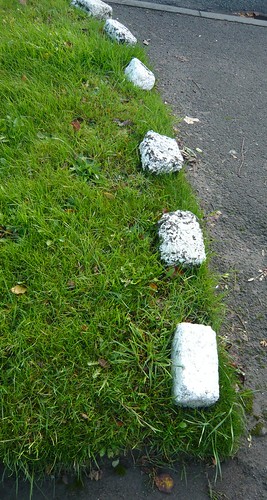
Neat, well trimmed edges make your lawn and garden look tidy and cared for. World class gardens take care of neat edges especially on formal lawns. In most cases you need to avoid obstructions that prevent achieving a well trimmed edge as these painted rocks do. Grass growing at the base of these rocks is hard to trim to the same length as the rest of your grass even if you use a strimmer.
Plants growing close to the edge will get in the way of a lawn mower or over-hang the lawn and weaken the grass.
A path in the lawn made from stepping stones should be sunk below the sward so that a lawn mower passes over the path edge and cuts right up to it. If the path is proud of the grass you may damage the mower and leave an untidy edge.
Where ever practical leave a gully or channel at the edge of the grass before the planting starts.
Best Tools for Cutting Edges
Lawn edgers allow you to cut back the edge by removing a sliver of soil. Useful if you have walked near the edge and it has crumbled or spread out. Amazon edgers below

Strimmers are useful on rough grass and hard to reach spots.
Black & Decker Strimmer
Lawn shears have a blade at 45° to the handles and are my favourite way of trimming lawn edges.
Bahco Lawn Shears
For many jobs you can’t beat a traditional spade. If you are trimming an edge use a line or string to keep you honest.
If part of an edge is in poor condition you can cut out a square foot as a turf and turn it around by 180° to make the inner cut as the new edge and the ragged part a foot inside the lawn. Fill any gaps with sand or top dressing.
Permalink
November 26, 2009 at 4:53 am
· Filed under Books

If gardeners are exceptional people then buy them a copy of this book for Christmas. It contains 20 stories and profiles about encounters with gardeners and a day in their life to provide reading matter for dark garden-free evenings.
Amongst those covered are these sixteen:
Roy Roberts Landscape Gardener
Roy Lancaster from Gardener’s Question Time

Tony Schilling Asian Heath Garden at Wakenhirst
Thomas Pakenham Meetings with Remarkable Trees

Geoffrey Dutton the Concrete Gardener
Beth Chatto Essex girl gardener

Howard Donald Waterer
Anthea Gibson ‘The Cotswold Gardener’
Lady Salisbury writer of a Gardener’s Life

Dan Pearson ‘Guardian of Gardeners’
Kim Wilkie ‘Reality is a condition induced by lack of imagination’.
Ronald Blythe Outsiders Gardener Friends.

Lucinda Lambton President of Garden History Society
Richard Mabey of Food for Free

Hugh “Wine Atlas” Johnson
James “Gaia Hypothesis” Lovelock.
Click on the book cover to buy from Amazon
Permalink
November 26, 2009 at 3:29 am
· Filed under Alpine Garden, Gardening

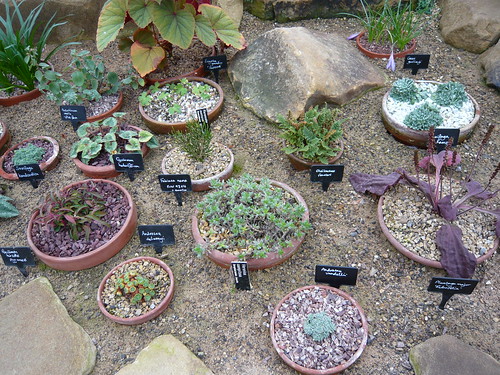
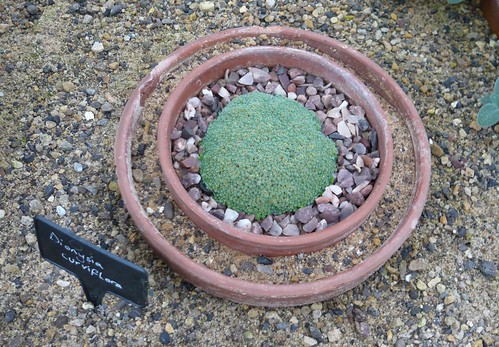
The new Alpine House at Harlow Carr has a plunge bed to be proud of as you may expect from the RHS. This Dionysia Curviflora has been double potted to facilitate watering and it’s flowers will be purple with a white inner ring and dark centre.
The plunge bed is at a good viewing height and the display can be changed as plants develop and seasons change. As a purpose built, alpine house plunge bed there are several features it would be hard to incorporate in my glasshouse but the rake from front to back and the use of rocks builds up height to provide a landscape rather than a flat two dimensional display.
The sand and gravel mixes vary depending on the plants being grown. Some free planting around the plunged pots adds to the attraction of this type of alpine display. The alpine house is climate controlled but much of the daily watering is done by hand before visitors arrive to view the gardens.
I am now keen to develop a better plunge area for my alpines. That is one of the joys or costs of visiting a best of class display like RHS gardens.
Tip – Study the best and think how you can incorporate new ideas in your gardening. The photo below shows how different coloured chippings and grits can work with your display.

Permalink
November 26, 2009 at 12:33 am
· Filed under House & Greenhouse plants, Trees and Shrubs

Get out and pick your holly for Christmas decorations now. As the berries ripen the birds descend and scoff the lot just when you are not looking.
You can condition the stems, leaves and berries and placing stalks in a glycerin solution. They will take up the liquid and become supple and longer lasting. Crush the stems and use warm glycerin then leave for a couple of weeks.

These variegated Holly trees are part of a holly hedge grown for decorative purposes not cutting for Christmas.

These berries look like they have already had the glycerin treatment but this is just how they were growing in a local Yorkshire field.
I dis leave the berries for the birds in case it is a cold winter.

Permalink
November 25, 2009 at 2:24 pm
· Filed under Flowers and Plants, Fruit, Vegetables & Herbs, Tips Hints and Ideas

The flowering crabs, Malus Rosaceae, are excellent floral trees with the added bonus of small usually edible fruit. The Malus Red Sentinel above has a profusion of small hard red autumn fruit that can be admired in the garden, left to feed birds, converted into a jelly or added to other food dishes. Crab apples generally contain a deal of pectin and are seldom eaten uncooked.
Favourite Crab Apples
- Golden Hornet is a small tree with white flowers producing a large crop of small yellow fruit.
- John Downie perhaps the best fruiting large conical crab apples of bright orange to red.
- Jay Darling is ornamental with large, deep red flowers and crimson tinted foliage.
- Eleyi has purpleish shoots and very decorative purpleish fruit in Autumn. Slightly later flowering and a good pollinator.
- Profusion is a fragrant hybrid with large wine red clustered flowers. Ox-blood red fruit make this one of the best Crab Apples.
Tips – Crab apples are very useful for pollinating your apple trees. Select varieties that flower at different times in white pink and red.
Permalink
November 25, 2009 at 9:33 am
· Filed under Alpine Garden

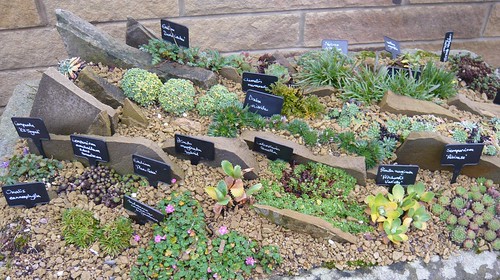
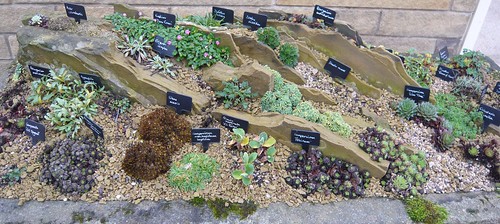
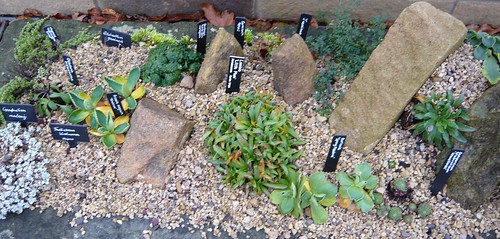
Outside Harlow Carr’s new Alpine house are a collection of troughs, stone sinks and other containers suitable for a collection of Alpine plants. The planting varies and is related to the soil and rock conditions each plant prefers. One container has old rotting logs and a richer soil for small rhododendrons and other species. Others have carefully inserted rock slivers to replicate mountain conditions giving shade and more importantly deep root runs and drainage.

Whilst the troughs vary in size they are all less than 6 feet by 4 feet and could fit into virtually any garden. There is also many more outdoor containers full of selected plants. I was amazed at the number and variety of plants on display in the middle of November. They are all carefully named on these black labels with a white fiber tip pen which I resolved to try in my garden. On some plants there is a topical note that explains why it currently features or how it is grown. ( An autumn flowering variety of snowdrop fit into that category)

The photographs can be enlarged using flickr by double clicking on the image and going to all sizes. I hope the name tags are then visible.
A picture inside the house is available on the RHS website. and for Alpine plant lovers Harlow Carr is now worth a special visit.
The Alpine garden society have a good article on your own Alpine trough
Permalink
November 25, 2009 at 4:23 am
· Filed under Trees and Shrubs

Hippophae Rhamnoides also called Sea Buckthorn, is related to Elaeganeous and is shown here and below with it’s heavy crop of Apricot coloured berries. The shrub can grow to over 15 feet but makes a nice ornamental feature. It flowers in spring followed by narrow silvery leaves through summer. Each plant is either male or female and you need both for pollination and only the female produces these great berries.
There are only 3 species of Hippophae. Hippophae elaegnaceae is excellent for seaside locations and is wind resistant. The orange berries are often retained on the plant through winter as they are a bit acid for the birds. They can and are cooked for human consumption.
Hippophae salicifolia has sage green leaves and can grow into a small tree with pendulous branches.
Tips Propagated from seed they can also be grown from root cuttings, suckers or layered.
Look for Hippophae sold under these alternative names as well as Sea Buckthorn, Seaberry, Siberian pineapple, or Alpine Sandthorn.
The berries are used in herbal medicine for a variety of ailments.

Read the rest of this entry »
Permalink
November 23, 2009 at 3:25 am
· Filed under Gardening

Pampas Grass in cottage garden
Pampas grass is the name given to species of the genus Cortaderia, most commonly Cortaderia Selloana which is available with white or pink plumes on strong stalks. Different varieties flower at different times and this example is a late autumn flowering variety that will look fine through early winter. Spring varieties may be slightly lower growing
Pampas grass will not tolerate wet boggy conditions but otherwise is a hardy easy to grow plant. Poor soil in a sunny position will encourage plumes. It takes some time for a small plant to produce the plumes but the clump then bulks up quite well. As you can see it should not be planted too close to the house or windows as it grows over 6 feet tall and can block out the light. The roots are not invasive or dangerous to good foundations. Even Dwarf Pampas Grass Pumila variety still grows to about 4 feet.
The dead leaves can be hard to remove because they have sharp edges prone to cut the unwary. Use strong secateurs and gloves or burn the leaves in January/February.
Permalink
November 23, 2009 at 2:35 am
· Filed under House & Greenhouse plants, Tips Hints and Ideas

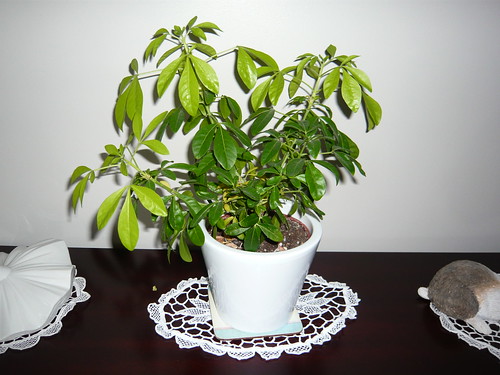
This small pot containing an even smaller Choisya ternata is growing happily in our front room. New leaves of light green are almost translucent and provide clean foliage. The leaves when crushed give off a very pleasant scent.
This plant was one of many grown from cuttings the siblings are now in the garden. Also called Mexican Orange Blossom I do not expect it to flower indoors but you never know and it is providing some interest in this quiet pre-Christmas season.
I have cheated a bit with the title as this is not yet a true bonsai plant but the restricted root run is constraining how it develops. I will prune and trim it carefully if it survives the dry conditions. That reminds me to water all the houseplants now the central heating is on full bore most days. Flushed with one success I may grow some Chiosya in bonsai pots for a miniature outdoor garden.
Permalink
November 20, 2009 at 9:37 am
· Filed under Pests, Problems and Health

Jasmin nudiflorum
‘If winter comes can spring be far behind’ or should that be changed, due to global warming, as the season merge. Due to lack of seasonal frost many spring flowers have been appearing through late Autumn and my Primula and even Wallflowers are showing lots of colour.
What we need is a series of crisp hard frosts to let everyone and everything know that the season has changed. Animals can go into hibernation (instead of the squirrels stealing the bird food) and plants can become dormant or die back as they are programmed by nature to do.
My Dahlias have given sterling service but now I wish the stalks a happy burial on the compost heap but I always wait for them to catch the frost first. Other plants are looking forward to getting frosted and what will the ’sprouts taste like without a bit of cold weather.
If it was rain that encouraged winter dormancy then everything would have shut up shop way back. The soggy ground would appreciate some frost sending worms deeper and breaking the claggy ground.
Bulbs need some cold weather to develop the best roots so come on Jack lets have some cold weather. In previous years I have lifted crowns of Rhubarb to get a bit of frost but I am leaving them in the ground this year and will see if it has a negative effect or not.
So come on Jack Frost get on your Icicle and pedal down and arrange a cold snap for British gardeners.
Permalink