Gardening Products

Tips for the Gardener

Soil Analysis – Testing Services and Kits

Posted: July 18th, 2010 | Author: hortoris | Filed under: Growing Aids | No Comments »

There are three things you may wish to test on your garden or allotment  soil.

  1. The nutrient levels including NPK and trace elements. Not only their presence but the  availability of this food for plants.
  2. The acidity or alkalinity of the soil normally called a ph test
  3. The consistency of the soil from small particles of clay through silt and loam to sand An analysis of humus levels also comes with this service but DIY systems are less sophisticated.

You can do tests yourself or send a sample and fee to the Royal Horticultural society for a full report.

RHS service, which has been developed specifically with gardeners in mind, provides an analysis of soil texture, pH, organic matter and three major plant nutrients (potassium, phosphorus and magnesium). You receive a detailed interpretation of the results as well as fertiliser recommendations for either fruit, vegetables, ornamentals or lawns.

The pH of a soil refers to its acidity or alkalinity and is a vital factor in plant growth. It often dictates what plants will thrive and what will fail. It’s easy to measure and is usually listed numerically on a scale of one to 14. Acid soils have a pH of below seven, neutral is pH7 and alkaline is above seven.

The texture and relative amounts of sand, silt, and clay are estimated by the feel of the soil in a moist condition. The soils are then classified into three categories: C (coarse textures of sand, loamy sand and sandy loam), M (medium textures of loam and silt loam), and F (fine textures of clay loam, silty clay loam, silty clay and clay.

Organic matter is determined by heating a  scoop of the soil sample and by assessing weight loss it can reported the per-cent organic matter by weight in the soil. For DIY worm activity is a good indicator.

Soil testing kits at Amazon

Agricultural testing report on a pdf or read more on Gardeners tips
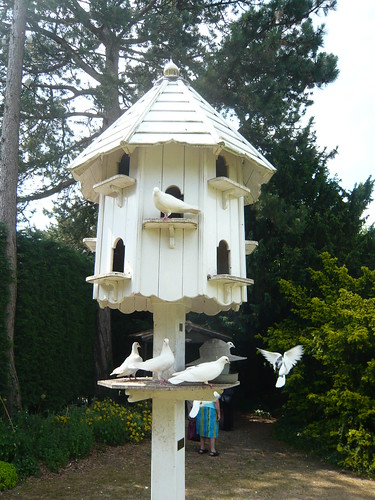

Get Birds in your Garden

Posted: July 16th, 2010 | Author: hortoris | Filed under: Products, Uncategorized | No Comments »

Burton Agnes Pocklington

Getting birds to visit and return to your garden can give you great pleasure. Food, safety and shelter are key features that will encourage wild life and birds in particular. A bird bath can be a useful and decorative feature.

Bird Food can be grown in the garden in the form of berries and seeds or supplemented by bird feeders, peanuts, fat balls and even bits of fruit.

Safety can be designed into the garden with hedgerows and cover plants.

  • Do not provide cover for lurking cats that want to prey on your garden birds.
  • More information can be found in a good reference book or from the RSPB
  • Keep bird food safe from squirrels and vermin by using the right sort of feeders.
  • Keep birds safe from disease by moving bird tables and feeding stations around your garden each year.

Book Cover

Garden bird books

Nesting Boxes for Birds

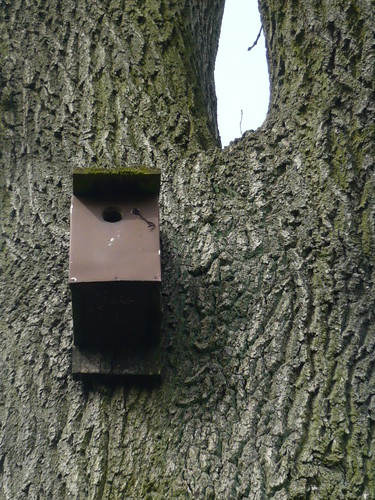
  • Birds will find nesting sites but you can help by putting up bird boxes.
  • Check the size of the hole is right for the birds you want to attract.
  • Do not be too tidy as birds need to be able ‘to feather their own nest’.
  • Try not to disturb nesting birds.

Bird box

See also Gardening for Birds or read about trees and shrubs for birds on Gardeners tips


Buying Garden Ponds fit for Water Lilies

Posted: July 16th, 2010 | Author: hortoris | Filed under: Uncategorized | No Comments »

Burton Agnes Pocklington

Instant Ponds can be created in your garden by purchasing a preformed molded pond like a big babies bath. They will have shelves at various heights on which to stand your water lilies or other aquatic plants. All you need to do is dig a suitable hole and drop in the empty pre-shaped pond.

  • Ensure your pond is level or the water will slop over one end and leave the plastic showing at the other.
  • If your soil is rocky it is best to bed down your pond into a layer of soft sand. This also helps with leveling and bedding down.
  • Bury the pond deep enough so the edge is not left proud.
  • Fill with water and leave to settle and mature before introducing plants and or fish.

Pond liners made from rubberised Butyl can be bought to create a pond of your own shape and design. Tips are available here.

  • Use an underlay and place the butyl on top.
  • The   water level for your pond should be at least 4″ below the top of the liner to prevent water loss due to capillary action into the surrounding soil.
  • Take care during future maintenance not to puncture the liner.

Green Island Triffid

Water Lilies

  • Nymphyea pygmy lilies like ‘rubra’ are miniature red/pink waterlily  flowers 1 – 2″ in size with a  spread of 18″.  They can be grown in a miniature patio pond, barrel, shallow  or tiny pond.
  • Water lilies can be augmented with marginal, herbaceous, bogside and oxygenating plants to suit all ponds.

Decorative Garden Containers

Posted: July 15th, 2010 | Author: hortoris | Filed under: Uncategorized | No Comments »

Long Toms

Flower Towers are something relatively new in the display of trailing plants.
Thompson Morgan supplied this photograph and have an advisory service for those interested in the ‘Maxi Tower’ large structure.

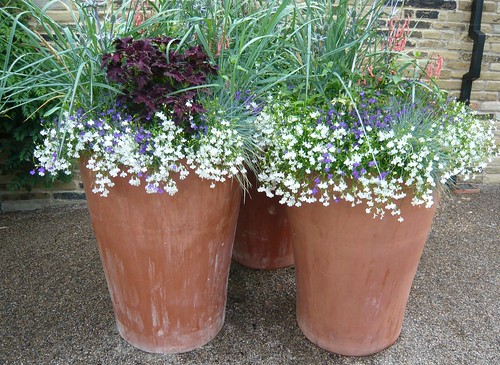
Classical Urns are still the best way of displaying clipped shrubs and topiary.

Hanging Baskets and window boxes have not changed greatly in design for many seasons. They now have better watering systems to keep the plants looking at their best.

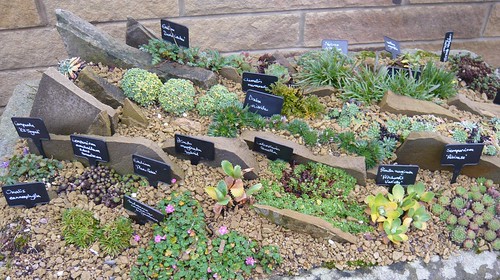
Alpine troughs are a traditional method of displaying small plants that repay close examination. Troughs can be raised to eye level or used in parts of the garden where there is no suitable soil. Old sinks are also used for this form of display so look out in reclamation yards. See an old strawberry planter in use on Alpine containers.

Alpine Trough

For practical containers read Functional Containers


Functional Garden Containers

Posted: July 15th, 2010 | Author: hortoris | Filed under: Products | 2 Comments »

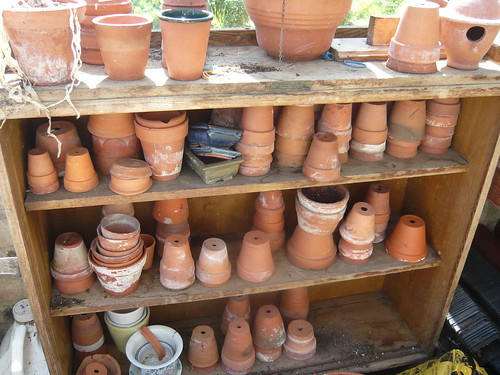
Pots for potting

Container gardening is decorative but containers in the garden are primarily functional.

Plant Related Containers

  • Plant pots do what the name implies. You put plants in pots to grow on or keep until ready for planting out.
  • Plant pots that are planted up are also useful for placing inside a decorative container. It can help with watering and allow the quick replacement of the plant when a new one is needed.
  • Clay plant pots help keep roots of plants cool due to the water evaporation.
  • Plastic pots are cheap, reusable, easy to store and available in many sizes.

Containers for Specific Functions

  • The water butt is the most useful container in my garden during summer.
  • I have an old plastic dustbin to store seed and potting compost near my potting bench. It has a lid to keep the compost fresh.
  • Sharp sand is kept in another old bucket shaped container and I have old boxes for perlite and vermiculite so they are readily available.
  • At the end of the season I put all my garden canes and supports in an old plastic kitchen bin just to keep them tidy and in a place where I can find them.
  • Tools including, hedge trimmers, are stored in an old wardrobe without doors ( I forget where they have gone) locked in my garage.

Pseudo Containers

  • Whilst not a true container, in my case, the compost heap could easily be in a purpose designed compost bin.
  • Are my bird feeders containers – well I guess they fit. Plastic ones last only 1or 2 seasons but the metal variety seem capable of going on and on.
  • I use a dustbin with a chimney lid  to collect burnable rubbish rather than sending it to landfill – not strictly correct but at the backend what is one more fire.
  • Is my garden pond a container – (oh this is getting a bit silly now ed.)

Greenhouses and Garden Sheds

  • These are the King and Queen of garden containers and once you have used them they seem indispensable. My only problem is space as they do get full. Well I guess that is containers for you.

See also Tips on making your own compost bin.


Leylandii Problems and Height Law UK

Posted: June 12th, 2010 | Author: tejvan | Filed under: Uncategorized | 2 Comments »

Leylandi Cypress can grow 4ft a year. That may not sound too much, but, once it gets going it can suddenly overwhelm a garden growing to a height of upto 80 feet.

This provides a long shadow over neighbouring gardens, restricting the plants that they can grow.
The Leylandi can also dry up neighbouring gardens. Firstly the tree takes up water, however, it also provides a large rain shadow depriving the soil of water. This can make it difficult to to grow anything in dry shade.
It is not particularly attractive. The Leylandi could be described as a useful utility plant. Good for screening the garden but hardly much to look at. When it is towering 50 feet over your garden covering it in a dense shade, it is hard to see any redeeming features in the plant.

If regularly pruned to a reasonable height (e.g. 2m – the height of a tall man), the Leylandi can do its job without annoying its neighbours.

Dealing with Leylandi That are Too Tall.

If you are a keen gardeners and have a garden overshadowed by Leylandi that has been allowed to grow unchecked, you are probably quite disappointed that your gardening has this rather unwelcome problem.

The first port of call is to speak politely to your neighbours asking if you can agree to limits its height. It can be difficult to approach people, you don’t want to fall out with your neighbours, and we instinctively don’t like interfering in their property. However, remember that you do have a right to raise the issue because it is affecting your garden and property. To get the best response from your neighbour try doing the following.

Avoid a confrontational attitude. Don’t blunder round and start shouting that your garden is dying because of their trees. This is not a good idea. Try to find something else to speak to your neighbours, try and find a common cause over something, this makes them feel they are not just neighbours but friends. Here they are more likely to try and do you a favour.

In most cases, people may not prune the conifer simply because they don’t have time or don’t think about it. One option to leave open is to offer cutting it yourself or at least sharing in the costs of cutting it down. If this is a big hedge, it may be a bit much. But, it might be worth it, if you really want to cut it down. If you meet the neighbour half way it is much harder for them to refuse.

Legal Approach.

In 90% of cases a friendly approach should help to improve the situation. But, unfortunately, there may be cases where that isn’t sufficient and a neighbour refuses. In this case, it may be necessary to refer the situation to the council. You will need to provide evidence you have tried dealing with the issue privately. f the council deems the hedge excessive, they can ( under the anti-social behavior act 2003 ) order it to be reduced in height to two metres. Failure to comply with this order could mean a fine of £1,000.

Related

  • Conifers in the Garden
  • RIP Leylandii at BBC

Dealing With A Neglected Lawn

Posted: June 10th, 2010 | Author: tejvan | Filed under: Uncategorized | No Comments »

lawn
One day, son, you could have a lawn like this. (New College Oxford,)

1. Evaluate the % of Weeds and Grass. If a lawn is primarily moss and other weeds, it may be best to start again, through clearing lawn and sowing new turf.
However, if grass still dominates despite many weeds, it can probably be rescued.
Start by cutting at a high level and slowly reducing height of cut.
Rake the lawn to remove a lot of thatch and moss. After raking is a good time to cut the lawn.

2. Feed with Nitrogen based feed in spring /summer to give grass good start and help it outcompete weeds.

3. Use General weedkiller to tackle the weeds in the lawn.

Best Lawn Weed Killers

Book Cover
Lawn weed killers

  • For bare areas try reseeding, first clearing out the lawn and then sow seed making sure it is well watered.
  • Water in summer to maintain strong grass growth.
  • Improve Drainage. Try aerating the lawn through spiking and a good regime of raking. This will help the lawn.
  • In autumn feed with a potassium based feed to help strong roots.
  • Provide paths in very wet and muddy areas. Sometimes it’s best to give up an area of lawn in a really unsuitable spot. Decking takes much less maintenance…

General Tips for lawn Care


Dealing with Moles in the Lawn

Posted: June 8th, 2010 | Author: tejvan | Filed under: Pests and Problems | No Comments »

Moles in the lawn are unfortunate, as they are difficult to remove without killing them. Their main diet is earthworms, but, removing these valuable garden creatures is hardly worth while. They are more likely in sandy soils, but, can appear anywhere – especially in more rural areas.

There are some things that are said to help remove moles, but, they are not guaranteed to work permanently.

You can try these in mole holes

  • Burning Wood,
  • Disinfectant in holes
  • Creosote.
  • Moth Balls

The mole hills are unfortunately unsightly, however, at least moles don’t do any real damage to plants, they are more a nuisance value than anything. If you really want to get rid of them, you may be best of employing the services of a professional mole catcher / killer. However, if you live in a very rural environment, you may have your work cut out as they are likely to keep returning.

Mole Catching

Book Cover

Human Mole Trap

This simple mole trap is put in a mole’s tunnel, it catches moles without killing them.

Book Cover


Watering Systems for the Garden

Posted: June 2nd, 2010 | Author: tejvan | Filed under: Uncategorized | 3 Comments »

watering-system
Sprinklers in use at Oxford Botanic Garden – necessary for the new grass seed being planted.

One of the challenges facing gardeners is getting sufficient water into the garden. There are different options available which have different pros and cons.

Sprinkler system / Sprinkler Host

Attached to water supply, sprinkler systems automatically spread water to a wide area ensuring a widespread coverage. However, it is somewhat wasteful as many water will go on paths e.t.c where it is not needed. There is also likely to be more evaporation as it is sent into air. This may be the best solution if you need to water a large area of new grass but for borders can be wasteful.

Leaky Pipe. A leaky pipe is a hose with a porous membrane. It means that water seeps out of pipe slowly. This means that a hose laid across a border will filter water to the soil where it is needed, at the roots of plants. Similar to a leaky pipe is a seap hose. Which is a hosepipe with a series of pin size holes, having a similar effect to a leaky pipe.

Drip System. This is one of most sophisticated and expensive systems. It is a hose with a serious of drips which can be turned on and off. This means that a pipe laid along a border can get water exactly to the plants which need it. This is very good because it enables you to discriminate between plants which need a lot of water and those which don’t thrive on excess water.

Watering Can. Hard work for anything but small gardens, it enables water to be directed exactly where needed.

See also: Watering Tips

  • Watering systems at Amazon.co.uk
  • Watering cans at T&M

Poly and Net Tunnel Growing

Posted: May 30th, 2010 | Author: hortoris | Filed under: Constructions and Greenhouses, Growing Aids | 1 Comment »

Poly and net  tunnels have three main benefits for the serious gardener:

  1. You can grow more difficult  and exotic crops in the tunnels micro-climate.
  2. Tunnels can extend the growing season at the start and end of the year.
  3. Tunnels are particularly useful to protect from insect and pest damage.

Thompson Morgan have a special offer at the moment on a Tunnel Collection. You can order one by clicking here from £59.99.

One of each of Easy Net Tunnel, Easy Fleece Tunnel and Easy Poly Tunnel.

  1. Easy Net Tunnel – Top quality, high density polythene netting, 5mm mesh on a concertina-style frame. Protects your plants from birds, insects and rabbits.
  2. Easy Fleece Tunnel - Made from high grade polypropylene fleece on a concertina-style frame. Creates warmth and insulation whilst allowing water and sunlight to filter through.
  3. Easy Poly Tunnel -  Tough UV stabilised polythene sheeting on a concertina-style frame. Protects tender crops from frost or harsh weather, as well as giving early planted crops a boost by creating a warmer environment to grow in.

Available in two sizes:
Standard: Dimensions 3m long x 45cm wide x 30cm high
Giant: Dimensions 3m long x 60cm wide x 45cm high


« Older Entries
Newer Entries »
  • Best of Gardeners Tips
  • Top 100 Gardeners
  • Gardening at Amazon.co.uk
  • Seeds at Thompson & Morgan
  • Jersey Plants Direct

Categories

  • Art
  • Books & Publications
  • Clothing
  • Constructions and Greenhouses
  • Garden Economics
  • Growing Aids
  • Pests and Problems
  • Products
  • Projects
  • Seeds and Plants
  • Tools and Equipment
  • Uncategorized
  • Weeds and Treatments
Gardeners Tips