Gardening Products

Tips for the Gardener

Swags and Ropes for Growing Roses

Posted: July 27th, 2010 | Author: hortoris | Filed under: Growing Aids | 1 Comment »

Swags

Swags are ropes slung between two points for training Roses and climbers.

Tips for Swags & ‘Rose on a Rope’

  • Ropes made from natural fibre like Hemp, Manilla, Sissal and Yucca are appropriate decoration in a rose garden.
  • Train the rose along the rope and it encourages flowering stems to break upwards.
  • Provide firm support as the ropes will be heavy when fully loaded with flowers.
  • The rope absorbs moisture and shrinks as it becomes wet.
  • Like all plant material it can be attacked by fungus which will cause it to discolour, rot and weaken.This can be substantially prevented by giving the rope a wood preservative treatment prior to fixing it in place.
  • W R Outhwaite (rose swag makers) recommend using either 1”diameter rope. ‘It is sufficiently chunky to be in scale with the supporting posts and of sufficient strength to carry any likely weight of plant growth with enough left over to give it a long life. Some people advocate even thicker rope but in our experience this can be very difficult to tension to remove the sag or drape between the posts.’
  • Ramblers or Climbers can be supported on ropes.

Using Mosaic in a Garden

Posted: July 26th, 2010 | Author: hortoris | Filed under: Art, Projects | No Comments »

Mosaic garden decoration can be created by small pieces of colored glass, stone, pebbles as above or other materials. Small pieces, of different colors, known as tesserae are used to create a pattern or picture which can be incorporated into a number of garden features.

Mosaic Garden Features

  • Paths and focal points on walkways are often featured with a mosaic pattern.
  • A garden table can be topped by a mosaic. Work from the centre and draw a pattern of concentric circles. Use tile nippers to cut pieces of broken china to create a design, butter them with adhesive and stick on the table. Grout carefully after mixing with a grout colour.
  • House numbers can be created in a mosaic.
  • Mosaics make perfect outdoor pictures and sculptures. A glass mosaic will catch the light and add reflections and movement.
  • Mosaic tiles can be used to stand your pots on.
  • Put mosaic patterns on step risers, or use them in new and interesting positions..
  • How to make a mosaic birdhouse.

Get children involved with decorating plant pots and containers. Making mosaics can be fun for all ages.


Building a Dry Wall

Posted: July 25th, 2010 | Author: hortoris | Filed under: Projects | No Comments »

Do you admire the drystone walls of the dales or want a double skinned wall for more plants? Well here are some tips to help you create your own in the garden. True Dry Stone Walling is more complex but these tips are simple to follow and will help you create a useful garden feature.

Building Your Own Double Skinned Dry Wall

  • A dry wall is made with soil packed between the stones rather than mortar.
  • The best material is rough unhewn stone in blocks of varying sizes but your wall may be built with bricks or blocks instead.
  • When making a double faced wall dig out a trench 6″ deep that is wider and longer than the planned wall.
  • Put in a 3″ layer of clinker or small rubble as a foundation and firm it down.
  • Lay your first course of stones on the foundation then add a few inches of soil before adding the next course of stones.
  • Make sure this and sunsequent courses overlap  the gaps in the stones of the previous course.
  • Press the soil in at the sides and gaps as you fill the cavity.
  • Set each course so that the wall is slightly wider at the base than the top.
  • The centre is filled in as the work progresses.
  • Plants in the wall gaps should have roots that grow into the centre compost.

Tools to Use

  • A spirit level will help you with the foundations and keeping the top level.
  • Use a piece of string across the wall face as you work.
  • Trowel the soil into the gaps.
  • At the end of the walls you may want to cement in a post.
  • Use a hammer or mallet to tamp down the stones.

For plants in your new wall read


365+ A Lawnmower for Every Day

Posted: July 21st, 2010 | Author: hortoris | Filed under: Tools and Equipment | No Comments »

Stan Hardwick of Filey in Yorkshire has a collection of 365 Lawnmowers.
The Daily Mail dubbed Stan The Lawn Ranger.

Lawn Mower Clippings

  • Stan a retired greenkeeper  knows a thing or two about grass but 365 lawnmowers – wow!
  • To house the treasures he has a two story garden shed – now there is an idea, I never have enough room.
  • Stan’s oldest is an 1862 Penny Mower which still works and he describes it as ‘a brilliant machine’.
  • Makes in the collection include Ransome, Suffolk, and the £2,000 Follows and Baites Climax.

Have you heard the joke about my Lawn?  It’s  weedy.

I must have been smoking grass to put that in! Turf it out in the next edition (ed)

What do you call a cow who works for a gardener?  A lawn moo-er.


Garden Disinfectants and Cleaners

Posted: July 20th, 2010 | Author: hortoris | Filed under: Uncategorized | No Comments »

Some parts of the gardeners equipment need to be sterile to avoid passing on fungus and bacteria.

Thanks to the European community not mall disinfectants are approved for garden purposes but this is how I continue to work in the garden.

Disinfecting and Cleaning

  • Seed trays and plant pots are dunked in a solution of Jeyes fluid mixed with water in an old dustbin so I can do a batch at once.
  • Blades of tools like secateurs and loppers are not treated as often as they should be and I have been recommended to wipe over with Methylated spirits.
  • I am not going to use the ‘Which’ gardening advice of passing blades through a hot flame as it may take the edge off (but let me know if this works for you).
  • I use Path Clear in early spring and if the moss and algae is heavy I have used farmers milking parlour cleaner.
  • There is a citrus based disinfectant (Citrox) recommended for greenhouses that I will try this Autumn.

Liberon Garden Furniture Cleaner is ideal for cleaning old, tired and dirty wooden garden furniture and natural decking.

Honey fungus can not be treated with disinfectant and needs to be dug out and burned.

Path Cleaning and Cleaners
Garden Disinfectants
Best Weed Killers
Wood Care
Fence Care


Trellis and Plant Supports

Posted: July 20th, 2010 | Author: hortoris | Filed under: Products | 6 Comments »

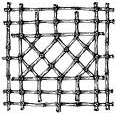
I thought ‘Trellis’ was the name of Humphrey Lyttelton’s correspondent of North Wales.  Then I realised it could be a square or a diamond shaped growing frame. Imagine my surprise when I saw it could be both (square and diamond not a correspondent and a frame). Am I bamboo-ed or bamboozled.

One of Mrs Trellis’s faux pas was to refer to Humph as if he were another media presenter as this quote shows “Dear Mr Titchmarsh, never let them tell you that size isn’t important. My aunt told me that, but then all my new wallpaper fell off.”

Garden Trellis

  • Trellis is made from interwoven pieces of wood or bamboo that is often used to support climbing plants.
  • There are many types of trellis for different places and for different plants, such as sweet peas, grapevines, ivy, and climbing roses.
  • Concertina trellis will open up to form diamond shaped holes. Prefabricated trellis will be attached to uprights and cross members.
  • Trellis can also refer to the structure made from interwoven wood pieces  attached to the roof or exterior walls of a house.
  • Trellis could be made from metal.
  • DIY trellis can be made from a lattice of tanalised wooden strips about 1″ wide

Trellis Shapes

  • As trellis is now used as a decorative medium there are a variety of shapes and sizes available.
  • Square and rectangular panels can also have curved arch shaped tops.
  • Side panels may be used to surround an arbour.
  • The top of fencing can be sculpted with a trellis shape.

Read more on supporting your plants in Autumn
See the exciting new Logo Board game for Christmas 2011


Garden Spades, Shovels and other Spades

Posted: July 19th, 2010 | Author: hortoris | Filed under: Tools and Equipment | No Comments »

The right tool for the right job and when it comes to ‘calling a spade’ then you have a choice.

Popular Shovel Shapes

Shovels

  • A spade has a flat, sharp blade whilst a Shovel has curved sides or edges.
  • Shovels are useful for scooping up bulky material like compost or straw.
  • A spoon shovel is a long bar with a small oval blade at the end, for digging deep narrow holes.
  • Coal shovels, Grain shovels and Snow shovels speak for themselves.
  • Shovels tend to be larger and heavier than spades.
  • Trowels and scoops have curved sides but are smaller hand tools.

Spades

  • Probably one of my most used garden tools in borders and for planting shrubs and trees.
  • I have a stainless steel light ‘Ladies Spade’ for normal work.
  • My heavy duty forged spade will be used for heavier work and double digging new land.
  • I am not keen on modern innovations like E shaped heads, carbon fibre handles preferring a traditional spade with an ash handle.
  • Spear and Jackson are excellent spades and other brands include Draper, Fiskars, Bulldog, Yeoman, Faithfull, Silverline and own brands.

Garden Safety Tips

Posted: July 19th, 2010 | Author: hortoris | Filed under: Tools and Equipment | No Comments »

Life is dangerous but it is better than the alternative. These are just a few tips to think about when in your garden but is up to you to take care and look out for other.

Electrical Equipment

  • All electrical products should have a residual current device which will cut-off the electricity supply if you have an accident. I have lost count of the times my hedge trimmer cable has been cut through.
  • Check that your tools, lights and equipment are suitable for use outdoors.
  • Never work with electrical power tools in wet or damp conditions.
  • Ensure products are turned to off before plugging in

Motorised Equipment

  • Know how to operate and particularly brake all motorised equipment – my mower has mown down plants before now when I thought the accelerator was the clutch.
  • Watch out for flying debris when shredding, sawing or creating chippings. I don’t wear goggles but may be I am now tempting fate.
  • Work a safe distance away from other people or pets and keep children away.

Sharp Equipment

  • Garden gloves are to protect your hands not keep them clean. Remove any thorns and splinters and wash your damaged hands with a bacteria gel.
  • Keep sharp blades sheathed – if it will lop a tree branch it will lop a finger – I made a cardboard cover for my bypass bladed loppers.
  • Keep your hands and feet away from the mower’s blades and wear sturdy shoes

General Safety Tips

  • When using hedge trimmer or chain saw, do not trim or cut higher than your shoulders, and secure ladders and keep them on a level surface.
  • Beware of slip and trip hazards. Put unused tools away and repair dangerous paths.
  • Take extra care with the  safety of children.

Slow Release Fertilizer

Posted: July 18th, 2010 | Author: hortoris | Filed under: Products, Uncategorized | No Comments »

Book Cover

‘What are the little blue things in the compost of my bought houseplants?’ I have been asked. Well it is most likely that they are slow release fertilizer.

Uses of Slow Release Granules

  • I now add   slow release granules when potting on and particularly for plants destined for the house.
  • Compost, particularly cheap multi-purpose compost, has very limited nutrients which are exhausted in a few weeks. Slow release thentakes over the fertilizing job  .
  • Acid loving plants can now get slow release specially formulated for there needs.
  • I augment the slow release during periods of rapid growth with an occasional liquid supplementary feed.

Fertilizer Brands

  • Miracle-gro has become one of my staples for fertilizer. The picture is of the slow release fertilizer It feeds for up to 6 months and includes NPK 17-9-11 with magnesium and trace elements
  • ‘Osmoform is a slow release fertilizer. The working principle is not based on a coating around the granules like with Osmocote, but on long nitrogen chains breaking down slowly. This process is influenced by temperature, micobiological activity and humidity. Osmoform contains NPK, magnesium and a package of trace elements’. Osmocote is NPK 15:4:9
  • Fisons   Ficote   14N-3.5P -6.5K is now sold as nutricote, Multicote 8 and Planta cote are other horticultural products.
  • Chempack also do a range for hobby gardeners that I use on occasion.
  • Terralit is a slow release fertilizing medium providing optimal nutrient supply for aquatic plants via the aquarium substrate
  • Phostrogen is another brand that now produces a six month slow release formula

Choosing Pruning Secateurs

Posted: July 18th, 2010 | Author: hortoris | Filed under: Tools and Equipment | No Comments »

Hand Pruners and Secateur Selection

  • Choose a model that is comfortable and the right size for your hand. Using a pair of secateurs that are too big can cause strain.
  • Check the position of the catch that lock them closed  and see how easy it is for you to move it. This is particularly important if you have reduced strength or flexibility in your hand and if you are left handed.
  • Left handed secateurs work like left handed scissors. There are several types and makes including those manufactured by Felco.

Types of Secateurs

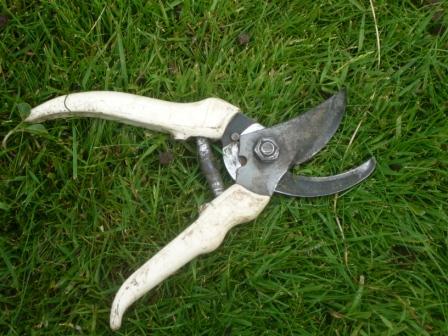
  • Bypass secateurs, as pictured above,  are suitable for cutting delicate stems as the action is less likely to  bruise the stem. The cutting blade passes a blunt blade, this cutting blade should be nearest the plant when cutting so only the pruned stem is crushed.
  • Anvil secateurs have a blade that cuts on to a flat surface. They are better for cutting hard woody stems. The blade is less likely to stick to the stem as it cuts.
  • Ratchet secateurs allow you to make a cut by squeezing and releasing the handles a number of times until you are through the stem. The mechanism clicks and holds the blades in place so you make gradual progress rather than having to cut in one go.

Personal Recommendations and Comments

  • Personal favourites are the bypass type that can get in close to the stems with the ‘nose’ .
  • A safety catch on the top rather than the side is less likely to catch and is easy to operate.
  • Revolving handle that move with your fingers are an unnecessary refinement.
  • Try before you buy to get a pair that suit from a weight and feel point of view.
  • Keep more than one  pair because even with bright coloured handles you will misplace them.

Check out Gardeners tips on using secateurs

Secateurs from Amazon.


« Older Entries
Newer Entries »
  • Best of Gardeners Tips
  • Top 100 Gardeners
  • Gardening at Amazon.co.uk
  • Seeds at Thompson & Morgan
  • Jersey Plants Direct

Categories

  • Art
  • Books & Publications
  • Clothing
  • Constructions and Greenhouses
  • Garden Economics
  • Growing Aids
  • Pests and Problems
  • Products
  • Projects
  • Seeds and Plants
  • Tools and Equipment
  • Uncategorized
  • Weeds and Treatments
Gardeners Tips