Browsed by
Category: Gardening

General gardening tips and hints

Stump Removal

Stump Removal


Redneck Gardening USA Style

When you have cut down a tree but can’t dig out the roots what do you do? You can hire a chipper or grinder that will take way some of the root wood by chipping away. If it is a large old tree you may have hired someone to do the job for you but make sure they have agreed to remove the stump.
Some trees are treated by drilling holes and pouring in sodium chlorate or special treatments to encourage rapid rotting but I find them less effective. Cross cuts and chemical treatment may stop regrowth but rotting still takes ages.

Tree Stump Killer Chemicals

Book Cover

Lawn Mowers from Qualcast or Atco

Lawn Mowers from Qualcast or Atco

Lawn mowers by Royal appointment come from Atco who were selling the above mower in 1924. You will now pay more than £95 for a 30 inch cut without the suit, pipe or hat. With models named Royale and Balmoral you can see how little effort the marketing people take by letting the grass grow under their feet. (Turf out the sod who is making these grasstuitous comments).

Qualcast made my first push pull mower and it may still be in use on some postage stamp sized lawn. New machines from Amazon cost about £32, are retro chic, environmentally very friendly and they help you keep fit. Cylinder mowers give you the stripes in the grass that are the hall mark of a manicured Lawn.

Book Cover

Weed Control Tips

Weed Control Tips

  1. To prevent weeds from germinating on your vegetable patch mulch with an old carpet, black polythene or even cardboard.
  2. Regular hoeing is the best way of keeping weeds down and stopping annuals weeds from setting seed. Pick dry weather to avoid spreading cuttings or the weeds into damp soil.
  3. Do not compost Elder or other pernicious weeds whose roots may survive.
  4. Dig out deep rooted weeds like Dandelions and Docks, you may be able to fashion a special tool out of apple corer or potato peeler.
  5. Put your plants close together to deprive weeds of light to germinate
  6. Try not to spread weed seeds yourself. Grass clippings may be full of seeds and many seedheads like foxgloves and dandelions will not compost fully.
  7. Beware some ornamental plants can self sow like weeds – I have loads of foxgloves and forget-me-nots that are my weeds.

For weeds in a lawn try a combined weed and feed but wait until April when the grass and weeds are growing strongly.

Book Cover

For persistent weed problems
you may have to resort to a chemical weed killer. Beware these weed killers do not know the difference between your prize plants and weeds – they kill that is why they are named killers.
Book Cover
Systemic Roundup kills most garden weeds with a single application, Once dry children and pets need not be excluded from treated areas. Fully degrades in soil by microbial action leaving no harmful residues to allow replanting.

Plugs For Growing Seedlings

Plugs For Growing Seedlings

In early Spring I bought some Zinnia plants as very small plugs. They have been a splash of stripy colour for several weeks now and with a bit of deadheading look set to on and on.

Yesterday I saw some ‘plugUgrow’ plants of early spring flowers .  I thought it would save me time and effort compared to seed sowing buying some Primroses and Violas, to say nothing of the certainty over germination.There was a fair selection of Winter Pansies and Violas but I opted for 24 Plum Velvet F1 Violas that are a deep purple with a mauve center according to the picture. The Primrose Terracotta Shades came in packs of 12 and were larger plugs and better plants.  I hope the flowers are as seductive as the picture suggests.

Plug Aftercare

  • If the compost is totally dried out or the gel is no longer supplying water to the plants I would give them a gentle water and leave for a couple of hours. My plugs were damp.
  • On the day of purchase, with a short stick I pushed through the bottom of the plug to ease the plant out and potted it into a 3″ pot already filled with multipurpose compost.
  • After a gentle watering at the base of the pot to help bedding in I put 15 pots to a seed tray in shade and shelter and will leave them for a few days to recover from repotting.
  • When I have space in the garden the plants will be well established with a good root system and they can be planted in their flowering position.
  • I will plant them close together to make a small mass of blooms of the same variety rather than have a pepper pot approach.
  • If the colours and plants habits are suitable I may allow them to survive as perennials but if they do not appeal I can compost them after flowering  and I am only down £2.50 per Plug pack.

Tip for little more than the price of a packet of seeds, plugs can guarantee 24 plants germinated and ready to pot on or plant out directly. It is  a quick and easy way to a patch of glorious colour.

Growing Blinking Big Beetroot

Growing Blinking Big Beetroot

There are many different kinds of Beet and that is the root of the problem. Beetroot Bulls Blood shown above is  ornamental, edible and is a heritage variety worth seeking out. Seakale beet, Chards and Spinach beet are grown for their edible leaves and the young green leaves of all Beetroot can be eaten in a salad. However we want big roots to make our eyes blink.

Growing Big Beetroots

  • Soil should be deeply cultivated in Autumn with plenty of humus and or peat incorporated. Do not use farmyard manure to avoid canker and aim to keep the ph level below 6 as beetroot do not like lime.
  • In spring ridge up the soil to about a foot high with 2 feet between rows. Prize plants will eventually need 3 feet spacing.
  • Sow the seed in groups of 3 at the top of the ridge in late spring keep the ground moist until germination. Expect 4 months growing time for the big beetroots.
  • When seedlings reach 2 inches thin out to two plants per station. From each seed several plants may have grown as each seed is really a clusters of seed.
  • Key Tip. One evening when the beetroot are 6″ high carefully scratch away the soil on the ridges away from the roots leaving only the tips of the root in the soil and the plant laying on the ground looking half-dead. Water the plant and soil and next morning they will have recovered and be working extra hard by swelling to survive.
  • As they swell thin out for a final time to 3 feet apart. Feed with a balance liquid feed from mid-summer and use a heavily dilute foliar feed from summer in addition.
  • Giant Beetroot are weighed without soil or foliage but may be you are just going to turn them into soup and chutney.

In August 2008 the Times online reported ‘Ian Neale … once grew the world’s biggest beetroot at 51lb 9oz (there is no metric system in the world of giant veg) – gets his monsters off to a good start by feeding them rock dust, essence of pig slurry and a material called “dinosaur fertiliser”, from a “big pile on the top of a moor in Yorkshire”.  Will August 2009 top that weighty tale and will 2010 be your year to top 50lbs?

Know Your Onions

Know Your Onions

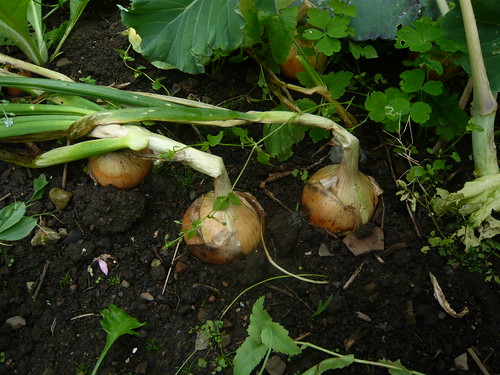
The necks of my Onions have just ‘gone over’ a bit earlier than usual but that could be down to the heavy rain we have had during July. Harvesting is a simple affair as I have pulled the Onions away from the soil to break the roots and left them in the sunshine to dry off. Shortly I will tie them to a string (like the old french onion sellers on the bicycles with hooped Breton shirts and berets) and string them from the garage roof to store (the onions not the French).

In ground that had early peas I am going to sow some August Onions such as Ailsa Criag the mild flavoured favourite or Reliance (I may transplant these seedlings or just thin them this year). Since I did well with over wintering Japanese Onion varieties I will also try find some sets of Express Yellow or Kaizuka or sow them where they will crop. Lastly in September I will plant a row of spring onions.

Shallots can wait until early spring around March time as can the smaller ‘Paris Silver Skin’ pickling onions. In spring I will again plant some main crop sets of both red and white onions as they have all earned there place in the veg garden by cropping well this year.

Tips

  • Onions like firm well prepared soil in the sun. Give the ground chance to settle.
  • For Autumn sowings rake in 3 oz per square yard of general fertilizer before sowing.
  • For spring planting rake in 4oz bonemeal & 2 oz of Sulphate of Potash per square yard in February.
  • Pickling onions do best in light unmanured soil.
Pruning Flowering Shrubs the Easy Way

Pruning Flowering Shrubs the Easy Way

rhododendron

Spring Flowering Shrubs that have finished flowering can be pruned in early summer. My Spirea were trimmed of flower heads and pruned of about one third of the old wood down to the ground this weekend. Hopefully also taking out weak growth and crossing branches will provide space for strong new stems to flower next year.

Forsythia was pruned after flowering back in April and other shrubs to now receive this treatment include Philadelphus, Ribes, Deutzia and Weigela. Weigela gets a lighter prune to encourage an Autumn flush of blossom. Rhododendrons (above) do not need pruning but I give them the once over to remove any problems.

Late summer flowering shrubs should be pruned next spring to encourage new flowering wood. Buddleja can be heavily pruned but avoid cutting into really old wood. Dogwoods should be stooled or cut bach to  about 10 inches high.  Choisya I just give a trim after flowering to retain shape and control the size but if they are putting on to much growth I will sacrifce flowers and prune early. Winter flowering Viburnum and Witch Hazel do not need much pruning so I tend to leave well alone.

Pruning Aims to achieve regular production of flowers and to keep a shrub healthy. A balance between old and new wood helps flowering. Creating space for light air and growth helps a plant remain healthy. Cutting back to a leaf or stem joint shapes and trains a shrub to do what the gardener wants.

After pruning care includes a dressing of blood fish and bone and a good mulch of compost. This will help the shrub replace all the wood it has grown and lost to my secateurs.

RHS

BBC Gardening Plant Finder

Growing Phormium or New Zealand Flax

Growing Phormium or New Zealand Flax

phormium

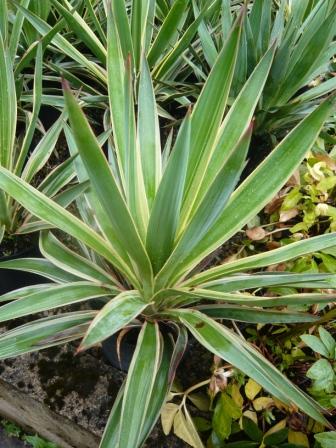
Spiky perennial plants sold as Phormium are available in variegated or self colours but all have striking sword shaped leaves. Phormium Tenax is the larger more commonly available variety but there are now approaching 100 varieties to choose from.

Growing Phormium

  • Phormiums are best growing in a sunny position although they will tolerate a fair amount of shade and like a stream side position.
  • Phormium have tough leaves that are resistant to desiccation so in the garden they rarely need any extra watering.
  • Varieties with upright leaves, such as ‘Sundowner’ and ‘Dusky Chief’ are reputed to be suitable for growing indoors
  • P. cookianum varieties are less hardy but with some bracken leaves for winter protection they should be OK. Try Black Adder or Maori Maiden.
  • Fernwood Nursery has a national Collection of over 70 varieties

flax

Collecting Seed from your Garden

Collecting Seed from your Garden

pansy

Do you like to grow your own plants from seed you have collected from your own garden. Well as you would expect it is as easy (or difficult) as nature intended but gardeners can certainly help with the selection and dispersal process.

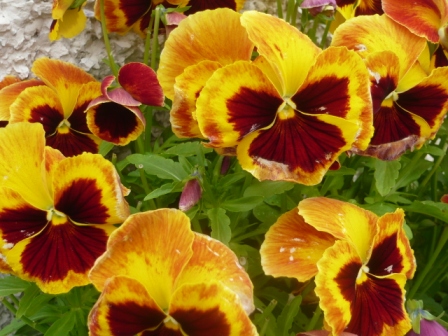
When seed is ripe or ready to be distributed you can help with the distribution process and the timing to get optimum conditions. I have just collected lots of seed from a colourful Aquilegia that I want to establish in my garden. The seeds are presented in a tubular pod with 5 cells that turn from green to brown and then progressively twist to squirt out the seeds over a couple of days. The squirting or sprinting process is like us squeezing an orange pip to get it to fly and is a key way of seed dispersal in nature. Pansies use the same process from a triumvirate of seed husks.

I collect the seed just before the husk is totally brown and keep it in a paper bag or old envelope for a week. By then the seed will fall out and the husk can be thrown way. Seed can then be sown in good conditions in the right place my Aquilegia will go into seed compost in september for upto 3 months in full light to help germination.

Read More Read More

Hover Mowers & Safety

Hover Mowers & Safety

mow

Hover mowers are quick and easy to use but they do not leave stripes in your grass. The motor mowers for long grass are an excellent way of clearing space like a hovering scythe. The electric Hover mowers are fine for small lawns and are far lighter than most other lawnmowers but they are unlikely to collect up the cut grass.

Before Using Your Mower

  • Read the instruction book, it may seem obvious but best to be prepared.
  • Fill the petrol tank before you start as pouring petrol into a hot engine can be as dangerous as smoking.
  • Examine the area to be cut for stones, bits of metal, toys or pets.
  • Set the cutting height, not too short!
  • When starting the machine keep it still, perhaps by putting your foot on the hood.

While Mowing