Browsed by
Category: Flowers and Plants

Annual, perennial and interesting flowers with advice on culture, information, tips and recommended varieties

Conservatory Plants

Conservatory Plants

November is a great time to plan next years plants for your conservatory. I would go for ‘shock and awe’ with some bold colours.

Lantana camara is worth the space in your cool conservatory where it will bloom from spring to late summer. It is evergreen and flowers best with good light. You will often see it in  Mediterranean gardens. There are numerous colour forms for this plant but my favourite is an orange flower changing to red.

Jasminum polyanthum is a favourite evergreen, twining climber. It has big clusters of white flowers tinged pink throughout summer. The heady scent permiates the conservatory especially in the evenings.

For winter interest Correa harrisii is a small evergreen shrub with an abundance of scarlet flowers during late winter. The leaves are narrow ovals with hairy undersides. Fragrant pink flowers are grown on Luculia gratissima.

Good partners for next summer are Cassia obtusa with deep yellow flowers contrasting with the purple-blue flowered evergreen Brunfelsia pauciflora.

Growing Lawns from Seed

Growing Lawns from Seed

The best times of year for sowing a lawn are March and early September. The ground will be warm or warming up and there should still be enough moisture to encourage the grass to grow. Dependant on the location and use of the lawn choose a seed mix not one individual variety. For sports fields they use rye grass but this is too coarse so avoid Rye grass mixes.

Hard Wearing Lawn

High Quality

Lawn

Shaded

Position

Chewing’s fescue

55%

80%

New Zealand Crested Dogstail

35%

Browntop Agrostis tenuis

10%

20%

30%

Fine leaved fescue

20%

Sheep’s fescue

40%

Creeping Red fescue

10%

Grass Sowing Tips

  • Rake a fine tilth and firm the soil down without compacting it
  • Remove stones and check the ground is level filling hollows
  • Apply phosphates
  • Mark areas and sow half the seed in one direction top to bottom then sow the other half side to side or hire a seed sower.
  • Roll the lawn twice to bring the seed into firm contact with the soil and bring a little moisture to the surface.
  • Erect a barrier to stop people walking on the new seeded area and put up cotton or bird scarers
  • Finer grass has smaller seeds so shake or mix your seed well before sowing
Cheap Good Value Perennials

Cheap Good Value Perennials

I was passing through Ilkley in Yorkshire when I was impressed by a small ‘Old Bridge Nursery’ by the side of the river Wharfe. There was negligible growing space but the crammed site was owned by an operation near Filey on the Yorkshire coast. It struck me as a good idea to have extra growing and growing-on capacity in such an auxiliary location.

Priced in pence per perennial pot (or per part of per pot perhaps) they seemed to be reasonable value for a three and a half inch pot . The roots were strong and just beginning to grow through the bottom of the pot and in most cases nicely filled the pot. Less than an inch of plant was showing but I bought 3 plants of which 2 were AGM varieties.

The Aster was so well developed I split it into 3 plants so they only cost very little each. As they are late to flower there is time for each plant to catch up and grow away strongly.

The red leaved Penstemon variety just caught my eye. If it grows and flowers well and is different from the red flowered, yellow leaved variety I have then I will take cuttings to increase the stock again for no cost.

I also got a Rudbeckia to fill a hole where another plant had been. I got to select the best plant from 50 but there were many other perennials that still had to show the first sign of newq growth .

I also bought 3 dwarf rhododendrons to plant in a space where a Eucalyptus tree is going to have to come out.

Tips for Good Value Perennials

Read More Read More

What can be put in Compost

What can be put in Compost

Tips on what can be turned into Compost

Type of Material

Carbon/ Nitrogen/

Trace

Tips

Ashes from untreated, wood

T

Fine amounts at most. Can make the pile too alkaline and suppress composting.

Bird & Chicken droppings

N

May contain weed seeds

Cardboard

C

Shred into small pieces if you use it. Wetting it makes it easier to tear.

Broad leaves

C

Shredding helps them break down faster. Decompose slowly have a separate pile for leaf mould. Can be acidic low in nutrients

Coffee ground and filters

T

Worms love coffee grounds

Chemically treated grass mowings

N

If weed treated compost won’t be organic but OK after 6 months

Diseased plants

N

If your pile doesn’t get hot enough, it might not kill the pathogen. Let it cure several months, and don’t use resulting compost near the type of plant that was diseased.

Eggshells

T

Break down slowly. Crushing shells helps.

Hair

N

Scatter so it isn’t in clumps.

Hedge Clippings

C

Cut up small

Kitchen rinse water

Neutral

Good to moisten the middle of the pile. Don’t over-moisten the pile.

Kitchen waste- vegetable matter

N & T

Fruit and vegetable peelings – uncooked trimmings

Manure horse, cow, pig, sheep, rabbit

N

Great source of nitrogen. Mix with carbon rich materials so it breaks down better.

Newspaper

C

Shred it so it breaks down easier.

Pine needles and cones

C

Acidic and decomposes slowly.

Seaweed

N

Good nutrient source.

Sawdust and wood shavings

C

You’ll need a lot of nitrogen materials to make up for the high carbon content. Don’t use too much, and don’t use treated woods.

Weeds

N

Dry them out on the pavement, then add later. Don’t use seed heads

Turf and grass sods

N

Make sure the pile is hot enough, or pile separately grass to grass roots to roots to make loam.

Other Compost additives

  • Add a thin layer of garden soil to your heap to help activation.
  • You can add a proprietary activator like Garrotta if you wish.
  • Have more nitrogen base items than carbon to help rotting
  • Use the above table as a guide to what composts.
  • Put leaves in a separate bin they take longer to rot and have little nutritional value
  • Put pine needles and conifer trimmings in a separate bag or bin as they take longer but make good acidic compost for heathers and similar plants.
Poplar Roundabout Felled in Sep-timber

Poplar Roundabout Felled in Sep-timber

In an oval roundabout in Menston a dozen Poplar trees were planted in the 1970s. As you can see only about half survive and these have been mistreated by polling them to restrict height.

What you may want to know about Poplars

  • Poplars (Populus)  are rapidly growing trees with shallow, spreading roots. Do not plant them near buildings.
  • The Black Poplar (nigra) has a shortish life of around 30 years so I shouldn’t be surprised by the state of these trees.
  • White Poplars (alba) are suckering trees with white woolly undersides to the leaf.
  • Balsam poplars can grow 6 feet per year and have a balsamic scent.
  • Female trees have long catkins but they are too high up these trees to see.

Poplar trees are usually felled in Sep-timber!

Autumn Backend Roses

Autumn Backend Roses


Late October and it feels very backendish. I am always pleased at the late rose buds that keep flowering in  ones and twos at this time of year. In a mild Autumn they can go on until Christmas even in Yorkshire.

Autumn Rose Tips

  • If you have been troubled with ‘black spot’ this year, collect all infected leaves and destroy then spray the rose again now with a fungicide.
  • Mulch your rose with the rotted compost you have been cultivating since spring.
  • Some people recommend pruning now to stop wind rocking roots loose but I wait until spring.
  • I have just taken cuttings of some roses.  8 inch lengths of stem of semi ripe wood have been put in a corner of the garden with some sand at the bottom of the hole. I will leave them a year or so and see what happens. A friend seems to have great success but she doesn’t know how she manages it.
  • Have a last look at nurseries and garden centers for the colour or variety of rose you want then order bear-rooted stock.
  • Good housekeeping makes for good roses.
Gourds & Squashes

Gourds & Squashes

Gourds
Gourds

Gourds are grown for the decorative fruit which come in weird and wonderful shapes.They are part of the curcurbit family along with cucumbers, courgettes, pumpkins and marrows.

Cultivation Tips

  • Hard seeds may need chipping or scarifying to allow water for germination.
  • Gourds need a long growing season – start indoors in heat.
  • The yellow or orange flowers need pollinating male to female like all the squash family to form fruit
  • Gourds are ready for harvest when the stems dry and turn brown.
  • Leave a few inches of stem attached when harvesting.
  • Seed packets often have a mixture of seeds. Plants cross pollinate easily so saved seed may produce strange results.

Gourd Varieties

There are three main types of gourd; the ornamental gourds, the lagenaria or large utilitarian gourds, and the luffa or vegetable sponge.

Read More Read More

My Plant Partners

My Plant Partners

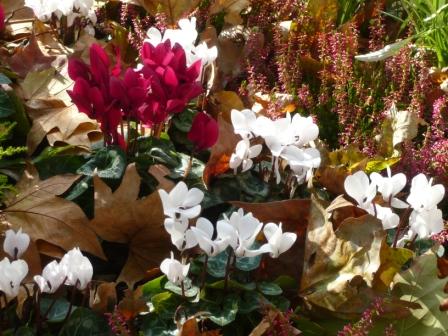
Combining plants in different ways is one of the joys of successful gardening. Different shapes and textures or bold colour schemes may be the trigger to make a combination work and there are companion plants that encourage growth in others. These wine red and white cyclamen produced a great contrast on their own but combined with the winter heather and the brown fallen leaves they were putting on a regal show in a local churchyard.

Recommended Plant Partnerships

  • A Chinese whitebeam tree, Sorbus hupehensis unfolds sea-green ferny leaves in spring with white flowers in summer. Its beauty can be enhanced by underplanting with the arching Berberis x rubostilla.
  • For autumn contrasts try Acer palmatum’s red leaves with a variegated Holly like Ilex Madame Briot.
  • For a silver leaved collection try Lavender Hidcote, Artemesia Lambrook Silver with Dianthus Mrs Sinkins. To highlight the combination have an old fashioned Gallica red rose as a centre piece.
  • Euonymus radicans and the smaller Eythronium White Beauty have pleasing yellow and white contrasts.
  • A couple of dogwoods can look striking in winter. Try cornus alba Sibirica red and the yellow stemed cornus stolonifera. Prune them hard in spring.
  • A rose like Queen Elizabeth can have its leggy stems surrounded by Rosemary or Lavender or even small violas.
  • Hostas and Primula japoinica or Harlow Carr hybrids both like waterside conditions and thrive together. Hostas with yellow-green leaves also go well in front of smoke bushes Cotinus coggygria
Cloak a wall in Jasmine

Cloak a wall in Jasmine

This Winter Jasmine or Jasminum Nudiflorum is just flowering on a neighbours, southwest facing, brick wall. Flowering a bit earlier this year it should flower through to March. The result shown is as a result of regular pruning and the stems have been tied in.

  • Left to it own devices the winter jasmine will form a 2 foot high mound as it won’t twine and is unable to climb unaided.
  • Cuttings from the arching stems can be taken in early summer.
  • Although deciduous the young stems are green and the flowers are born on bare stems giving the overall impression of an evergreen.
  • Unlike indoor Jasmine this plant has little or no fragrance
  • The AGM has been awarded to Jasminum Nudiflorum and it also has an apt Chinese name ‘Welcoming Spring Flower’

Compost and Composting Advice

Compost and Composting Advice

As would be Compost Kings our articles on composting can be found by key word search in the box. To get a full view of the ‘gardening industry’ that is now ‘Composting’ you could also read up on some other web sites. Some web pages may only be fit for composting themselves but at least the web does not smell.

Whatever you choose to do about composting, remember well rotted garden compost has been great food for many creatures and they will have left all their waste products as nutrients in your compost. Despite this free excrement do not expect your compost to be the only fertiliser you need. Garden compost excels when it is used to condition the soil.

Some Composting Links

Green Guides not girl guides but plans for your new compost heap
Reduce Landfill encouragement from Texas (Cattle produce may be) to compost
Wiggy Wigglers Worm suppliers  that worm your their way into your garden.
Compost Guide – A complete guide to composting?
Worm Composting Guide – Learn how to vermicompost with a worm bin.
Garden Organic Advice on the cornerstone of organic gardening
Master Composter Backyard Composting – Build a garden compost pile, build bins, worm composting, trench composting, soil incorporation, glossary, compost reference of organic materials, troubleshooting, FAQ, Message Board.
Compost Instructions with thanks for the ideas