Browsed by
Category: Flowers and Plants

Annual, perennial and interesting flowers with advice on culture, information, tips and recommended varieties

Pettinger’s Pelargoniums

Pettinger’s Pelargoniums

Sorry this is not a new geranium nursery or supply business although I wish it was. It is  just a follow up and continuation of my earlier promise  to keep updating my new found enthusiasm for Pelargoniums.
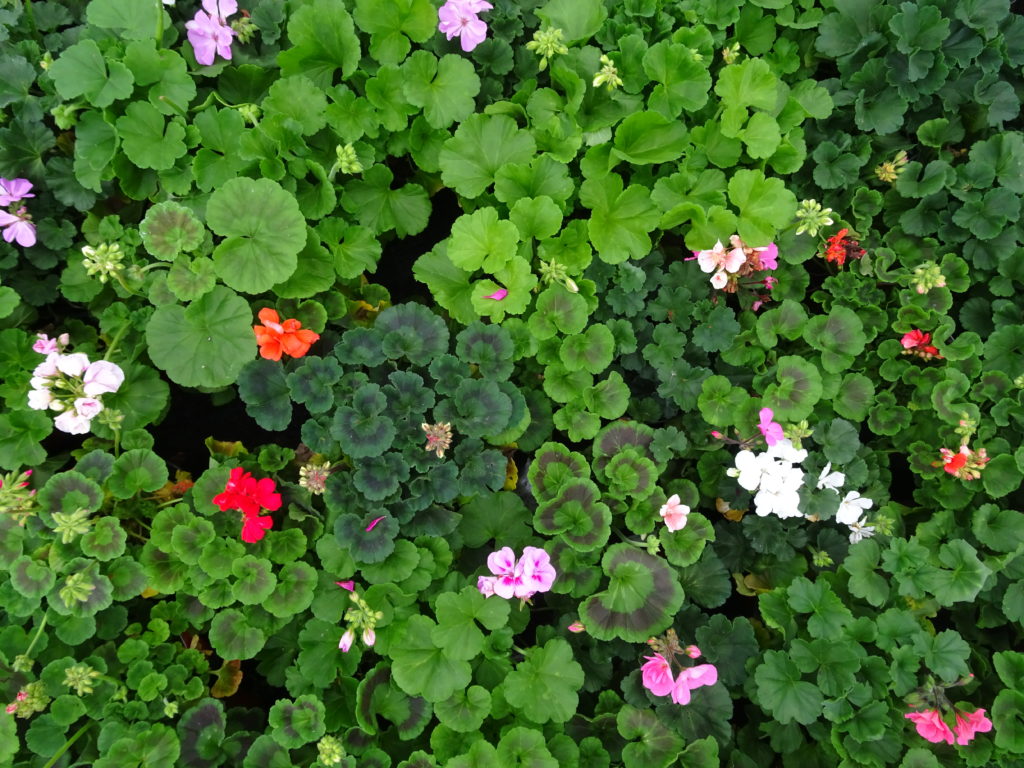
Zonal geraniums from overhead.

This is a garden center photo taken 17th June 2019. The plants were in 4″ pots selling for £2.49. There was nothing to tempt me with this selection on quality, originality or value for money grounds.

From the ridiculous to the sublime I went to visit a more upmarket garden location in South London.
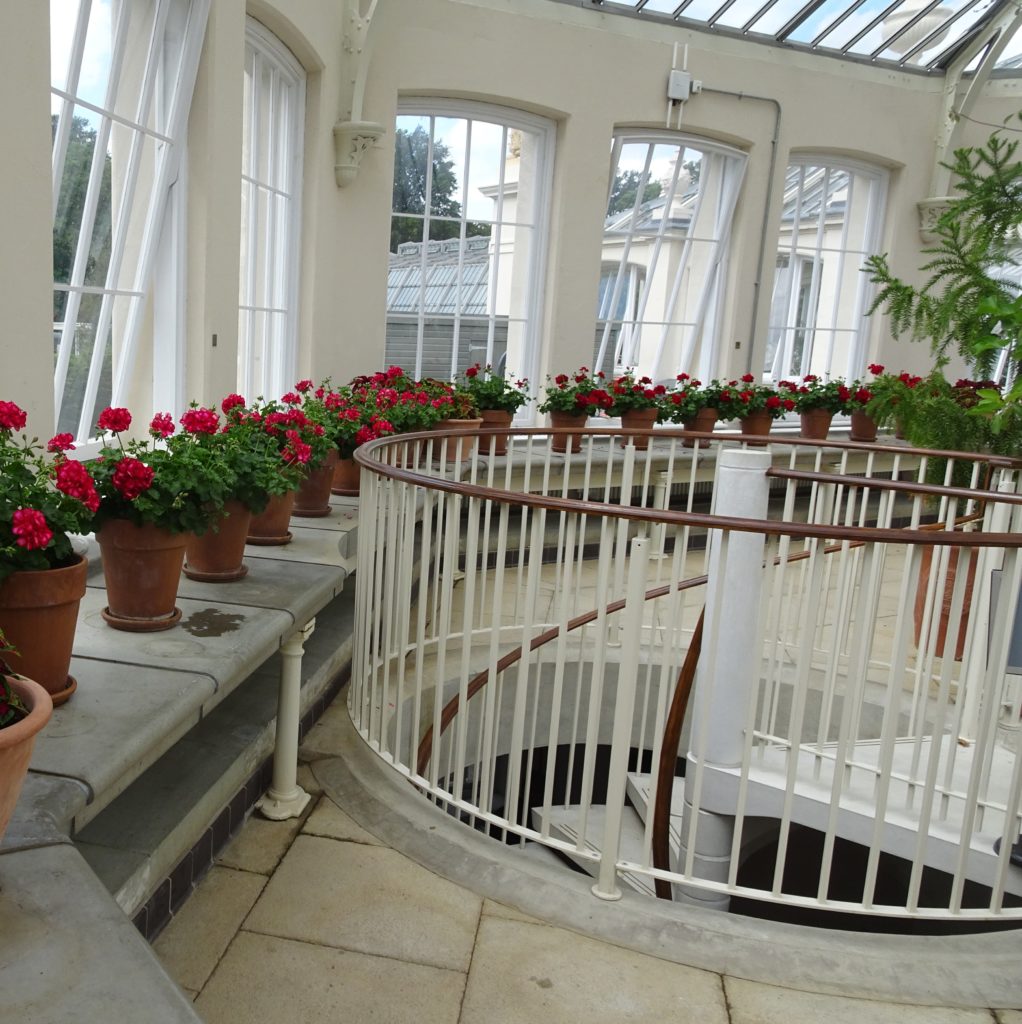
Geranium Update and Kew

  1. A trip last week to Kew garden chimed well with my recent pelargonium theme with a good display of many species. In the grounds they avoided the brash colour schemes of the familiar bedding plant varieties and had the best mixture of species in the Princess of Wales Conservatory.
  2. I was impressed with the greenhouse display of 8″ pots of several specific varieties including ivy leaved types.
  3. As an aside comment I arrived at Kew to queue in the June rain (what else). Next time I will book a ticket via the internet to gain rapid access. Due to the rain I bought a ride on the Kew train that provided a 45 minute guided tour of whole site. A worthwhile investment for the guides know-how and the ability to jump off and on during the day.
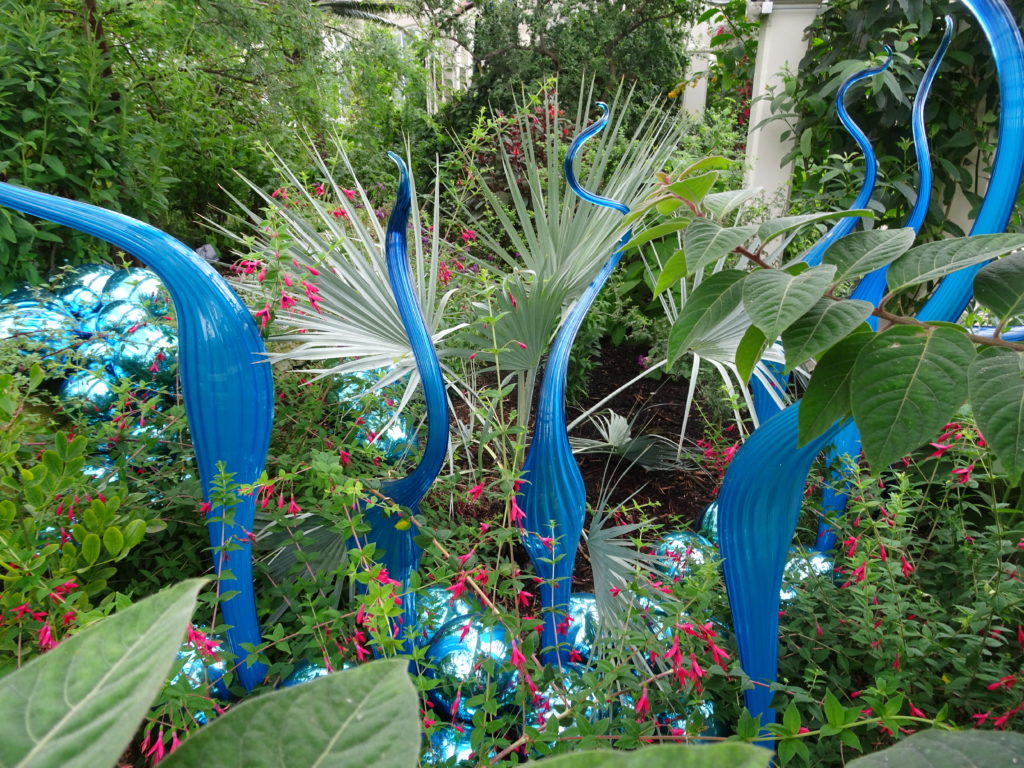
  4. Currently there is a Dale Chihuly  exhibit of luminous glass artworks set in Kew’s spectacular landscape and greenhouses.

 

London Mews and Georgian Terraces had some good flowering displays on substantial plants. They probably survive our winters due to shelter from the nearby buildings. As is my wont I failed to get the best ones photoed.
Geranium Time and Time Again

Geranium Time and Time Again

Yes it is well past time to look at geraniums again. Since this blog started there have been over 60 pages of tips about geraniums. The most popular have been about scented,  regal and dwarf geraniums but zonals and bedding also retain much interest. (You can find these and more links by using our search button).

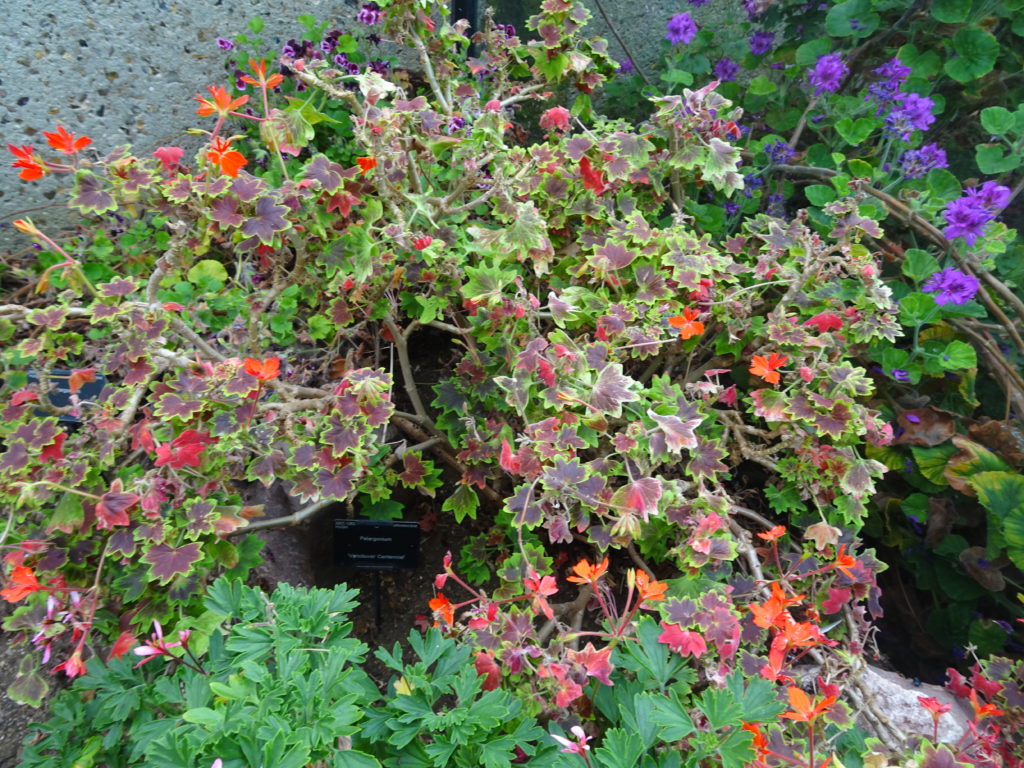
Pelargonium Vancouver Centennial’ @ Kew Garden
Why then is there this new post about geraniums? Well it is a reflection of my personal taste and intentions as I relaunch my horticultural interest in the 200 or so pelargonium species that we all call geraniums. (There are a further 400+ loosely related species correctly classed as geraniums often called hardy geraniums. Are you with me so far?) I am going to call pelargoniums by the common name of geraniums to the annoyance of some in the Pelargonium and Geraniums society.

Geraniums Again From a Personal point of View

  1. This post is intended to force me to follow up my good intentions to grow more and better geraniums.
  2. My first early horticultural memory is of pot plants grown on windowsills by my mother 60 years ago. The colour and unique musty scent of the leaves lingers somewhere in my brain. I do not remember the pink variety but it seemed vaguely dutch and royal and it certainly ‘was a good dooer’.
  3. Traditionally I garden by numbers and go for volume, the more the merrier (and usually the more cramped).
  4. An aspiration here is to grow fewer, show quality plants.
  5. Again I also want some house plants to give away as I think they make nice gifts and are easyish for the novice to cultivate and enjoy.
  6. My record keeping has been spasmodic over the years so it needs more attention.
  7. So may be  the start of a series of pages noting how I get on or at least a way of keeping my nose to the ground.

Princess of Wales Conservatory Kew Garden June 2019

Growing My Vegetables in Containers

Growing My Vegetables in Containers

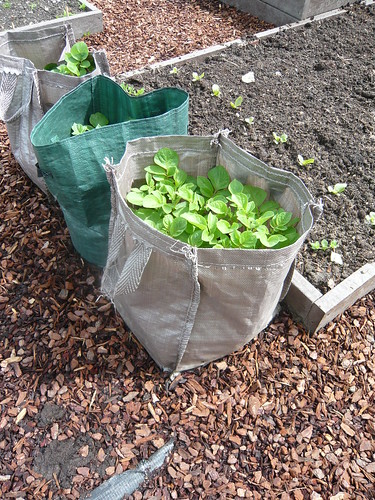
Potato sacks

You can grow fresh relatively clean vegetables in containers. This is useful for gardeners with restricted space or where you want vegetables close to the kitchen door.

Selecting Containers

  • Growbags get there name for a good reason. They are the first container to consider for vegetables.
  • Old large plant pots are fine as long as you clean them thoroughly. Disinfect with jeyes fluid in necessary.
  • Your own selection of containers, troughs, window boxes, even old drain pipes may be brought into service.
  • Depth for most crops should be at least 1 foot to avoid watering problems.
  • I use an old dustbin to grow ‘large long’ vegetables – it doesn’t always work but they do attract attention.

Compost or Soil

  • To get good results we recommend using sterilised potting media
  • John Innes No 3 holds nutrient, water and has some weight and body.
  • Proprietary potting compost are equally of use.
  • Good quality loam or garden soil will be fine but may lack nutrient, harbour insects and disease.
  • Mix in 20% of well rotted manure if you wish to grow organically.

Crop Selection

  • Sow Broad Beans from February 6-8″ apart.
  • Round carrots like Nantes and Amsterdam sown from February to June. The pots height can stop or deter carrot root fly.
  • Herbs and salad crops do well in containers. Small lettuce can be sown successively from January
  • Potatoes are my favourite as they come out clean and problem free. You can grow lots of varieties this way. One tuber for every foot of container diameter.
  • Peas with edible pods can be sown from March as can beetroot.

I start a few seed potatoes as soon as they arrive, end January/February. They are just starting to flower so I can pick some fresh tubers anytime from now on. They were in a double container if you count the greenhouse and vertical grow  bag.
I cover with fleece in very cold weather and happily move the pots for protection of the really early spuds. If the crop fails I have only lost a bit of effort and I can get on with full quantities in March.

Early Salad Varieties of Potato

Aim for a waxy texture with your salad potatoes and you will probably get some of the best flavoured spuds you have had in a Salad. Waxy potatoes remain intact after cooking and do not go into the water. Waxy potatoes tend to be Early to crop 75 -95 days. Waxy potatoes lend themselves to growing in large pots, barrels or containers.

Charlotte is resistant to blight and has a good cooked waxy texture.

Read More Read More

Larch a Conifer for Bonsai or Forests

Larch a Conifer for Bonsai or Forests

There are two common species of larch Larix kaempferi (aka leptolepis  the Japanese Larch) and European Larch Larix decidua. As the name implies the Larch looses their tufted leaves in autumn. They grow in most conditions but do not like wet or chalky soil

European larch is a large tree up to 100 feet tall.  It is conical in shape when young. It has a tendency to  lose its lower branches.  The drooping branches display a greyish colour. The European larch has longer needles than other Larches.

The Japanese larch has shoots of reddish brown. It has a rosette of neat shorter needles. It is a very hardy species grown in forests for timber.

Other Larch species include Siberian larch Larix sibirica and the  Russian larch,  Larix potaninii is a species  found in China and Nepal. Larix principis-rupprechtii, the Prince Rupprecht’s larch is also from china

Read our Root and Branch review of the Common Larch

Bonsai with Larch

  • The larch is a popular outdoor Bonsai species. Particularly the Japanese Larch Larix kaempferi.
  • The trunks grow thickly and relatively quickly. Uncharacteristic shapes can be pruned in.
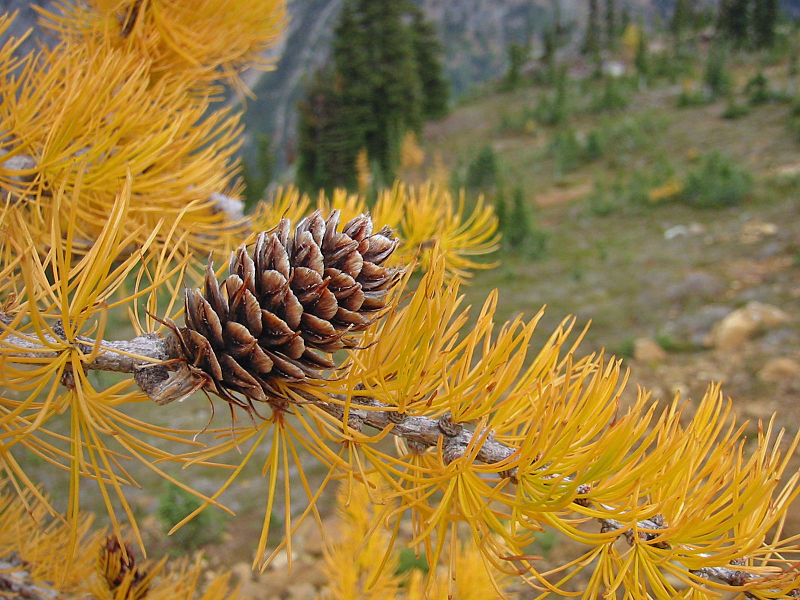
  • The trees displays seasonal colours bright green in spring then  foliage darkens during summer and turns  golden yellow before falling in autumn.
  • Do not be concerned if some exposed roots peek out from the soil.
  • More information from south devon bonsai society.
  • Foliage darkens during summer and in autumn turns bright gold.

Read More Read More

Green and Red Compliment your Spring Garden

Green and Red Compliment your Spring Garden

peonie

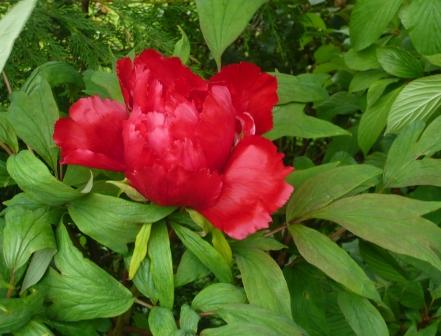
The two best complimentary colours are Red and Green.  There are many ways this is demonstrated in the spring garden and they will be sure to draw compliments. The Peonies are just opening under a bit of shelter and shade.

rg-no-b

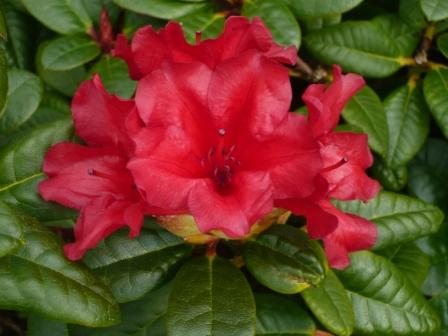
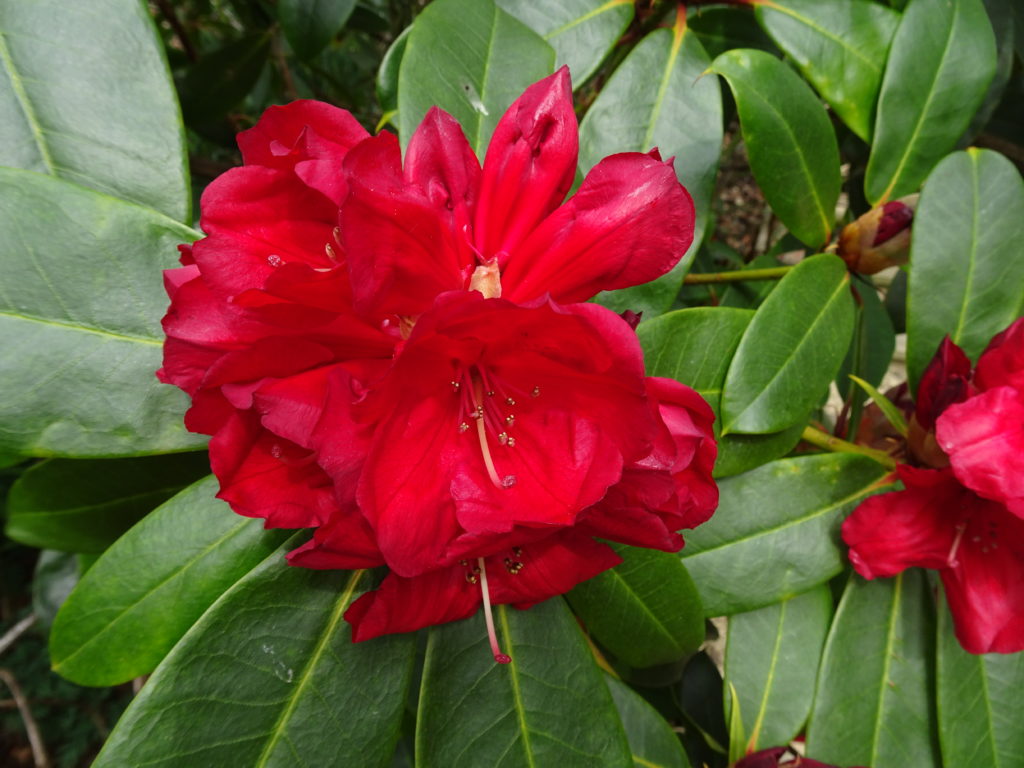
The early Rhododendrons escaped frost damage and the red flower is set off by the texture and green of the healthy leaves.

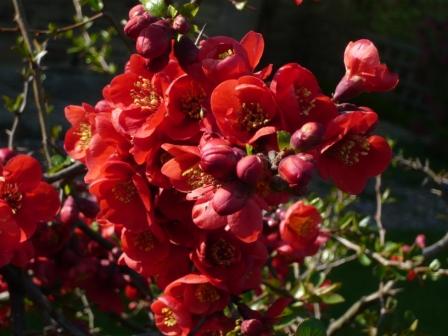
This flowering Quince gave strong colour before many leaves had opened light green but the surrounding grass had been trimed with neat lines in the lawn and the effect was stunning.

quince

See also Colourful Tips for other complementary colour combinations.

colour-contrast

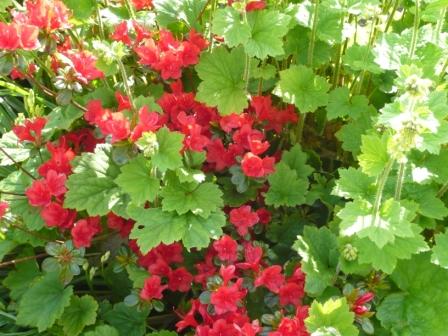
These lime green leaves are complementary to the Azaleas bright vermilion.

Some of the best art work by Georgia O’Keeffe is her paintings of Red Poppies. I recommend you try growing Oriental Red Poppies the for your Red – Green garden.

See also Colourful Tips for other complementary colour combinations.

My Spring Actions

My Spring Actions

2019 was off to a great start in Yorkshire; weather-wise at least.

Never knowing how many more springs I will be gardening I resolved to try the new and not to repeat the same mistakes as previous years. Surprisingly this philosophy has delivered several new tips that may be worth sharing.

New Spring Tips

  • Why have I never watered my dry compost before seed sowing. I use commercial compost for starting dahlias and summer bulbs into growth in frost free conditions. This year they have gone into predampened compost and the results are encouraging.
  • The daffodils have been great and I am photographing the garden in sections to see where they excel and where I can add new bulbs for next year.
  • Members of the primula family are also benefiting from the good damp ground that has followed a virtually snow free winter.
  • I can’t compete with the price of a bunch of daffodils from the supermarket so I am not trying. The space is too precious. However gardeners can compete on variety and specials and I have them in a dozen deep plant pots .
  • On miniature varieties of daffodils gardeners can compete handsomely as prolific results and good naturalisation seem to be easy. That is where I am setting my stall out.

Trying the New

  • I chop and change my selection of plants to grow each year. It means I get to select and buy new items that take my fancy. I do try to be loyal to a species for a couple of seasons but I think my auricula love affair is waning.
  • I have already dropped my membership of the Cactus Society and just composted the last specimens.
  • This year I am majoring on cyclamen which may take some years to reach excellence level. So to compliment that I have opted to try some indoor and outdoor Gloxinia.
  • I have returned to seaweed extract and just tried to perk up the lawn with a special watering. I will see how that goes.
Orchid Shows

Orchid Shows


Winter and early spring is often a good time for Orchid shows in the UK. We have already missed half a dozen shows in January.

 Feb  6     Hinckley & District Orchid Society A.G.M and Quiz
Barwell Constitutional club
7-300pm – 10-00     Contact: keith bates 01455444177 [email protected]
Trade Attending :-
     Feb  9     The North of England Orchid Society Monthly Show and AGM
Barton Village Hall, the A6 north of Preston
10.30am – 3.30pm     Contact: George Barnes 01942 810958 or via website form http://orchid.org.uk/email.htm
Trade Attending :- Phoenix Orchids, John Keeling
     Feb  20     Royal Horticultural Society RHS Orchid Committee
Council Room, Vincent Square
1130 –      Contact: Jill Otway [email protected]
Trade Attending :-
     Feb  23     The South West Orchid Society  Annual Orchid Show
West Monkton Village Hall, nr Taunton TA2 8NE
10.30am – 4pm     Contact: Marian Saunders 01278455170 [email protected]
Trade Attending :-
     Feb  24     East Midlands Orchid Society displaying at the Harrogate OS Annual Show
Pavilions of Harrogate, Great Yorkshire Showground, HG2 8NZ
10:00 – 16:00     Contact: Melv. Stephen 01159 198124 [email protected]
Trade Attending :-
     Feb  24     Harrogate Orchid Society Annual Show
The Pavilions Harrogate Showground Wetherby Road Harrogate HG2 8NZ
10.30am – 4.00pm     Contact: Ivor Pawson 01909 477832 [email protected]
Trade Attending :-

However here are some as listed by the British Orchid Council to tempt you in February. I will be going as a spectator to the Harrogate show and potential some others. The trade usually attend to show their products and will offer advice to the novice. For other pending shows see orchid.org


Chill Out Music in Your Garden

Chill Out Music in Your Garden

You may want a tranquil peaceful garden but sometimes you need some supplementary relaxation. After your toils to achieve a neat restful space you can reward yourself with some gentle music. The National Trust recognise this and have launched a CD collection of ‘Music for Tired Gardeners’.

Relax after a hard days gardening to the music of Vaughn Williams’ Greensleeves, or if the weather in inclement Chopin’s Raindrop prelude may refresh you. Other composers on the CD include Tchaikovsky, Delius, Debussy, Schumann and Eric Coates etc. You may not be  ‘In a Monastery Garden’ but the Delius operatic composition ‘The Walk to the Paradise Garden’ will be some compensation.

Walking around your garden you can sign the old traditional song ‘How many kinds of sweet flowers grow In an English country garden?
How many kinds of sweet flowers grow
In an English country garden?
We’ll tell you now of some that we know
Those we miss you’ll surely pardon
Daffodils, heart’s ease and phlox
Meadowsweet and lady smocks
Gentian, lupine and tall hollyhocks
Roses, foxgloves, snowdrops, blue forget-me-nots
In an English country garden

Like me you may not remember the next two verses about ‘How many insects come here and go In an English country garden?’ and ‘How many songbirds fly to and fro In an English country garden?’

Happy listening and Happier gardening


New Gardeners Do Not Need A Garden

New Gardeners Do Not Need A Garden

It is possible to enjoy gardening without having a traditional garden. Budding new gardeners can get a lot of pleasure and experience from a simple approach to plants and growing.

  1. Children can learn from growing mustard and cress from a packet of seeds in the kitchen. Put some cotton wool in half a clean eggshell dampen and sow some seeds. Better still may be a saucer with a damp face cloth.  A bean or pea seed in a jam jar wedged against the glass with some blotting paper will grow a root and a shoot to demonstrate the wonders of nature.
  2. Pot plants are often an introduction to gardening. Indoor they need light and water but most can survive at least 6 months without feeding. Green leaved plants may be easier to keep alive than flowering plants which in my experience need more care and attention.
  3. Without a traditional garden you can use grow bags on a balcony or path. I fill some bags and containers with bulbs or young, ready grown plants.
  4. Windowsill in my house are chock-a-block with plants from herbs and salad to exotic orchids. Even new gardeners can give some of these a go.
  5. If all else fails new gardeners can visit parks & gardens, garden centers and even look around the hedgerows and neighborhoods to get gardening knowledge and experience.


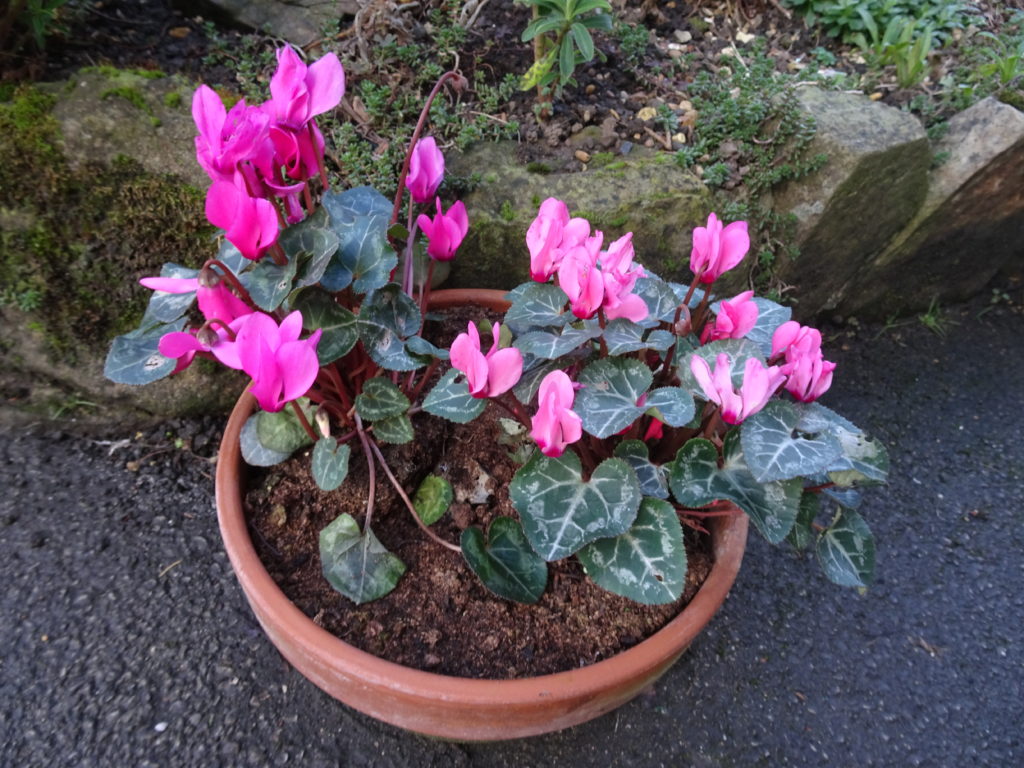
Cyclamen in a Pot on the Drive

Kelp Forest and Seaweed Growing

Kelp Forest and Seaweed Growing

It may seem unusual to feature a subsea area in a  series about gardens but this post may provide some food for thought. The oceans and seas are still capable of surprising us with a bountiful harvest including new and exotic eating experiences.

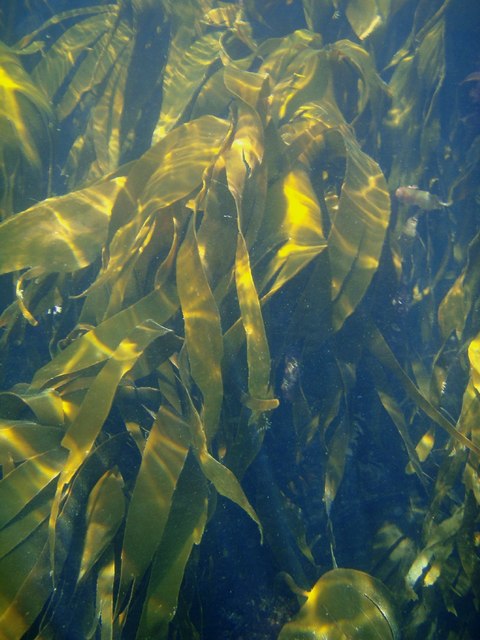
A Kelp Forest

Kelp Facts

  • Kelp is part of the brown seaweed family phaeophyceae or laminariales. There are many different genera and species that grow in shallow, temperate saline water.
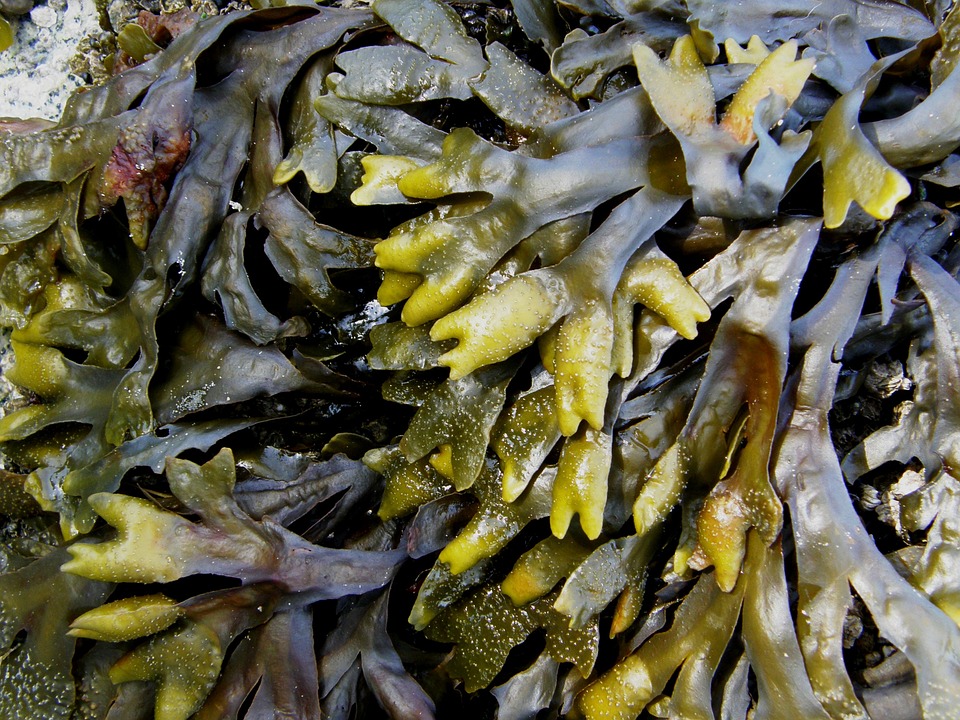
  • All Kelps are seaweeds but not all seaweeds are Kelp
  • Kelp captures and stores carbon
  • Kelp provides shelter for numerous fish species. It is also a breeding ground for juvenile sea creatures and a key part of the ecostem. The fronds or leaves sway in the temperate waters across the globe including thearound the UK.
  • The stipe or stalk stretches down to root in the seafloor anchoring the plant around rocks and boulders.
  • Iodine is present in Kelp along with many other important minerals. There is dramatically more calcium in Kelp than a similar volume of milk.

Is Kelp Good For You?

  • Kelp, produces a thickening agent used in ice cream, toothpaste and other products.
  • Some kelp species are eaten in salads and as edible decorative wrapping for sushi rice.
  • Kelp is used to produced Soda ash by burning.
  • These uses makes it a progressively more valuable commodity. Harvesting these sea-vegetables by hand sustains several coastal communities. Mechanical kelp harvesting is too intrusive, damaging of future crops and the ecosystem but it is on the increase.

Seaweeds are primitive sea plants

  •  There are at least 10,000 different species of seaweed
  • Salads can be made with Sea Lettuce or Purple Laver.
  • Laver bread is made from seaweed.
  • Agar and Carrageenan can be extracted from seaweed for use is used in the production of  paper and toothpaste.