A Good Year for Lilies
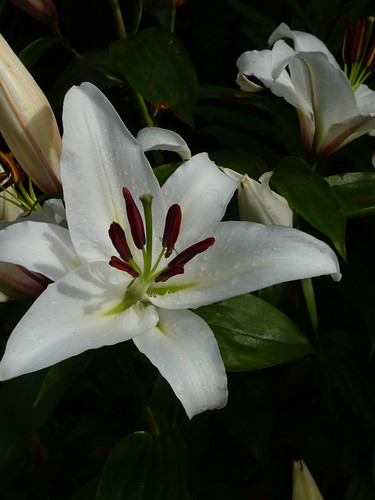
‘My dustbins absolutely fully of Lilies’. ‘Well throw them away then’. ‘I can’t Lilly’s wearing them’. so sang Lonnie Donnegan when his old man was a dustman.
‘My dustbins absolutely fully of Lilies’. ‘Well throw them away then’. ‘I can’t Lilly’s wearing them’. so sang Lonnie Donnegan when his old man was a dustman.
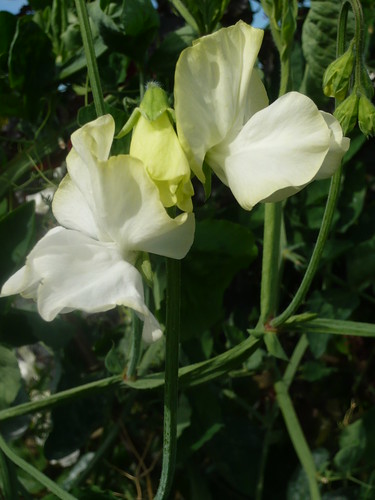
Where best to plant Sweet Peas? I have grown Sweet Peas in 3 locations this year and got very different results.
Best Growing Location
The best location by a country mile has been in a new bed which had plenty of garden compost incorporated last back-end. The roots are shaded from the sun so do not dry out whilst the plants get into the sun when about 18 inches tall.
2″ high seedlings were planted out in April from modules where 3 seeds had been germinated together. I did not split the seedlings leaving them in a clump. I guess this had the same effect of pinching out to get branching a task that I never got around too. I was given a tip to pinch out the tendrils that take energy and distort the lengthy stems of the Sweet Peas and I have done this where the support and my inclination allows.
I planted garlic cloves at the back of the bed but they have not done nearly as well. Other than that and some night scented stock at the front of the peas there has been no competition from other plants. I have lost count of the large bunches of sweet peas we have had in the house and given away. As long as I keep picking them I hope the floral display will last.
Worst Location
From the same batch of seedlings, treated in the same way I planted several near an obelisk that also has a Climbing Rose and Honeysuckle already established. I top dressed with compost but didn’t get it too the roots. Despite Growmore and liquid feed top ups, the plants have looked starved and are only now beginning to provide enough flowers for a vase. The summer has been wet so it is not down to moisture but the lack of humus and competition from other hungry feeders.
Middling Location
In a large terracotta pot some spare plants were supported by 5′ canes. The conditions could be controlled but flowers didn’t start until the plants were at the top of the support and now have nowhere to grow. Next year I will try one of the dwarf varieties of Sweet Pea in pots.
Redneck Gardening USA Style
When you have cut down a tree but can’t dig out the roots what do you do? You can hire a chipper or grinder that will take way some of the root wood by chipping away. If it is a large old tree you may have hired someone to do the job for you but make sure they have agreed to remove the stump.
Some trees are treated by drilling holes and pouring in sodium chlorate or special treatments to encourage rapid rotting but I find them less effective. Cross cuts and chemical treatment may stop regrowth but rotting still takes ages.
Tree Stump Killer Chemicals


Lawn mowers by Royal appointment come from Atco who were selling the above mower in 1924. You will now pay more than £95 for a 30 inch cut without the suit, pipe or hat. With models named Royale and Balmoral you can see how little effort the marketing people take by letting the grass grow under their feet. (Turf out the sod who is making these grasstuitous comments).
Qualcast made my first push pull mower and it may still be in use on some postage stamp sized lawn. New machines from Amazon cost about £32, are retro chic, environmentally very friendly and they help you keep fit. Cylinder mowers give you the stripes in the grass that are the hall mark of a manicured Lawn.


The compact foliage of some hardy geraniums make them desirable to grow as ground cover plants. The newer Geranium pratense Violaceum and Summer Skies have interesting double flowers in purple and rose pink respectively. The variety Laura is a clean white double flower with less robust foliage. Hayloft plants currently offer these varieties in partnership with the Daily Telegraph.
The picture above shows hardy Geranium Rozane Gerwat in full flower. Other blue varieties included in the Telegraph offer are the low growing Sabini-Blue and Jolly Bee and AGM variety. Rather than spend too much money on offers look for friends well stocked gardens and ask for a root or two. I have just cleared out many hardy geraniums from my garden as they were getting too profuse. (Now the compost heap has a profuse overload).
New varieties and introductions like the double geraniums take longer to mature as plants and you will be lucky to find any being given away at the moment.
For weeds in a lawn try a combined weed and feed but wait until April when the grass and weeds are growing strongly.

For persistent weed problems you may have to resort to a chemical weed killer. Beware these weed killers do not know the difference between your prize plants and weeds – they kill that is why they are named killers.

Systemic Roundup kills most garden weeds with a single application, Once dry children and pets need not be excluded from treated areas. Fully degrades in soil by microbial action leaving no harmful residues to allow replanting.
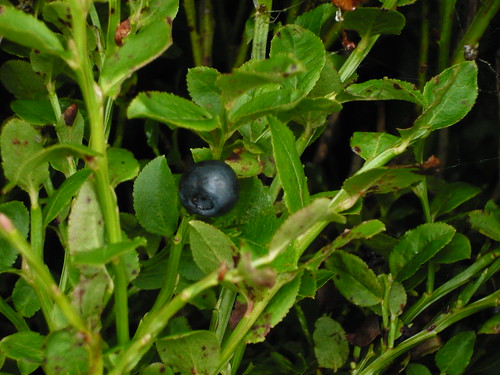
This is a wild Bilberry picked on August the 6th 2009 to make me a fruit pie. Bilberries are hard to grow in cultivation so the majority are picked from the wild moors and heaths as they like damp, acidic soil. The fruit are small, very dark skinned with dark sweet juice, just right for those pies.
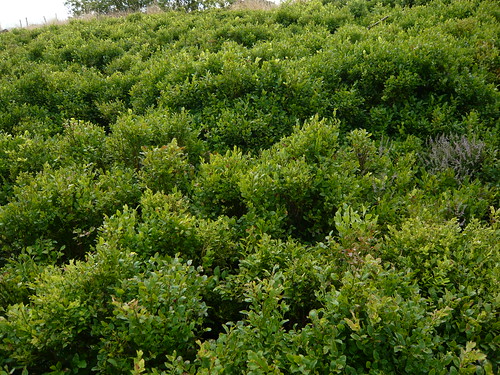
As a deep blue fruit, bilberries contain dense levels of anthocyanin pigments and are thought to be one of the ‘Super Fruits’ that have health benefits. Below are a host of Bilberry plants or Vaccinium Myrtillus on our local moor. You need a lot of plants for one pies worth of Bilberries.
Below is a Blueberry or a cultivated Vaccinium with larger fruit and an easier plant to grow successfully. This plant is just coming into fruit with paler flesh than the Bilberry but it likes similar acid soil and moisture. The fruit are famous in USA for Blueberry Muffins but they are not a patch on my Bilberry pie.


The Foxglove family includes several perennial species that are at least as interesting as the native purple foxglove. The variety above is Digitalis Ferruginea and the red/brown throat of the flower contrasts with the Red Monarda in the background. The plants are ‘neat but not gaudy’ according to the RHS AGM for this plant but at 4 feet tall I think they can look special.
The name Foxglove comes not from foxes but ‘folks’ gloves’ because it was thought that the flowers were used as gloves by fairies. Well not at the bottom of my garden.
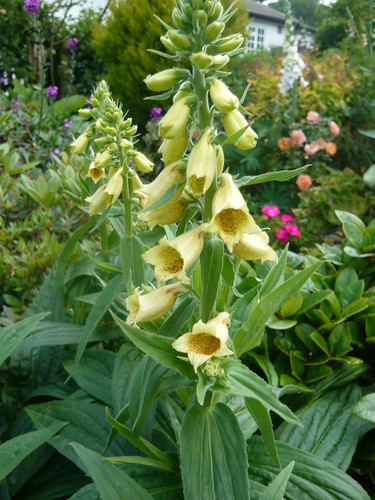
This Digitalis Lutea is the yellow perennial. I grow this in strong clumps amongst my Rhododendrons. It flowers after the Rhododendrons have finished and maintains some interest in this part of the garden through summer. It tends to self sow and as a short lived perennial I can transplant those I need for continuity.

This Foxglove Alba has a light brown speckled throat. When you think about it there are not many true brown flowers.

Progressively becoming one of most popular Acer varieties Acer Palmatum Asahi Zuru is still quite rare in English gardens. The deep pink and white variegation in Spring is followed by three tone pink, white and green foliage until Autumn. Asahi Zuru grows quickly when young then slows down and becomes more dense. This tree at Harlow Carr was about 15 foot high and will grow 9-12 foot wide in time.
Tips for growing Acer Palmatum Asahi Zuru

Some plants achieve Trendiness others have a trend thrust upon them and I think this is what happened to the Tree Ferns during the last decade.
What causes an outbreak of trendiness?
Returning to Tree Ferns the RHS offers it’s usual quality advice to members on the web site. I think it is interesting that out of 1.2m hits on the web the two top ranking nurseries selling Tree ferns are The Urban Jungle and The Palm Center two places I am unlikely to buy from.
