Growing Good Crocosmia

The national plant collection of Crocosmia in Lincolnshire has 270 different varieties.
Most are grown in containers to make use of the available growing space.
Growing Hints and Tips
- The bronzed leaf varieties are a bit tricky being more tender and slower to bulk up. Given good drainage and a warm sunny spot then Nigricans or Dusky Maiden may be OK. ‘Dark Leaf Apricot’ (Coleton Fishacre) should be even easier.
- Crocosmia like plenty of water in the growing season and are hardy in winter as long as they do not get too wet.
- A warm sunny spot suits Crocosmia best but do not forget the water.
- Crocosmia attract insects and if possible leave the leaves on through the winter as wildlife utilise these leaves to make their homes. The old leaves also help protect emerging shoots from spring frosts but you can mulch instead if you wish.
- Montbretia can be rampant and others you should watch out for include Red King, Meteore, Red Star and Marcotijn.
Choice Varieties
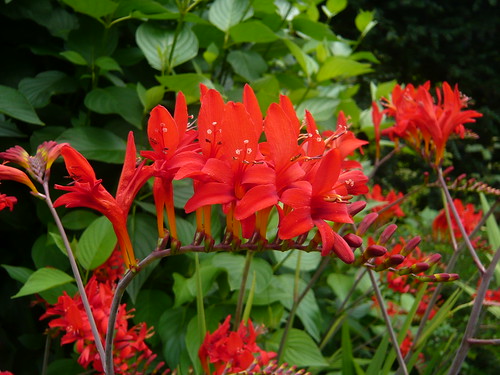
Crocosmia masoniorum ‘Jupiter’ – Long single sprays of lovely bright orange flowers with a burgundy stripe down each petal, blue/green leaves ‘Firebird’ has many sprays of extraordinarily large flame red flowers with a striking golden centre. ‘Scarlatti’ has 4 feet tall spikes of pillar-box red flowers with conspicuous yellow stamens. ‘Rowallane Yellow’ is also 4’ tall.
Crocosmia compacts include ‘Vulcan’ a variety with many deep red flowers on short stems, ideal for a smaller garden 1-2ft ‘Debutante’ with dainty salmon orange flowers fading to a cerise pink with age and ‘Bicolor’ – An old variety which has small flowers with alternate tepals of golden yellow and vermilion red, 1-2ft
Crocosmia x crocosmiiflora ‘His Majesty’ – An old fashioned variety with large flowers which are apricot overlaid scarlet-orange at the edges 2-3ft (Aug-Sept) ‘Pepper’ has a creamy background splashed with orange. ‘Sultan’ has red booms with
an orange blotch. ‘Mephistopheles’ dates from 1925 and produces a high plant.
Crocosmia ‘Severn Sunrise’, ‘Burford Bronze’ ‘Lucifer’, ‘Okavango’ and ‘Highlight’ are all other varieties to watch out for.
Descriptions and information from ‘Crocosmia Carnival’ The Garden September 2009, Holden Clough nurseries and Mark Fox the National Plant collection holder.

Crocosmia are corms of South African origin that produce arching branches of flowers and long sword like leaves. They thrive in well-drained soil in sun or dappled shade. Crocosmias require only the minimum of care with occasional thinning of plant clumps but in cold areas it’s worth covering plants with a mulch of well-rotted compost in winter. Leave the leaves on until the following spring, when dried they smell of saffron. Plant corms at least 4-6 inches deep. Old varieties of Montbretia can be quite invasive so select from the newer varieties now being developed.
National Collection of Crocosmia in Caister www.simplesite.com/crocosmia
Selection of varieties
- Crocosmia ‘Lucifer’ AGM is currently a must have popular crocosmias because of its flame-red flowers contrasting well with the fresh green, sword-like foliage. It has great vigour and produces imposing clumps in the late summer border.
- Crocosmia masoniorum ‘Jupiter’ with long single sprays of bright orange flowers with a burgundy stripe down each petal,
- Crocosmia ‘Bicolor’ – An old variety which has small golden yellow and vermilion red flowers .
- Crocosmia masoniorum ‘ Firebird’ A floriferous variety with red flowers with and golden centre but a strong grower tending to take over.
- Crocosmia ‘Scarlatti’ – Tall spikes of star-shaped, pillar-box red flowers with conspicuous yellow stamens, 4ft tall
- Crocosmia ‘Burford Bronze’ – Many sprays of large flat golden yellow flowers over dark bronze foliage, provides a good foliage plant as well.
- Crocosmia Citronella Clear lemon yellow flowers and pale green leaves. Or for other yellows try Rowallane Yellow and Canary Bird.
- Crocosmia Zambezii A beautiful new variety producing large salmon-orange flowers with a deeper central mark.
- ‘Star of the East’ produces the largest flowers. Its star-shaped apricot blooms have six regularly spaced, broad petals. This is one of the latest to flower, and often blooms until October.
- Crocosmia ‘Vulcan’ a compact variety with deep red flowers on short stems.
- Crocosmia ‘Debutante’ – One of the shortest, with dainty salmon orange flowers fading to a cerise pink with age 1-2ft late flowering
- Crocosmia ‘Severn Sunrise’ has branched stems packed with salmon-orange flowers which fade to pink to give a stunning show!
5 thoughts on “Growing Good Crocosmia”
Sorry that this is probably not the best place for these but I couldn’t find a contact address.
I’m sure you must be aware of the problems experienced by allotment holders last year due to the use of manure contaminated by a persitent herbicide called aminopyralid. Information has been collated about this problem from the links on this page http://www.glallotments.btik.com/p_Contaminated_Manure.ikml
Just to update on the latest re aminopyralid contamination in case you would like to provide updates on your website or to allotment holders in your area.
The latest infomation re manure contamination is posted on my website here http://www.glallotments.btik.com/p_herbicide_latest.ikml
I have also sent out a email for circulation by everyone I know that has been affected which is here http://www.glallotments.btik.com/attachments/contaminated_manure_alert.pdf which you may find useful to circulate to allotment holders in your area.
It is particularly important that gardeners be aware of the need for caution when obtaining manure in light of the fact that the government are now considering reinstating the licence that was temporarily suspended last year. As this is a concern to many gardeners you may wish to publicise an a epetition that has been started here http://petitions.number10.gov.uk/aminopyralidban/
I am posting updates as I get them on my blog http://glallotments.blogspot.com/ just on case you want to keep a watching brief.
Just to update you that the website mentioned above has moved to http://glallotments.co.uk
and the manure pages are accessed from
http://glallotments.co.uk/ACManure.aspx
Hiya, I know this is a really old post but thought I would ask anyway.. Do you know or have a picture of what the crocosmia masoniorum looks like when it comes up? Last summer we were given a bunch of it and planted it. It died right back and disappeared. Now it its place are quite thick red shoots appearing. Is this the crocosmia masoniorum coming up? Or just brambles? Thanks 🙂
I hope and think it will be fine new shoots of crocosmia masoniorum coming through for this year. It’s leaves look red when very young and so do the flowers
Comments are closed.