Gardening Products

Tips for the Gardener

Garden Safety Tips

Posted: July 19th, 2010 | Author: hortoris | Filed under: Tools and Equipment | No Comments »

Life is dangerous but it is better than the alternative. These are just a few tips to think about when in your garden but is up to you to take care and look out for other.

Electrical Equipment

  • All electrical products should have a residual current device which will cut-off the electricity supply if you have an accident. I have lost count of the times my hedge trimmer cable has been cut through.
  • Check that your tools, lights and equipment are suitable for use outdoors.
  • Never work with electrical power tools in wet or damp conditions.
  • Ensure products are turned to off before plugging in

Motorised Equipment

  • Know how to operate and particularly brake all motorised equipment – my mower has mown down plants before now when I thought the accelerator was the clutch.
  • Watch out for flying debris when shredding, sawing or creating chippings. I don’t wear goggles but may be I am now tempting fate.
  • Work a safe distance away from other people or pets and keep children away.

Sharp Equipment

  • Garden gloves are to protect your hands not keep them clean. Remove any thorns and splinters and wash your damaged hands with a bacteria gel.
  • Keep sharp blades sheathed – if it will lop a tree branch it will lop a finger – I made a cardboard cover for my bypass bladed loppers.
  • Keep your hands and feet away from the mower’s blades and wear sturdy shoes

General Safety Tips

  • When using hedge trimmer or chain saw, do not trim or cut higher than your shoulders, and secure ladders and keep them on a level surface.
  • Beware of slip and trip hazards. Put unused tools away and repair dangerous paths.
  • Take extra care with the  safety of children.

Slow Release Fertilizer

Posted: July 18th, 2010 | Author: hortoris | Filed under: Products, Uncategorized | No Comments »

Book Cover

‘What are the little blue things in the compost of my bought houseplants?’ I have been asked. Well it is most likely that they are slow release fertilizer.

Uses of Slow Release Granules

  • I now add   slow release granules when potting on and particularly for plants destined for the house.
  • Compost, particularly cheap multi-purpose compost, has very limited nutrients which are exhausted in a few weeks. Slow release thentakes over the fertilizing job  .
  • Acid loving plants can now get slow release specially formulated for there needs.
  • I augment the slow release during periods of rapid growth with an occasional liquid supplementary feed.

Fertilizer Brands

  • Miracle-gro has become one of my staples for fertilizer. The picture is of the slow release fertilizer It feeds for up to 6 months and includes NPK 17-9-11 with magnesium and trace elements
  • ‘Osmoform is a slow release fertilizer. The working principle is not based on a coating around the granules like with Osmocote, but on long nitrogen chains breaking down slowly. This process is influenced by temperature, micobiological activity and humidity. Osmoform contains NPK, magnesium and a package of trace elements’. Osmocote is NPK 15:4:9
  • Fisons   Ficote   14N-3.5P -6.5K is now sold as nutricote, Multicote 8 and Planta cote are other horticultural products.
  • Chempack also do a range for hobby gardeners that I use on occasion.
  • Terralit is a slow release fertilizing medium providing optimal nutrient supply for aquatic plants via the aquarium substrate
  • Phostrogen is another brand that now produces a six month slow release formula

Choosing Pruning Secateurs

Posted: July 18th, 2010 | Author: hortoris | Filed under: Tools and Equipment | No Comments »

Hand Pruners and Secateur Selection

  • Choose a model that is comfortable and the right size for your hand. Using a pair of secateurs that are too big can cause strain.
  • Check the position of the catch that lock them closed  and see how easy it is for you to move it. This is particularly important if you have reduced strength or flexibility in your hand and if you are left handed.
  • Left handed secateurs work like left handed scissors. There are several types and makes including those manufactured by Felco.

Types of Secateurs

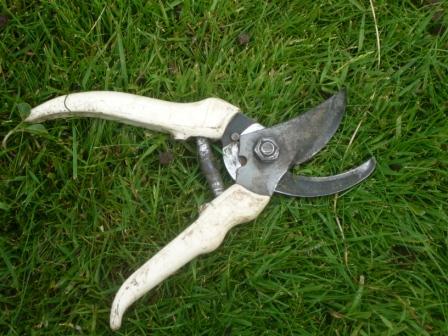
  • Bypass secateurs, as pictured above,  are suitable for cutting delicate stems as the action is less likely to  bruise the stem. The cutting blade passes a blunt blade, this cutting blade should be nearest the plant when cutting so only the pruned stem is crushed.
  • Anvil secateurs have a blade that cuts on to a flat surface. They are better for cutting hard woody stems. The blade is less likely to stick to the stem as it cuts.
  • Ratchet secateurs allow you to make a cut by squeezing and releasing the handles a number of times until you are through the stem. The mechanism clicks and holds the blades in place so you make gradual progress rather than having to cut in one go.

Personal Recommendations and Comments

  • Personal favourites are the bypass type that can get in close to the stems with the ‘nose’ .
  • A safety catch on the top rather than the side is less likely to catch and is easy to operate.
  • Revolving handle that move with your fingers are an unnecessary refinement.
  • Try before you buy to get a pair that suit from a weight and feel point of view.
  • Keep more than one  pair because even with bright coloured handles you will misplace them.

Check out Gardeners tips on using secateurs

Secateurs from Amazon.


Soil Analysis – Testing Services and Kits

Posted: July 18th, 2010 | Author: hortoris | Filed under: Growing Aids | No Comments »

There are three things you may wish to test on your garden or allotment  soil.

  1. The nutrient levels including NPK and trace elements. Not only their presence but the  availability of this food for plants.
  2. The acidity or alkalinity of the soil normally called a ph test
  3. The consistency of the soil from small particles of clay through silt and loam to sand An analysis of humus levels also comes with this service but DIY systems are less sophisticated.

You can do tests yourself or send a sample and fee to the Royal Horticultural society for a full report.

RHS service, which has been developed specifically with gardeners in mind, provides an analysis of soil texture, pH, organic matter and three major plant nutrients (potassium, phosphorus and magnesium). You receive a detailed interpretation of the results as well as fertiliser recommendations for either fruit, vegetables, ornamentals or lawns.

The pH of a soil refers to its acidity or alkalinity and is a vital factor in plant growth. It often dictates what plants will thrive and what will fail. It’s easy to measure and is usually listed numerically on a scale of one to 14. Acid soils have a pH of below seven, neutral is pH7 and alkaline is above seven.

The texture and relative amounts of sand, silt, and clay are estimated by the feel of the soil in a moist condition. The soils are then classified into three categories: C (coarse textures of sand, loamy sand and sandy loam), M (medium textures of loam and silt loam), and F (fine textures of clay loam, silty clay loam, silty clay and clay.

Organic matter is determined by heating a  scoop of the soil sample and by assessing weight loss it can reported the per-cent organic matter by weight in the soil. For DIY worm activity is a good indicator.

Soil testing kits at Amazon

Agricultural testing report on a pdf or read more on Gardeners tips


Get Birds in your Garden

Posted: July 16th, 2010 | Author: hortoris | Filed under: Products, Uncategorized | No Comments »

Burton Agnes Pocklington

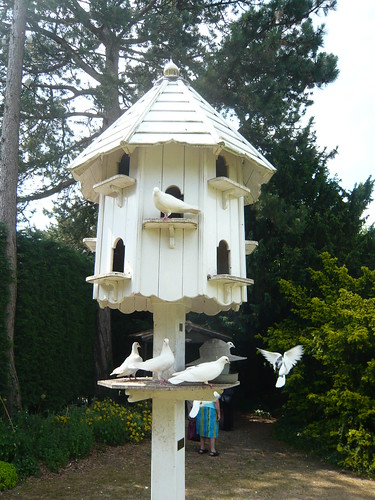
Getting birds to visit and return to your garden can give you great pleasure. Food, safety and shelter are key features that will encourage wild life and birds in particular. A bird bath can be a useful and decorative feature.

Bird Food can be grown in the garden in the form of berries and seeds or supplemented by bird feeders, peanuts, fat balls and even bits of fruit.

Safety can be designed into the garden with hedgerows and cover plants.

  • Do not provide cover for lurking cats that want to prey on your garden birds.
  • More information can be found in a good reference book or from the RSPB
  • Keep bird food safe from squirrels and vermin by using the right sort of feeders.
  • Keep birds safe from disease by moving bird tables and feeding stations around your garden each year.

Book Cover

Garden bird books

Nesting Boxes for Birds

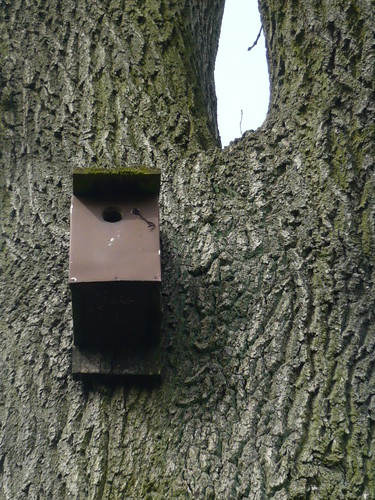
  • Birds will find nesting sites but you can help by putting up bird boxes.
  • Check the size of the hole is right for the birds you want to attract.
  • Do not be too tidy as birds need to be able ‘to feather their own nest’.
  • Try not to disturb nesting birds.

Bird box

See also Gardening for Birds or read about trees and shrubs for birds on Gardeners tips


Buying Garden Ponds fit for Water Lilies

Posted: July 16th, 2010 | Author: hortoris | Filed under: Uncategorized | No Comments »

Burton Agnes Pocklington

Instant Ponds can be created in your garden by purchasing a preformed molded pond like a big babies bath. They will have shelves at various heights on which to stand your water lilies or other aquatic plants. All you need to do is dig a suitable hole and drop in the empty pre-shaped pond.

  • Ensure your pond is level or the water will slop over one end and leave the plastic showing at the other.
  • If your soil is rocky it is best to bed down your pond into a layer of soft sand. This also helps with leveling and bedding down.
  • Bury the pond deep enough so the edge is not left proud.
  • Fill with water and leave to settle and mature before introducing plants and or fish.

Pond liners made from rubberised Butyl can be bought to create a pond of your own shape and design. Tips are available here.

  • Use an underlay and place the butyl on top.
  • The   water level for your pond should be at least 4″ below the top of the liner to prevent water loss due to capillary action into the surrounding soil.
  • Take care during future maintenance not to puncture the liner.

Green Island Triffid

Water Lilies

  • Nymphyea pygmy lilies like ‘rubra’ are miniature red/pink waterlily  flowers 1 – 2″ in size with a  spread of 18″.  They can be grown in a miniature patio pond, barrel, shallow  or tiny pond.
  • Water lilies can be augmented with marginal, herbaceous, bogside and oxygenating plants to suit all ponds.

Decorative Garden Containers

Posted: July 15th, 2010 | Author: hortoris | Filed under: Uncategorized | No Comments »

Long Toms

Flower Towers are something relatively new in the display of trailing plants.
Thompson Morgan supplied this photograph and have an advisory service for those interested in the ‘Maxi Tower’ large structure.

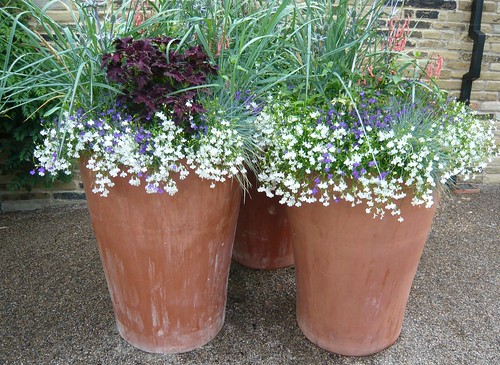
Classical Urns are still the best way of displaying clipped shrubs and topiary.

Hanging Baskets and window boxes have not changed greatly in design for many seasons. They now have better watering systems to keep the plants looking at their best.

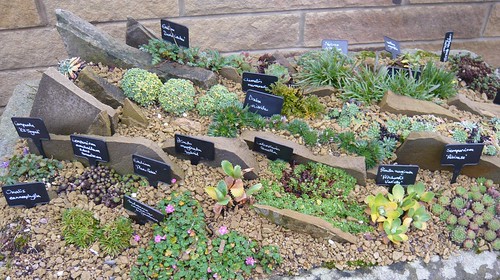
Alpine troughs are a traditional method of displaying small plants that repay close examination. Troughs can be raised to eye level or used in parts of the garden where there is no suitable soil. Old sinks are also used for this form of display so look out in reclamation yards. See an old strawberry planter in use on Alpine containers.

Alpine Trough

For practical containers read Functional Containers


Functional Garden Containers

Posted: July 15th, 2010 | Author: hortoris | Filed under: Products | 2 Comments »

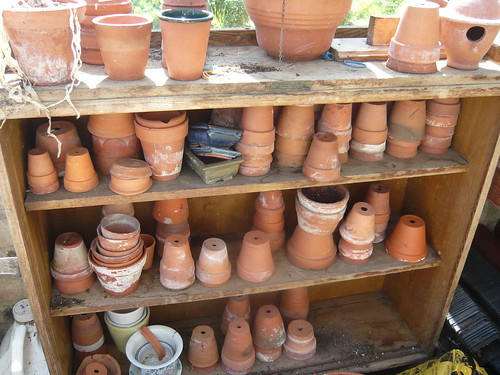
Pots for potting

Container gardening is decorative but containers in the garden are primarily functional.

Plant Related Containers

  • Plant pots do what the name implies. You put plants in pots to grow on or keep until ready for planting out.
  • Plant pots that are planted up are also useful for placing inside a decorative container. It can help with watering and allow the quick replacement of the plant when a new one is needed.
  • Clay plant pots help keep roots of plants cool due to the water evaporation.
  • Plastic pots are cheap, reusable, easy to store and available in many sizes.

Containers for Specific Functions

  • The water butt is the most useful container in my garden during summer.
  • I have an old plastic dustbin to store seed and potting compost near my potting bench. It has a lid to keep the compost fresh.
  • Sharp sand is kept in another old bucket shaped container and I have old boxes for perlite and vermiculite so they are readily available.
  • At the end of the season I put all my garden canes and supports in an old plastic kitchen bin just to keep them tidy and in a place where I can find them.
  • Tools including, hedge trimmers, are stored in an old wardrobe without doors ( I forget where they have gone) locked in my garage.

Pseudo Containers

  • Whilst not a true container, in my case, the compost heap could easily be in a purpose designed compost bin.
  • Are my bird feeders containers – well I guess they fit. Plastic ones last only 1or 2 seasons but the metal variety seem capable of going on and on.
  • I use a dustbin with a chimney lid  to collect burnable rubbish rather than sending it to landfill – not strictly correct but at the backend what is one more fire.
  • Is my garden pond a container – (oh this is getting a bit silly now ed.)

Greenhouses and Garden Sheds

  • These are the King and Queen of garden containers and once you have used them they seem indispensable. My only problem is space as they do get full. Well I guess that is containers for you.

See also Tips on making your own compost bin.


Poly and Net Tunnel Growing

Posted: May 30th, 2010 | Author: hortoris | Filed under: Constructions and Greenhouses, Growing Aids | 1 Comment »

Poly and net  tunnels have three main benefits for the serious gardener:

  1. You can grow more difficult  and exotic crops in the tunnels micro-climate.
  2. Tunnels can extend the growing season at the start and end of the year.
  3. Tunnels are particularly useful to protect from insect and pest damage.

Thompson Morgan have a special offer at the moment on a Tunnel Collection. You can order one by clicking here from £59.99.

One of each of Easy Net Tunnel, Easy Fleece Tunnel and Easy Poly Tunnel.

  1. Easy Net Tunnel – Top quality, high density polythene netting, 5mm mesh on a concertina-style frame. Protects your plants from birds, insects and rabbits.
  2. Easy Fleece Tunnel - Made from high grade polypropylene fleece on a concertina-style frame. Creates warmth and insulation whilst allowing water and sunlight to filter through.
  3. Easy Poly Tunnel -  Tough UV stabilised polythene sheeting on a concertina-style frame. Protects tender crops from frost or harsh weather, as well as giving early planted crops a boost by creating a warmer environment to grow in.

Available in two sizes:
Standard: Dimensions 3m long x 45cm wide x 30cm high
Giant: Dimensions 3m long x 60cm wide x 45cm high


Raised Beds Raise Crop Yield

Posted: May 30th, 2010 | Author: hortoris | Filed under: Growing Aids | Tags: good soil | No Comments »

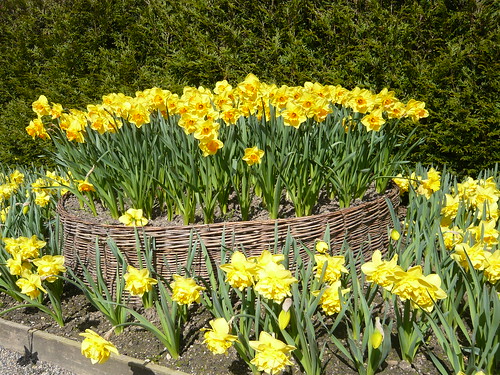
daffodil in willow display

In praise of raised beds I find I get more veg and salad with a raised bed. Not only that but with careful siting I can access the raised bed with less bending – good news for a creaky old gardener.

Types of Raised Bed

  • Pre-formed wooden boards or plastic are easy to assemble and long lasting. The photo above shows how the boards have lifted the base above the surrounding soil.
  • The photo then shows how woven willow is used to hold a pile of soil as a raised bed for Daffodils.
  • You can build a permanent wall of stone or breeze blocks, then fill it with good compost and manure.
  • If you use your own boards or planks support the lower side with long pegs driven into the ground so the raised soil doesn’t push the board over. I made my pegs from 1-2″ diameter tree prunings.

Raised beds are available from Thompson Morgan in several styles. I like the idea of the mini-grow bed that can be moved when not in season.


« Older Entries
Newer Entries »
  • Best of Gardeners Tips
  • Top 100 Gardeners
  • Gardening at Amazon.co.uk
  • Seeds at Thompson & Morgan
  • Jersey Plants Direct

Categories

  • Art
  • Books & Publications
  • Clothing
  • Constructions and Greenhouses
  • Garden Economics
  • Growing Aids
  • Pests and Problems
  • Products
  • Projects
  • Seeds and Plants
  • Tools and Equipment
  • Uncategorized
  • Weeds and Treatments
Gardeners Tips