Gardening Products

Tips for the Gardener

Asparagus on Canvas

Posted: December 23rd, 2010 | Author: hortoris | Filed under: Art, Uncategorized | No Comments »
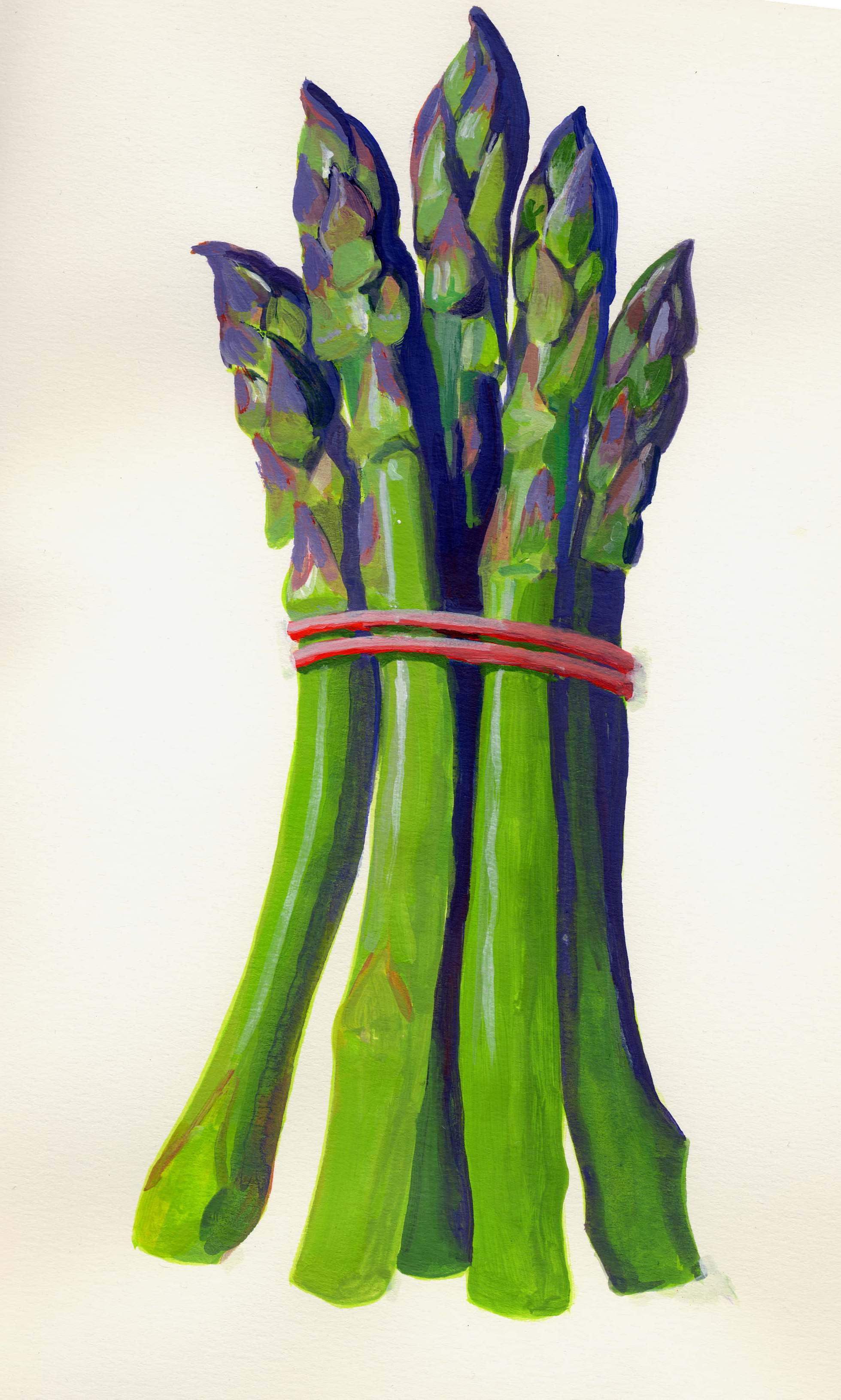
The original painting of this Asparagus Connovers Colossus is available to purchase from Gardening Products. A limited edition giclee print is also available on a range of acid free art quality substrates.

Forming part of the work by Leeds resident artist Andrew Breslin he has supplied artwork to the Royal Horticultural Society including magazine rights to this particular work.



Artistic Garden Hangings

Posted: August 17th, 2010 | Author: hortoris | Filed under: Art, Uncategorized | No Comments »

Trees are a great places to locate art in your garden. RHS Hyde Hall has a series of these woodland nymphs in various strategic locations around the garden.

An explanation of each wood nymph is provided alongside the sculpture. Both enhance the experience of walking through the woodland glade and do not detract from the natural beauty of the trees.


Garden Art by Iron Stop

Posted: August 13th, 2010 | Author: hortoris | Filed under: Art, Uncategorized | No Comments »

Our sister site Gardeners Tips was contacted by Iron Stop the American makers of artistic garden spinners. I was interested enough to show case a couple of products on these pages. This is just a sample of the range of long lasting metal, powdered coated garden ornaments.

‘Iron Stop creates custom metal art and other ornamental features for the home and garden.’ Contact them through their web site Iron Stop .


Plant Labels, Markers and Tags – DIY

Posted: August 3rd, 2010 | Author: hortoris | Filed under: Projects, Uncategorized | 1 Comment »

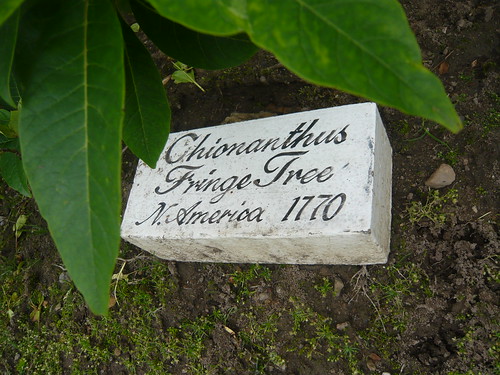
plant label brick

Do you ever think you have ‘dropped a brick’ when you can’t remember the name of one of your plants?
Do you yearn for something other than a small plastic tag with a pencil markings you need to be a contortionist to read?
Perhaps you reuse the colourful nursery plant labels that are bleached by the sun in one season?

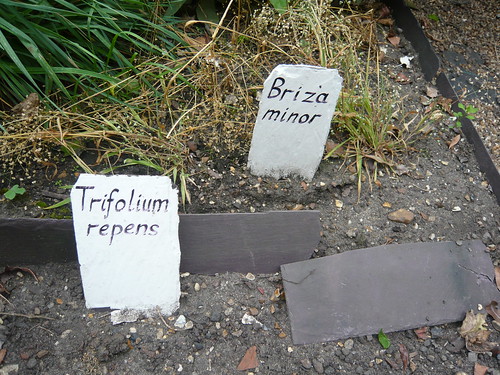
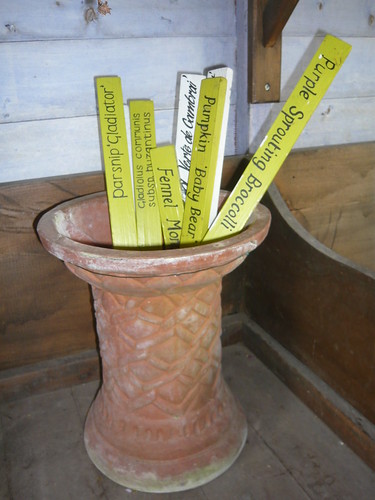
Well pictured here are 3 home made methods of visually recording your prized plants.

Plant lables

This bed is edged with old slates and other slates for name tags are painted white. The size was 2.5″ by 6″ and the short edge was capable of being wedged into the soil. I would need to practice my script writing to get the feel of this old style naming but the effect was in-keeping with this bed of plants.

plant lables

Do not be fooled by the shape of these labels. As they say ‘a good big one beats a good small one any-day’. And these name tags were big as the Jardiniere was over 2′ tall so the name sticks were 3 feet plus. Not so obtrusive when well sunk into the garden but still visible without a microscope.

My favourite was the white brick (with the flat side). Other alternatives include engraved stones as labels, wooden tags and labels or aluminium diy labels from suppliers like Alitags.
The RHS has a web page of children’s projects to make fun labels, you just need a plant called ‘Blue Peter’


Garden Disinfectants and Cleaners

Posted: July 20th, 2010 | Author: hortoris | Filed under: Uncategorized | No Comments »

Some parts of the gardeners equipment need to be sterile to avoid passing on fungus and bacteria.

Thanks to the European community not mall disinfectants are approved for garden purposes but this is how I continue to work in the garden.

Disinfecting and Cleaning

  • Seed trays and plant pots are dunked in a solution of Jeyes fluid mixed with water in an old dustbin so I can do a batch at once.
  • Blades of tools like secateurs and loppers are not treated as often as they should be and I have been recommended to wipe over with Methylated spirits.
  • I am not going to use the ‘Which’ gardening advice of passing blades through a hot flame as it may take the edge off (but let me know if this works for you).
  • I use Path Clear in early spring and if the moss and algae is heavy I have used farmers milking parlour cleaner.
  • There is a citrus based disinfectant (Citrox) recommended for greenhouses that I will try this Autumn.

Liberon Garden Furniture Cleaner is ideal for cleaning old, tired and dirty wooden garden furniture and natural decking.

Honey fungus can not be treated with disinfectant and needs to be dug out and burned.

Path Cleaning and Cleaners
Garden Disinfectants
Best Weed Killers
Wood Care
Fence Care


Slow Release Fertilizer

Posted: July 18th, 2010 | Author: hortoris | Filed under: Products, Uncategorized | No Comments »

Book Cover

‘What are the little blue things in the compost of my bought houseplants?’ I have been asked. Well it is most likely that they are slow release fertilizer.

Uses of Slow Release Granules

  • I now add   slow release granules when potting on and particularly for plants destined for the house.
  • Compost, particularly cheap multi-purpose compost, has very limited nutrients which are exhausted in a few weeks. Slow release thentakes over the fertilizing job  .
  • Acid loving plants can now get slow release specially formulated for there needs.
  • I augment the slow release during periods of rapid growth with an occasional liquid supplementary feed.

Fertilizer Brands

  • Miracle-gro has become one of my staples for fertilizer. The picture is of the slow release fertilizer It feeds for up to 6 months and includes NPK 17-9-11 with magnesium and trace elements
  • ‘Osmoform is a slow release fertilizer. The working principle is not based on a coating around the granules like with Osmocote, but on long nitrogen chains breaking down slowly. This process is influenced by temperature, micobiological activity and humidity. Osmoform contains NPK, magnesium and a package of trace elements’. Osmocote is NPK 15:4:9
  • Fisons   Ficote   14N-3.5P -6.5K is now sold as nutricote, Multicote 8 and Planta cote are other horticultural products.
  • Chempack also do a range for hobby gardeners that I use on occasion.
  • Terralit is a slow release fertilizing medium providing optimal nutrient supply for aquatic plants via the aquarium substrate
  • Phostrogen is another brand that now produces a six month slow release formula

Get Birds in your Garden

Posted: July 16th, 2010 | Author: hortoris | Filed under: Products, Uncategorized | No Comments »

Burton Agnes Pocklington

Getting birds to visit and return to your garden can give you great pleasure. Food, safety and shelter are key features that will encourage wild life and birds in particular. A bird bath can be a useful and decorative feature.

Bird Food can be grown in the garden in the form of berries and seeds or supplemented by bird feeders, peanuts, fat balls and even bits of fruit.

Safety can be designed into the garden with hedgerows and cover plants.

  • Do not provide cover for lurking cats that want to prey on your garden birds.
  • More information can be found in a good reference book or from the RSPB
  • Keep bird food safe from squirrels and vermin by using the right sort of feeders.
  • Keep birds safe from disease by moving bird tables and feeding stations around your garden each year.

Book Cover

Garden bird books

Nesting Boxes for Birds

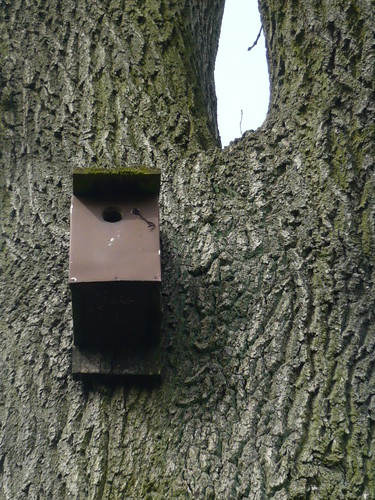
  • Birds will find nesting sites but you can help by putting up bird boxes.
  • Check the size of the hole is right for the birds you want to attract.
  • Do not be too tidy as birds need to be able ‘to feather their own nest’.
  • Try not to disturb nesting birds.

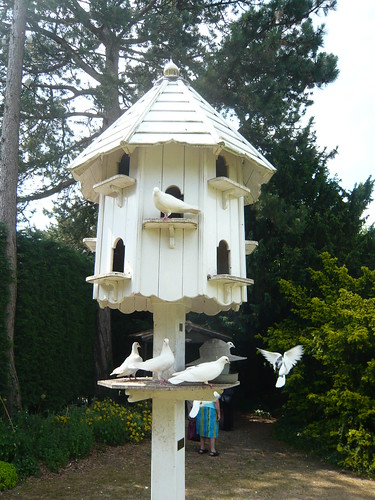
Bird box

See also Gardening for Birds or read about trees and shrubs for birds on Gardeners tips


Buying Garden Ponds fit for Water Lilies

Posted: July 16th, 2010 | Author: hortoris | Filed under: Uncategorized | No Comments »

Burton Agnes Pocklington

Instant Ponds can be created in your garden by purchasing a preformed molded pond like a big babies bath. They will have shelves at various heights on which to stand your water lilies or other aquatic plants. All you need to do is dig a suitable hole and drop in the empty pre-shaped pond.

  • Ensure your pond is level or the water will slop over one end and leave the plastic showing at the other.
  • If your soil is rocky it is best to bed down your pond into a layer of soft sand. This also helps with leveling and bedding down.
  • Bury the pond deep enough so the edge is not left proud.
  • Fill with water and leave to settle and mature before introducing plants and or fish.

Pond liners made from rubberised Butyl can be bought to create a pond of your own shape and design. Tips are available here.

  • Use an underlay and place the butyl on top.
  • The   water level for your pond should be at least 4″ below the top of the liner to prevent water loss due to capillary action into the surrounding soil.
  • Take care during future maintenance not to puncture the liner.

Green Island Triffid

Water Lilies

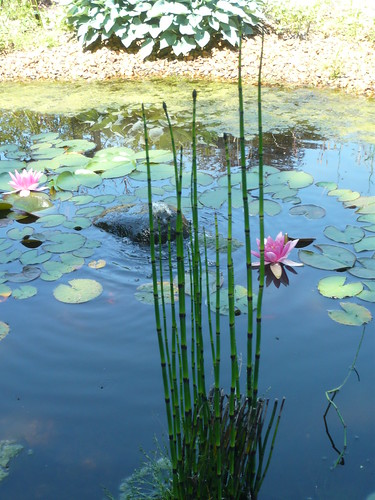
  • Nymphyea pygmy lilies like ‘rubra’ are miniature red/pink waterlily  flowers 1 – 2″ in size with a  spread of 18″.  They can be grown in a miniature patio pond, barrel, shallow  or tiny pond.
  • Water lilies can be augmented with marginal, herbaceous, bogside and oxygenating plants to suit all ponds.

Decorative Garden Containers

Posted: July 15th, 2010 | Author: hortoris | Filed under: Uncategorized | No Comments »

Long Toms

Flower Towers are something relatively new in the display of trailing plants.
Thompson Morgan supplied this photograph and have an advisory service for those interested in the ‘Maxi Tower’ large structure.

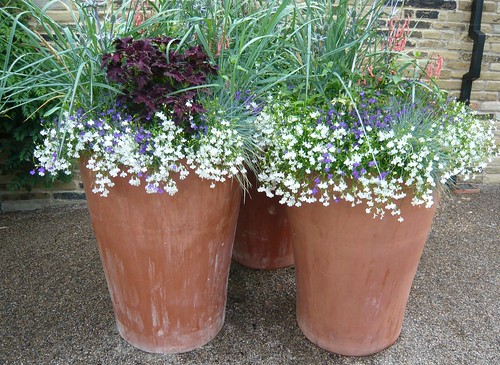
Classical Urns are still the best way of displaying clipped shrubs and topiary.

Hanging Baskets and window boxes have not changed greatly in design for many seasons. They now have better watering systems to keep the plants looking at their best.

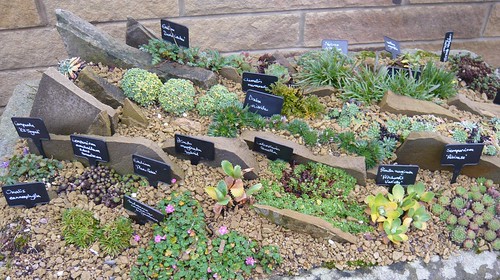
Alpine troughs are a traditional method of displaying small plants that repay close examination. Troughs can be raised to eye level or used in parts of the garden where there is no suitable soil. Old sinks are also used for this form of display so look out in reclamation yards. See an old strawberry planter in use on Alpine containers.

Alpine Trough

For practical containers read Functional Containers


Leylandii Problems and Height Law UK

Posted: June 12th, 2010 | Author: tejvan | Filed under: Uncategorized | 2 Comments »

Leylandi Cypress can grow 4ft a year. That may not sound too much, but, once it gets going it can suddenly overwhelm a garden growing to a height of upto 80 feet.

This provides a long shadow over neighbouring gardens, restricting the plants that they can grow.
The Leylandi can also dry up neighbouring gardens. Firstly the tree takes up water, however, it also provides a large rain shadow depriving the soil of water. This can make it difficult to to grow anything in dry shade.
It is not particularly attractive. The Leylandi could be described as a useful utility plant. Good for screening the garden but hardly much to look at. When it is towering 50 feet over your garden covering it in a dense shade, it is hard to see any redeeming features in the plant.

If regularly pruned to a reasonable height (e.g. 2m – the height of a tall man), the Leylandi can do its job without annoying its neighbours.

Dealing with Leylandi That are Too Tall.

If you are a keen gardeners and have a garden overshadowed by Leylandi that has been allowed to grow unchecked, you are probably quite disappointed that your gardening has this rather unwelcome problem.

The first port of call is to speak politely to your neighbours asking if you can agree to limits its height. It can be difficult to approach people, you don’t want to fall out with your neighbours, and we instinctively don’t like interfering in their property. However, remember that you do have a right to raise the issue because it is affecting your garden and property. To get the best response from your neighbour try doing the following.

Avoid a confrontational attitude. Don’t blunder round and start shouting that your garden is dying because of their trees. This is not a good idea. Try to find something else to speak to your neighbours, try and find a common cause over something, this makes them feel they are not just neighbours but friends. Here they are more likely to try and do you a favour.

In most cases, people may not prune the conifer simply because they don’t have time or don’t think about it. One option to leave open is to offer cutting it yourself or at least sharing in the costs of cutting it down. If this is a big hedge, it may be a bit much. But, it might be worth it, if you really want to cut it down. If you meet the neighbour half way it is much harder for them to refuse.

Legal Approach.

In 90% of cases a friendly approach should help to improve the situation. But, unfortunately, there may be cases where that isn’t sufficient and a neighbour refuses. In this case, it may be necessary to refer the situation to the council. You will need to provide evidence you have tried dealing with the issue privately. f the council deems the hedge excessive, they can ( under the anti-social behavior act 2003 ) order it to be reduced in height to two metres. Failure to comply with this order could mean a fine of £1,000.

Related

  • Conifers in the Garden
  • RIP Leylandii at BBC

« Older Entries
Newer Entries »
  • Best of Gardeners Tips
  • Top 100 Gardeners
  • Gardening at Amazon.co.uk
  • Seeds at Thompson & Morgan
  • Jersey Plants Direct

Categories

  • Art
  • Books & Publications
  • Clothing
  • Constructions and Greenhouses
  • Garden Economics
  • Growing Aids
  • Pests and Problems
  • Products
  • Projects
  • Seeds and Plants
  • Tools and Equipment
  • Uncategorized
  • Weeds and Treatments
Gardeners Tips