Hepatica the Old ‘New Kid’ on the Block
A pot grown favourite is still trying to make its mark in main stream gardening.
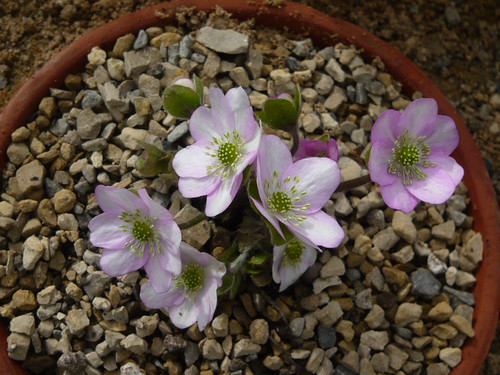
Hepatica nobilis cultivation has been popular as a ground cover plant. Blue purple flowers like a simple Anemone flower in blue/purple at about 4 inches high. Now special varieties are capturing the hearts of British growers and alpinists.
They are named after their leaves which look like the three lobes of the human liver.
Leaves and Foliage
- The leaves are basal and dark leathery green, each with three lobes.
- The foliage, which follows the flowers, can be almost as interesting as the blooms.
- Some leaves are arranged in glossy green clover shapes with delicate, dark markings. Others are almost bronze, or marbled, with a pale variegation.
The Flowers
- Flowers with doubled petals and a range of colour patterns have been developed
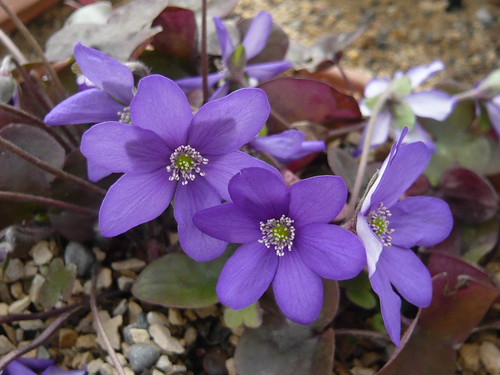
- Hepatica reaches a height of 3-4†and flower from February to May. Flowers may be white, bluish purple or pink; they are supported singly on hairy, largely leafless stems.
- Hepatica var. japonica f. magna flowers are large and come in shades of blue, purple, red and white, green and occasionally yellow, with contrasting colours for the stamens.
- Some Hepaticas come with frilly centres, or totally double. Some have two-tone petals and their variations are even more subtle than those seen in auriculas, but you do have to peer closely to appreciate them.
Growing Conditions
- Hepaticas are not easy to grow and dislike dry conditions.
- In the wild they grow on sunny mountain slopes and under deciduous trees up to 3,300ft high.
- Hepaticas are renown for their tolerance of alkaline limestone derived soils
- Hepatica will grow in both sandy and clay-rich substrates in deeply shaded deciduous woodland and scrub associated with limestone.
- Moist soil and winter snowfall is a requirement but they dislike dry frost.
- In spring they need shade and to be kept a little drier through the summer.
Varieties and Species
Hepatica nobilis var. pyrenaica (H. pyrenaica) – Pyrenees slightly easier to grow
Hepatica nobilis var. japonica (H. japonica) – Japan
Hepatica nobilis var. nobilis – European Hepatica – Alps north to Scandinavia
Hepatica nobilis var. pubescens (H. pubescens) – Japan
Hepatica nobilis var. acuta Sharp-lobed Hepatica –
Hepaticanobilis var. obtusa Round-lobed Hepatica – North America
Hepatica transsilvanica – Carpathian Mountains and Transylvania slightly easier to grow
2 thoughts on “Hepatica the Old ‘New Kid’ on the Block”
Comments are closed.